
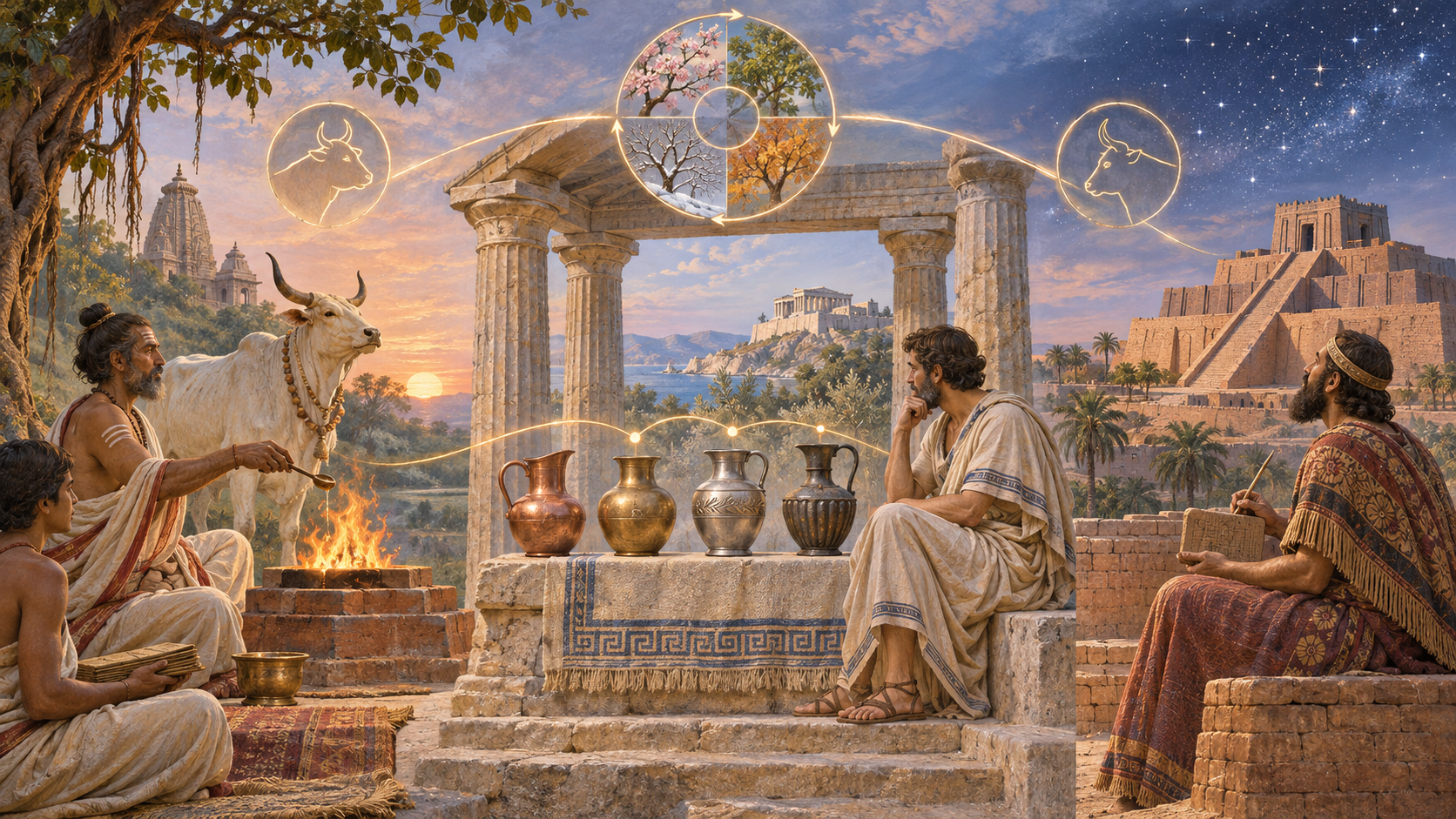
If you have encountered claims that Vedic civilization once shaped the whole world, the examples can feel compelling: Greek ages of metal, a sacred buffalo losing its legs as humanity declines, and Babylonian chronologies spanning hundreds of thousands of years. The difficult question is not whether the resemblances exist. They do. It is what those resemblances permit you to conclude.
You do not have to choose between dismissing every correspondence as coincidence and declaring every correspondence proof of Vedic origin. A better method preserves what is genuinely striking, identifies the differences, and marks the boundary between an observed parallel and a demonstrated historical connection.
Key takeaways
- The strongest comparison is not a generic belief in a lost golden age. It is a structured sequence of four ages in which moral and spiritual conditions progressively deteriorate.
- The sacred animal losing one leg in each age is more distinctive than the broad theme of decline. The correspondence between the Sioux buffalo and the bull of Dharma in the Srimad Bhagavatam deserves serious attention.
- The Greek association of civilizational decline with weapons, cow-killing, and the withdrawal of Justice adds unusual detail. It is evidence of a meaningful parallel, though not by itself evidence of direction or transmission.
- Ancient reports of extremely long chronologies show that deep human antiquity was imaginable outside Bharat. They do not verify that every reported archive or reign actually lasted as long as claimed.
- Use a ladder of conclusions: shared motif, specific structural correspondence, plausible transmission, probable transmission, and demonstrated derivation. Do not jump from the first or second rung to the fifth.
Where the four ages genuinely align

The central Vedic pattern is a moral grammar of time. Satya, Treta, Dvapara, and Kali are not merely four blocks on a calendar. Humanity begins on a high spiritual plane, loses qualities through successive ages, and reaches its most degraded condition in Kali-yuga. A new Satya-yuga eventually restores the original condition and begins the cycle again. In the Vaishnava presentation, time itself operates within a divinely ordered cosmos rather than as a blind succession of physical events.
A recognizably similar pattern appears in the ancient Mediterranean sequence of gold, silver, bronze, and iron. In the account associated with Aratos, Virgo is Justice personified. She lives among human beings during the golden age and calls them to truth. In the silver age she withdraws to the mountains and returns only occasionally to rebuke human conduct. By the bronze age people have invented the sword and begun eating the flesh of cows; Justice then leaves the human world for the celestial sphere. The wider scheme continues the descent into an iron age. The number of ages, their order, and their moral direction closely resemble the Vedic cycle.
The cow detail merits notice because it is not required by the generic idea of social decline. Many cultures can independently imagine a peaceful past followed by war. It is more unusual to make the killing and eating of cows a boundary after which Justice abandons direct association with humanity. That fits naturally beside the Dharmic place of cow protection. Even so, an unusual agreement remains a clue. To turn it into a claim of borrowing, you would still need chronology, a route of contact, and evidence showing the direction in which the motif travelled.
The closest visual correspondence comes from a Sioux tradition in which a celestial woman teaches the people their religion and explains four ages. A sacred buffalo loses one leg during each age and stands on a single leg in the present age of degradation. In the Srimad Bhagavatam, Dharma appears as a bull whose legs disappear over the successive yugas until only one remains in Kali-yuga.
This is narrower and more diagnostic than a shared golden-age story. Both traditions combine four stages, moral decline, a sacred bovine figure, the progressive loss of legs, and one surviving leg in the present age. The difference between a buffalo and a bull does not erase that structure. Nor does the structure tell you whether one tradition influenced the other, whether both inherited an older pattern, or whether similar sacred-animal symbolism developed separately. Without dated witnesses and a traceable path of transmission, the proper description is a striking structural parallel.
| Tradition | Age structure | Image of decline | What you can safely conclude |
|---|---|---|---|
| Vedic civilizational tradition | Satya, Treta, Dvapara, and Kali | Dharma loses one leg in each age; spiritual conditions deteriorate | A complete cyclical model joins chronology, ethics, and cosmic order |
| Ancient Greek tradition | Gold, silver, bronze, and iron | Justice withdraws as violence and moral disorder increase | The four-stage descent is a substantial conceptual parallel |
| Sioux tradition | Four ages ending in the present degraded age | A sacred buffalo loses one leg during each age | The animal-and-legs pattern is a particularly close structural correspondence |
Precision also matters in naming the Bharatiya side. The animal comparison specifically involves the Srimad Bhagavatam. Calling it simply a teaching found in “the Vedas” blurs which text carries the motif and makes the historical claim harder to examine. A strong Dharmic case should name the relevant text whenever it is known.
Why 432,000 and long lifespans matter, but do not settle history

Vedic chronology gives the four yugas lengths in a 4:3:2:1 relationship, each calculated from an interval of 432,000 years. The corresponding human lifespans are described as 100,000 years in Satya-yuga, 10,000 in Treta-yuga, 1,000 in Dvapara-yuga, and 100 in Kali-yuga. Whatever position you take on those durations, the model clearly presents moral decline, diminishing longevity, and cosmic chronology as parts of one ordered system.
Very large conceptions of the past were not confined to Bharat. Porphyry, writing around AD 300, reported that Callisthenes had sent Aristotle Babylonian eclipse records covering 31,000 years. Iamblichus, in the fourth century, attributed to Hipparchus a claim that Assyrian observations extended over 270,000 years and recorded the return of all seven planets to the same positions. Berosus assigned 432,000 years to the reigns of Babylonian kings before the Flood.
The recurrence of exactly 432,000 is more noteworthy than a vague statement that the past was very long. It establishes a numerical correspondence worth investigating. It does not tell you why the number appears in both settings. Possible explanations include transmission, inheritance from an older numerical tradition, a symbolic calculation reached through different paths, or a relationship not yet adequately reconstructed.
You should also distinguish a report about an ancient archive from the archive itself. The claims associated with Porphyry and Iamblichus pass through named chains of testimony. They demonstrate that educated people in the Mediterranean world could accept immense chronological horizons. They do not, without surviving observations and independent corroboration, demonstrate that continuous astronomical records were actually maintained for 31,000 or 270,000 years.
Biblical genealogies preserve another part of the pattern: diminishing human longevity. Adam is assigned 930 years, Seth 912, Jared 962, Methuselah 969, and Noah 950. Excluding Enoch, whose departure is narrated differently, the listed pre-Flood figures average 912 years. The post-Flood sequence falls broadly from several centuries toward lifespans close to 100 years. The decline from extraordinary ancestral longevity to the familiar human range resembles one component of the yuga model, although the surrounding theology, chronology, and sequence are not identical.
The useful conclusion is modest but important. The modern habit of placing ordinary human lifespans and a comparatively short remembered history onto every ancient culture is historically misleading. Several traditions imagined humanity as extremely old, its earliest people as exceptionally long-lived, and its condition as declining rather than steadily advancing. That shared orientation is significant even before anyone establishes a direct civilizational relationship.
What these parallels can honestly establish
What is directly visible
Three observations stand without requiring a theory of worldwide Vedic influence. First, traditions outside Bharat preserve a four-stage descent from a better human condition to a worse one. Second, the Sioux and Bhagavata narratives share a remarkably specific device: the condition of dharma is represented by a sacred bovine animal with progressively fewer legs. Third, West Asian and Mediterranean chronologies include enormous time spans, including the exact figure of 432,000 years in the Babylonian king tradition.
Those are real correspondences. Describing them as coincidence before examining them would be as premature as declaring them proof of a single global civilization.
What remains a historical hypothesis
The proposition that Vedic culture directly produced all these traditions remains a hypothesis. Resemblance alone cannot determine direction. Even if transmission occurred, the motif might have moved outward from Bharat, entered Bharat from elsewhere, passed in both directions over a long period, or descended into several cultures from an earlier common inheritance.
Independent development must remain in the comparison as well. Human societies repeatedly observe that institutions decay, violence increases, and memory idealizes an earlier order. That can explain a generic sequence from virtue to disorder. It is less satisfying as a complete explanation for a four-part sequence joined to a sacred bovine animal losing exactly one leg per age. The right response is not to discard independent development, but to recognize that greater specificity places greater pressure on a coincidence-only explanation.
What would strengthen a claim of transmission
A historical case becomes stronger when several kinds of evidence converge. Look for securely dated versions of each narrative; a plausible sequence showing which witness is earlier; intermediate forms along known paths of contact; a cluster of rare details rather than one familiar theme; and linguistic, textual, astronomical, or material evidence that points in the same direction. No single item has to do all the work, but the argument should become harder to explain without contact as the correspondences accumulate.
Use calibrated language while that work remains incomplete. A “parallel” means that two forms resemble one another. “Possible influence” adds a plausible opportunity for contact. “Probable transmission” requires multiple distinctive matches and evidence of direction. “Demonstrated derivation” requires corroboration strong enough to rule out the major alternatives. A Dharmic argument loses nothing by using the first label when the first is what the evidence supports.
A six-step test for any cross-cultural Vedic claim
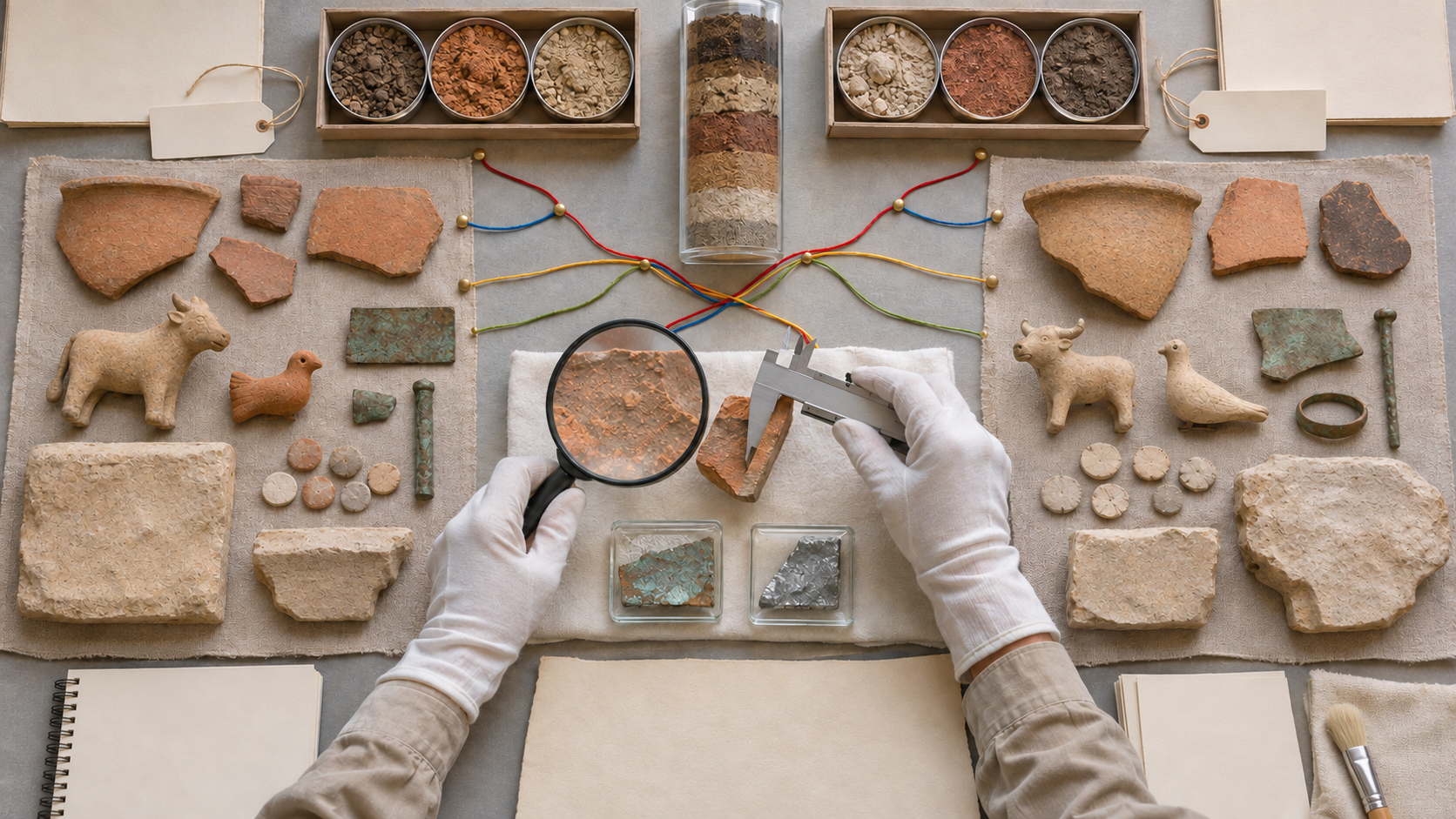
When you meet the next claim about a Vedic motif in Greece, West Asia, Europe, or the Americas, test it in this order:
- State the Bharatiya motif exactly. Name Satya, Treta, Dvapara, and Kali rather than saying only “four ancient ages.” If the comparison comes from the Srimad Bhagavatam, identify that text.
- Write down the other tradition without harmonizing it. Preserve its own names, symbols, sequence, and outcome. Do not quietly turn a buffalo into a bull or a goddess of Justice into Dharma.
- Separate the shared structure from the differences. Four declining ages are shared by the Vedic and Greek schemes. The Greek account adds Virgo and withdrawal to the stars; the Bhagavata account adds Dharma’s diminishing legs.
- Grade the specificity. A lost golden age is broad. Four ordered ages are narrower. Four ages plus a bovine figure losing one leg per age are narrower still. An exact number such as 432,000 deserves separate attention because numerical identity is easier to test than a loose thematic resemblance.
- Trace the testimony. Ask whether you possess an early text, a later report about an earlier text, or an inherited tradition whose early date has not yet been established. A statement that someone once possessed 270,000 years of observations is not equivalent to having those observations.
- Match the conclusion to the evidence. Say “striking parallel” when you can show resemblance, “plausible contact” when you can also show opportunity, and “transmission” only when chronology and direction are supported.
Applied here, the Greek sequence is a strong conceptual parallel with an unusual cow-protection detail. The Sioux image is an even closer structural parallel to the Bhagavata bull of Dharma. The Babylonian figure of 432,000 is an exact numerical correspondence. None of the three, on the evidence presently identified, supplies a complete transmission history.
The next time you encounter a sweeping civilizational claim, make a two-column ledger: exact matches on one side and unresolved differences on the other. Then label the conclusion as parallel, possible influence, probable transmission, or demonstrated derivation. That small discipline keeps the inquiry open without asking the evidence to say more than it can. It also gives Vedic civilizational memory the serious, patient examination it deserves.
References

Leave a Reply
You must be logged in to post a comment.