
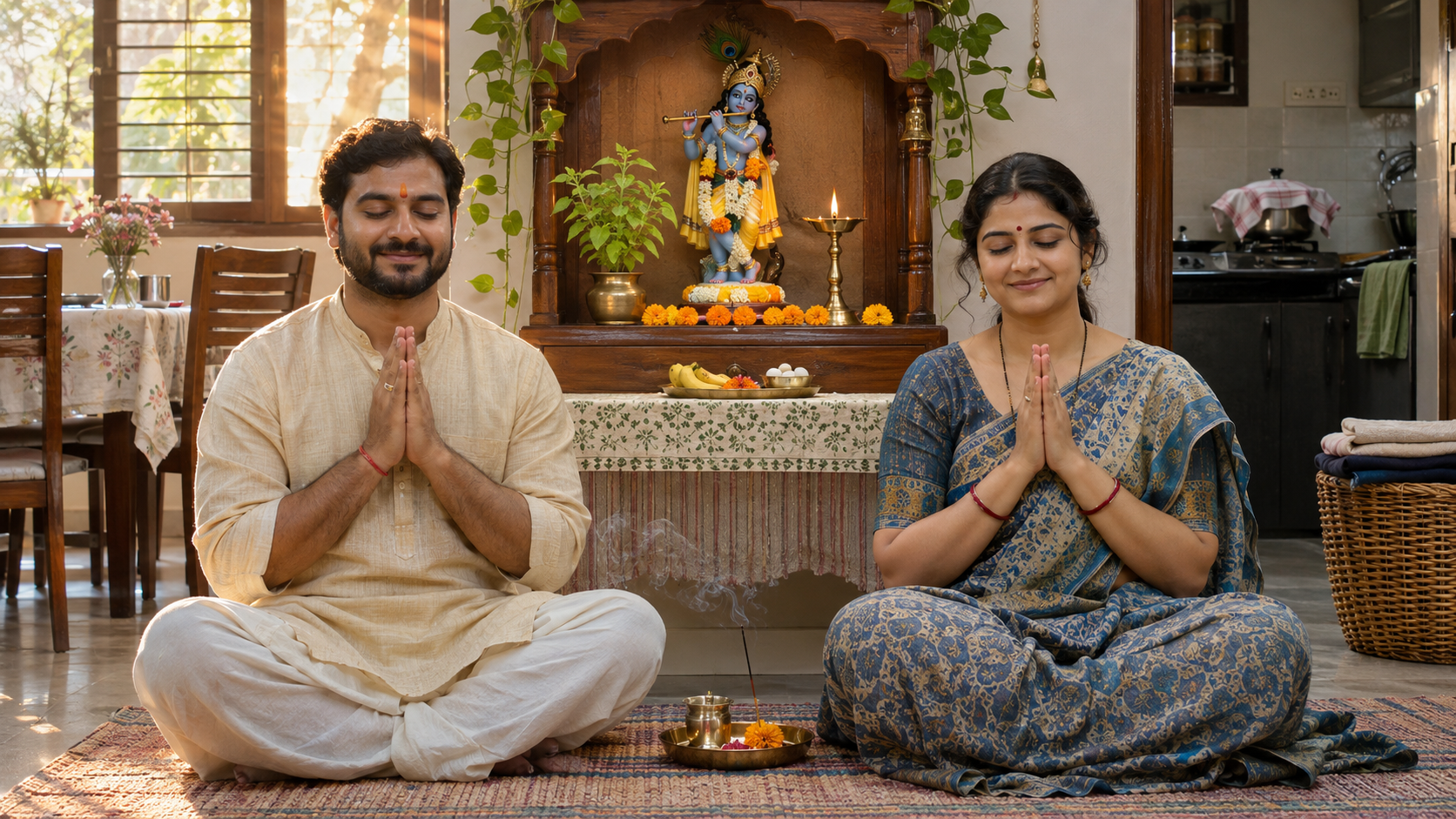
You may already agree that Krishna should be at the center of your marriage. The harder question is what that changes when you are choosing a spouse, dividing household work, handling money, protecting sadhana, or facing the same argument again.
A Krishna-centered home is not identified by devotional vocabulary alone. It is a home in which husband and wife help each other become more truthful, self-controlled, dependable, and absorbed in service. That purpose has to appear in the calendar, the distribution of work, and the way conflict is repaired.
Put Krishna above the marriage without putting your spouse below it
Sri Caitanya-caritamrta, Madhya-lila 13.80 places our deepest identity beyond social position: we are servants of the servants of Sri Krishna. Husband, wife, parent, professional, and caregiver are important roles, but none is the complete self. Bhagavad-gita 18.46 then shows how those roles become spiritually meaningful: you worship the all-pervading Lord by performing your own work properly.
This prevents two opposite mistakes. The first is making the spouse an ultimate source of identity, emotional completion, or happiness. No human being can carry that weight. The second is using transcendence to neglect ordinary promises. Cooking, earning, cleaning, listening, caring for dependants, and keeping agreements do not become less spiritual because they look ordinary. When they are your responsibilities, doing them conscientiously is part of serving Krishna.
Srimad-Bhagavatam 6.18.34 presents the husband-wife bond as especially effective when both are attached to one another for advancement in Krishna consciousness. The operative principle is mutual cooperation for spiritual growth. Mutual means that neither person is merely an instrument for the other’s ambitions. Cooperation means that affection becomes visible in conduct.
- Putting Krishna first does not mean that every public religious activity outranks a promise made at home.
- Serving your spouse does not mean surrendering moral judgement or tolerating degrading conduct.
- Maintaining individual sadhana does not mean building two unrelated lives under one roof.
- Accepting different duties does not give either spouse unlimited authority or exemption from accountability.
Use a practical test: after living this way, are both of you becoming more capable of remembering Krishna, keeping your word, controlling your impulses, and serving without resentment? If one person’s religious life consistently depends on the exhaustion, silence, or fear of the other, the household may use devotional language without yet embodying devotional cooperation.
Test character and compatibility before you make vows

Attraction can begin without effort. Character cannot. A person becomes ready for household life by learning self-command, accepting responsibility, and developing a life that is not sustained by constant attention from a romantic partner. The traditional expectation that a prospective householder should first become a conqueror of the senses reflects a practical truth: marriage does not automatically cure neediness or indiscipline.
If you are considering marriage, do not stop at shared labels. Two people may both identify as devotees while holding incompatible expectations about practice, family, work, money, children, intimacy, and authority. Discuss the life you would actually have to live.
- Direction of devotion: What practices does each of you protect now? What place will japa, worship, study, association, prasada, and service have in the home? Look for an honest direction, not a polished performance.
- Conduct under frustration: How does the person behave when tired, contradicted, disappointed, or unable to get what they want? Courtesy during courtship reveals less than restraint under pressure.
- Real affection and respect: Do you actually like one another? Can you admire the other person’s character without trying to remodel their personality? Shared theology cannot compensate for contempt.
- Household expectations: Discuss earning, spending, debt, residence, housework, care of parents, children, education, hospitality, and community service. Replace phrases such as traditional roles or equal partnership with a description of who expects to do what.
- Boundaries with family and authority: Decide how advice from parents, gurus, mentors, and community leaders will be received. Respect for elders should not erase the couple’s responsibility to speak honestly and make accountable decisions.
- Capacity for repair: Can both people admit fault, hear an unwelcome truth, apologise without qualification, and change a repeated behaviour? Agreement on every issue is impossible; repair is indispensable.
Write your answers separately before comparing them. That makes hidden assumptions easier to see. A trusted elder, mature married couple, or qualified counsellor can help you examine a difficult mismatch, but they should not manufacture consent or make the decision in your place.
Do not enter marriage as a rehabilitation project. Persistent lying, coercion, uncontrolled rage, concealed addiction, serious financial deception, or violence should not be renamed minor incompatibility. Slow the process and obtain appropriate help. A ceremony does not make dangerous behaviour safe.
If you are already married, do not use this checklist to conduct a permanent retrial of your spouse. Use it to identify the unspoken expectation beneath a recurring dispute. Many differences can become manageable once they are turned into explicit agreements. Harmful conduct requires a different response and should not be negotiated as a mere preference.
Give the household a rhythm that protects devotion and duty

Your home becomes centered on what its routine protects. A picture of Krishna on the wall matters, but the calendar reveals whether remembrance, service, rest, and family obligations have a dependable place.
Begin with a modest household rule of life. Protect each person’s essential sadhana. Agree on a joint practice that you can maintain without theatrical intensity: offering food, praying together, reading, kirtan, or another practice consistent with your lineage. A small observance kept faithfully is more useful than an ambitious programme that repeatedly collapses and becomes material for blame.
Then hold a fixed household meeting each week. Do not wait for a dispute to create the agenda. Use the same sequence so that practical pressure does not consume the spiritual purpose of the conversation.
- Begin with prayer or a brief shared remembrance of Krishna.
- Name something you appreciated in the other person’s conduct.
- Ask whether each person’s sadhana is realistically protected.
- Review the coming commitments, including employment, children, elders, temple service, guests, and rest.
- Review household work and any task that has silently fallen onto one person.
- Discuss spending or obligations that affect both of you.
- Choose one unresolved issue that needs a decision rather than reopening every grievance.
- End by stating who will do what and when you will check it.
Make mutual cooperation observable. Saying that both spouses serve the household can conceal a large imbalance if one person remains the default cook, cleaner, planner, caregiver, appointment keeper, and social coordinator. Name each recurring task, its owner, and the standard for completion. The owner should carry the task from noticing to finishing, not merely wait to be directed.
This matters spiritually. One spouse should not gain uninterrupted practice or public recognition by relying on the other’s invisible labour. If children or elders depend on you, their care belongs inside the household’s dharma; it is not an embarrassing interruption of real devotional life. Public seva should be planned in proportion to the duties already accepted at home.
Do not demand identical devotional temperaments. One person may be drawn to study, another to worship, hospitality, music, or practical service. Shared direction is more important than identical expression. The question is whether the differences strengthen the home or allow one person to withdraw from responsibility.
Repair conflict without turning Krishna into a weapon
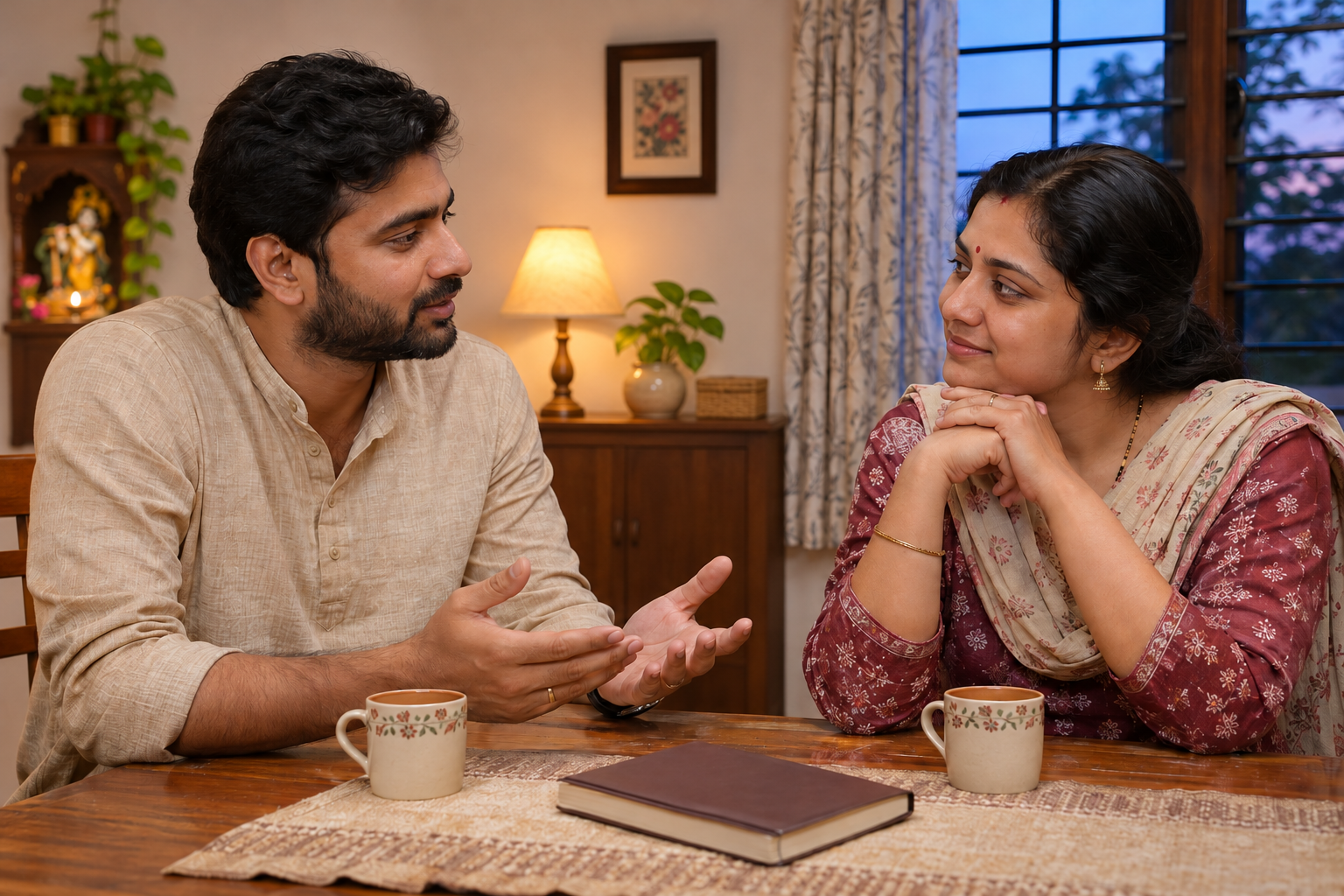
Religious language can make a disagreement harder to resolve when it is used to claim superior purity. Calling your spouse’s concern maya, ego, attachment, disobedience, or lack of surrender does not answer the concern. It places your interpretation beyond examination and pressures the other person to defend their devotion instead of discussing the problem.
When a conflict begins to circle, stop arguing about motives and move through a repair sequence.
- Lower the heat: Pause if either person is insulting, shouting, threatening, or unable to listen. A pause must include a clear intention to return; silence used as punishment is not repair.
- State the observable event: Describe what happened without assigning a spiritual diagnosis. A missed payment, changed plan, broken promise, or harsh remark can be discussed directly.
- Name the effect and request: Explain what the event disrupted and ask for a specific change. Requests such as more respect are too broad; identify the conduct that would demonstrate respect.
- Reflect before answering: Each person should be able to restate the other’s concern accurately. Understanding is not the same as conceding every conclusion.
- Own your contribution: Name what you did, omitted, or avoided. Do not attach an accusation to the apology.
- Choose a repair: Decide what will change, who is responsible, and when the matter will be reviewed. An apology without altered conduct cannot carry the whole burden of reconciliation.
It also helps to identify which kind of problem you are facing. A preference difference may require flexibility. A broken agreement requires accountability and restitution. A pattern that removes safety requires outside intervention. Treating all three as ordinary marital compromise exposes the more vulnerable spouse to further harm.
Seek qualified help when the same conflict repeatedly defeats your attempts at repair, when trust has been seriously damaged, or when depression, addiction, trauma, or another mental-health concern is shaping the household. Mature spiritual counsel can clarify values, while a properly qualified counsellor can address relationship or psychological patterns. One form of help does not automatically replace the other.
Threats, stalking, sexual coercion, physical violence, severe control of money or movement, danger to children, and threats of self-harm are not tests of devotional endurance. If there is immediate danger, move toward safety and contact local emergency or specialist support. Do not rely on a joint counselling session when speaking openly could provoke retaliation; seek confidential professional advice appropriate to the risk. Krishna-centered marriage requires willing cooperation, and coercion destroys that condition.
Even in a healthy marriage, each person’s inner life remains their responsibility. The example of Draupadi near the end of the Mahabharata’s final journey is used to stress that no spouse can perform another person’s final remembrance. Marriage supports the individual’s journey toward Krishna; it does not replace that journey. Protecting personal practice, therefore, is not preparation for separation. It is part of giving the marriage its proper spiritual purpose.
Key takeaways for your next household meeting

- Write one sentence stating what your marriage is for. Make spiritual growth and mutual service concrete enough to guide a decision.
- Protect both individual sadhana and a sustainable joint practice. Do not make one spouse responsible for the other’s entire devotional life.
- Turn assumptions about work, money, family, and service into named agreements.
- Examine whether invisible household labour is protecting one person’s freedom at the other’s expense.
- Discuss observable conduct during conflict; do not use devotional rank or vocabulary to silence a concern.
- Distinguish a preference difference from a broken agreement and a safety problem. Each requires a different response.
- Ask for mature spiritual or professional help before resentment, secrecy, or danger becomes the household’s normal condition.
At your next conversation, ask two questions: What in our present routine helps each of us remember and serve Krishna, and what repeatedly obstructs it? Then choose one duty each of you will carry more faithfully. A Krishna-centered household is built when remembrance changes how you speak, work, promise, repair, and care for the person beside you.
References

Leave a Reply
You must be logged in to post a comment.