
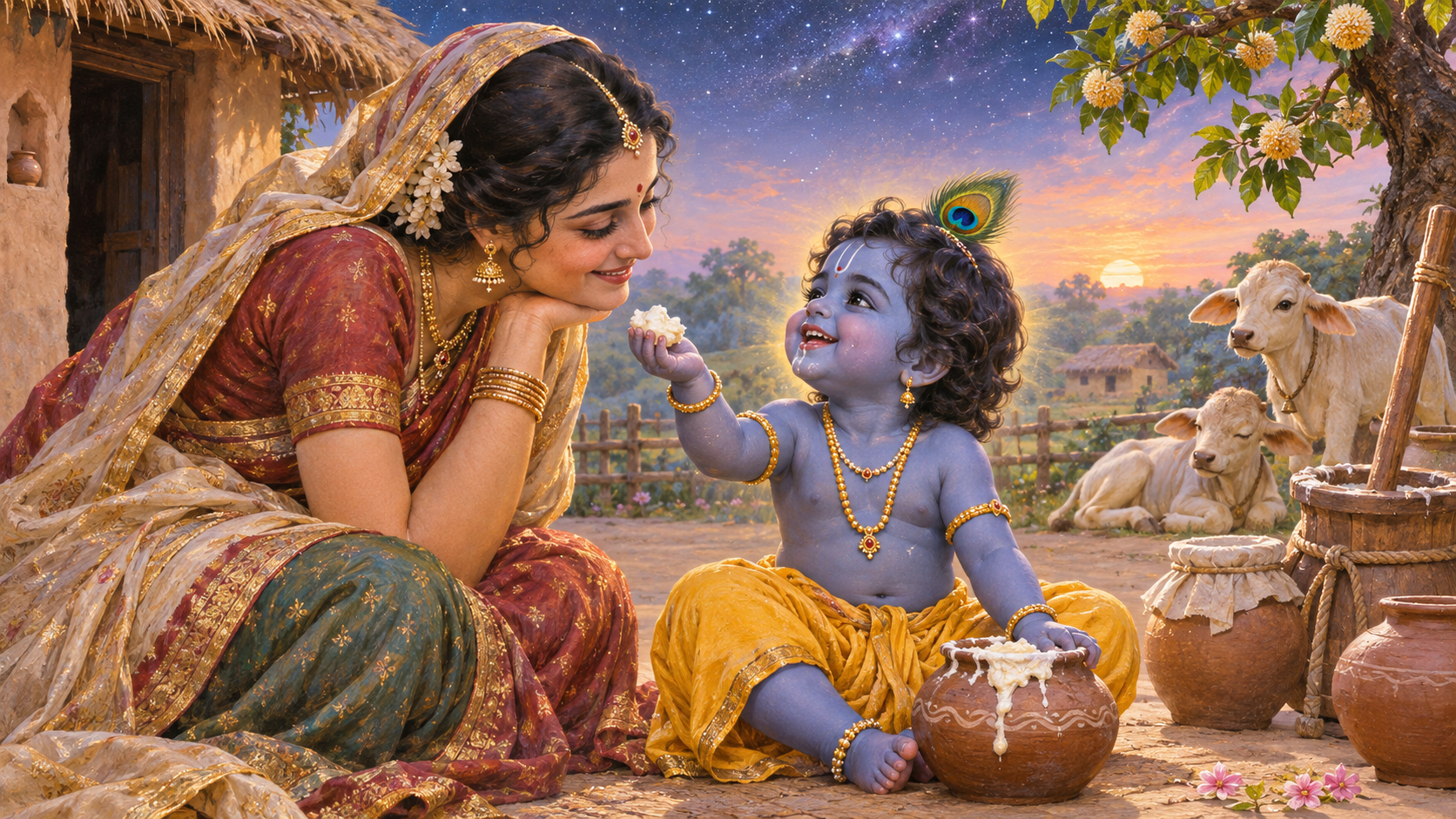
You may have heard Krishna’s childhood pastimes since you were young, yet still feel unsure how to read them. Should you search for a moral lesson, marvel at the miracle, or simply enjoy the sweetness of the scene?
Begin with a more precise question: what does this pastime reveal about Krishna’s relationships? That question keeps the theology, the human feeling and the practical value together. It also stops a sacred lila from shrinking into either a children’s tale or an abstract argument.
The child is not on the way to becoming divine
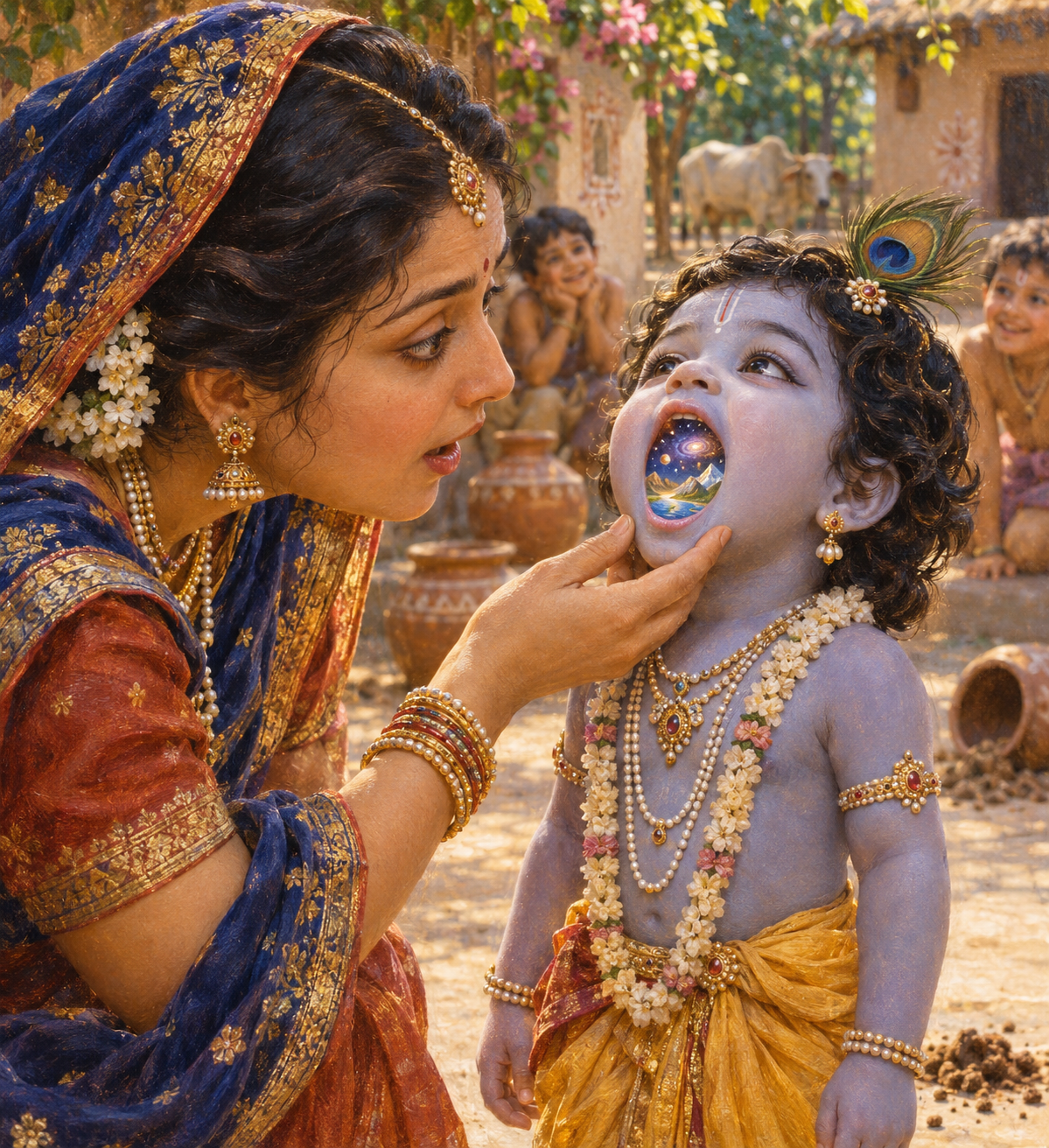
In the devotional vision of the Bhagavatam, child Krishna is not an incomplete form who will acquire divinity later. The Supreme freely accepts the position of a child. His smallness is part of the revelation, not a denial of it.
This distinction changes how you read every scene. If you notice only the child, the extraordinary moments can look like ornaments added to an otherwise ordinary biography. If you notice only the Supreme, the meals, games, interruptions and affectionate exchanges can look like a disguise to be discarded once the theology has been extracted.
The lila asks you to hold both truths together. Krishna possesses divine freedom, yet he permits loving relationships to shape the visible action. Power produces wonder; freely accepted closeness produces affection. The childhood pastimes show that intimacy with the divine is not a lesser alternative to reverence.
Try a simple discipline as you read: identify one detail of divine greatness and one detail of intimacy. Do not force the two into a formula. Notice how the scene allows each to deepen the other.
Two episodes reveal the Bhagavatam’s reading pattern
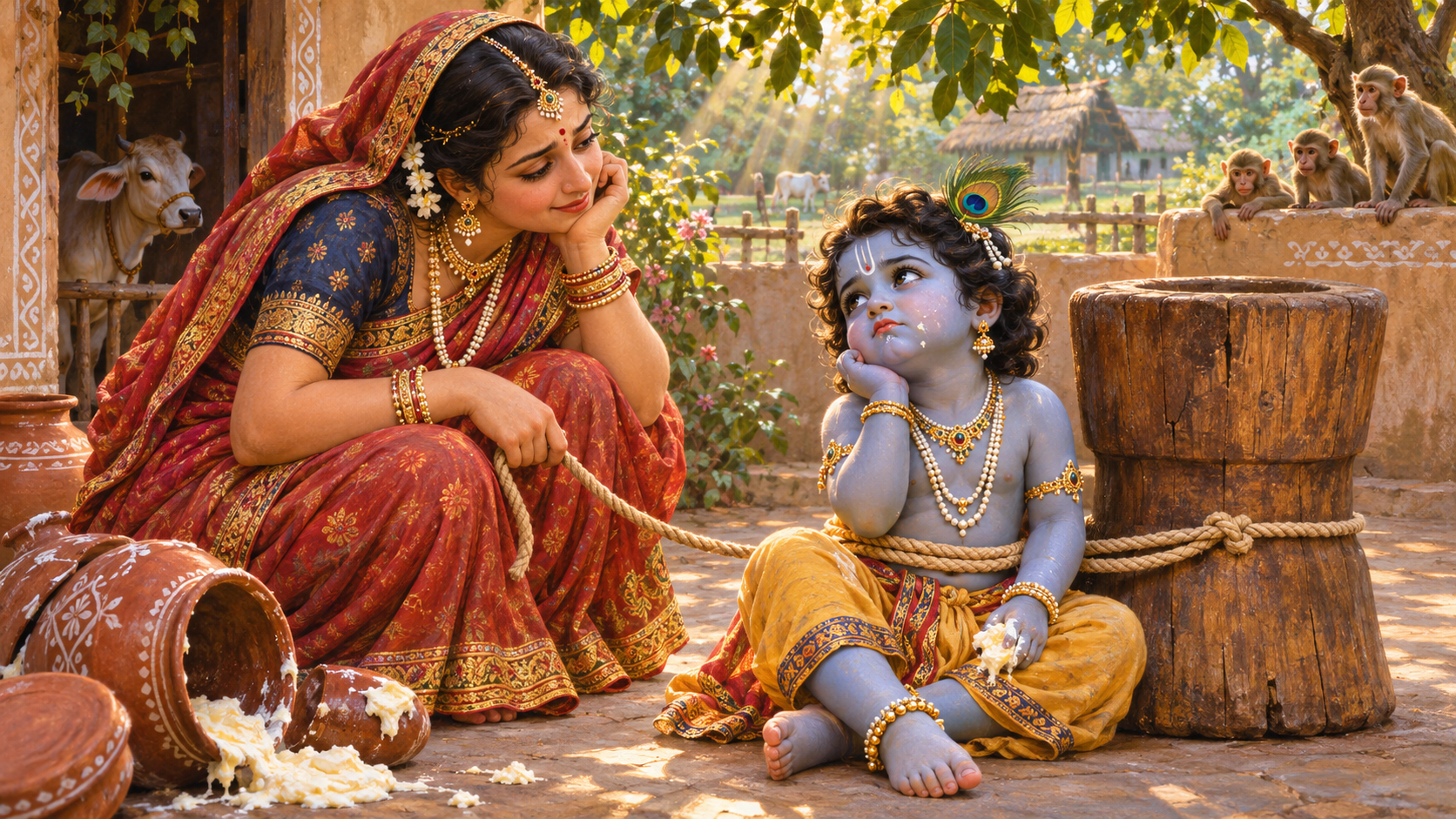
In the account surrounding Narada’s curse and Krishna’s blessing, you should not stop reading at the word “curse.” Follow the entire movement: wrongdoing is confronted, a consequence is imposed, Krishna enters the situation, and the apparent punishment becomes an occasion for liberation and reorientation.
This does not mean that pain is secretly pleasant or that every harsh act should be renamed a blessing. The sharper principle is that divine grace can use a consequence without allowing that consequence to have the final word. Narada’s intervention and Krishna’s deliverance therefore belong to one moral arc. Correction exposes bondage; Krishna brings the corrective process to its liberating end.
The lesson is especially useful when you face a difficult turn in your own life. Do not hastily call the difficulty a blessing, but do not assume that its present appearance determines its final meaning. Ask what attachment is being exposed, what correction is required, and whether the experience is turning you toward humility, responsibility and remembrance of Krishna.
At Srimad-Bhagavatam 10.13.14, the scale becomes strikingly ordinary: a shared meal gives way to concern because the calves have wandered in search of grass. A reader waiting only for spectacle can skim past this transition. A careful reader notices that dependent creatures, ordinary duties and interruptions all remain inside the field of Krishna’s lila.
That small narrative turn trains your attention. Devotion does not begin only when an unmistakable miracle occurs. It also appears in companionship, care and the response to an interruption. The familiar world is not an obstacle that must disappear before Krishna can be remembered.
Use four passes instead of hunting for a quick moral
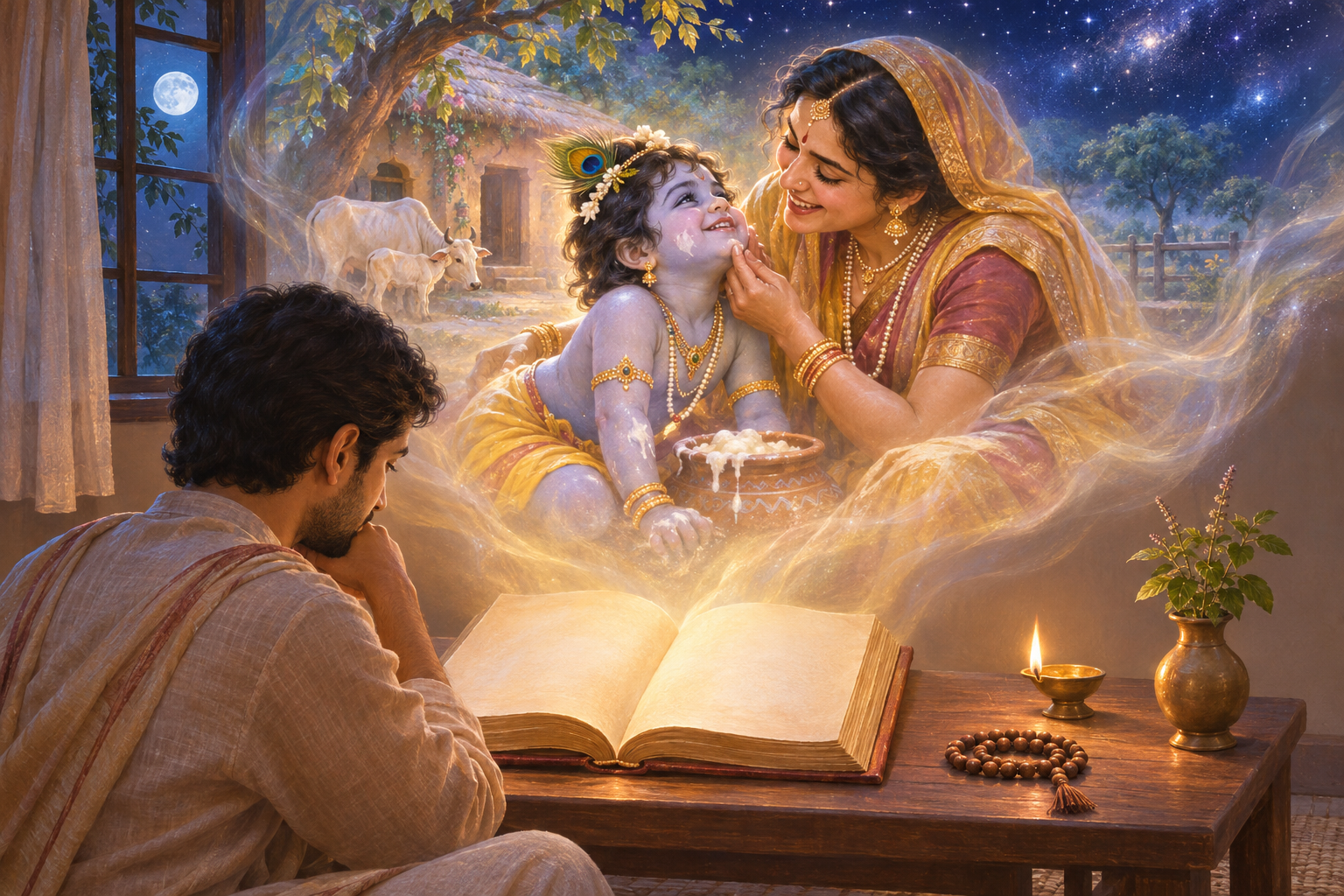
A childhood lila often becomes clearer when you read it several ways in a deliberate order. Keep these four passes beside you when you open the Tenth Canto:
- State the event. Summarize what happens without explaining it. This prevents a familiar interpretation from replacing the actual scene.
- Trace the relationship. Notice who trusts, serves, fears, corrects, plays with or depends upon Krishna. Ask how Krishna receives that particular approach.
- Locate the revelation. Identify what becomes visible about Krishna: his freedom, accessibility, care, power to bless, or willingness to accept intimate affection.
- Choose a response. End with something the scene asks of you: attentive remembrance, gratitude, correction of conduct, service, prayer or a more honest view of your attachments.
The order matters. Starting with a moral can make Krishna incidental to his own lila. If your conclusion would remain unchanged after removing Krishna from the scene, you have probably produced a generic lesson rather than read the pastime on its own terms.
For the events of Bhagavatam 10.10, “consequences can sometimes help us” is too vague. The more exact insight is that corrective consequence reaches fulfillment through Krishna’s liberating encounter. At 10.13.14, “take care of your responsibilities” is likewise incomplete. The devotional center is that attention to small, dependent lives and the intimacy of companionship are not outside Krishna’s presence.
Four common readings that miss the devotional center
- Reducing every event to allegory. Symbolic reflection can be helpful, but it should not erase Krishna, the relationships or the movement of the narrative. First receive the lila as told; only then consider what it illuminates in your life.
- Looking only for displays of power. A miraculous event tells you that Krishna can act beyond ordinary limits. The characters’ responses tell you why that power matters within a relationship. Always examine both.
- Using grace to erase accountability. The movement from Narada’s curse to Krishna’s blessing does not make wrongdoing irrelevant. Grace redirects consequence toward release; it does not require you to pretend that the original bondage was harmless.
- Confusing childlike intimacy with casualness. The tender atmosphere of the childhood lilas invites closeness, not trivialization. Read slowly enough for affection and reverence to coexist.
Use the result as a diagnostic. If a reading leaves you only amused, frightened or equipped with a self-help slogan, return to the relationship at the center of the scene. Ask what Krishna gives, what he accepts, and how the encounter changes those around him.
Key takeaways
- Read child Krishna as the divine freely accepting intimacy, not as an incomplete figure gradually acquiring power.
- Follow an episode to its end. A curse, interruption or apparent setback may acquire a different meaning through Krishna’s intervention.
- Attend to ordinary details. Meals, calves, companionship and care can carry the theological weight of the lila.
- Do not call suffering good merely because grace can transform it. Transformation, not denial, is the relevant principle.
- Move from event to relationship, from relationship to revelation, and from revelation to a concrete devotional response.
For your next reading, place Bhagavatam 10.10 beside 10.13.14. Read each passage once for the sequence of events and again for the relationships. Then write a single sentence answering: “What kind of relationship with Krishna does this scene invite me to remember?” Carry that sentence into your prayer, japa or conduct for the day. The childhood lilas become spiritually fruitful when careful hearing changes the quality of your attention.
References
- Dandavats – Morning Class SB 10.13.14 – HG Navina Nirada Prabhu – 3 November 2026
- Dandavats – Narada’s Curse Became Krsna’s Blessing – Srimad-Bhagavatam 10.10 Summary

Leave a Reply
You must be logged in to post a comment.