
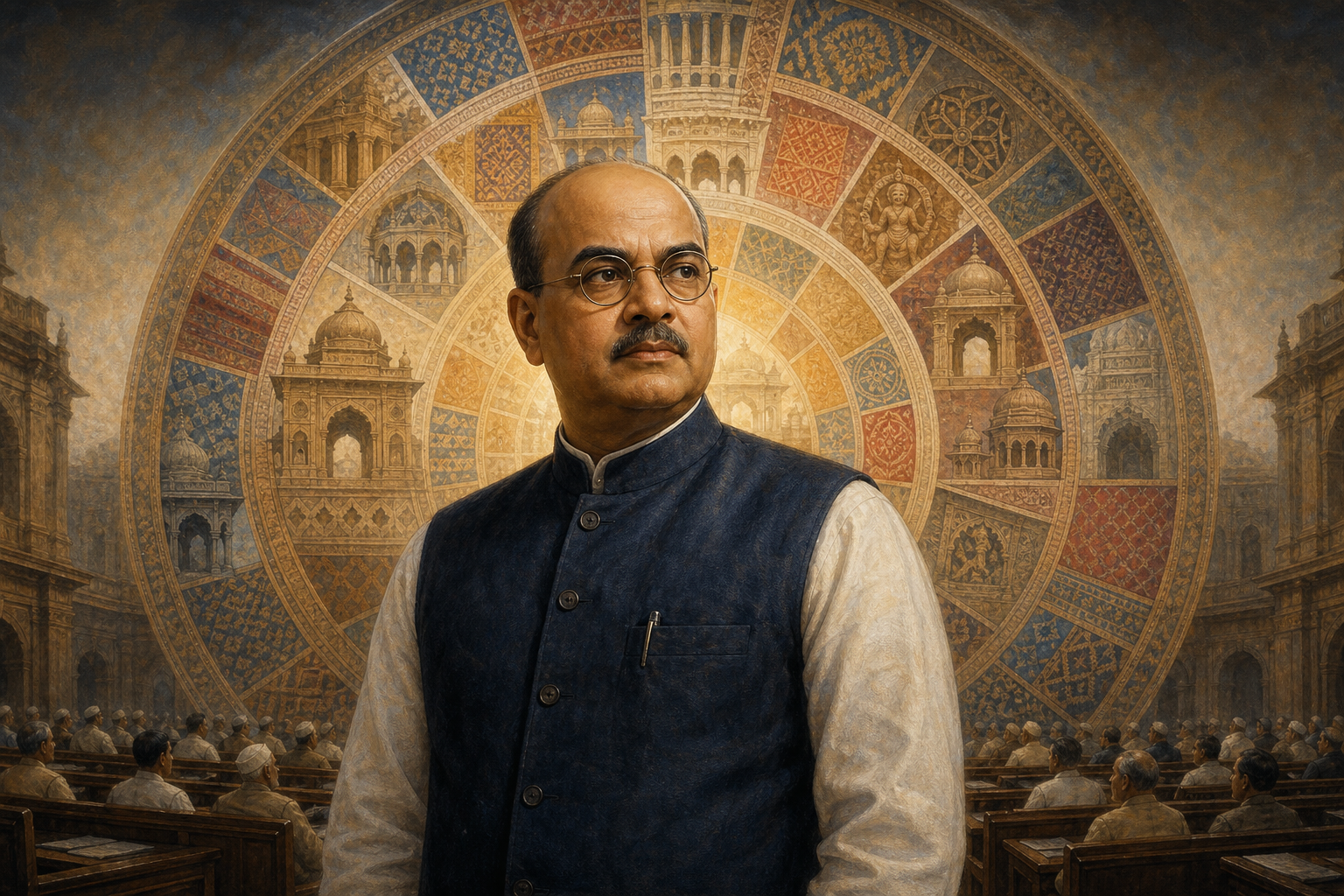
Syama Prasad Mookerjee’s constitutional thought is best understood as an attempt to reconcile three commitments: a sovereign Union, equal citizenship and the preservation of India’s cultural and regional diversity. This makes his position more substantial than either a demand for administrative uniformity or a slogan about territorial unity.
The available source material connects his arguments in the Constituent Assembly, his experience as an educationist and his 1952 intervention on Jammu and Kashmir. Read together, they reveal a practical test for constitutional accommodation: differences could be protected, but they should not mature into competing sovereignties or unequal forms of citizenship.
Key takeaways
- Mookerjee located the authority of constitution-making in the people of India rather than in institutions inherited from British rule.
- His idea of national unity allowed languages, cultures and local institutions to flourish within a common constitutional order.
- He treated accommodation as legitimate when it built trust and aided integration, but resisted arrangements that suggested a separate source of sovereignty.
- His 1952 Lok Sabha speech provides firmer evidence of his position on Jammu and Kashmir than quotations that have been incorrectly associated with the 1949 Article 370 debate.
Popular sovereignty required more than a powerful Centre
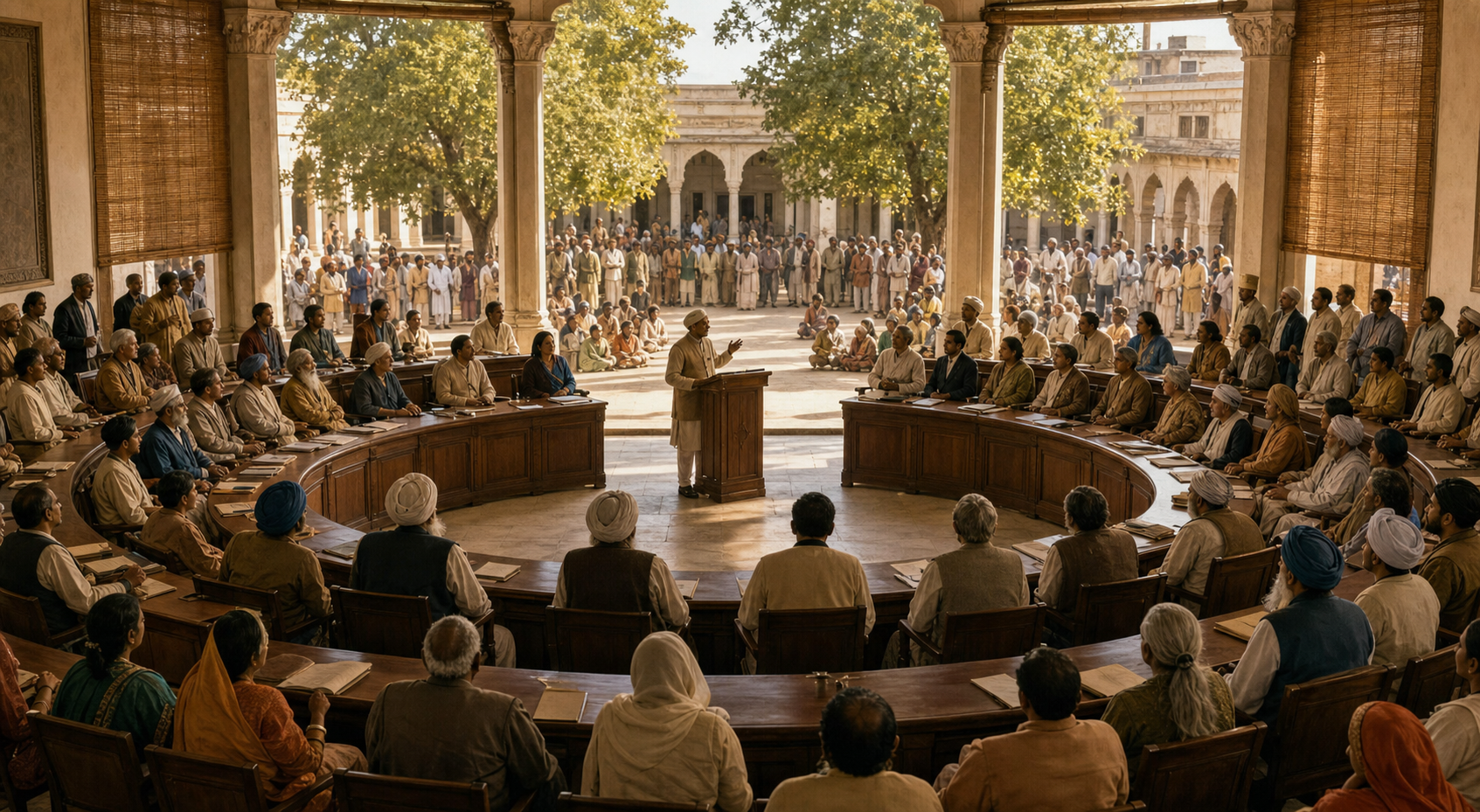
The source article places Mookerjee’s intervention of 17 December 1946 at the foundation of his constitutional outlook. Although the Muslim League was absent from the Constituent Assembly, he opposed delaying its work indefinitely. His argument was that the Assembly drew its sanction from the Indian people, not from the British Parliament or government.
That claim established popular sovereignty as the basis of the emerging republic. It also helps distinguish constitutional strength from mere centralisation. In the account presented by the source, Mookerjee simultaneously called for fair treatment of minorities and resisted a political structure that would divide citizens into permanently antagonistic communal compartments. A common sovereign authority therefore had to be accompanied by equal civic standing.
Cultural plurality was not excluded from this design. Languages, regional memories, sampradayas and local institutions could retain their identities without becoming claims to separate nationhood. The underlying distinction was between diversity within a political community and diversity used to deny the existence of that community. On this reading, constitutional unity supplied the security in which cultural differences could endure.
Mookerjee’s educational career adds an institutional dimension to the argument. The source reports that he became Vice-Chancellor of the University of Calcutta at the age of 33 and promoted Indian languages, wider educational access and institutional reform. His broader public life connected universities, legislatures and industry with nation-building. Sovereignty could establish the constitutional framework, but competent institutions and shared civic habits were needed to sustain it.
Jammu and Kashmir tested the limits of constitutional asymmetry
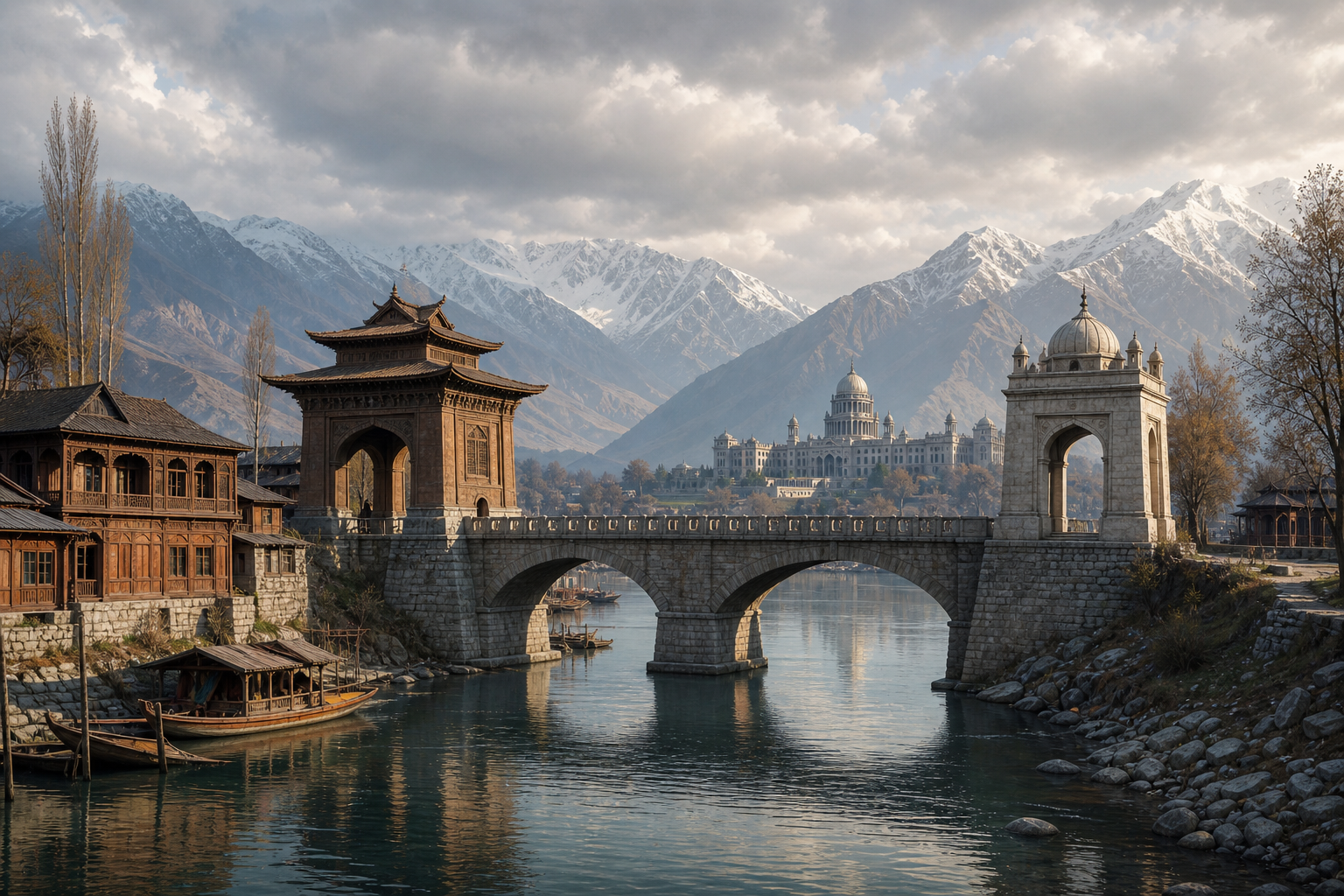
The Jammu and Kashmir question placed Mookerjee’s principles under exceptional pressure. As the source recounts, Maharaja Hari Singh signed the Instrument of Accession on 26 October 1947 while raiders advancing from Pakistan threatened the state. The Governor-General accepted it the next day, after which Indian forces were deployed. The instrument initially gave the Dominion legislative authority in specified fields, principally defence, external affairs and communications, together with associated matters.
The source carefully separates that accession from Article 370. Accession was the act by which Jammu and Kashmir joined India; Article 370 later governed the application of provisions of the Indian Constitution to the state. Its mechanism used presidential orders, consultation for subjects covered by the Instrument of Accession and concurrence for the extension of other constitutional provisions.
When N. Gopalaswami Ayyangar introduced draft Article 306A on 17 October 1949, the source reports that he identified unresolved hostilities, territory outside Indian control, proceedings at the United Nations and the absence of a state constituent assembly as reasons for an interim arrangement. The eventual provision appeared in the Constitution’s part dealing with temporary, transitional and special provisions.
Yet its operation was legally more complicated than the word temporary might suggest. According to the source, Article 370(3) permitted the President to modify the provision or declare it inoperative, while the original proviso required a recommendation from Jammu and Kashmir’s Constituent Assembly. That body dissolved in 1957 without recommending abrogation. Numerous presidential orders subsequently extended substantial parts of the Indian Constitution and Union law to the state, making the relationship evolutionary rather than fixed.
Mookerjee’s response, as documented in his Lok Sabha speech of 7 August 1952, was not a rejection of every concession. The source describes him as acknowledging the exceptional circumstances, recognising the need for consent and opposing indiscriminate coercion. He was willing to consider an interim settlement if the sovereignty of the Indian Parliament was accepted and the concessions were examined openly through constitutional means.
His governing test asked whether a proposed difference would harm India and whether it would genuinely strengthen Kashmir. This allowed room for pragmatic accommodation while drawing a boundary against separate constitutional sovereignties, competing civic symbols or unequal categories of citizenship. His concern about the Balkanisation of India was therefore directed less at regional identity itself than at institutional arrangements capable of turning identity into political separation.
The documentary record reveals a more nuanced position

The source also corrects an important problem in the historical record. It notes that two polished statements about temporary special provisions have been attributed to Mookerjee with references to the Constituent Assembly Debates. However, the searchable record of the 17 October 1949 debate on draft Article 306A contains no recorded intervention by him, and the wording could not be verified there.
That correction does not overturn the conclusion that he favoured fuller integration or regarded the arrangement as transitional. It changes the evidentiary basis for that conclusion. His verified 1952 parliamentary speech is the stronger source, and it portrays a politician balancing integration with consent, constitutional examination and religious equality.
This distinction matters because slogans tend to collapse several questions into one. Mookerjee’s position concerned not only the final degree of integration but also the means used to achieve it and the civic order integration was meant to protect. The source reports that he wanted Kashmir to demonstrate that Hindus, Muslims, Christians and others could live without fear and with equal rights. National unity, in this formulation, derived its legitimacy from inclusive citizenship rather than religious hierarchy.
A constitutional test extending beyond one territorial dispute
Mookerjee’s framework can be expressed as a distinction between protected difference and divided authority. The first encompasses cultural identity, language, regional administration and transitional arrangements intended to build confidence. The second begins when an arrangement implies a rival sovereignty, makes citizenship unequal or transforms a temporary response into an enduring constitutional separation.
This interpretation also clarifies why federalism and national unity need not be opposites. Regional discretion can bring government closer to citizens, while common constitutional guarantees preserve mobility, equality and political membership. The crucial issue is not whether every region has identical institutions, but whether institutional differences remain accountable to the same sovereign constitutional community.
Future debates over autonomy and integration can usefully return to that test: whether an accommodation enlarges trust and equal participation, or instead creates durable boundaries between citizens. Applying it responsibly requires the same documentary discipline that the source brings to Mookerjee’s record, especially when later political memory is more categorical than the evidence.