
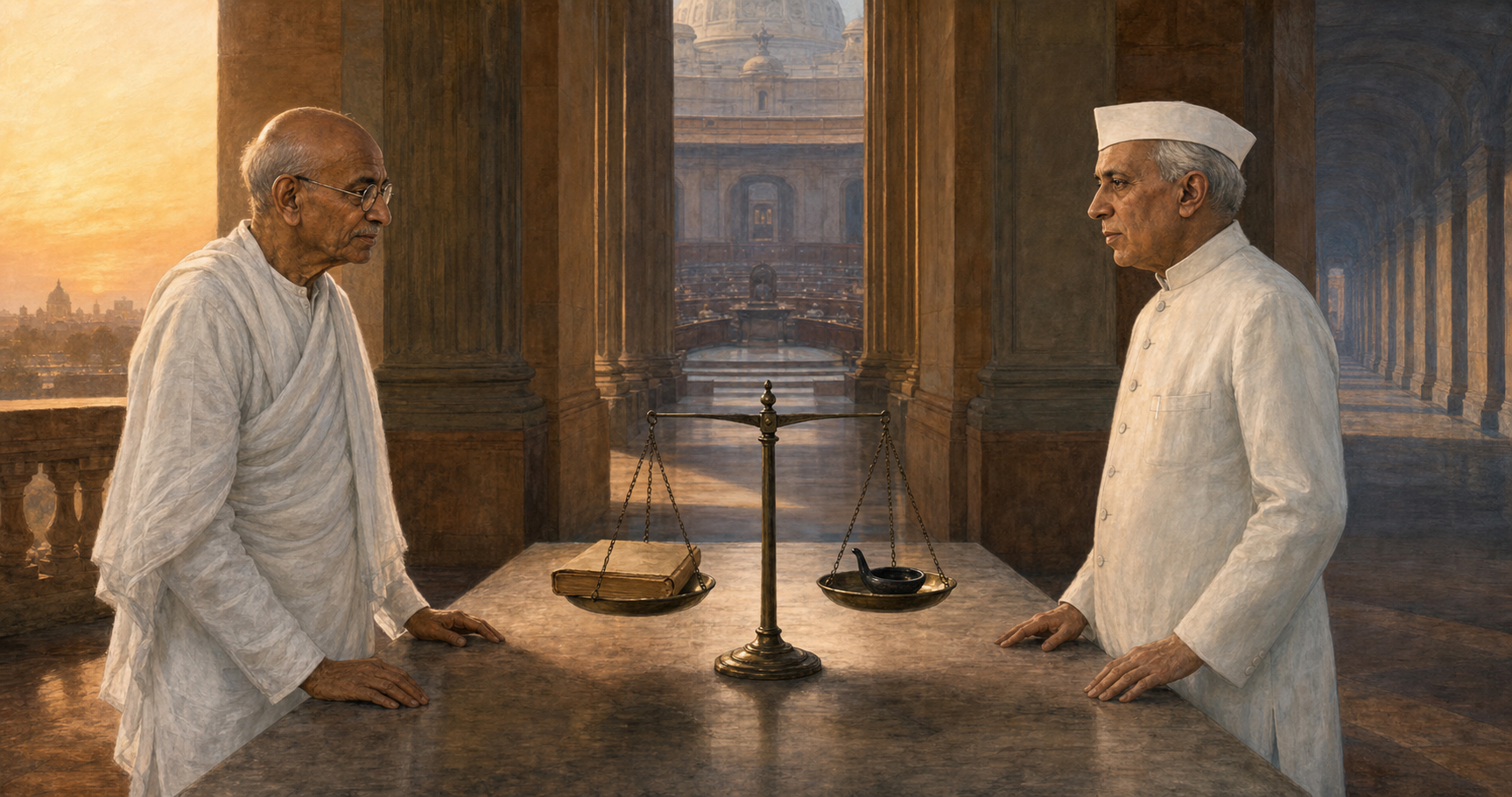
If you are trying to decide whether Rajaji’s break with Nehru was merely an old quarrel over socialism, start with a harder question: what happens when the state controls scarce opportunities, a dominant party inherits the prestige of national liberation, and those who govern face few effective restraints?
You do not have to make Rajaji flawless or reduce Nehru to a caricature. The useful lesson is institutional. Personal virtue matters, but ethical government lasts only when rules prevent patriotism, party loyalty, and administrative discretion from becoming private political currency.
The real divide: what does power do to people?
Rajaji and Nehru are commonly placed at opposite ends of an economic argument: free enterprise against socialism, decentralised choice against state direction. That distinction is real, but it does not reach the deepest layer of their disagreement.
Rajaji persistently challenged the system later described as Nehruvian socialism because he believed extensive economic controls would damage both efficiency and public character. When an official can grant a licence, release a quota, approve an import, or make an exception, the official possesses something that citizens and businesses must compete to obtain. The transaction may remain lawful. Yet the system creates a market for access, influence, loyalty, and silence even before an envelope of cash changes hands.
This is the moral psychology behind Rajaji’s economic criticism. A permit is not inherently corrupt, and scarcity can require regulation. The ethical problem begins when permissions are numerous, standards are opaque, exceptions are valuable, and review is weak. An honest administrator then operates inside a structure that rewards supplication. A dishonest one can convert public authority into private advantage.
The conflict also concerned political concentration. After Sardar Patel’s death, authority became more centralised while Rajaji and other independent-minded contemporaries moved away from the Congress establishment. Acharya Kripalani, B.R. Ambedkar, John Mathai, Ramnath Goenka, and Rajaji did not all leave the dominant system for identical reasons. Their different disagreements nevertheless reveal how difficult autonomous counsel had become around a powerful political centre.
That distinction protects us from two bad readings. One treats Nehru’s stated ends as sufficient proof that his methods were ethical. The other treats every failure of the period as proof of his personal malice. Neither follows. A leader may sincerely pursue equality while building machinery that rewards influence. Conversely, an institutionally dangerous system does not establish that every person operating it was corrupt.
When you assess an economic policy, therefore, do not stop at its declared beneficiary. Identify who makes the decision, whether the criteria are public, how an unsuccessful applicant can appeal, and who profits from delay. Those questions expose the ethical content of administrative design far better than the labels socialist or capitalist.
Scarcity made discretion a political currency
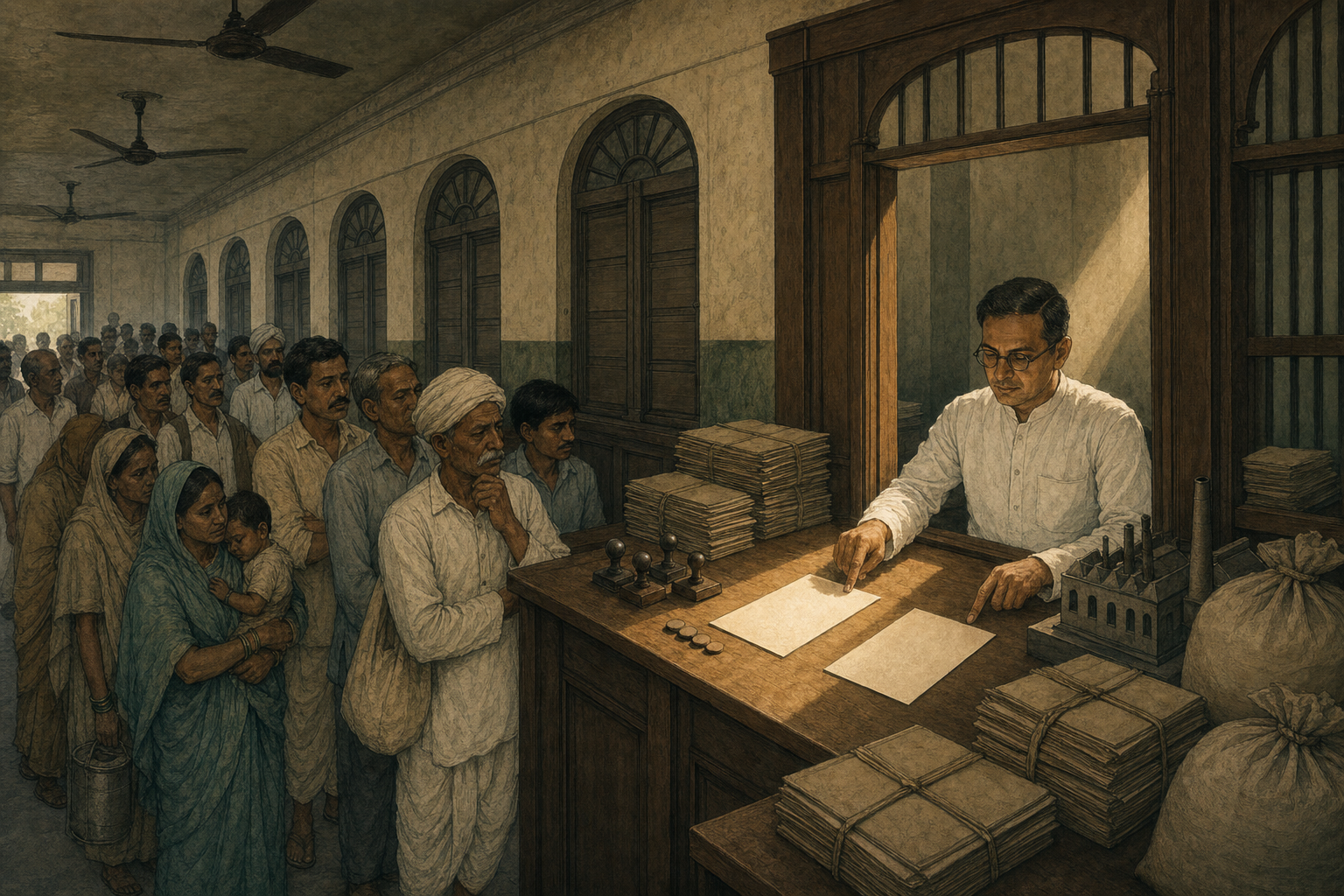
The early republic did not inherit normal economic conditions. Between roughly 1947 and 1952, rationing, foreign-exchange constraints, import restrictions, and widespread shortages shaped daily administration. These pressures help explain why controls existed. They also explain why control over exceptions became so valuable.
A shortage does more than reduce supply. It changes the political meaning of permission. When the market cannot satisfy demand and the state decides who may buy, import, transport, or distribute something, access to the decision-maker can become as valuable as the commodity itself. A broker no longer needs to produce value; proximity to authority may be enough.
The automobile trade made the contradiction unusually visible. Buicks, Packards, and Cadillacs appeared as status symbols among members of a recently austere political class. Well-connected figures were reported to have navigated strict import rules, acquired vehicles at controlled prices, hoarded them, and resold them for multiples in a cash-heavy secondary market. Large-denomination payment, including Rs 100 notes, featured in these accounts.
The cars matter for more than their glamour. They show the complete chain of rent-seeking: an artificial scarcity, a valuable permission, privileged access, resale at a higher price, and cash that obscures the benefit. Whenever you encounter a controlled market in political history, look for that chain rather than searching only for a spectacular bribery case.
Some allegations were more serious and require correspondingly greater caution. Journalist D.F. Karaka alleged in 1950 that certain Congress office-bearers had formed an arms-and-ammunition company using Bombay’s Congress House as its address. The allegation associated party premises with a private commercial venture in regulated goods. It should not be silently upgraded into a judicial finding. Its ethical significance is narrower: such a charge could appear plausible in an environment where the boundaries among party access, public authority, and private business had become uncertain.
This gives you a disciplined way to handle contested episodes. Establish the structural mechanism first. Then ask whether multiple behaviours fit it. Treat each named allegation according to its evidentiary status. You do not need to prove every colourful story to recognise that opaque scarcity, discretionary exemptions, and political connections form a dangerous combination.
The practical implication is direct. If a government must ration something, ethical administration requires published eligibility rules, recorded reasons for exceptions, separation between the decision-maker and the beneficiary, and a usable appeal process. Scarcity may justify allocation. It does not justify secrecy.
The party-state boundary failed before it had hardened
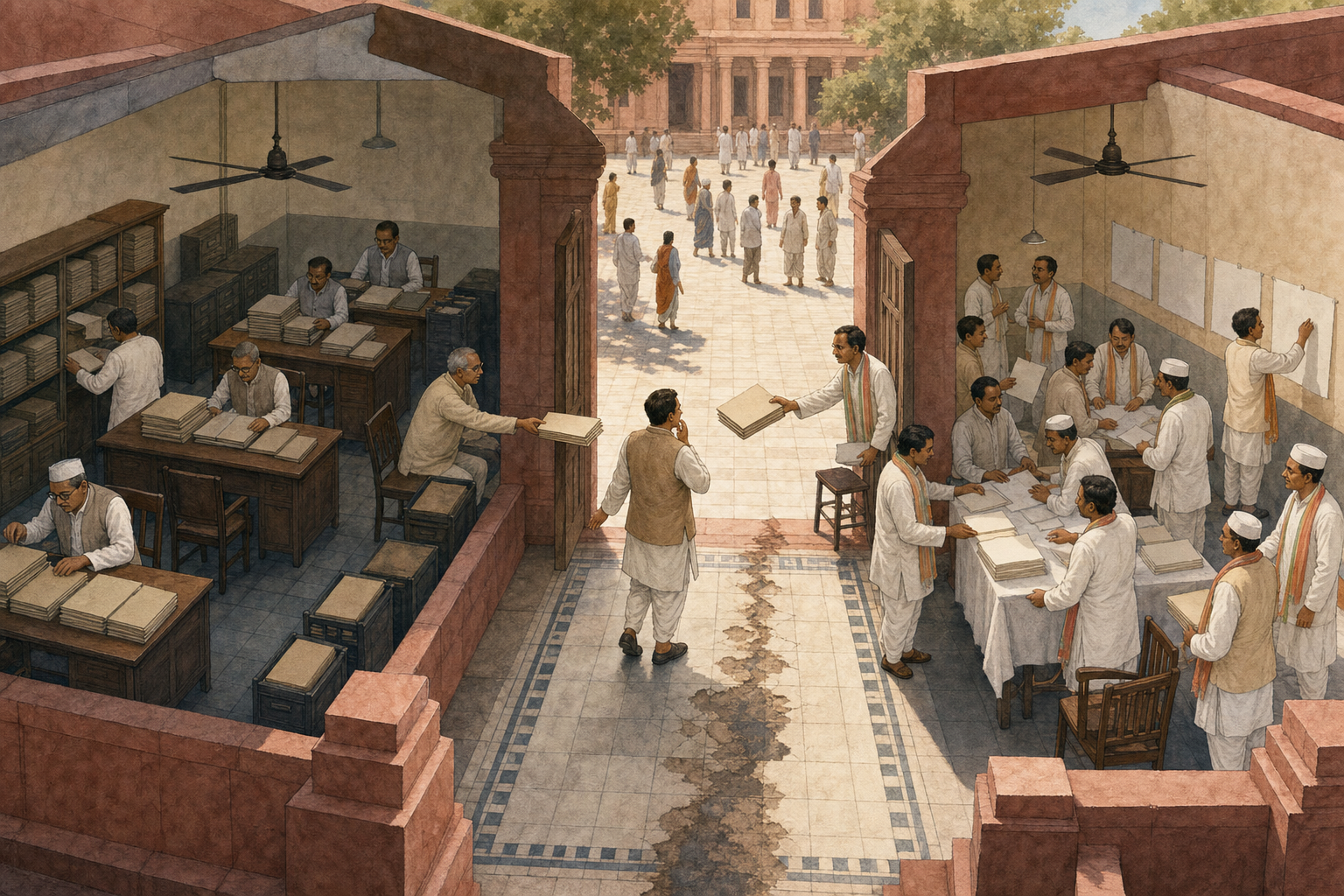
The freedom struggle demanded sacrifice, discipline, and solidarity. Government demands something different: impartiality among citizens, including those who never belonged to the victorious movement. The moral capital earned in resistance cannot become a hereditary claim on public benefits.
That transition proved difficult. Historian Jadunath Sarkar had already warned in the 1940s that detention by the colonial government was being treated as a qualification for ministerial office, while patient constructive workers without the recognised symbols of sacrifice could be dismissed as lesser patriots. His warning identified a powerful temptation: turning yesterday’s suffering into today’s entitlement.
The decay was visible to Congress veterans themselves. Two days before Gandhi’s assassination, the 80-year-old Gandhian Konda Venkatappaiah warned that many freedom fighters had shed their moral restraints after Swaraj and that public resentment against Congress was becoming severe. Early electoral dominance coexisted with candid internal alarm about everyday governance. Organisational reach and reverence for the freedom movement should therefore not be mistaken for universal approval of those administering the new state.
K.G. Mashruwala, Gandhi’s close associate and the editor of Harijan after 1948, identified the institutional danger with particular precision. He objected to using admissions, scholarships, and other state-controlled benefits to reward supporters of the ruling party. He also warned that coercion against political opponents would teach a future governing party to reward its own sufferers and punish its predecessors in return.
This is how nepotism becomes cyclical. The first government calls a favour repayment for patriotic sacrifice. Its successor calls a similar favour justice for those previously excluded. Each side cites the other’s conduct as precedent. Public office ceases to serve citizens under a common rule and becomes an instrument for alternating compensation and revenge.
You can detect the breach without knowing every private motive. Ask whether a public benefit depends on a citizen’s party connection; whether government premises or officials serve private party business; whether political detention is treated as a permanent credential; and whether criminal or administrative power falls more heavily on opponents. Repeated yes answers indicate that party and state are no longer meaningfully separate.
The remedy is not collective amnesia about the freedom struggle. India should honour sacrifice. But honour, commemoration, and historically justified assistance must be governed by public criteria. They cannot become discretionary rewards dispensed by the party that claims ownership of patriotism.
Rajaji made opposition part of constitutional ethics
Rajaji’s importance does not rest only on having predicted defects in economic controls. He demonstrated that opposition to a dominant national party could be principled, strategic, and constitutional.
He brought unusual range to that role. Rajaji had been a major freedom fighter, India’s last Governor-General, Chief Minister of Madras State, a writer on constitutional and economic questions, and an interpreter of Vedanta and the Mahabharata. He also wrote on law, Hindu society, free enterprise, public affairs, and the danger of black money. His criticism of the post-independence order therefore came from within the national movement and from a civilisational understanding of political duty, not from indifference to India.
This matters because dominant parties often try to collapse three different claims into one: we led the nation, therefore we represent the nation, therefore opposition to us is opposition to the nation. The first claim may be historically defensible. The other two do not follow. Past service cannot grant a permanent monopoly over patriotism.
Rajaji eventually pursued broad anti-Congress cooperation in Tamil Nadu. Those alliances helped produce the decisive political change of 1967, including the ascent of the DMK. Supporting a coalition did not require agreement with every position of every participant. Its constitutional meaning was that Congress dominance could be challenged through persuasion, organisation, alliances, and elections rather than through abandonment of the democratic order.
That is a demanding model of opposition. It refuses to let the ruling party own the nation, but it also refuses to treat the constitutional system as worthless merely because one party dominates it. It distinguishes cooperation on a limited democratic objective from total ideological endorsement. And it gives dissatisfied citizens somewhere lawful to go.
The lesson remains useful whenever you consider a political alliance. Judge it on three levels: the immediate constitutional objective, the methods used to pursue it, and the limits each participant preserves. A coalition formed to end hegemony can serve democracy, but only if it does not excuse coercion, conceal fundamental disagreements, or replace one permanent entitlement with another.
A dharmic audit for political power

Dharma should not be reduced to a religious seal placed on a preferred economic programme. Hindu, Buddhist, Jain, and Sikh traditions have distinct doctrines and institutions. Yet each gives serious weight to disciplined conduct, truthfulness, restraint of appetite, responsibility beyond the self, and protection from arbitrary harm.
That shared ethical ground changes how we judge statecraft. A policy cannot become dharmic merely because its stated goal sounds compassionate. Its instruments, incentives, treatment of opponents, and effect on the office-holder’s appetites also matter. D.V. Gundappa captured the danger by comparing newly acquired power to a treasure chest placed before people who had long gone hungry. Political ethics must assume that temptation exists and build restraints before the feast begins.
Key takeaways: five questions to ask of any government
- Allocation: When the state controls a scarce benefit, are the eligibility rules and reasons for exceptions public?
- Symmetry: Would supporters defend this power if their strongest political opponent inherited it tomorrow?
- Boundary: Are public money, premises, appointments, scholarships, licences, or prosecutions being used to strengthen a party?
- Remedy: Can a person who is denied, punished, or displaced obtain an independent review without seeking political patronage?
- Restraint: Does the office-holder answer criticism under common rules, or convert past sacrifice and present popularity into exemption from scrutiny?
One adverse answer does not by itself prove corruption. Several adverse answers reveal an institutional danger even when no individual crime has been established. This is why Rajaji’s warning remains more useful as an audit of power than as ammunition in a personality contest.
The same method also keeps historical judgement fair. Credit Nehru’s stated public purposes where they deserve credit, but inspect the discretion created by the chosen means. Honour the Congress’s freedom-struggle legacy, but do not confuse that legacy with an unlimited claim on the state. Admire Rajaji’s foresight, but test his alliances and decisions by the same standards applied to his opponents.
The next time a leader asks you to excuse opaque discretion because the cause is noble, put the rule beside the beneficiary. Look for the denied applicant, the route of appeal, the treatment of critics, and the precedent being handed to the next government. That is how Rajaji’s warning becomes civic practice rather than another commemorative slogan.
References
