
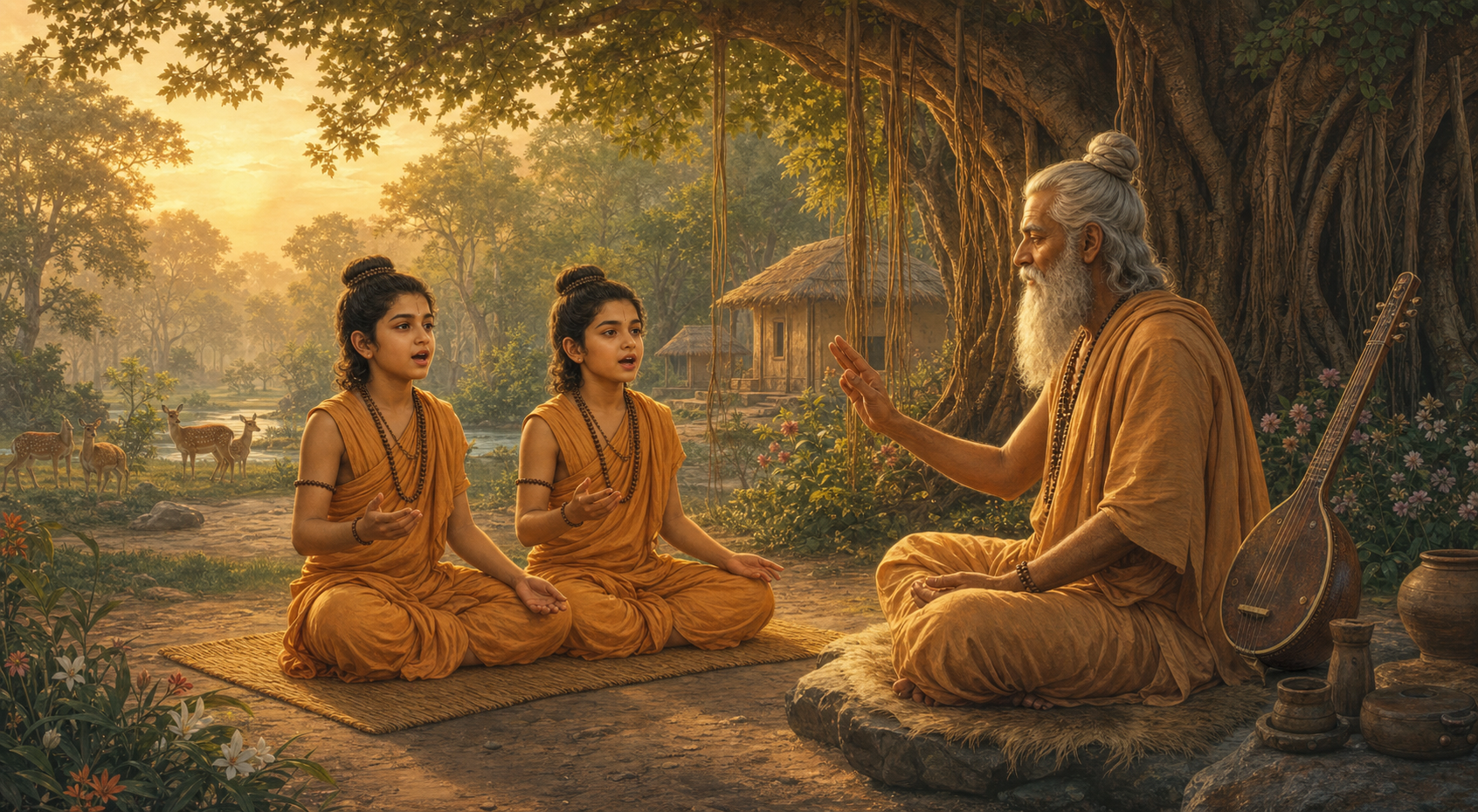
If you are trying to understand what it means to say that Lava and Kusha transmitted the Ramayana orally, do not picture two children loosely retelling a familiar story. The received tradition presents something far more disciplined: Valmiki taught them a composed work whose wording, metre, pronunciation, musical movement and emotional character all had to be carried together.
That distinction changes how you hear any Ramayana recital. Voice was not decoration added after the poem was finished. It was the means by which the poem became memorable, public and capable of placing both ordinary listeners and a king under the searching light of dharma.
Oral transmission did not mean an improvised retelling

Modern readers sometimes treat oral and written culture as opposites. The story of Lava and Kusha does not permit that simple division. Within the received tradition, Valmiki has two connected roles: he is the Adikavi who composes the Ramayana, and he is the teacher who prepares its first reciters. Composition gives the narrative its verbal and metrical form; teaching places that form within trained memory; performance gives it a life among listeners.
Orality here is therefore a method of disciplined preservation. Lava and Kusha do not receive only the plot: exile, loss, loyalty, war and return. They learn how the verses are shaped and how their meaning should move through sound. The performer is neither a silent container nor a free inventor. He must preserve what was entrusted to him while making its ethical force audible.
This also tells you how cautiously to frame the tradition. Lava and Kusha are remembered as the Ramayana’s first trained exponents, but that does not give us a modern transcript of an ancient performance or prove that every later recital descends through one mechanically traceable line. Ramayana recensions and regional retellings vary in detail and emphasis. The durable claim is more precise: the tradition places controlled oral performance at the very beginning of the epic’s public life.
When someone calls this episode evidence of “oral transmission,” ask what that phrase is being used to mean. If it means casual storytelling from memory, it misses the point. If it means a composed narrative preserved and renewed through trained voices, attentive ears and repeated performance, it describes the model well.
Valmiki trained memory, metre, voice and moral feeling

The Ramayana was not entrusted to the twins as prose information that could be delivered in any convenient form. The received tradition associates its verses with the anustubh metre and describes Lava and Kusha as learning chandas, or metrical structure; svara, or controlled intonation; and bhava, the feeling appropriate to what is being narrated. Later descriptions of this performance ideal also emphasize rhythmic balance and dhvani, the suggestive meaning that reaches beyond a verse’s bare statement.
Each element performs a different task. Wording protects the narrative from careless alteration. Metre organizes breath, pace and memory. Clear pronunciation prevents sound from obscuring sense. Intonation directs attention without rewriting the verse. Bhava allows the listener to feel the weight of separation, duty, grief, courage and consequence. Restraint keeps the performer from becoming more important than the story.
The balance matters. Accuracy without feeling can reduce recitation to verbal storage. Feeling without accuracy can turn sacred narrative into the performer’s personal display. Lava and Kusha embody a third possibility: emotion disciplined by form. Their credibility comes from the union of technical training and ethical formation.
You can use that standard when listening to a recitation now. Notice whether the words remain intelligible when melody enters. Notice whether pauses serve the meaning or merely heighten spectacle. Notice whether sorrow, valour and devotion are distinguished without exaggeration. Most importantly, notice whether the rendition leaves you thinking about the choices within the narrative, rather than only admiring the voice that delivered them.
This is why the twins’ youth is significant without being sentimental. They are not authoritative merely because they are children or because they are Rama and Sita’s sons. They become trustworthy carriers through study, repetition, clarity and composure. The episode treats transmission as character training: before a person can carry a sacred narrative into public life, that person must learn how not to distort it through carelessness or vanity.
The movement from the ashram to Ayodhya changed the recital
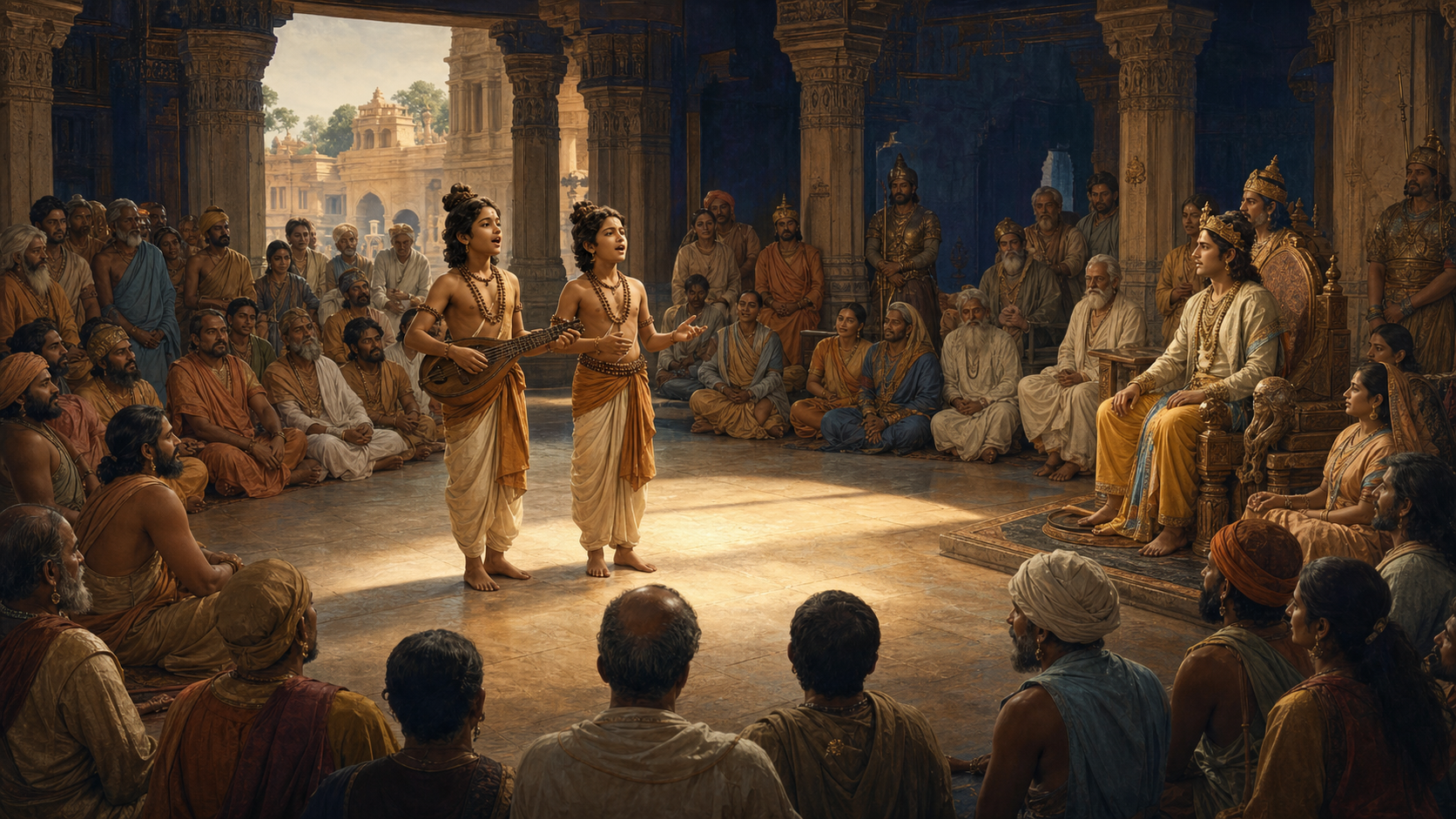
The first audience is placed within Valmiki’s ashram, among sages, students and seekers. This is not incidental scenery. A contemplative community can listen for coherence, verbal control and moral depth before the recital enters a royal or urban setting. Silence and concentration become part of the transmission process because they allow fine distinctions of sound and conduct to be received.
The later movement into Ayodhya changes the function of the performance. Accounts commonly associate the public recital with the period of the ashvamedha, when Lava and Kusha sing before Rama himself. The journey is therefore not merely from forest to city. It is a movement from formation to public accountability.
In the ashram, the twins learn to carry the Ramayana faithfully. In Ayodhya, the same narrative enters civic and royal hearing. Rama is simultaneously the listener and the subject whose conduct has become itihasa. A sovereign hears his own life narrated from beyond the immediate language of courtly command. Royal power cannot simply control the moral meaning of the events being sung.
This is one reason the scene remains ethically potent. The recital does not function as uncomplicated praise of a victorious king. It turns kingship, family obligation, suffering and public duty into matters that can be heard and considered by a gathered community. The narrated Rama is an exemplar, but exemplary narrative invites scrutiny as well as reverence.
The Ramayana’s status as itihasa rather than shruti is important here. It teaches through persons acting under pressure, not through abstract commands alone. You are asked to watch duties collide, choices produce consequences and moral ideals enter an imperfect social world. The recital makes that examination communal: the king, sages and citizens hear the same narrative, even though each listener occupies a different place within it.
The audience consequently belongs to the transmission chain. Concentrated listening, or ekagrata, is not passive consumption. Silence, tears and thoughtful approval signify that the recital has been received as morally intelligible. Such responses are not substitutes for textual fidelity, and they are not proof in the modern critical sense. They show how sacred meaning becomes socially present when disciplined speech meets disciplined attention.
When you read this episode, ask two questions that are easy to overlook: who is allowed to hear the narrative, and what becomes possible because they hear it together? In the ashram, listening supports formation. In Ayodhya, it makes memory public and places authority within a shared moral field. The same verses do different work because the audience and the stakes have changed.
A practical way to carry the model into a home or study circle
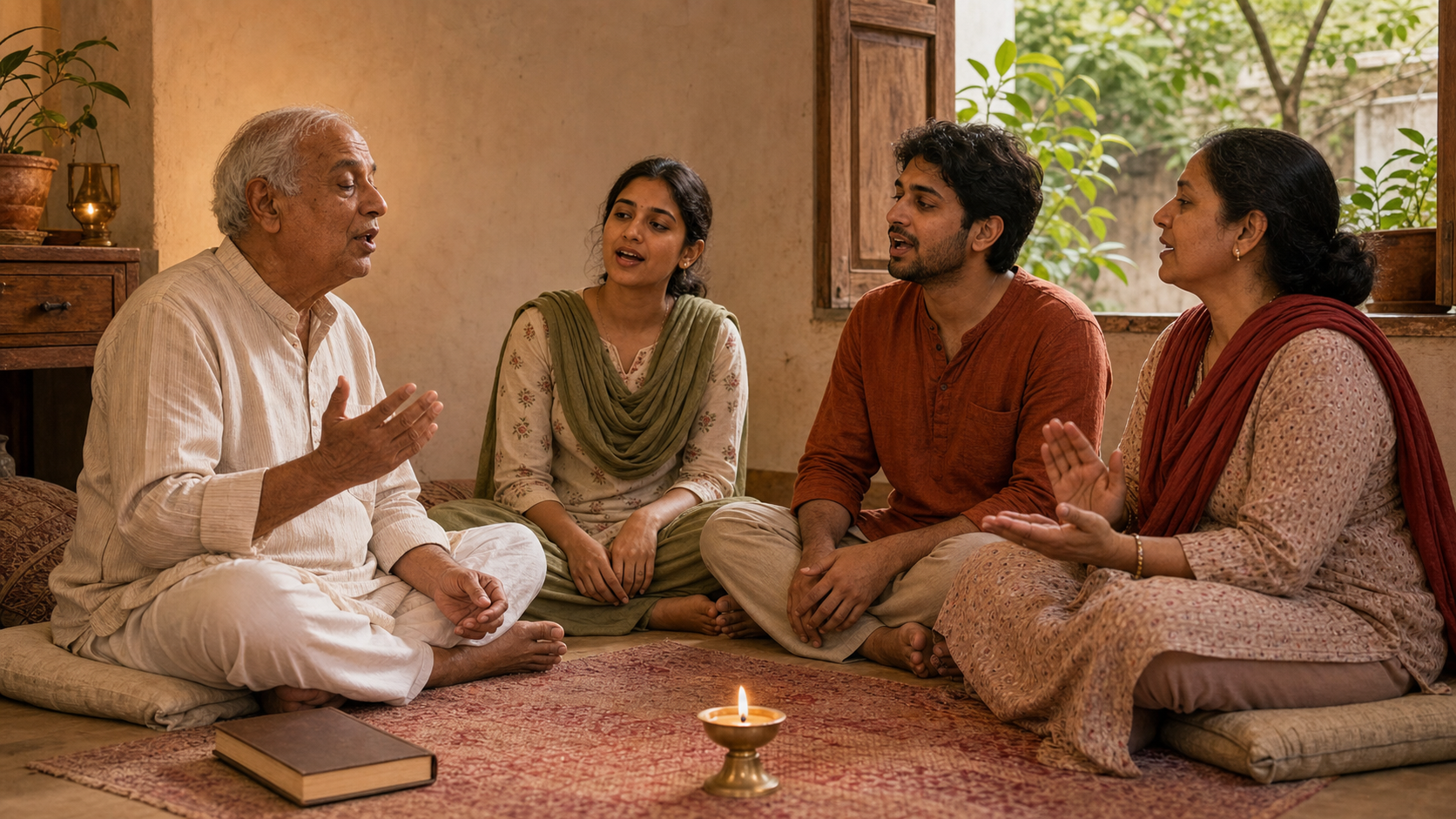
You do not need to reconstruct an imagined ancient melody to learn from Lava and Kusha. You can preserve the central discipline of their model by giving wording, sound, interpretation and listening their proper order.
- Identify the version before reciting. Name the Sanskrit text, regional Ramayana or translation you are using. Variation among recensions should not be confused with careless error, but listeners need to know which verbal form is being preserved.
- Let the passage be heard before explaining it. Read or chant a manageable unit without interrupting it with commentary. This allows listeners to encounter its pace, repetition and emotional movement as a whole.
- Correct the craft without manufacturing authority. Check wording, pronunciation and metre where you have reliable instruction. If you do not know a traditional melodic form, a clear and measured reading is better than presenting an invented tune as inherited practice.
- Bring in bhava after securing clarity. Emotion should reveal the situation rather than overwhelm it. Ask what duty is under pressure, what a decision costs and who must live with its consequences.
- Turn listeners into future carriers. Let another participant recite the passage at a later gathering or explain its central ethical tension. Transmission becomes durable when the audience moves from consumption to responsible participation.
With children, do not confuse discipline with performance anxiety. Clear diction and careful memory matter, but the purpose is not to produce a display for adults. The deeper aim is to join accurate speech with attention, humility and reflection. Praise loudness or theatrical confidence too heavily, and you teach the opposite of the restraint associated with Lava and Kusha.
The same test applies to public katha, temple recitation and digital recordings. Ask whether musical and dramatic choices help you hear the narrative more precisely. A rendition can be beautiful yet weaken transmission if ornament swallows the words. It can be technically exact yet fail pedagogically if no space remains for listeners to consider dharma.
This disciplined relationship between sound and ethical instruction also resonates across Dharmic traditions. Communal recitation in Buddhist settings, Jain narrative retellings, and Sikh katha and kirtan differ in theology and textual form, but all recognize that shared sound can train memory, attention and community. The comparison should preserve those distinctions rather than collapsing every practice into one system.
Key takeaways
- Lava and Kusha’s oral transmission is best understood as disciplined performance of a composed itihasa, not free improvisation.
- Valmiki’s teaching joins verbal accuracy with chandas, svara, bhava and restrained delivery.
- The ashram audience represents formation and attentive testing; the Ayodhya audience turns the recital into public moral memory.
- Rama hearing his own life makes kingship answerable to a narrative of dharma that can be heard by the wider community.
- Listeners help sustain sacred memory through concentration and response, but attentive reception does not give them license to detach the story from its transmitted form.
- Differences among recensions and regional Ramayanas call for identifying the version being recited, not pretending that every performance preserves one identical wording.
The next time you approach the Ramayana, choose a passage and hear it aloud before discussing it. Name the version, protect the words, attend to the cadence and then ask what conduct the passage requires you to examine. That small change moves you closer to the culture of listening that made Lava and Kusha more than narrators: it made them custodians.
References
