
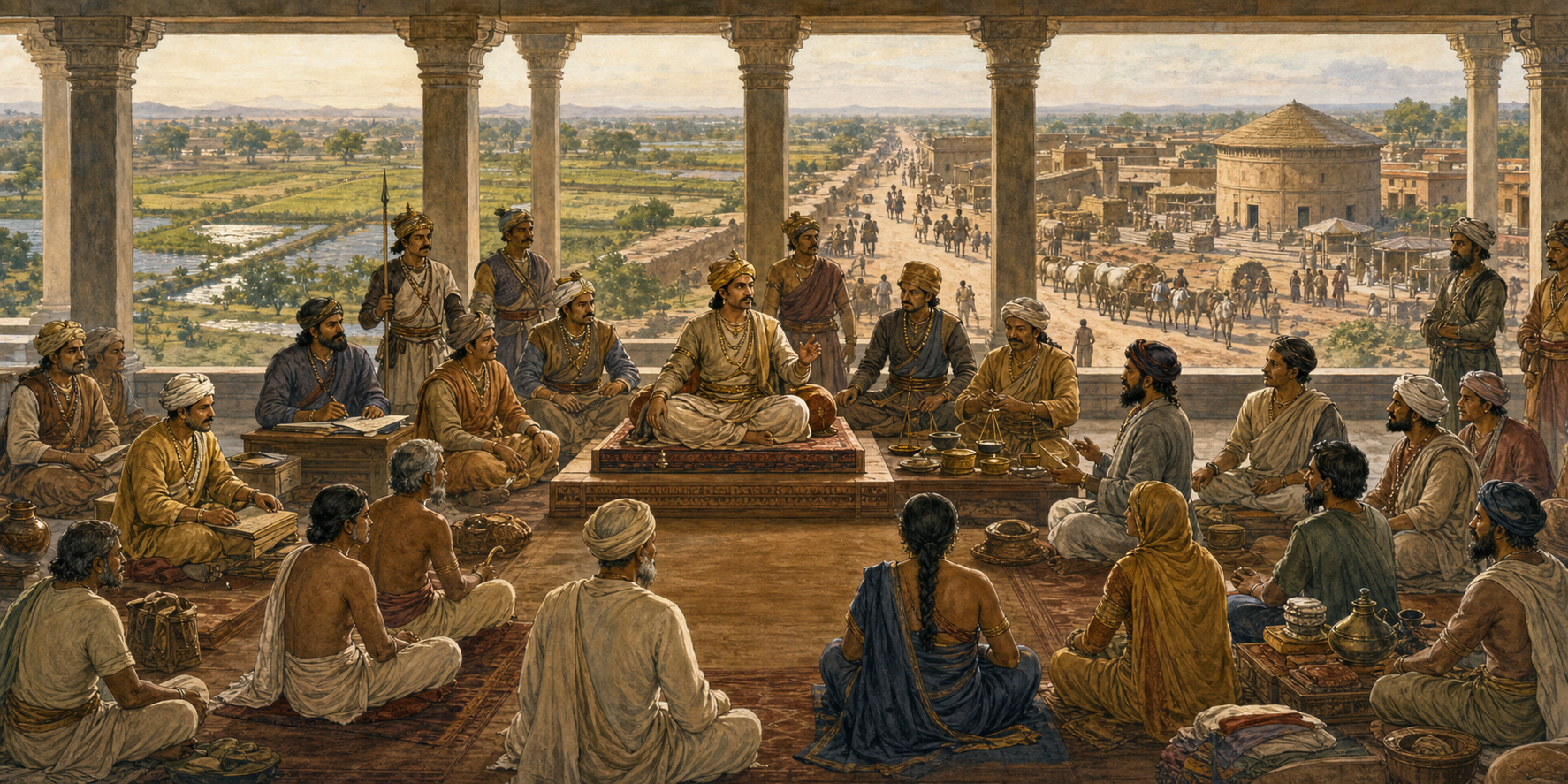
Rajadharma changes the central question of kingship. Instead of asking only who held power and extracted resources, it asks what made authority legitimate, what duties constrained a ruler, and how political institutions translated those duties into practice.
The supplied review of Saumya Dey’s Indic Kingship in Theory and Practice develops this perspective across Indian political history from 500 BCE to 1800 CE. Its value lies neither in idealising monarchy nor in denying conflict, hierarchy, taxation, and coercion. It lies in showing why those features must be interpreted alongside protection, restrained revenue demands, distributed authority, public welfare, and the ethical expectations attached to sovereignty.
Rajadharma Made Political Power a Moral Office
In the account presented by the review, Indic kingship was organised around a vocabulary of obligation. Dharma supplied standards by which royal conduct could be judged, while the ruler’s position carried responsibilities toward political order and public protection. Kingship, on this reading, was not simply ownership of a territory or command over an army. It was an office whose legitimacy depended upon the proper exercise of authority.
This distinction matters because power and legitimacy are not identical. A ruler might possess the capacity to wage war, levy taxes, or punish offenders without thereby satisfying the normative demands of kingship. Rajadharma therefore offers an internal standard of criticism: conduct could be assessed against duties associated with sovereignty rather than excused merely because it was royal conduct.
The review identifies protection, moderated taxation, welfare, ritual legitimacy, and respect for distributed or local authority as parts of this political horizon. These elements should not be treated as proof that every ruler governed well. They instead reveal what the tradition considered politically meaningful and what kinds of claims rulers had to make when presenting themselves as legitimate.
The Crucial Test Is the Movement from Ideal to Institution
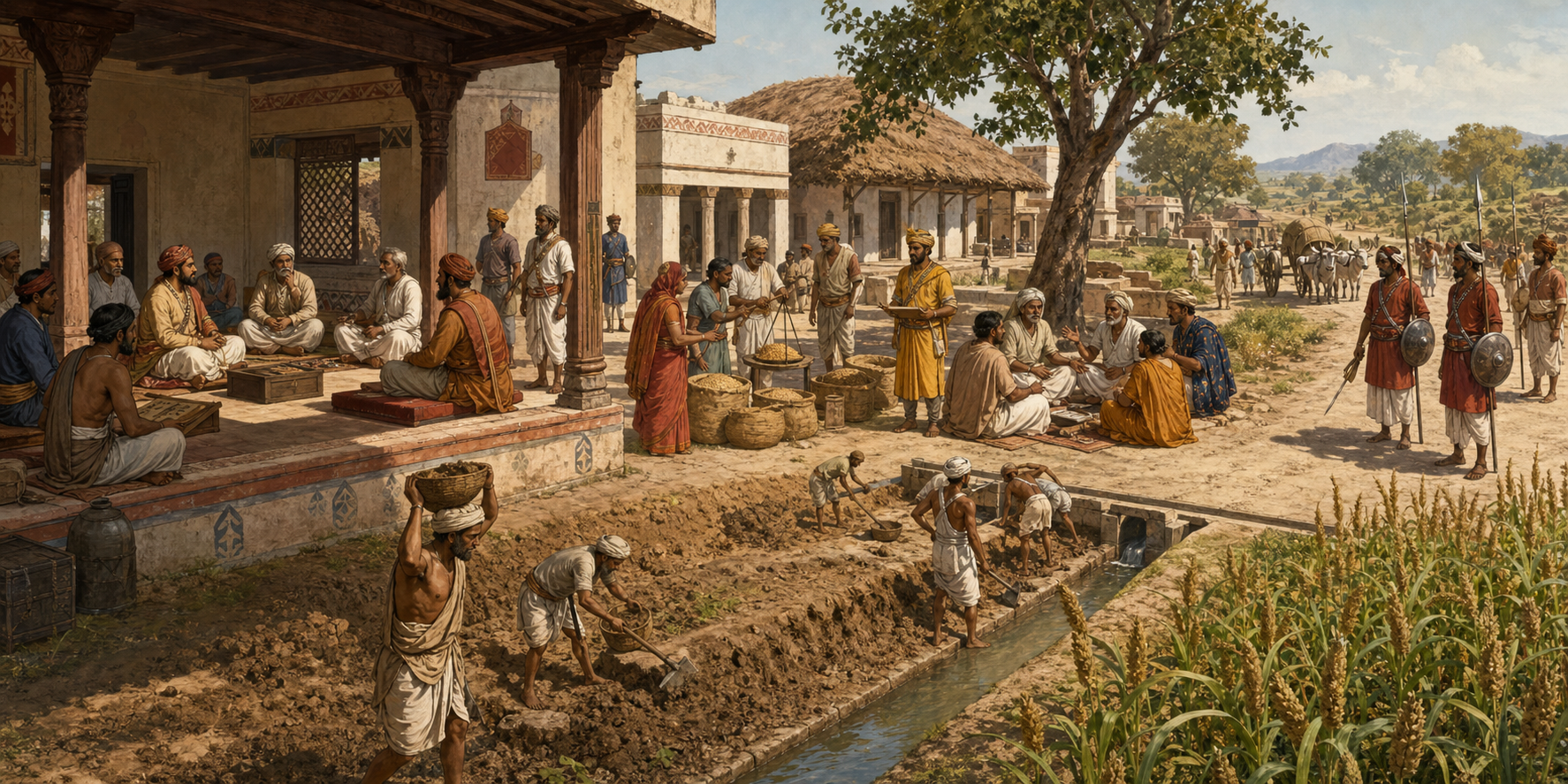
A study of rajadharma can fail in two opposite ways. It can mistake prescriptions for an administrative record, or it can dismiss prescriptions as irrelevant because rulers did not always obey them. The review credits Dey with avoiding both errors by moving between normative conceptions and governing practice.
Texts describing the ideal king disclose standards of political legitimacy, but they cannot establish universal royal virtue. Conversely, evidence of warfare, taxation, ambition, or coercion cannot by itself prove that the ethical vocabulary of kingship was merely decorative. Historical judgment requires examining the institutions through which authority operated: administrative offices, village bodies, councils, guilds, revenue arrangements, grants, and other forms of shared or delegated power discussed in the review.
This theory-practice distinction also makes rajadharma historically useful without turning it into apologetics. A norm may influence political behaviour, provide grounds for resistance, shape public expectations, or constrain claims to legitimacy even when it is violated. The distance between an ideal and actual conduct is therefore evidence to investigate, not a reason automatically to accept or discard the ideal.
Why European Class Categories Do Not Settle the Question

The review places Dey’s argument against deterministic versions of Marxist historiography, not against the study of material conditions. Land, labour, taxation, trade, military finance, and control of resources plainly affect political life. The disputed step is the reduction of law, religion, philosophy, culture, and political obligation to expressions of an economic structure whose decisive meaning is already assumed.
Marxist historians in post-independence India, the review notes, broadened scholarship by attending to agrarian relations, labour, material culture, revenue systems, and communities often neglected in older dynastic narratives. That contribution remains compatible with criticism of a total explanation. The problem arises when every form of hierarchy confirms exploitation, cooperation becomes concealed exploitation, and ethical or religious motives are treated in advance as ideological cover.
The review invokes Karl Popper’s criticism of unfalsifiable theories and Imre Lakatos’s description of protected theoretical cores to explain this concern. A framework loses explanatory discipline when contrary evidence can never count against its central conclusion. Applied to Indian history, this means that a land grant cannot automatically prove European-style feudalism, just as taxation cannot automatically prove predation. Resemblance may justify comparison, but it does not establish institutional identity.
Rajadharma consequently should not replace economic analysis with an equally total moral theory. Its stronger role is corrective and comparative. It restores political concepts that historical actors themselves treated as significant, then asks how those concepts interacted with material interests, institutions, and conflict.
A Better Method for Reading the Evidence

The review emphasises that no single class of evidence is self-sufficient. Inscriptions may project royal legitimacy; court literature may praise patrons; religious and philosophical texts formulate ideals rather than modern administrative reports; archaeological remains reveal material conditions without supplying their own interpretation. Coins, grants, legal works, oral traditions, and foreign travel accounts illuminate different parts of political life.
Triangulation is therefore the most important methodological lesson. A claim about taxation becomes more persuasive when prescriptions, revenue terminology, inscriptions, settlement evidence, and administrative records point in a compatible direction. Claims about participation or distributed power likewise require evidence from councils, guilds, villages, offices, and patterns of representation. Convergence does not eliminate interpretation, but it makes interpretation more accountable.
Key takeaways
- Rajadharma treated sovereignty as an obligation-bearing office rather than power without an internal standard.
- Normative texts reveal expectations of legitimacy; they do not prove that every king fulfilled them.
- War, hierarchy, and taxation are historical facts to interpret, not automatic proof of a single civilisational model.
- Economic analysis remains necessary, but it should be tested alongside political, ethical, institutional, and cultural evidence.
- The strongest conclusions emerge when different kinds of sources converge and contrary evidence is allowed to challenge the framework.
This approach also clarifies the proper meaning of objectivity in historical inquiry. Complete freedom from perspective is unattainable because historians select questions, sources, and causal sequences. Objectivity is better pursued through disclosed assumptions, comparison among evidence types, attention to anomalies, and willingness to revise a preferred interpretation.
Future work on Indic kingship can build on this method by testing the language of rajadharma against particular institutions, regions, and reigns. The result would be neither a morality tale nor a predetermined history of exploitation, but a more exact account of how duty, interest, authority, and public expectation shaped Indian political life.