
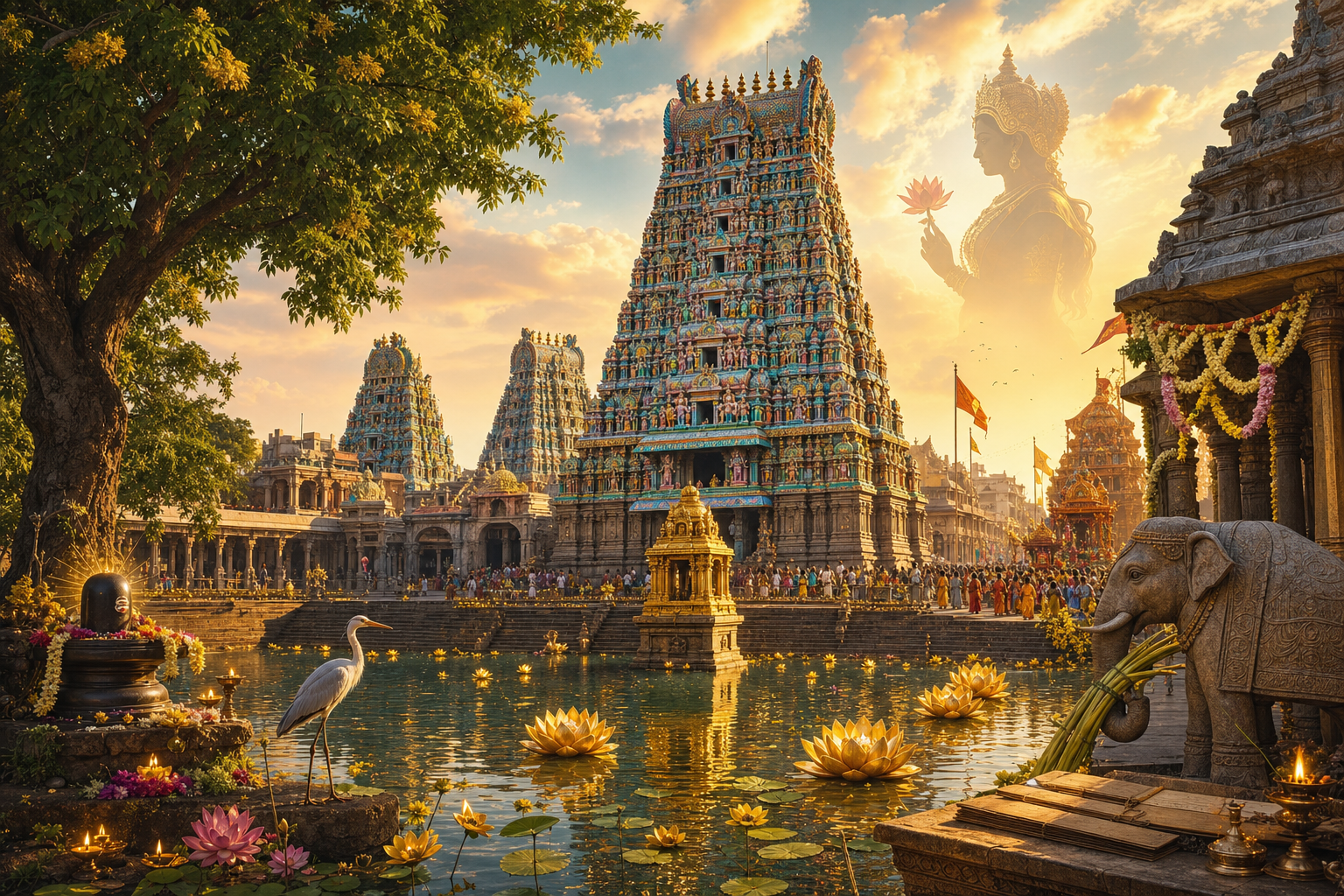
Madurai Meenakshi Temple Sthala Puranam and its living sacred geography. The Madurai Meenakshi Sundareshwar Temple is not merely an architectural monument in Tamil Nadu; it is a layered sacred landscape where mythology, royal memory, Tamil literature, temple ritual, and civic identity meet. Known formally as Arulmigu Meenakshi Sundaraswarar Temple, it stands in the heart of Madurai on the southern bank of the Vaigai River and is dedicated to Goddess Meenakshi, a form of Parvati, and Lord Sundareswarar, a form of Shiva. The temple’s sthala puranam, or place-based sacred history, explains why Madurai is remembered not only as a city of learning and commerce, but also as Kadambavanam, the ancient forest where divine presence revealed itself.
In Hindu temple tradition, a sthala puranam is more than a legend attached to a shrine. It is a theological map that explains how a place becomes sacred, why its rituals matter, how its symbols should be read, and why generations continue to return to it with devotion. In the case of Madurai Meenakshi Temple, the sacred narrative begins with purification, moves through the birth and sovereignty of a divine queen, expands into the wedding of Meenakshi and Sundareswarar, and then unfolds through the famous Thiruvilaiyaadal traditions, the 64 playful yet profound deeds attributed to Lord Shiva in Madurai.
The emotional power of this temple lies in the way its legends speak to ordinary human concerns: guilt, longing, childlessness, responsibility, pride, surrender, compassion, and liberation. Even when the stories are grand and cosmic, they remain accessible. A king seeks an heir. A ruler learns humility. A bird restrains its appetite. A devotee is rescued from danger. A city is built around a divine command. This is why the Madurai Meenakshi Temple continues to feel intimate despite its vast scale and historic grandeur.
Kadambavanam: the forest that became Madurai. The temple’s own historical tradition preserves an older memory of the area as a forest of Kadamba trees. In one strand of the sthala puranam, a merchant named Dhananjaya, returning through the forest, discovers a self-manifested Shiva Linga near a sacred pond. During the night, he witnesses celestial beings performing worship there. When he reports this vision to King Kulasekara Pandya, Shiva appears in the king’s dream and commands him to transform the forest into a settled sacred city. The king then builds a temple around the Linga and lays out broad streets and urban structures around it.
This narrative is important because it connects temple, city, and kingship. Madurai is not presented as a settlement that later acquired a shrine; rather, the city is imagined as growing outward from a revealed sacred center. This is consistent with the old South Indian pattern in which temple, market, palace, water tank, festival street, and residential quarter became interdependent parts of a sacred urban organism. The modern visitor still senses this relationship when approaching the temple through Madurai’s crowded streets: commerce, devotion, food, music, flowers, and ritual objects all form part of the temple’s extended life.
Indra’s sin and the Golden Lotus Pond. One of the earliest legends associated with the Madurai Meenakshi Sundareshwar Temple concerns Indra, the king of the devas. According to the sthala puranam, Indra once killed a powerful asura who had been terrorizing the worlds. Because the being he killed carried the sanctity of a Brahmin birth, Indra incurred a grave sin and wandered in search of purification. When he passed through the Kadamba forest, the weight of his sin was mysteriously lifted. Searching for the source of this grace, he found a radiant Shiva Linga beneath a Kadamba tree and the nearby Golden Lotus Pond, known in Tamil tradition as Potramarai Kulam.
Indra bathed in the sacred waters and worshipped Shiva with golden lotus flowers. The story is a compact theological statement on karma, expiation, and grace. Hindu thought gives great importance to karma, not as fatalism but as moral continuity. Actions bear consequences, and purification requires recognition, discipline, and surrender. Yet the Madurai legend adds a tender dimension: even a celestial being is not above moral consequence, and even a grave burden can be softened through sincere contact with the sacred. The temple therefore becomes a place where ethical repair is imagined as possible.
The Golden Lotus Pond carries this symbolism into the temple’s physical geography. Temple tanks are not decorative additions; they are ritual, ecological, and symbolic spaces. They mark transition from the outer world to the inner sacred order. In Madurai, the pond is tied to cleansing, poetic memory, and divine recognition. Its presence reminds devotees that water in Indian sacred architecture is never merely functional. It signifies purification, receptivity, fertility, and the reflective stillness needed before approaching the deity.
The birth of Meenakshi: sovereignty, Shakti, and divine destiny. The most beloved portion of the Madurai Meenakshi Temple legend concerns the birth of the goddess. King Malayadhvaja Pandya and Queen Kanchanamalai had no child and performed the Puthra Kaameshti Yagam seeking an heir. From the sacrificial fire emerged a three-year-old girl of extraordinary beauty and power. She had three breasts, which troubled the royal couple, especially because they had expected a son who would inherit and govern the kingdom.
A divine voice reassured them that the child was not ordinary. She was to be raised like a prince, trained to rule, and crowned as queen. The voice also declared that her third breast would disappear when she met her destined consort. The child was named Thadaathagai, later revered as Meenakshi Amman. This episode is one of the most striking theological statements in Tamil temple tradition: the goddess is not introduced as passive, dependent, or secondary. She is born for kingship, trained for rule, and recognized as the sovereign of Madurai.
For many devotees, this is one reason the Madurai Meenakshi Temple has such enduring emotional force. The goddess is not only a motherly figure of compassion; she is also a warrior, ruler, and guardian. Her fish-shaped eyes, evoked by the name Meenakshi, symbolize watchfulness and grace. She sees the city, protects it, and governs it. The temple’s ritual culture preserves this royal dimension, especially during festivals that mark her coronation, procession, and marriage.
Meenakshi’s encounter with Shiva at Kailash. After ascending the throne, Thadaathagai undertakes a campaign of conquest. In the puranic idiom, this represents not merely political expansion but the unbounded energy of Shakti. She conquers earthly and celestial regions and finally reaches Mount Kailash, where she prepares to face Lord Shiva. At the moment she sees him, the prophecy is fulfilled: her third breast disappears, and her warrior confidence turns into bashful recognition. Her minister Sumathi reminds her of the divine voice that had foretold this moment.
The older narrative interprets this event as the disappearance of ego, illusion, and pride before the Supreme. In a broader Dharmic reading, it may also be understood as the harmonization of power and wisdom. Meenakshi’s strength is not rejected; it is fulfilled. Shiva does not defeat her in a crude martial sense. Rather, the encounter reveals the completion of divine polarity: Shakti and Shiva, energy and consciousness, sovereignty and stillness. This symbolic union is central to the theology of the temple.
Shiva then comes to Madurai as Somasundarar, or Sundareswarar, and marries Meenakshi. The wedding is described as a cosmic celebration attended by gods, sages, celestial beings, kings, artists, scholars, and common people. Lord Vishnu, honored as Meenakshi’s brother in the ritual imagination of the festival, performs the sacred act of giving the bride. The legend preserves a powerful image of religious integration: Shaiva, Shakta, and Vaishnava elements do not stand apart but participate in one shared sacred drama.
Chithirai Thiruvizha and the public life of myth. The celestial marriage of Meenakshi and Sundareswarar is not confined to scripture. It is ritually renewed during the Chithirai Thiruvizha, one of Tamil Nadu’s most celebrated temple festivals. The festival brings together the marriage of Meenakshi and Sundareswarar with the journey of Kallazhagar, linking Madurai’s Shaiva and Vaishnava sacred geographies. During the Nayak period, especially under Thirumalai Nayak, these festival traditions were organized with great civic and ceremonial importance.
Such festivals show how a sthala puranam becomes public memory. Myth is not treated as a distant story; it is walked through streets, sung in hymns, enacted in processions, and witnessed by households across generations. The city becomes a ritual theater. Devotees who may not study theological texts still absorb the central message through sight, sound, movement, and shared participation. This is one reason Madurai remains one of India’s great temple cities.
Thiruvilaiyaadal: Shiva’s 64 divine acts in Madurai. The Madurai sthala puranam is inseparable from the Thiruvilaiyaadal legends, the 64 divine sports of Lord Shiva as Sundareswarar. These stories present Shiva as a deity who enters the lives of kings, poets, merchants, laborers, fishermen, scholars, and humble devotees. He appears in many forms: a siddhar, a poet, a mendicant, a worker, a teacher, and a rescuer. The theological point is clear: the divine is not remote from worldly life. It intervenes, tests, corrects, protects, and blesses within the ordinary fabric of society.
The literary history of these legends is also significant. Early Tamil and Sanskrit works such as Perumbattrappuliyur Nambi’s Thiruvaalavayudaiyar Thiruvilaiyaadal Puranam and the Halasya Mahaatmyam preserve older versions of the Madurai cycle. Paranjothi Munivar’s Thiruvilaiyaadal Puranam, generally placed in the 16th to 17th century, became especially influential in Tamil devotional culture. These works are not simple folklore collections; they are literary, theological, and cultural documents that reveal how Madurai understood itself as a city shaped by divine play.
Some Thiruvilaiyaadal narratives are linked to historical tensions among religious communities, including Saiva and Jaina traditions in medieval Tamil Nadu. A responsible reading should avoid turning these narratives into modern hostility. Jainism, Buddhism, Sikhism, and the many Hindu sampradayas all belong to the broader Dharmic civilizational world in different ways, sharing concerns for self-discipline, liberation, compassion, truthfulness, and ethical living. The sectarian layers in old temple literature are best studied as products of their historical setting, while the deeper lesson remains the pursuit of dharma, humility, and spiritual refinement.
The stork and the ethics of restraint. One of the most moving Thiruvilaiyaadal stories tells of a stork that arrives at the Golden Lotus Pond. As a bird, its natural instinct is to catch fish. Yet upon recognizing the sanctity of the temple precinct, it restrains itself and refuses to violate the sacred space. Shiva, pleased by this self-control, grants the bird release from the cycle of birth and death. The stork then asks that future birds be protected from a test they may not be able to pass. Shiva grants the request by ensuring that the pond will not contain aquatic life that might tempt them.
This legend is remarkable because grace is extended beyond the human world. It resonates with the broader Dharmic recognition that moral life is not limited to human society. The stork’s restraint evokes ahimsa, discipline, and concern for others. Its final request is especially profound: having succeeded in self-control, it does not boast but asks that weaker beings be spared. The story therefore turns a small animal episode into a meditation on compassion and ethical imagination.
The stone elephant and the humbling of royal pride. Another famous Madurai legend describes Shiva appearing as a mendicant in the temple and performing wonders. When word reaches the Pandya king, the king summons him. Shiva refuses to appear in court, indicating that his place is among devotees. Angered, the king comes to the temple and challenges the mendicant to prove his power by feeding sugarcane to one of the stone elephants near the sanctum. The mendicant offers the sugarcane, and the stone elephant comes alive, trumpets, eats, and then returns to stone. The king realizes the divine identity of the mendicant and bows in humility.
The legend teaches that worldly authority cannot command the divine. Kingship is honored in the Madurai tradition, but it is also corrected when it becomes arrogant. This balance is central to temple-based political theology in South India. The ruler protects the temple, but the temple also disciplines the ruler. The miracle of the stone elephant is therefore not merely spectacle; it is a lesson in humility, devotion, and the limits of power.
The Naalvar and Tamil devotional memory. Madurai’s sanctity is deepened by its connection to the great Saivite savants, often remembered as the Naalvar: Thiru Gnaanasambandhar, Thirunaavukkarasar, Sundarar, and Manickavasagar. Their hymns and lives helped shape Tamil bhakti as a literary and devotional force. The temple tradition remembers Thiru Gnaanasambandhar’s hymns on sacred ash, Thirunaavukkarasar’s devotional praise, Sundarar’s intimate relationship with Shiva, and Manickavasagar’s intense mystical poetry in works such as Thiruvaasagam and Thirukkovaiyar.
The account of sacred ash, or Thiruneeru, is especially meaningful in the Madurai context. In the devotional imagination, sacred ash is not only a ritual substance placed on the body; it is a reminder of impermanence, purification, and the soul’s search for union with the universal spirit. When applied in the story of King Nedumaaran’s suffering, it becomes a symbol of healing. At a philosophical level, ash teaches that all embodied pride eventually returns to simplicity, and that spiritual wisdom begins when the ego accepts this truth.
Manickavasagar’s connection to the Pandya world adds another dimension. The stories of the saint, the king, the horses, the foxes, and the Vaigai flood dramatize the tension between royal duty and mystical surrender. Whether approached historically or devotionally, these narratives reveal a recurring theme in Tamil bhakti: the divine may overturn worldly calculations in order to awaken deeper wisdom. The power of Thiruvaasagam lies in this emotional intensity, where the individual soul longs for the Supreme with vulnerability and complete devotion.
History, architecture, and the temple as a cultural archive. The present Madurai Meenakshi Temple is the result of many historical layers. Literary traditions connect Madurai to Sangam-era memory and early Tamil devotional literature. The temple is revered among the important Shiva shrines celebrated in the Tevaram tradition. Pandya patronage, later damage during 14th-century invasions, Vijayanagara-era recovery, and extensive Nayak-period reconstruction all contributed to the temple’s current form. The temple’s official history especially remembers Vishwanatha Nayak, Ariyanatha Mudaliar, and Thirumalai Nayak for major works, including mandapams, urban improvements, and festival infrastructure.
Architecturally, the temple is one of the most recognizable examples of the Dravidian temple-city form. It is enclosed by towering gopurams, with the official temple account noting 14 major towers and identifying the southern tower as the tallest at about 51.9 meters. These gopurams are not only entrances; they are visual scriptures. Their dense sculptural surfaces present deities, guardians, myths, auspicious forms, and theological imagination in stone and stucco. A devotee entering through them symbolically moves from the crowded multiplicity of the world toward the concentrated presence of the sanctum.
The Thousand Pillar Hall, the Golden Lotus Pond, the goddess and Shiva shrines, the festival corridors, and the mandapams together create a sacred environment that is both artistic and functional. Every space has a ritual role. Processions require streets and corridors. Worship requires thresholds, lamps, water, fragrance, sound, and movement. Art is therefore not separate from practice. The temple’s sculptures and structures are best understood as part of a living system of worship, not as museum pieces detached from devotion.
Why the Madurai Meenakshi Temple still matters. The continuing relevance of the Madurai Meenakshi Temple lies in its ability to hold together multiple dimensions of Indian civilization. It is a Shakti shrine where the goddess rules. It is a Shaiva shrine where Sundareswarar performs divine acts. It includes Vaishnava participation through the wedding tradition. It preserves Tamil literary memory through the Tevaram, Thiruvilaiyaadal Puranam, and later devotional works. It reflects South Indian political history through Pandya, Vijayanagara, and Nayak patronage. It remains a living temple where ritual, festival, and pilgrimage continue to shape daily life.
For the modern reader, the sthala puranam offers more than antiquarian interest. Indra’s purification speaks to moral accountability. Meenakshi’s birth and coronation speak to sacred feminine authority. Her marriage to Sundareswarar speaks to the union of power and consciousness. The stork teaches restraint and compassion. The stone elephant teaches humility before the divine. The Naalvar traditions teach that poetry, music, and devotion can transform society. These are not abstract lessons; they are embodied in a temple that millions continue to experience through darshan, sound, procession, and memory.
The Madurai Meenakshi Sundareshwar Temple therefore stands as one of the great sacred centers of Hindu tradition and Tamil cultural heritage. Its legends should be read with reverence, historical care, and a spirit of unity among Dharmic paths. When approached in that way, the temple becomes not a site of narrow sectarian identity but a luminous example of how sacred stories, architecture, ritual, ethics, and community can sustain a civilization across centuries.
Inspired by this post on Hindu Pad.
