
If you are asking whether village self-government in Bharat existed before modern statutory panchayats, do not begin with a slogan about timeless village republics. Ask what villagers could actually organize: water, land records, security, disputes, education, health care, worship, and essential services.
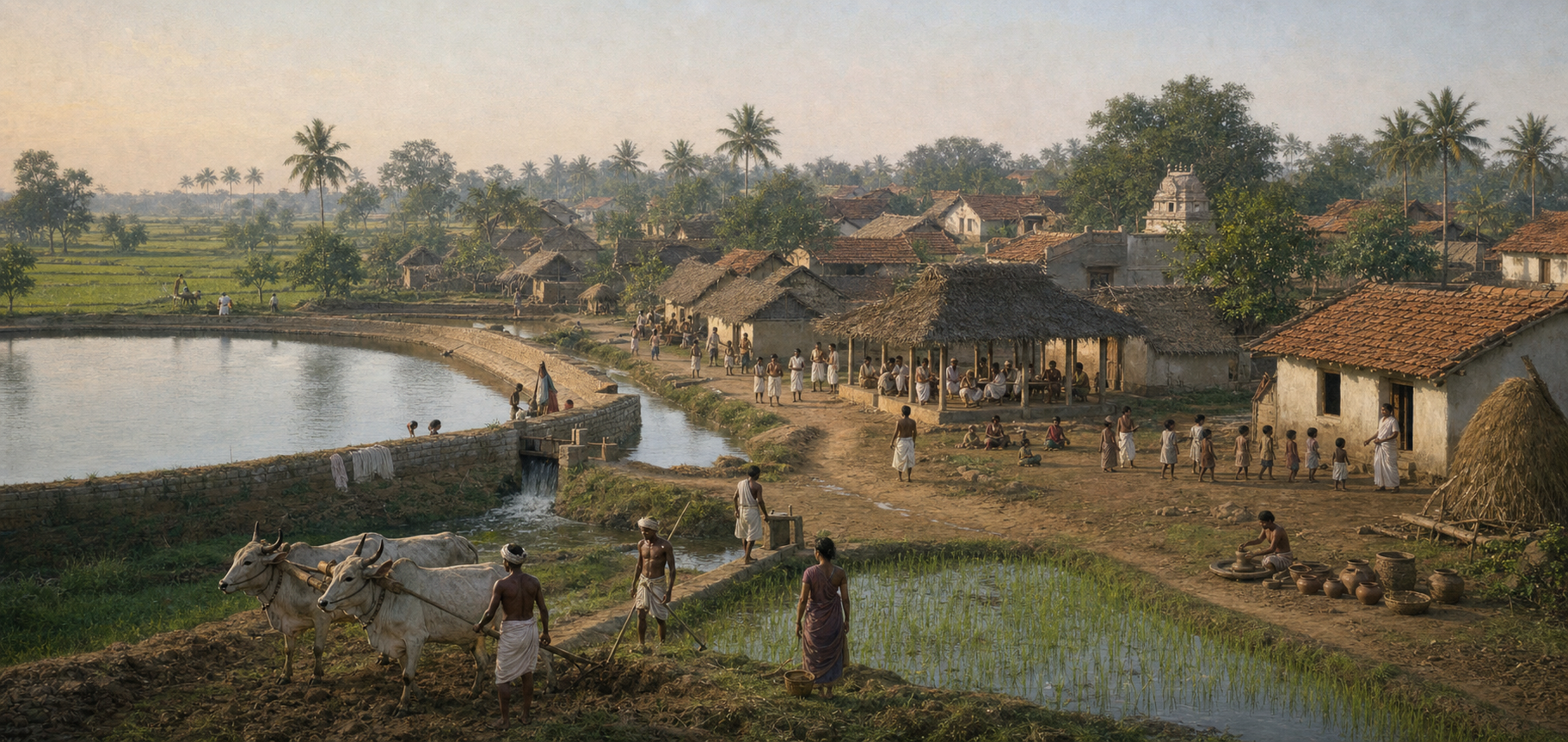
Kelambakkam gives you a concrete answer. In 1891, this South Indian settlement of about 300 people living in 50 to 60 houses had specialized officers, a tank-supported agricultural system, a multi-age school, local healers, craft households, and religious institutions with civic functions. It was not sovereign, and the surviving detail does not prove that it was democratic or socially equal. It was, however, capable of organizing much of its daily life close to the people affected by each decision.
Water made the village a governing unit
Kelambakkam stood in the Chingleput district, now Chengalpattu, between Kanchipuram and Mahabalipuram. Local tradition placed its beginnings in the 11th century, but its institutional importance does not depend on proving an ancient pedigree. The arrangement visible in 1891 is more useful: a compact residential core, a small central temple, fields within reach, and a large irrigation tank binding settlement and cultivation into one working unit.
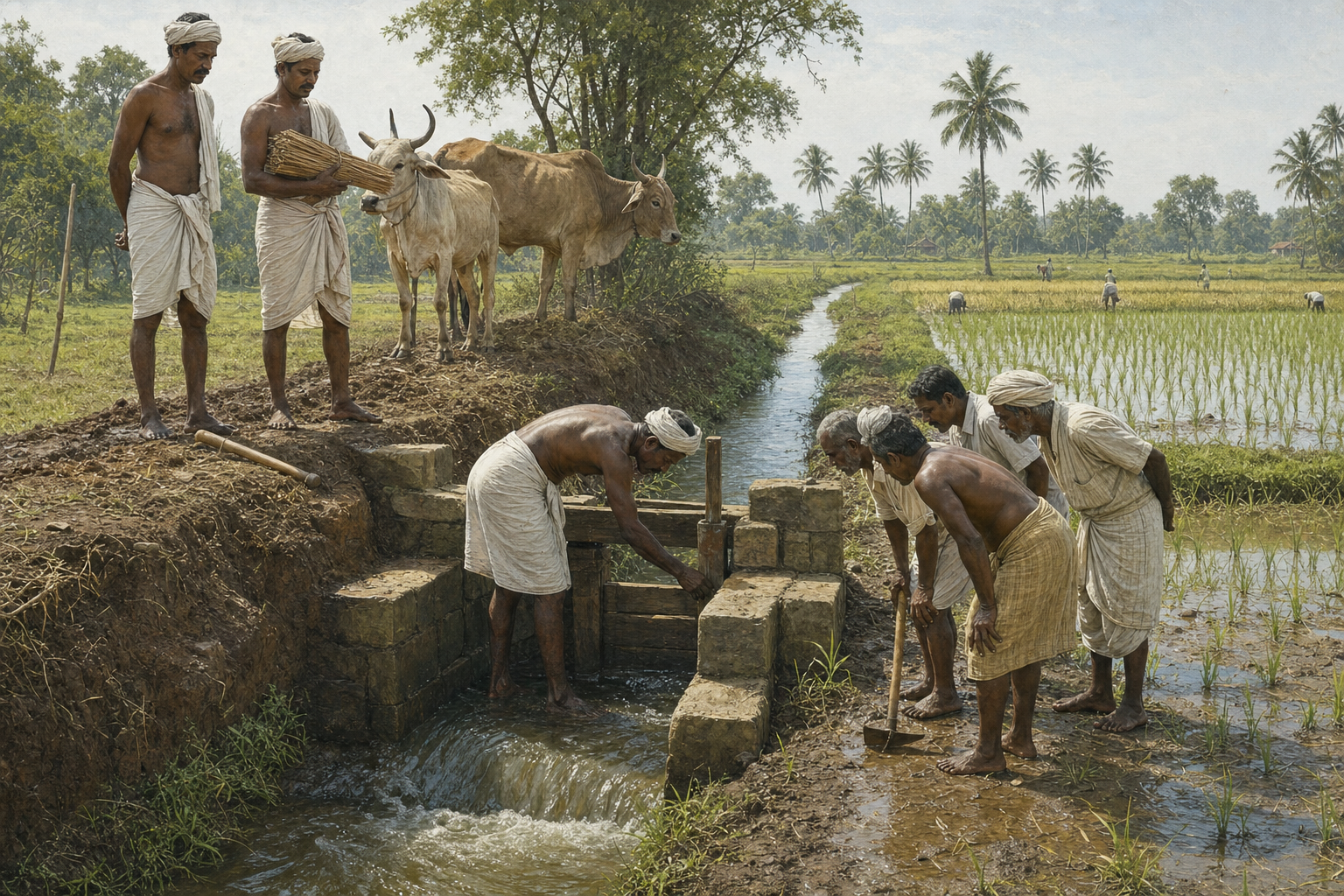
The village possessed roughly 500 acres of green fields and a tank able to water them for six months. That tank was not scenery. A Tamil eri captured monsoon water, allowed some of it to percolate into the ground, and released the stored supply through sluices according to agricultural need. Its condition affected planting, harvest expectations, drinking-water security, groundwater, and the value of nearby fields.
This is the first practical lesson in reading village self-government: follow the shared resource. A common asset creates recurring decisions. Someone must inspect it, repair it before the rains, regulate its use, respond when supply falls short, and reconcile competing claims. Communal labour and seasonal maintenance therefore belonged to the institutional core of the village, even when they did not resemble a modern government department.
When you encounter a claim that an old settlement governed itself, test it through five questions:
- What resource or service required collective management?
- Who possessed the local knowledge needed to manage it?
- Who kept the relevant records?
- Who enforced decisions or guarded the asset?
- How were maintenance and essential labour supported between crises?
Kelambakkam can answer all five. That is stronger evidence of governing capacity than either nostalgia about an ideal village or the colonial assumption that administration arrived only from above.
Self-government meant divided responsibility, not village sovereignty
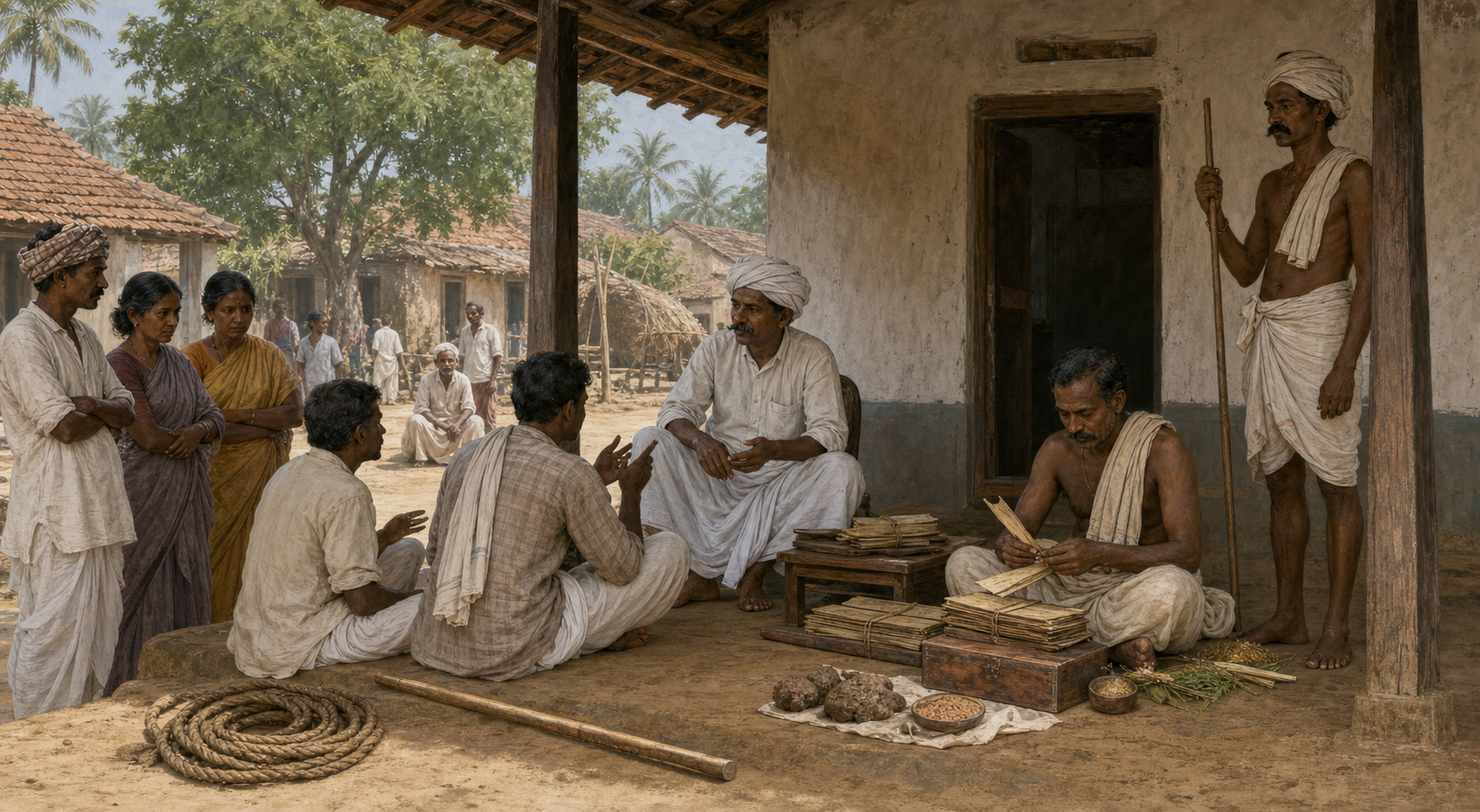
Three named offices formed the most visible administrative layer: the Munsiff, Karnam, and Taliyari. Their functions were distinct enough to create a basic division between executive authority, record-keeping, and enforcement.
| Village role | Operational work | Why it mattered |
|---|---|---|
| Munsiff | Handled petty civil and criminal matters, coordinated tax collection, and assisted higher authorities | Placed routine decisions and minor disputes within reach of villagers |
| Karnam | Knew field boundaries, holdings, rents, and the details behind monetary disagreements | Made land administration depend on identifiable records and local knowledge |
| Taliyari | Kept night watch, protected ripening crops, and deterred theft | Connected public order directly to agricultural security |
The Munsiff was generally associated with respected ancestry. That detail matters because authority rested partly on inherited standing and social trust, not merely on an impersonal appointment. The Karnam’s knowledge was equally consequential. In an agricultural society, uncertainty about a boundary, rent, or holding could become uncertainty about livelihood. A person who knew the fields and maintained their administrative memory was therefore central to order.
The Taliyari shows why security cannot be separated from the economic calendar. Crops become especially vulnerable as they ripen. Watching them at night protected months of labour at the precise moment when theft could turn a household’s expected harvest into debt or hunger. Local policing was thus timed to a local risk rather than organized as a generic, distant service.
Yet Kelambakkam was not an independent republic. The Munsiff’s involvement in taxation and his obligation to assist higher officials connected the village to a larger state. Nor should you assume that the existence of local offices proves elections, universal participation, equal political voice, or adequate checks on powerful families. The available detail establishes responsibilities; it does not establish who could challenge an officer, how an appeal worked, or how landless households and women participated in formal decisions.
The accurate description is bounded self-government. Routine knowledge, implementation, security, and dispute handling were localized, while revenue and higher authority extended beyond the village. That distinction lets you recognize indigenous institutional capacity without turning it into a claim the evidence cannot carry.
Education, care, and craft labour kept administration alive
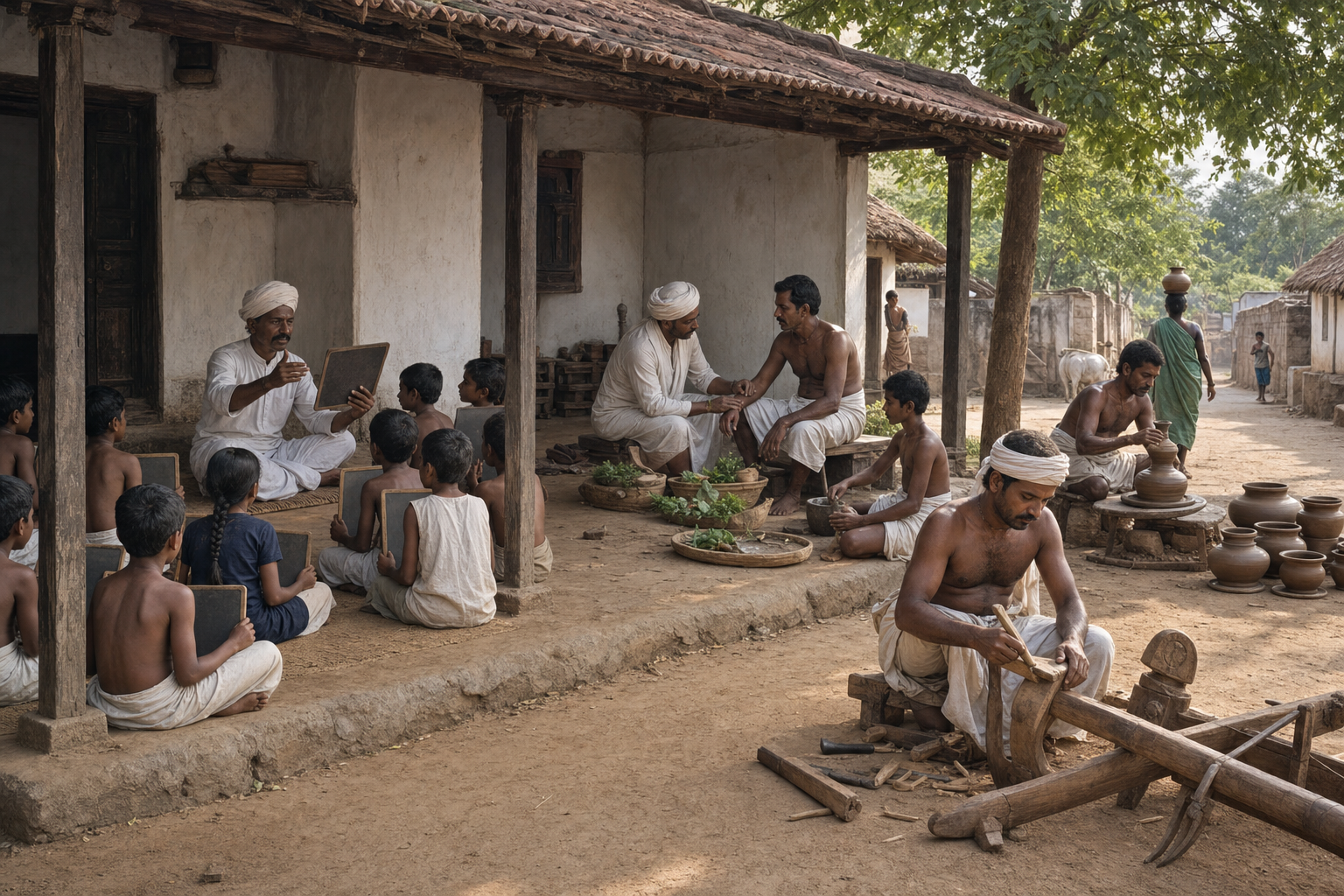
A village does not govern itself merely because it has officers. It must also reproduce knowledge, maintain health, support families through birth and illness, and retain the skills needed to repair tools and infrastructure. Kelambakkam distributed those tasks among people whose work reached far beyond a narrow occupational label.
The Vadyar, or schoolmaster, began teaching before sunrise and continued through structured intervals. Young children formed letters on sanded floors. Older pupils moved to cadjan, or palm-leaf, writing and reading. The classroom combined ages and levels: one group could voice the alphabet while another copied text, performed arithmetic aloud, or recited metrical verses.
The curriculum was practical as well as ethical. Pupils learned literacy, compound arithmetic rules, and simple interest. Prayer to Saraswati and Vighneswara opened and closed the school day, while poetical maxims taught truthfulness, devotion, and respect for parents and elders. Competence, rather than an age-based grade, marked completion. Clear reading and writing on palm leaf, together with accurate arithmetic, were generally expected after four or five years.
The Vadyar also visited homes to see whether children took medicine, ate at the proper time, and behaved responsibly. You should therefore resist forcing this school into a modern binary. It was neither simply a secular literacy centre nor merely a place of religious recitation. It joined commercial numeracy, textual learning, moral formation, and student welfare because village life required all four.
Care was similarly distributed. The Vythian used the Tamil verse text known as the Vagadam when selecting remedies and diets. Religious observances could accompany treatment, providing reassurance and communal support as well as a sacred interpretation of illness. This demonstrates an organized local ecology of care; it does not establish the clinical effectiveness of every historical remedy by modern standards.
Kailasam, the Ambattan, combined the work of barber, practical surgeon, and musician. His flutes and drums were needed for temple festivals and household ceremonies. His wife Thoyamma served as a midwife, bathing mothers and infants, offering simple remedies, and watching their recovery. Their household connected bodily care, ceremonial continuity, and social communication in ways that a modern occupational category would conceal.
Carpenters, blacksmiths, shepherds, washermen, potters, barbers, and other service providers completed the network. Many received shares of grain or the use of rent-free service land. Such compensation was well suited to a seasonal agrarian economy in which cash income could be irregular. It helped retain necessary skills, spread some agricultural risk, and sustain work on tanks, paths, tools, and temple property.
Do not confuse interdependence with equality. Courtesy toward service communities and the economic importance of their labour do not by themselves reveal their political power or freedom of occupation. What can be said firmly is that Kelambakkam’s continuity depended on many kinds of specialized knowledge. A history concerned only with the headman would miss most of the people who made local government workable.
The temple joined sacred duty to civic continuity
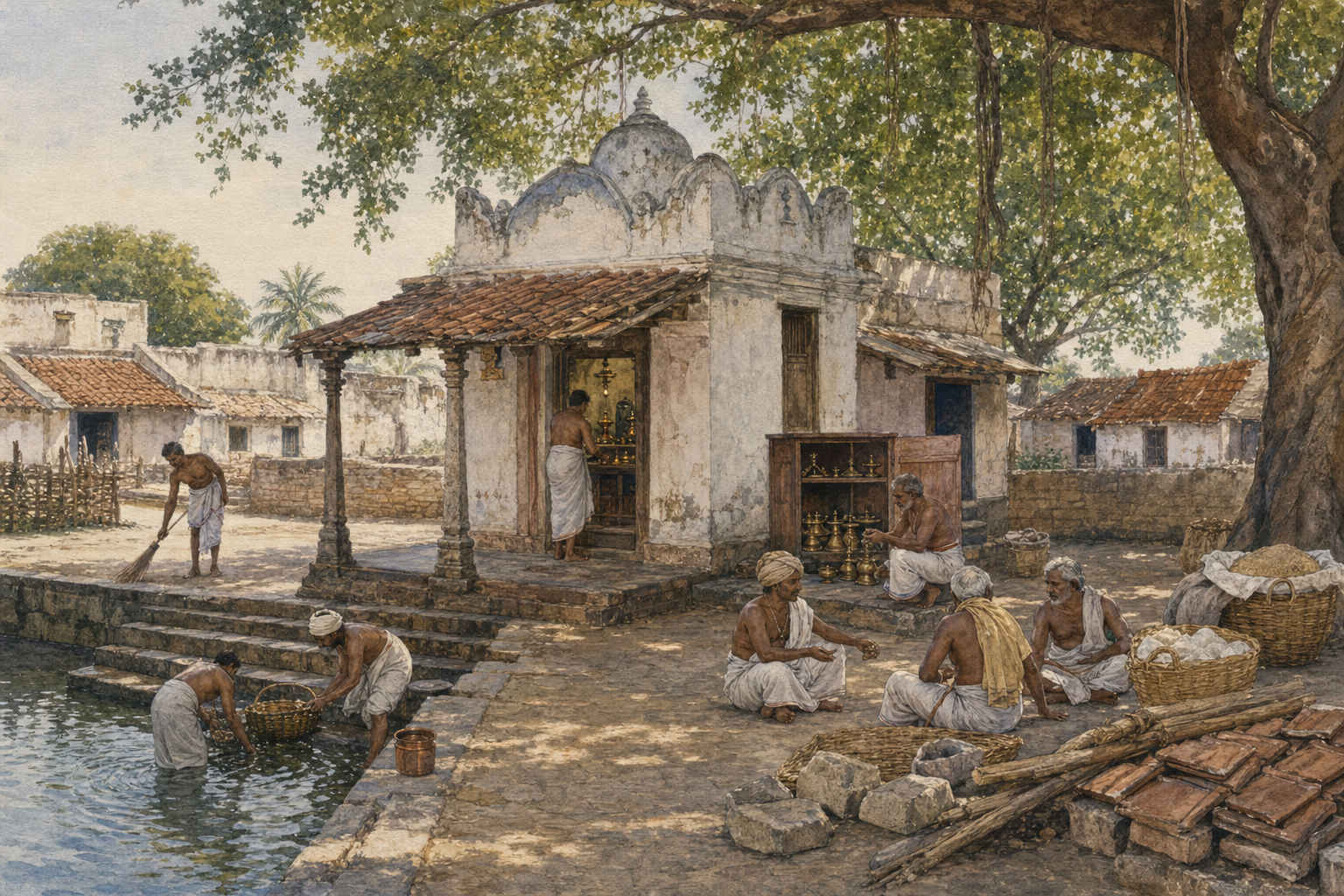
The temple stood near the physical centre of Kelambakkam, but its importance was not limited to location. The Purohita brought knowledge of Sanskrit, astrology, and the four thousand stanzas of the Divya Prabandham into household and village counsel. Two other Brahmins conducted temple worship in orderly turns. Ritual responsibility therefore had a schedule and a division of labour, just as irrigation and security did.
The Grama Devata, the village Goddess, occupied another point where spiritual and public concerns met. Her worship was associated with protection against epidemic disease. A Pujari conducted the rites and sometimes acted as an oracle. Contributions made during festivals and the fulfilment of vows also supported communal needs. The sacred institution could thus mobilize money, participation, trust, and shared attention during moments of collective concern.
This does not mean that the temple was the entire government. The Munsiff handled disputes and revenue, the Karnam maintained land knowledge, the Taliyari guarded property, and occupational households supplied education, care, music, tools, and repairs. The temple instead provided moral language, ritual coordination, and a durable centre of belonging alongside those functions.
A Dharmic reading should preserve that distinction without imposing an artificial wall between sacred and civic life. Hindu, Buddhist, Jain, and Sikh communities have not shared one administrative template. They do share a civilizational concern with disciplined duty, learning, care, restraint, and service. Kelambakkam’s particular institutions were Hindu and Tamil; the broader insight is that a community becomes resilient when obligations are embodied in regular practices rather than left as abstract ideals.
Key takeaways for reading Kelambakkam without romanticizing it
- Begin with the tank. Its maintenance, storage, and release connected ecology to authority. Shared water made coordination a necessity rather than a philosophical preference.
- Use a functional definition of self-government. Kelambakkam localized records, minor adjudication, crop protection, education, care, and essential services even though it remained connected to higher revenue authority.
- Do not equate local rule with modern democracy. Named offices and community duties demonstrate administrative capacity, but they do not prove elections, universal representation, equality, or reliable safeguards against abuse.
- Count the people outside formal office. The teacher, physician, midwife, barber-surgeon, musicians, artisans, and agricultural service households were part of the village’s governing capacity because daily order depended on their knowledge.
- Read the temple precisely. It was a ritual centre, advisory institution, source of social legitimacy, and means of mobilizing contributions. It complemented rather than replaced administrative offices.
- Treat Kelambakkam as a case, not a national average. One closely described village can disprove the claim that rural Bharat lacked organized institutions. It cannot prove that every Indian village was equally capable, harmonious, or inclusive.
The most useful legacy of Kelambakkam is not a demand to reconstruct every arrangement of 1891. It is a method for judging local government now. Choose one shared asset in your own locality, such as a pond, temple property, school, grazing ground, or common path. Identify who keeps its records, who maintains it, who decides between competing uses, who enforces the decision, and where an aggrieved person can appeal. If those responsibilities cannot be named, decentralization exists largely on paper. If they are clear, answerable, and close to the people affected, the old village principle is still doing practical work.
References
