
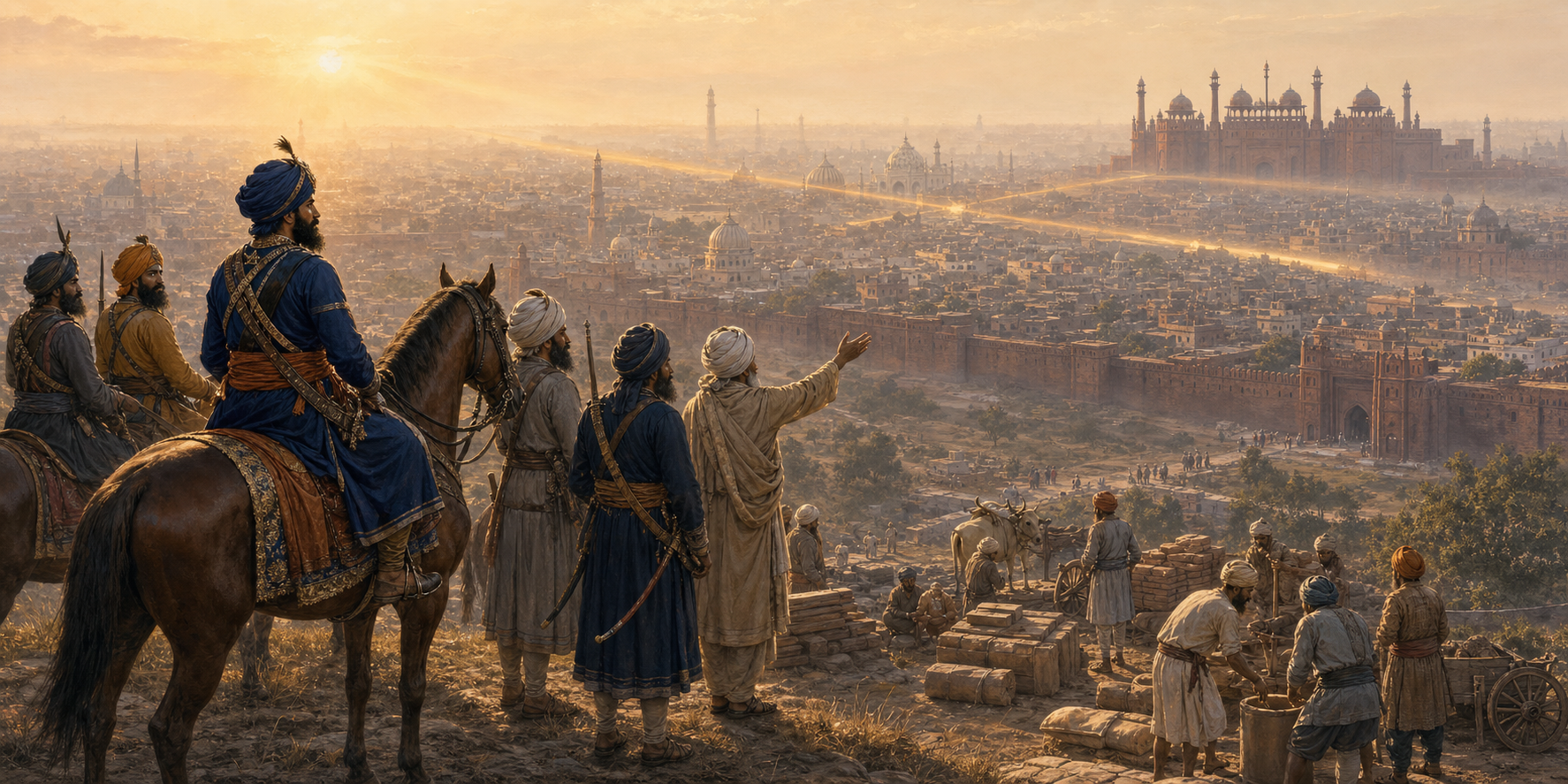
You may know Bangla Sahib, Sees Ganj Sahib or Rakab Ganj Sahib as separate destinations. Visit them that way, however, and you can miss the larger achievement. They belong to a connected Sikh geography of Delhi: a network of places recalling martyrdom, compassion, cremation, hospitality, community leadership and encounters with political power.
If you are preparing for a visit, teaching this history or trying to understand why Baghel Singh matters, do not begin by counting buildings. Ask what he chose to preserve after Sikh forces entered Delhi in 1783. That question turns a collection of shrines into a readable map of dharma.
Delhi was held briefly, but its Sikh memory was secured
By the late eighteenth century, Mughal authority was weakening under pressure from several regional powers. Delhi remained an imperial capital and a center of trade, but its court could no longer command North India as it once had. Sikh misls moving eastward from Punjab were therefore entering a contested political field, not an orderly empire with undisputed control.
In March 1783, confederated Sikh forces entered Delhi and briefly demonstrated that the balance of power had changed. Sardar Baghel Singh, associated with the Karor Singhia misl and the politics of the Dal Khalsa, recognized that possession of the capital would be temporary. A monument, institution or protected place of memory could endure long after an army withdrew.
His decisive act was therefore administrative as well as military. An agreement with Mughal emperor Shah Alam II recognized the Sikh claim to commemorate sites connected with the Gurus. It also allowed a defined Sikh guard to remain in Delhi while the work proceeded. Funding came from an agreed portion of the city’s octroi, or chungi, commonly described as six annas in the rupee, approximately 37.5 percent.
That arrangement joined four things that heritage work needs: recognized authority, security, revenue and people responsible for execution. Construction and development proceeded over the following months, with work extending into 1784 where necessary. When you hear that Baghel Singh conquered Delhi, therefore, look beyond the moment of entry. His greater success was converting military leverage into protected public memory.
Read the shrines as an ethical sequence, not isolated monuments
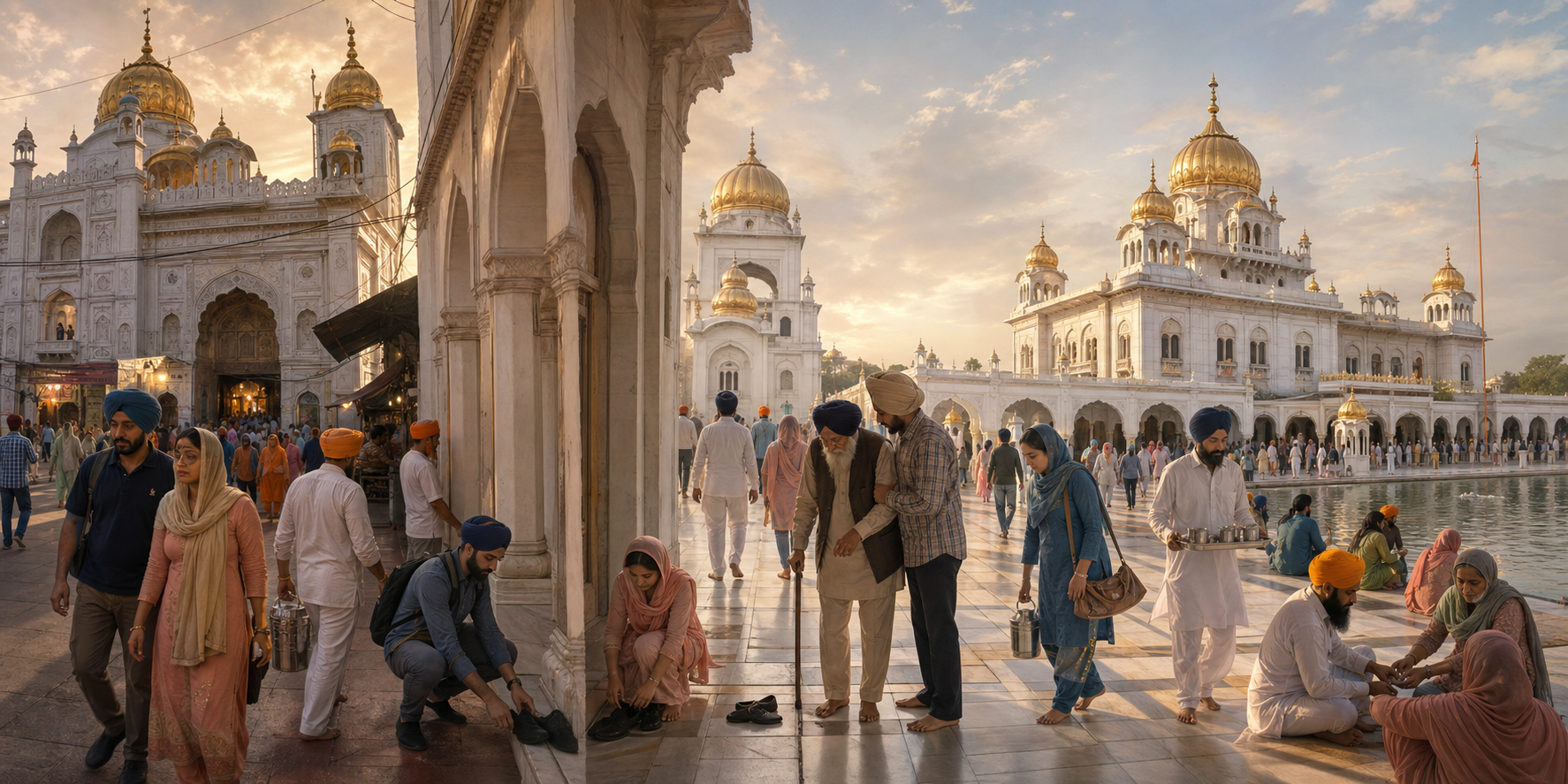
The safest historical claim is not that every wall or structure visible now has remained unchanged since 1783. It is that Baghel Singh’s initiative identified, marked and developed a connected group of places preserved in Sikh memory. At each gurdwara, distinguish among the event associated with the location, the institutional commemoration established under his program and the building you encounter now. That simple distinction keeps the history precise without diminishing the sanctity of the place.
Sees Ganj and Rakab Ganj: conscience and the duty to respond
Gurdwara Sees Ganj Sahib in Chandni Chowk marks the place associated with the beheading of Guru Tegh Bahadur in 1675. Sikh remembrance understands his martyrdom as a defense of freedom of conscience: spiritual conviction was not to be surrendered merely because imperial power demanded conformity.
Gurdwara Rakab Ganj Sahib, near today’s Parliament, recalls the place where Lakhi Shah Vanjara and his companions performed the Guru’s cremation. The two sites should be read together. Sees Ganj confronts you with the cost borne by the person who refuses injustice. Rakab Ganj asks what courage is required from the community after that sacrifice.
Pause at both with one question: what does freedom of conscience demand from someone who is not the immediate target of oppression? That is the bridge between the seventeenth-century event and public life now.
Bangla Sahib, Bala Sahib and Mata Sundri: compassion becomes continuity
Gurdwara Bangla Sahib commemorates Guru Har Krishan’s service during an epidemic and his final days in Delhi. It gives the sacred map a different center of gravity. Authority appears here not as command but as proximity to people who are suffering.
Gurdwara Bala Sahib is associated with Guru Har Krishan’s cremation rites and also carries memories of Mata Sundri and Mata Sahib Kaur. Gurdwara Mata Sundri, in turn, honors Mata Sundri’s guidance of the community in the period after Guru Gobind Singh. These places prevent the map from becoming a sequence concerned only with battles, emperors and martyrdom. They direct your attention to care, mourning and the work of sustaining a panth across generations.
Nanak Piao and Majnu ka Tilla: hospitality creates sacred space
Gurdwara Nanak Piao recalls Guru Nanak’s well and langar. Water and food are not decorative additions to its memory; they reveal how sacred presence becomes socially legible. A stranger does not need status before receiving welcome.
Gurdwara Majnu ka Tilla, associated with early Sikh encounters along the Yamuna, adds encounter and spiritual conversation to this geography. Read beside Nanak Piao, it shows that a sacred city is formed not only where someone suffers or rules, but also where people meet, listen and share what sustains life.
Damdama Sahib and Moti Bagh: spiritual authority faces political power
Gurdwara Damdama Sahib marks Guru Gobind Singh’s historic audience with the Mughal court, while Gurdwara Moti Bagh commemorates his presence near Delhi’s royal axis. These nodes are important because not every sacred association in the city is a story of victimhood. Some preserve presence, negotiation and the refusal to let imperial authority define the limits of spiritual authority.
When visiting them, notice the relationship between location and power. Baghel Singh’s program placed Sikh memory within the capital’s political landscape rather than at a safe symbolic distance from it.
Plan a pilgrimage that gives each place a question
Delhi’s Sikh geography is too dispersed and too layered to treat as a race through a checklist. A more useful visit has a theme, a manageable circuit and a repeated method of attention.
- Choose your lens before leaving. Use freedom of conscience, seva or the relationship between spiritual and political authority. One lens will help you notice connections that nine unrelated stops will not.
- Use a three-shrine core if your time is limited. Sees Ganj, Rakab Ganj and Bangla Sahib form a strong interpretive sequence: martyrdom, the community’s response and compassionate service. This is a thematic order, not a claim that it is the shortest route through present-day traffic.
- Add sites by meaning. Mata Sundri and Bala Sahib deepen the theme of continuity; Nanak Piao and Majnu ka Tilla develop hospitality and encounter; Damdama Sahib and Moti Bagh focus attention on the Guru’s relationship with courtly power.
- Ask the same three questions at every stop. What event does this location remember? What virtue does the memory demand? What living institution carries that virtue into the present? Record one sentence for each answer.
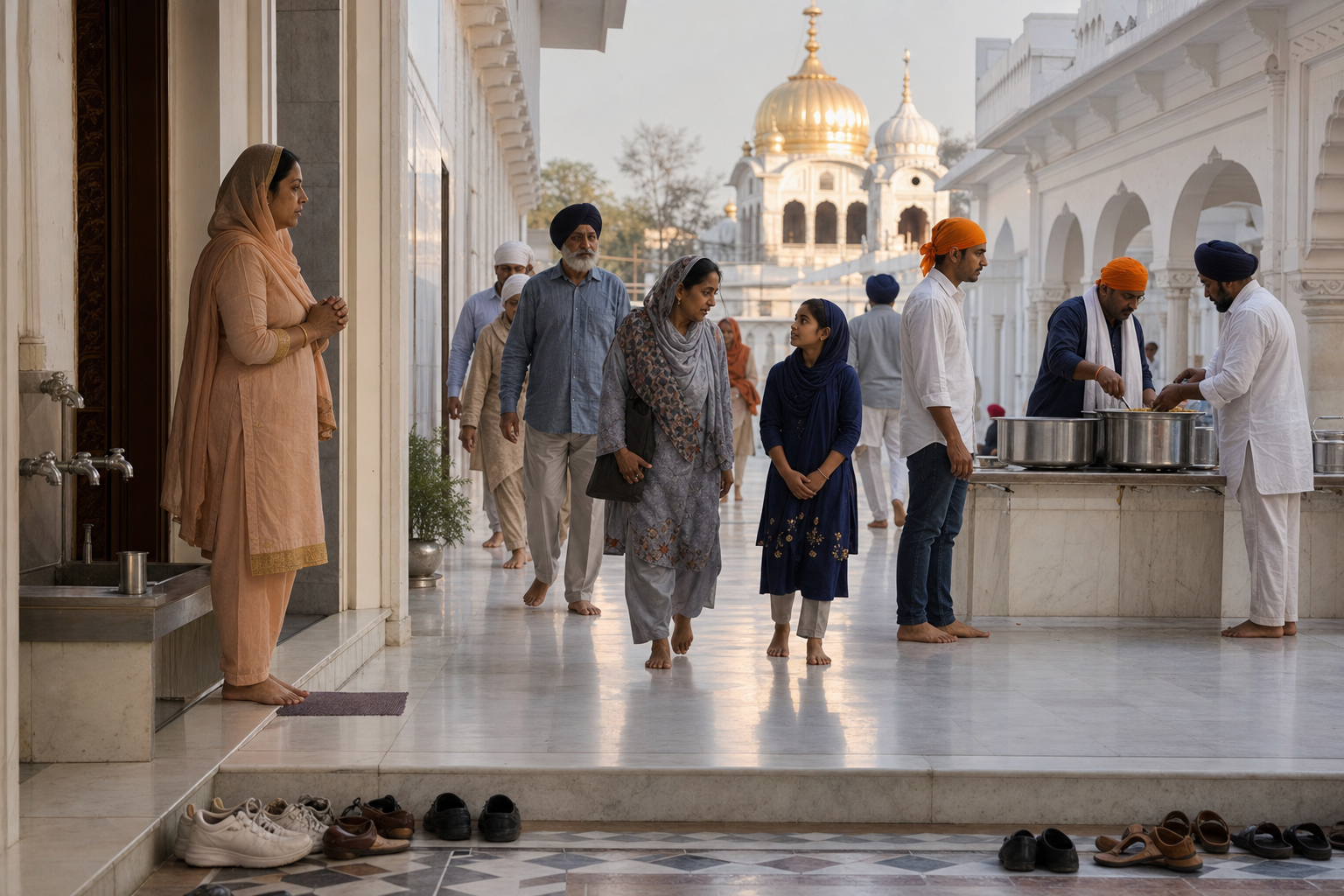
- Participate respectfully rather than merely observing. Cover your head, remove footwear, wash your hands and follow local directions concerning prayer, photography and langar. If you eat in the langar, accept only what you can finish and sit where the sevadars direct you.
Check current opening arrangements and transport conditions before setting out; those can change even when the historical meaning does not. If you are taking children or students, give each person one site to explain in terms of an event, a value and a form of service. That assignment turns passive sightseeing into memory they can retell.
Baghel Singh’s model shows how heritage survives power
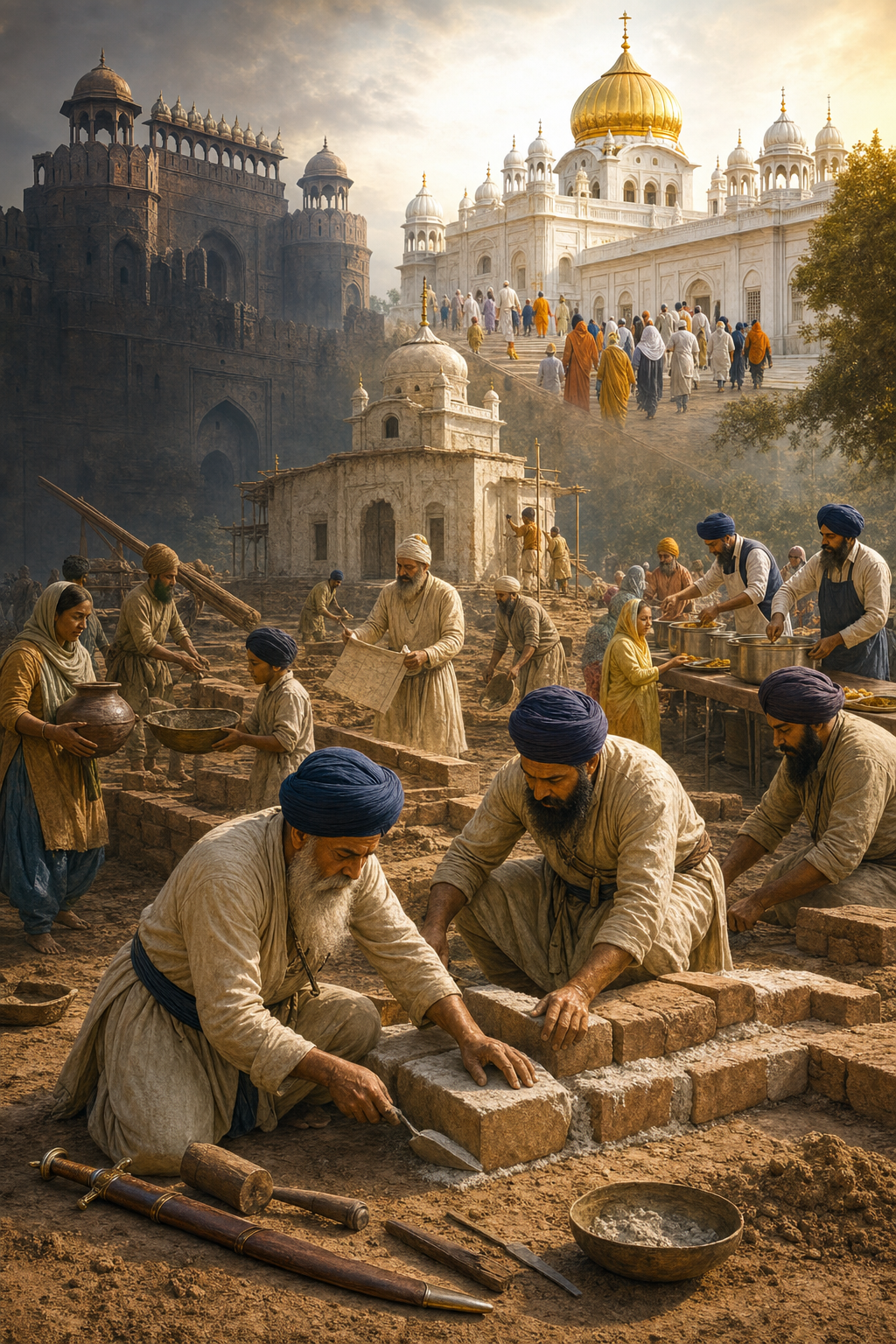
Baghel Singh’s achievement can be read as a practical heritage model. Its parts are concrete:
- Locate memory. Identify places through durable community remembrance rather than allowing politically inconvenient events to disappear from the city.
- Obtain recognition. Translate a moral claim into an arrangement that governing authority must acknowledge.
- Protect the work. Assign people who can secure builders, property and the process of commemoration.
- Fund continuity. Use a predictable revenue stream rather than depending only on a burst of enthusiasm after victory.
- Make the institution useful. Join remembrance to langar, water, rest and other forms of service so that heritage remains part of daily life.
This is why the octroi agreement matters as much as the dramatic entry into Delhi. A city does not remember through sentiment alone. Someone must identify a place, establish responsibility, protect it, pay for its development and give people a reason to keep returning.
In dharmic language, the model joins Kshatra Dharma with seva and lokasangraha. Courage guards what is worthy; service directs that strength toward others; lokasangraha holds society together. The Sikh ideal of sarbat da bhala, the welfare of all, supplies the measure of success. Power is not vindicated merely because it wins. Its moral quality becomes visible in what it protects and whom its institutions serve.
The gurdwara’s openness across caste and community makes this more than a policy formula. Langar embodies equality through an ordinary, repeated act: people receive nourishment together without first proving rank. For Hindu, Sikh, Jain and Buddhist readers concerned with the shared civilizational life of Bharat, this is practical pluralism. Difference is not erased, but the dignity of the person arriving at the door is not negotiable.
Key takeaways
- Baghel Singh’s enduring achievement in Delhi was not temporary military control but a protected network of Sikh memory.
- The 1783 agreement combined imperial recognition, a Sikh guard and a share of octroi revenue, allowing commemoration to become organized work.
- Sees Ganj and Rakab Ganj should be read together as places of martyrdom and courageous community response.
- Bangla Sahib, Nanak Piao and the other nodes show that seva, hospitality and continuity are as central to the map as confrontation with power.
- The sites are traditionally connected with Baghel Singh’s program, but the sacred association, the institutional foundation and the present structure should not be treated as the same historical layer.
- A meaningful visit uses one ethical question across several shrines instead of measuring success by the number of stops completed.
Before you begin your circuit, write down one question: what should strength protect after the moment of victory has passed? Carry it through Sees Ganj, Rakab Ganj and Bangla Sahib, then answer it only after you have sat with the memory and, where possible, shared in the langar. You will leave with more than a list of Delhi landmarks; you will understand the civic discipline behind their survival.
References
- SikhNet Videos — Sardar Baghel Singh: The Visionary Who Etched Sikh Heritage on Delhi’s Sacred Map (1783)
- SikhNet News — Sardar Baghel Singh: The Visionary Who Etched Sikh Heritage on Delhi’s Sacred Map (1783)
