
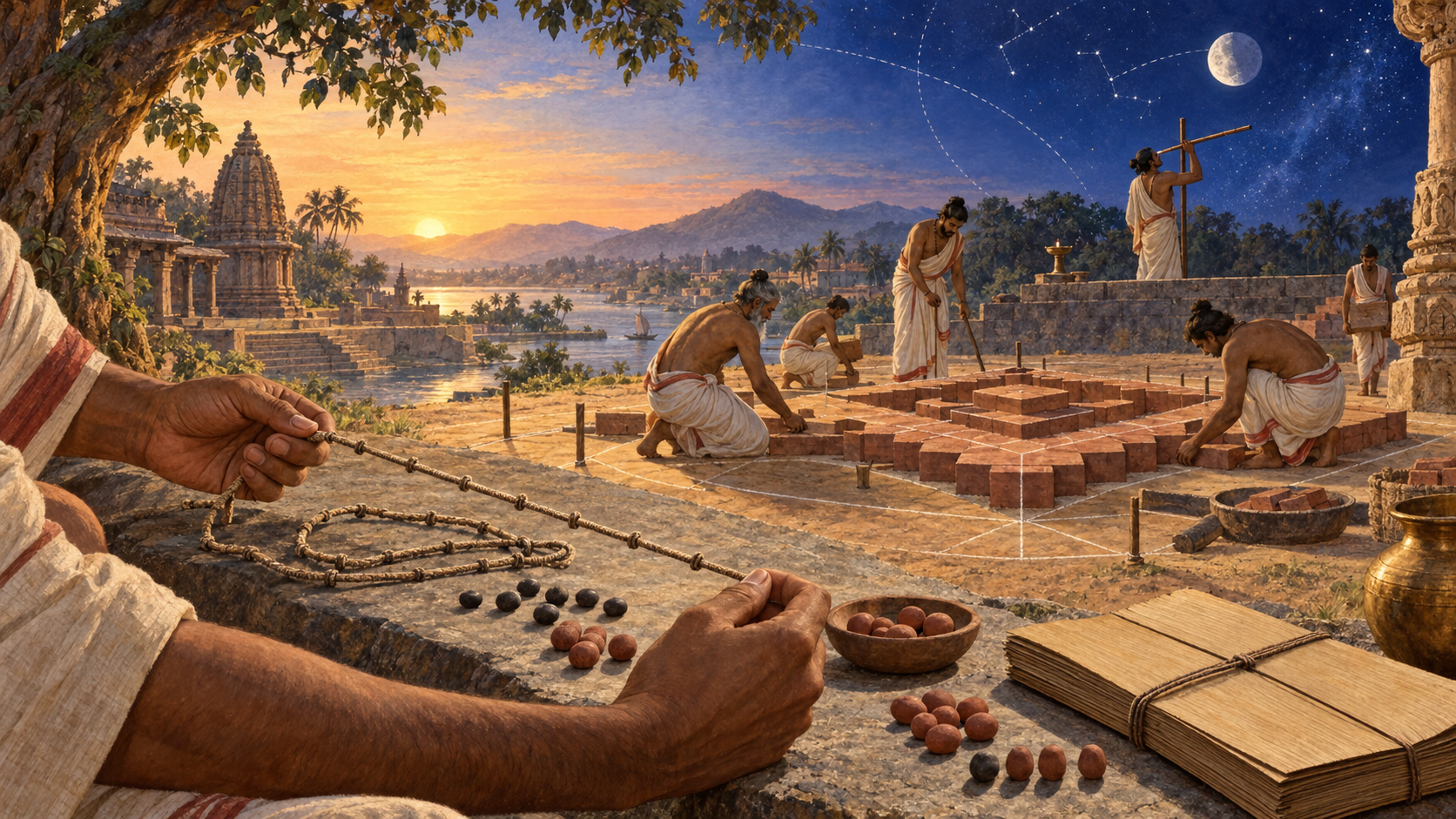
If you arrived asking whether ancient Bharat invented mathematics, a simple yes or no will mislead you. Mathematics has no single, demonstrable moment of birth. Bharat’s achievement is more substantial than a slogan: a long tradition connecting numerical language, ritual construction, geometry, astronomy, arithmetic, algebra, and trigonometry.
You can understand that tradition without either diminishing it or claiming more than the evidence can carry. Keep three things separate as you read: what an artifact permits us to infer, what a text explicitly teaches, and what a named mathematician turns into a repeatable procedure.
Begin with the kind of evidence you actually have
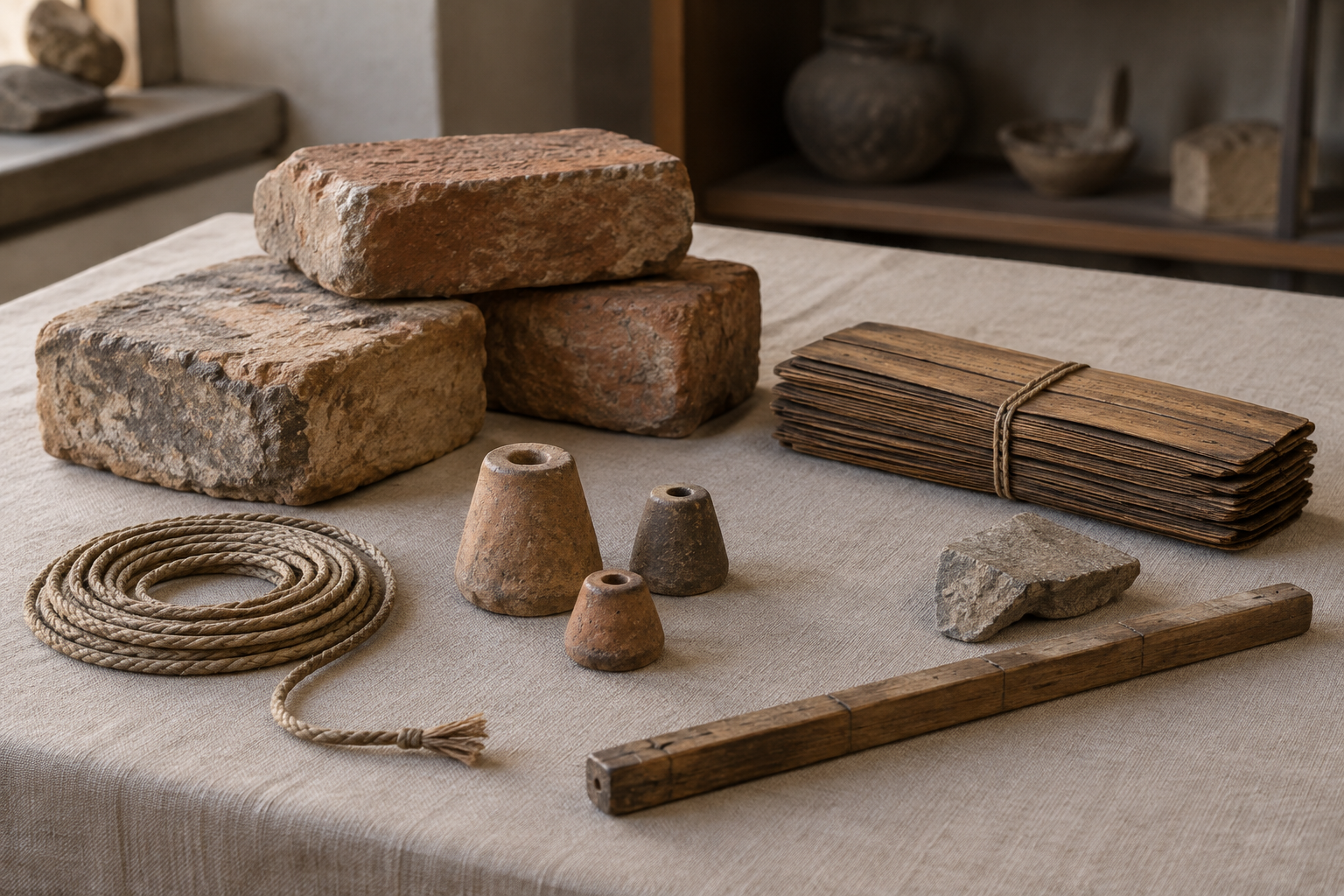
The Indus Valley civilization is often placed at the beginning of Bharat’s mathematical story. Its material remains permit reasonable inferences about measurement, proportion, and planned construction. But the Indus script remains undeciphered, so those remains cannot yet give us readable equations, named theorems, or instructions in the inhabitants’ own words.
That limit cuts both ways. The absence of readable mathematical writing is not evidence that mathematical practice was absent. At the same time, a carefully made artifact is not by itself proof that its makers possessed a particular formal theorem. The responsible claim is that the material culture points to mathematical practice while leaving its precise intellectual form unresolved.
Apply the same test whenever you encounter a claim about priority. Ask whether it rests on an excavated object, an explicit rule in a datable text, or a later attribution. Then state only what that level of evidence can establish. A disciplined case for Bharat’s mathematical heritage is stronger than a maximal claim that can be overturned by one missing qualification.
Vedic mathematics joined number to ritual construction
The Vedic layer becomes clearer when you ask what people needed numbers to do. Numerical vocabulary in the Yajurveda includes names for quantities reaching from arbuda, or 10,000,000, through narbuda and samudra to parardha, given as 1,000,000,000,000. These terms show that very large quantities were conceptually available. They should not, by themselves, be treated as proof of every later feature of decimal notation.
Patterns also appear in forms a modern student can recognize. The sequence 1, 3, 5, and onward to 99 occurs in connection with the Taittiriya Samhita and has the structure of an arithmetic progression. The sequence 24, 48, 96, 192, continuing by doubling to 393,216, occurs in connection with the Panchavimsha Brahmana and has the structure of a geometric progression. The important thing to notice is not merely that large numbers were recited. Ordered numerical change itself had become an object of attention.
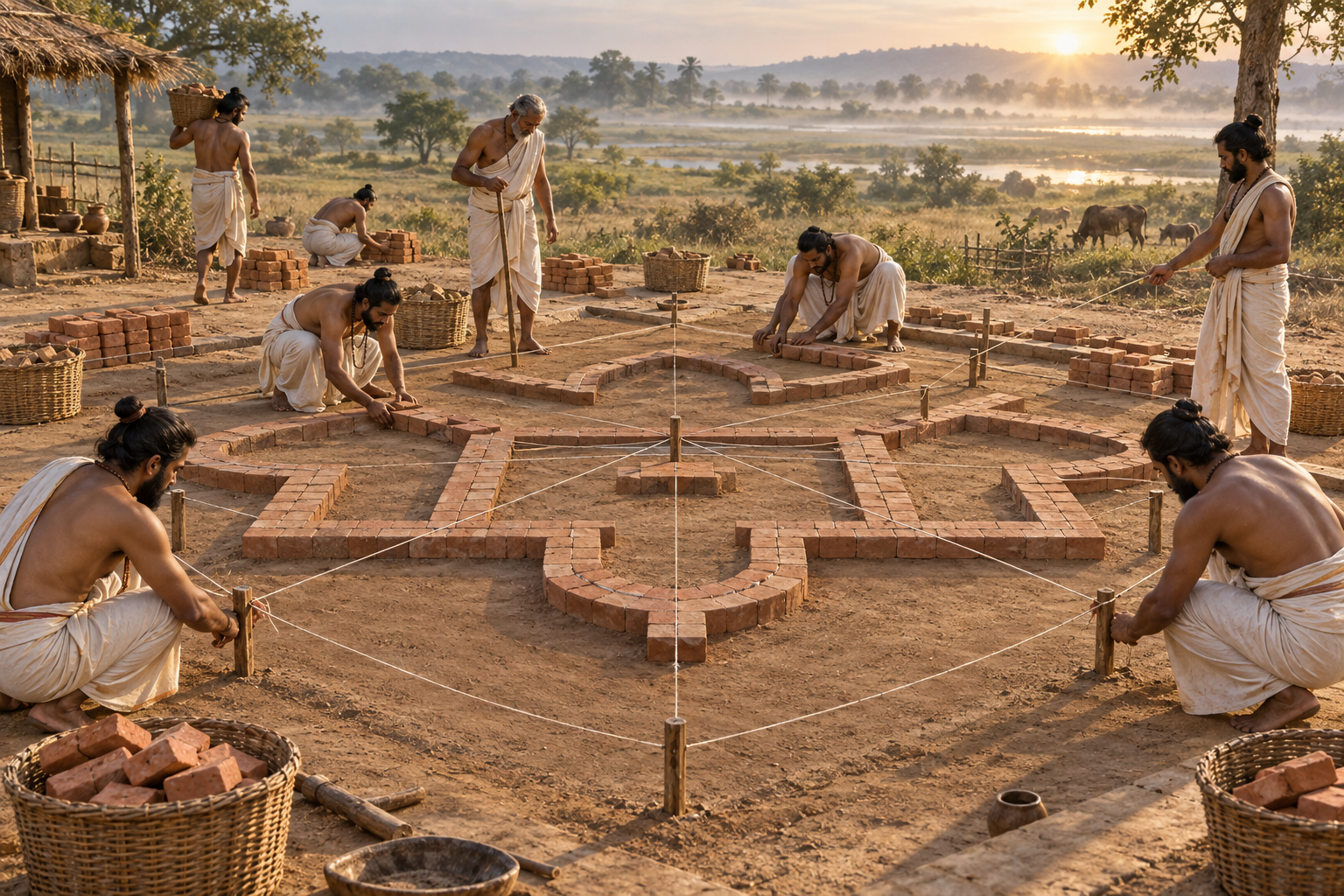
Ritual construction made geometry practical. The Mahavedi used in Vedic sacrifice had the form of an isosceles trapezium, creating concrete questions about sides, height, and area. The Shulba Sutras developed this constructive setting further. Shulba refers to a rope, an appropriate name for rules concerned with laying out measured forms.
The principal Shulba traditions include Baudhayana, Apastamba, Manava, and Katyayana, among others, and are generally placed between about 800 and 200 BCE. Within them are rules for geometrical figures, conversions between equal-area shapes, relations comparable to the Pythagorean theorem and its triples, and a notably accurate treatment of √2. These are not decorative observations. An altar builder who must change a square into another form without changing its area has an exact operational problem to solve.
This setting matters. You do not have to remove mathematics from ritual life to make it intellectually respectable. In this part of Bharat’s history, ritual requirements generated problems of measurement, transformation, and precision. Read the constructions first as procedures: identify the starting shape, the required shape, the quantity that must remain unchanged, and the sequence of operations used to get there.
Classical mathematicians turned problems into algorithms
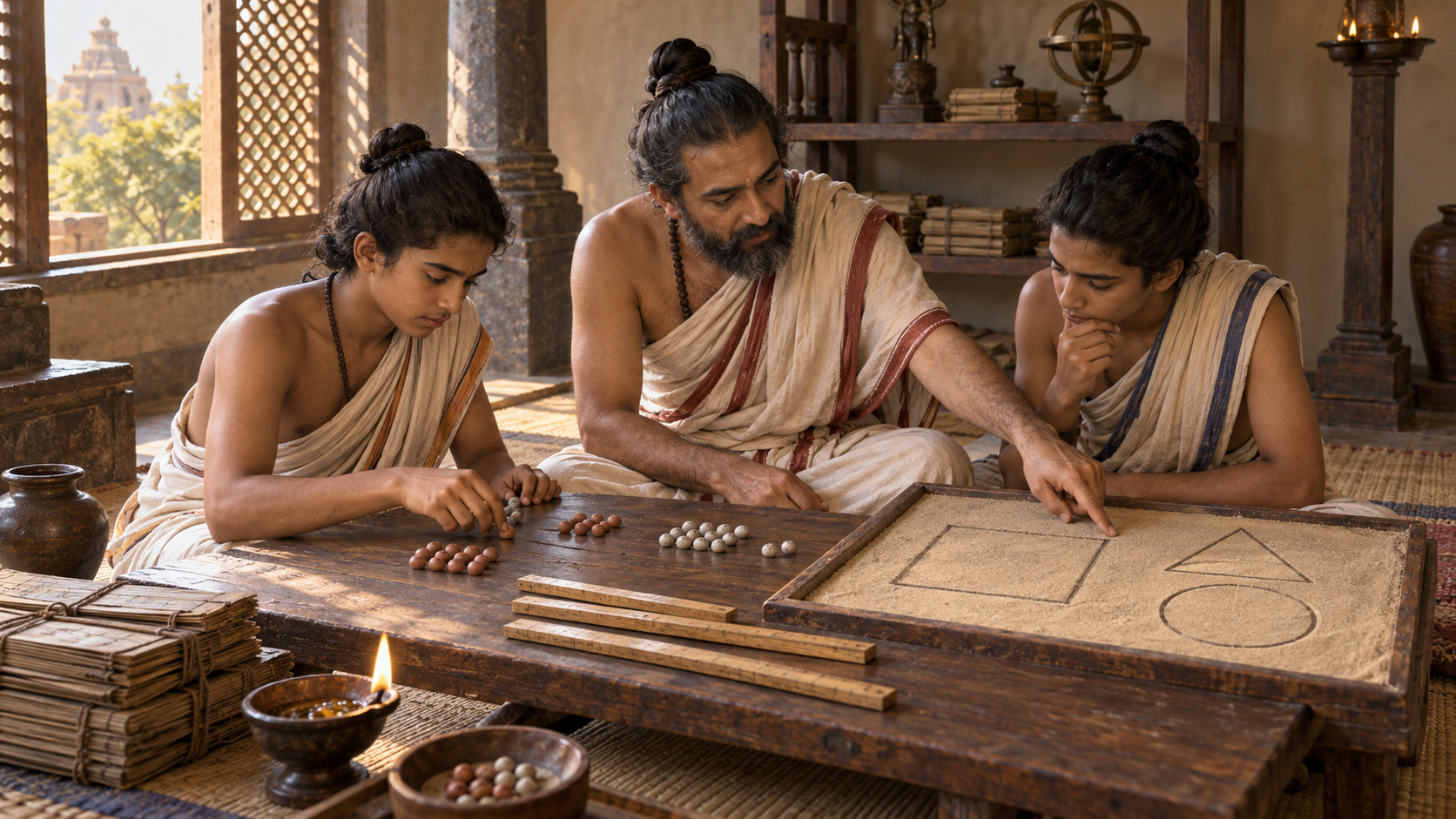
With the classical mathematicians, the evidence changes character. We encounter named thinkers, named works, and procedures addressing recognizable mathematical classes. The most useful way to study them is not as a ceremonial list of great names, but as a map from each thinker to a particular kind of problem.
| Mathematician and period | Mathematical focus | What you should notice |
|---|---|---|
| Aryabhata, 476-530 CE | Aryabhatiya: a value of π, a method for square roots, quadratic equations, and first-degree indeterminate equations | Separate the numerical result from the procedure used to obtain it. |
| Varahamihira, first half of the sixth century | Panchasiddhantika: values of sin 30° and sin 60°, within a wider trigonometric tradition | Look at trigonometry as a computational practice, not merely a list of modern identities. |
| Brahmagupta, 588-660 CE | Area of a cyclic quadrilateral and volume of a pyramid’s frustum | Check the condition attached to a formula: a cyclic quadrilateral is not an arbitrary quadrilateral. |
| Mahavira, ninth century | Ganit Sara Sangraha: a method for finding the least common multiple of two numbers | An algorithm matters because it can be repeated on new inputs. |
| Sridhara, first half of the eleventh century | Trisatika, Patiganita, and Bijaganita; quadratic methods and geometrical interpretations of algebra | Modern notation may express an old procedure without reproducing its original presentation. |
| Bhaskaracharya, twelfth century | Siddhanta Shiromani; its Lilavati and Bijaganita sections address arithmetic and algebra, including rules for signs | Follow how operations with positive and negative quantities become systematic. |
Sridhara provides a useful warning about historical translation. The general quadratic solution familiar to students is written today as x = (-b ± √(b² – 4ac)) / 2a and is associated in this tradition with his work on quadratic equations. That compact symbolism is a modern presentation of the mathematical relationship; it should not be mistaken for the exact typography in which an eleventh-century scholar expressed the procedure.
Bhaskaracharya’s treatment of signs offers another bridge to the classroom: multiplying two negative quantities gives a positive result, while multiplying a negative and a positive gives a negative result. The rule feels elementary now because it has become part of ordinary education. Historically, making such operations explicit helped turn algebra into a system that could be taught and reused.
If you want more than name recognition, choose one row from the table and reconstruct its problem. For Brahmagupta, begin by identifying why the word cyclic limits the quadrilateral under discussion. For Mahavira, work through the purpose of an LCM algorithm. For Aryabhata, distinguish calculating a square root from merely recording one. This approach lets you see mathematical thought in action.
Zero mattered because it worked inside place value
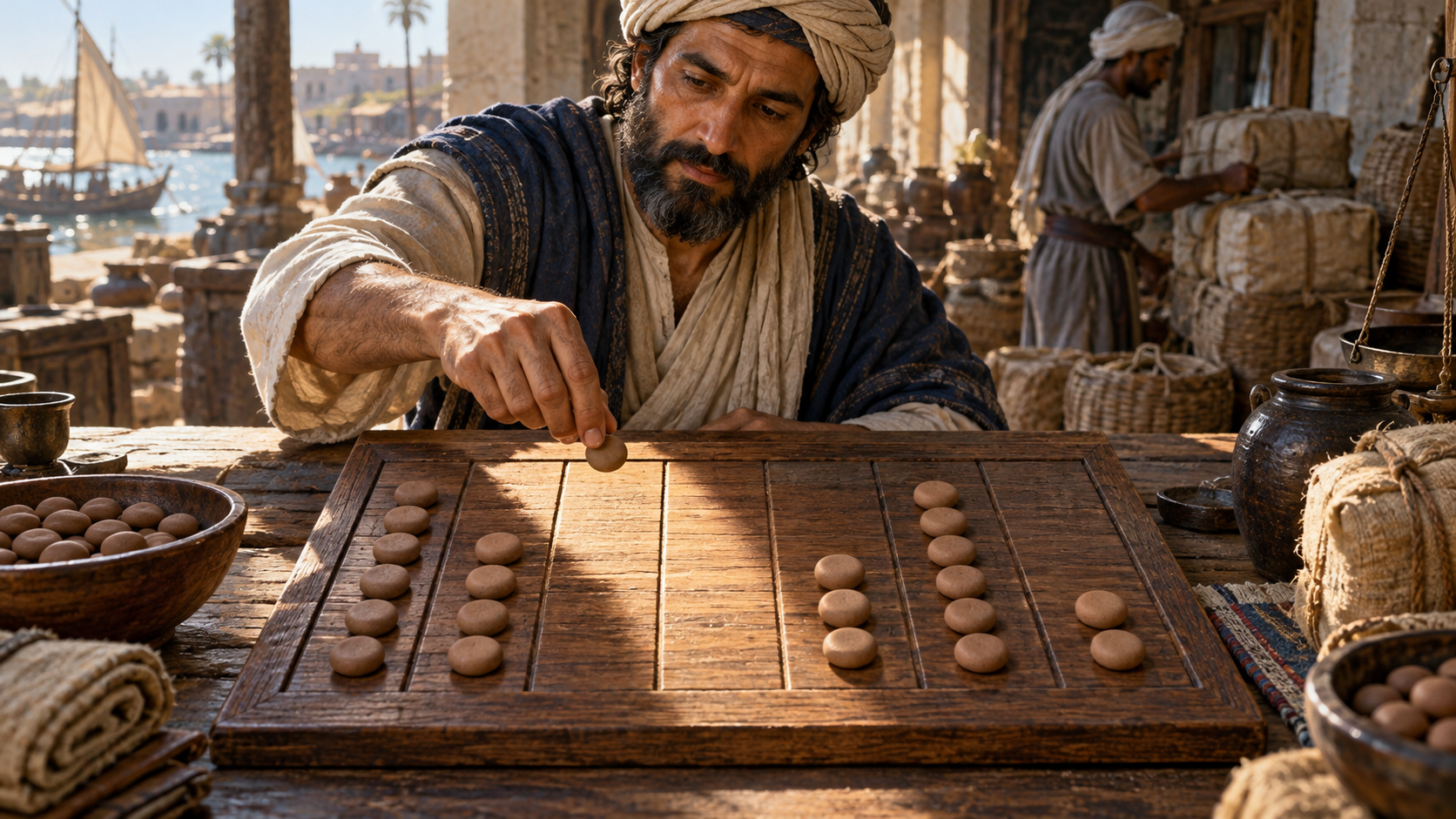
The sentence Bharat invented zero is memorable, but it can conceal several different claims. A culture may recognize nothingness, use a mark for an empty position, treat zero as a number, or place it inside a systematic notation. Those are related achievements, not interchangeable ones.
Bharat’s especially consequential contribution was the effective integration of zero with decimal place-value notation. Evidence for a decimal system is placed around 400 BCE, while Pingala’s Chhandasutra is associated with a use of zero around 200 BCE. The significance lies in the working system: a digit’s position carries a power of ten, and zero can preserve a position in which no other quantity is recorded.
You can demonstrate the mechanism with 5, 50, 500, and 505. The symbol 5 remains the same, but its value changes with its position. In 505, the zero holds the tens place open, preventing the number from collapsing into 55. That small exercise explains more than repeating an invention claim, because it shows what the notation enables: compact representation, reliable calculation, and the reuse of a small set of numerals across quantities of very different sizes.
Priority debates become confused when one participant means a placeholder and another means a number with operational rules. Before accepting or rejecting any claim about zero, ask which achievement is being dated. Bharat’s case is clearest when zero and decimal place value are examined as an integrated mathematical technology.
Key takeaways
- Do not reduce the history to a claim that mathematics had one birthplace; identify Bharat’s documented contributions precisely.
- Indus Valley artifacts can support inferences about mathematical practice, but the undeciphered script prevents confident claims about written theories or algorithms.
- Vedic numerical language includes very large quantities and structured sequences, while ritual construction created exact geometrical problems.
- The Shulba traditions address measured layouts, equal-area transformations, diagonal relations, and √2 in a procedural setting.
- Aryabhata, Varahamihira, Brahmagupta, Mahavira, Sridhara, and Bhaskaracharya are best understood through the problems and algorithms associated with their work.
- The durable achievement of zero lies in its operation within decimal place-value notation, not in an undefined claim about discovering nothingness.
For your next step, choose one construction from the Shulba tradition and one algorithm from a classical mathematician. Ask what problem each solves, what remains invariant, and how its verbal or geometrical procedure maps into notation you know. You will gain a firmer grasp of Bharat’s mathematical inheritance and be able to discuss it with pride without leaning on claims the evidence cannot sustain.
References

Leave a Reply
You must be logged in to post a comment.