
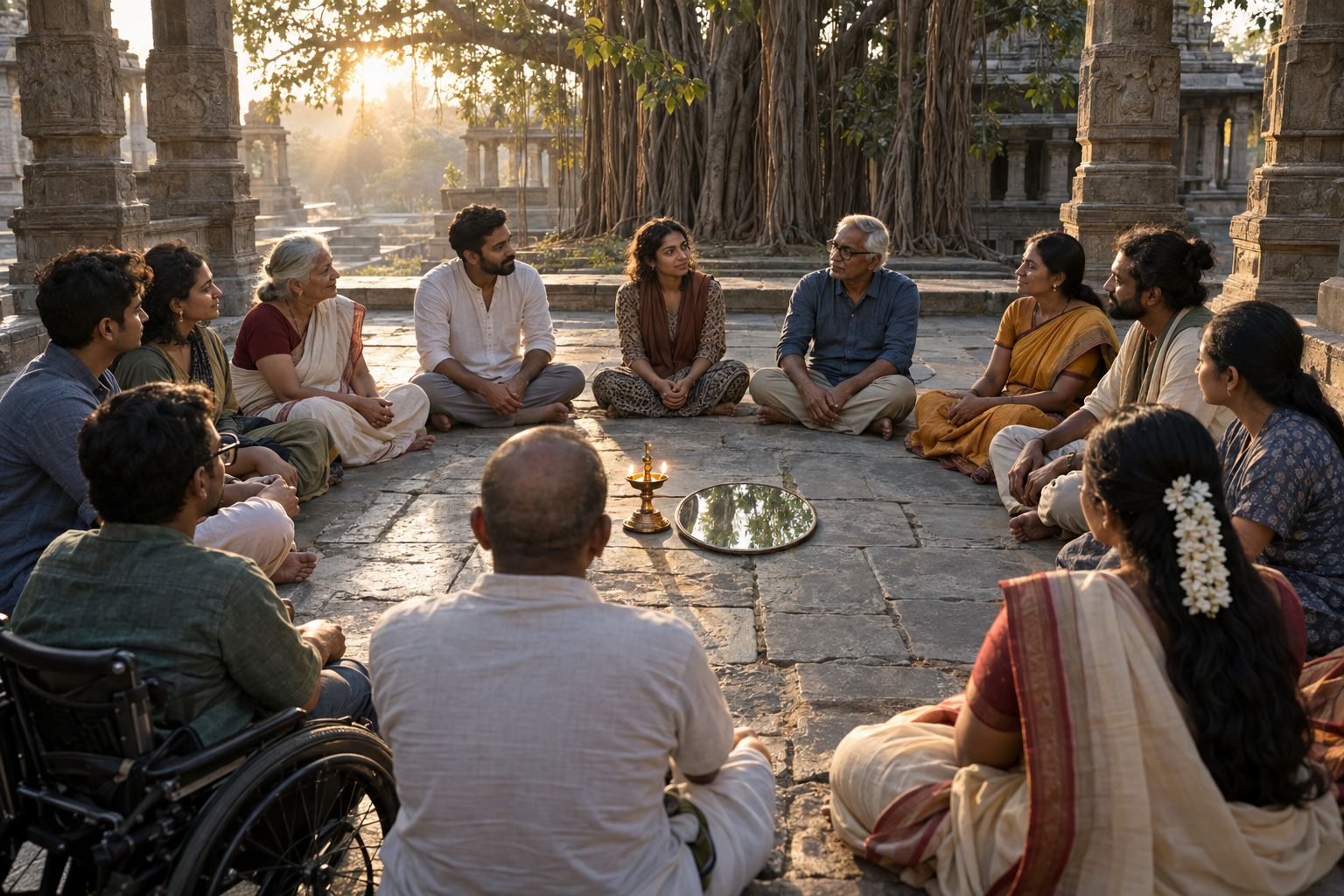
You may be entering a difficult conversation with what feels like an impossible choice: condemn Hindu civilisation as irredeemably unequal, or defend Dharma by denying every injustice committed in its name. Refuse that choice. Neither civilisational shame nor automatic defensiveness will help you identify what is true, protect what is worthy or correct what has gone wrong.
A stronger Hindu response holds principle and practice together. We can defend the dharmic ideal of equal worth while examining whether our families, temples, associations and educational institutions embody it. That is collective self-critique: not inherited guilt, but a shared willingness to test conduct against professed standards and make a repair where the two diverge.
Key takeaways
- Do not use a scriptural ideal to deny social failure, or social failure to erase the ideal. One tells you what the standard is; the other tells you where work remains.
- Collective self-critique is different from collective guilt. Guilt assigns undifferentiated blame; self-critique identifies a present duty, a responsible institution and a specific repair.
- Test equality through access, voice, dignity and remedy. Praise and symbolism matter less if people remain excluded from learning, service or decision-making.
- Apply the same discipline to birth-based status, the treatment of women and responsibility toward animals. Selective equality is not equality.
- When a failure is found, move from argument to construction: change the rule, open the path, appoint an owner and set a date to review the result.
Equality becomes credible when principle judges practice
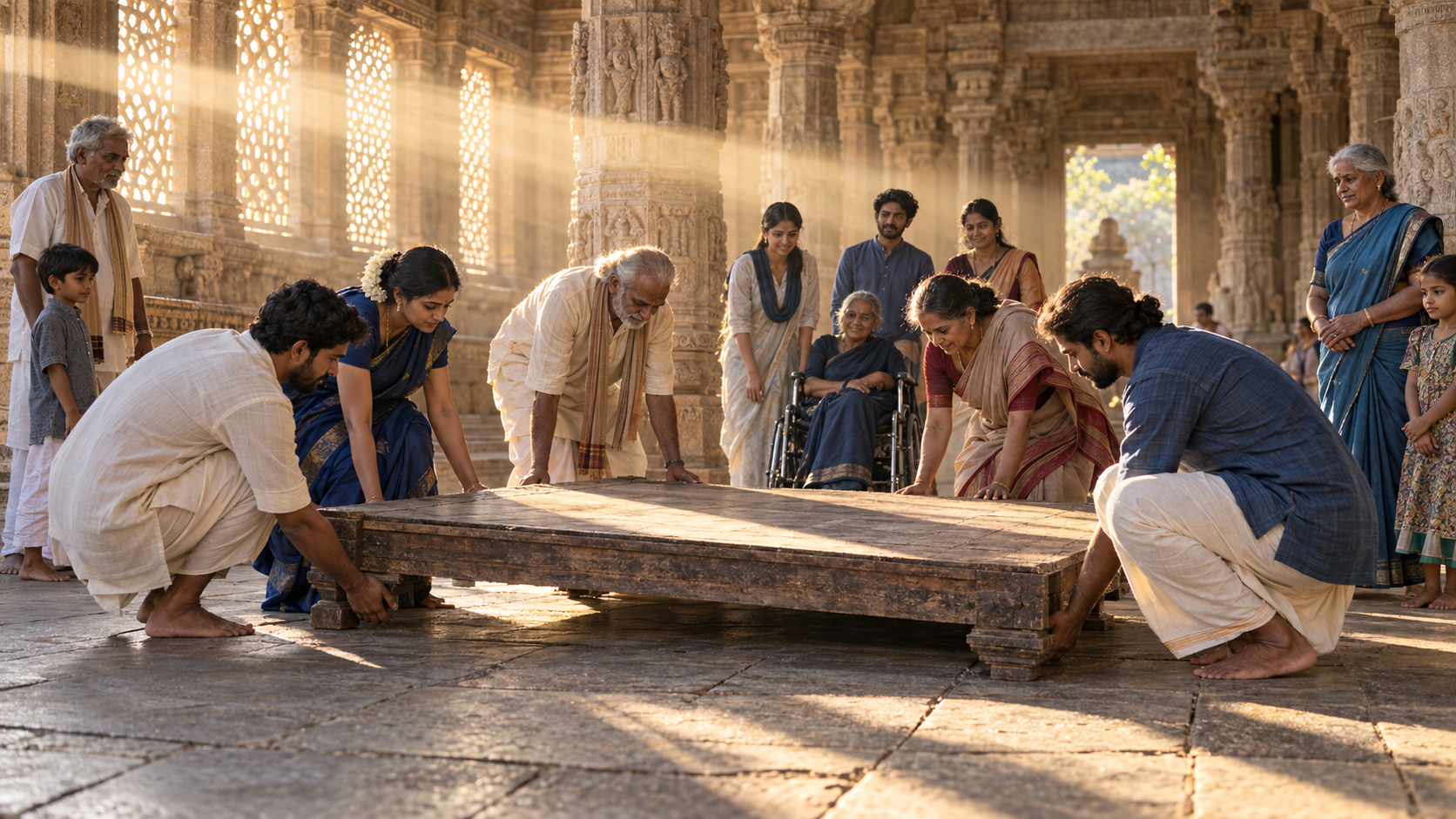
The first mistake in these debates is to force a single answer out of three different questions. What does Dharma teach? How did Hindu communities behave in a particular place and period? What does a Hindu institution do now? A quotation may help answer the first question. It cannot, by itself, answer the other two.
- The normative question: What qualities, duties and relationships does the teaching commend?
- The institutional question: Who can learn, serve, lead, deliberate and seek redress under the actual rules?
- The experiential question: How are people treated when those rules meet family pressure, custom and local power?
Keeping these questions separate prevents two opposite evasions. A verse is not an attendance register, so it cannot prove that every community behaved justly. But misconduct does not cancel the verse either. The ideal remains available as a standard by which misconduct can be named and corrected.
Consider varna. The Bhagavad-gita describes the fourfold ordering through guna and karma – qualities and action – and associates duties with qualities arising from a person’s nature. In an egalitarian reading, this directly challenges the conversion of birth into permanent privilege. It makes character, competence, conduct and responsibility more important than ancestry.
That reading gives you a criterion, not a complete social history. Hindus can disagree about the meaning, application and continuing role of varna. What cannot be defended as equality is the use of ancestry to humiliate a person, deny basic dignity or make an inherited hierarchy immune from moral examination. Functional difference does not establish unequal human worth.
The same distinction matters when discussing women. The Atharvaveda has been read as affirming intellectual parity between husband and wife, while a well-known Manusmriti formulation connects the honouring of women with the moral condition of a community. These teachings can challenge degradation, but invoking honour is not enough. A community must ask what honour permits a woman to do: learn, speak, deliberate, lead, question and report mistreatment without retaliation.
Dharmic equality also exceeds the human social order. The Yajurveda’s call to see through the eye of friendship and its injunctions to protect animals place care for living beings within the field of duty. Compassion cannot remain a devotional mood if the animals under a community’s control are neglected. The condition of the creature is a better test than the grandeur of the slogan.
When someone raises a genuine failure, answer in this order: state the dharmic standard, acknowledge the relevant departure and name the repair you support. That response protects Dharma more effectively than pretending a departure could never have occurred.
A dharmic audit turns accusation into repair
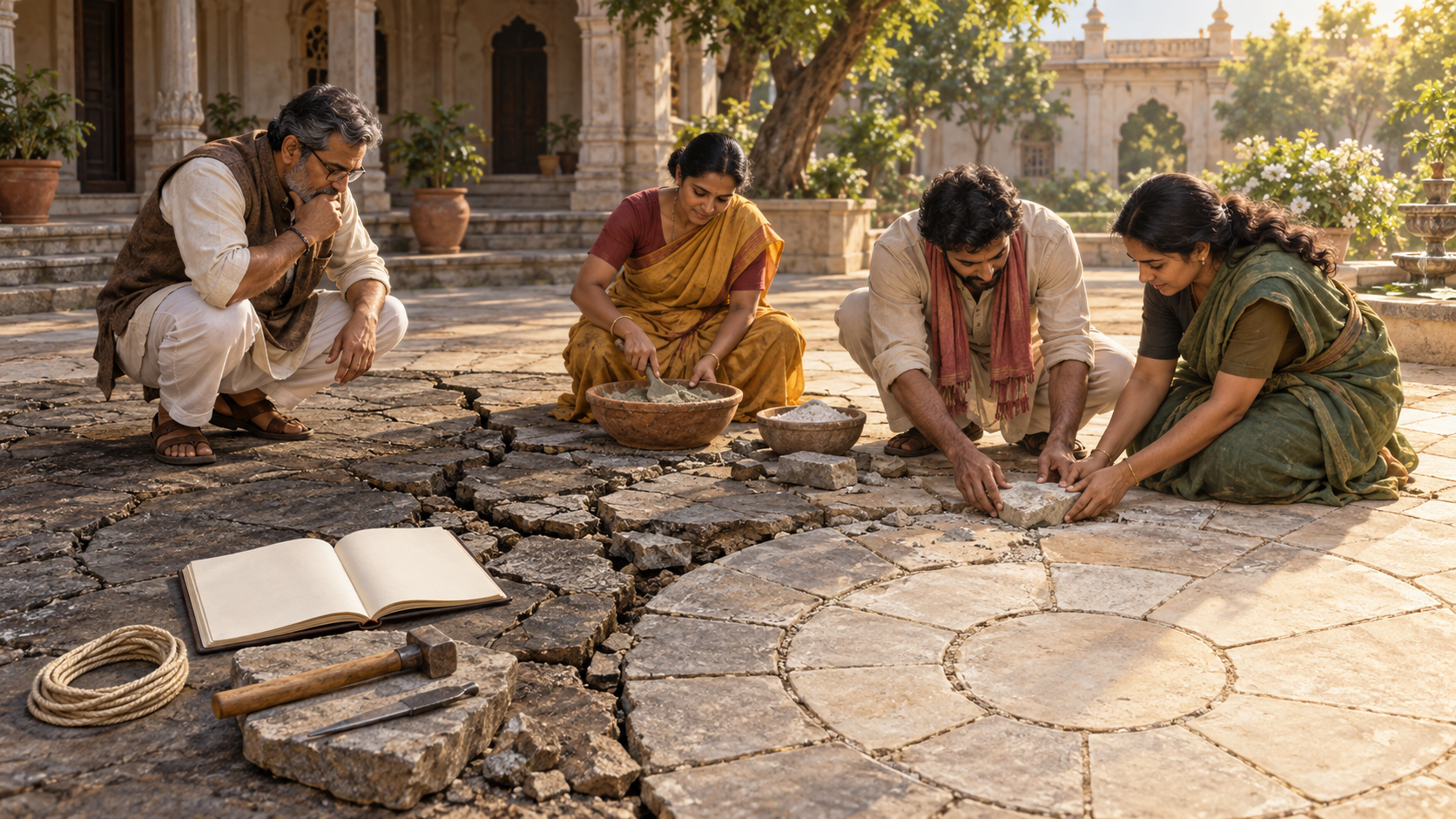
Broad questions such as “Is Hinduism equal?” usually produce broad declarations. An audit is more useful because it narrows the discussion to a practice that can be examined and changed. You can use the following method in a temple trust, cultural association, ashram, educational programme or family-run religious activity.
- Name one practice precisely. Do not begin with the moral character of an entire civilisation. Begin with a rule, selection process, custom, complaint procedure or recurring pattern.
- State the relevant dharmic norm. Identify the teaching you believe governs the matter and explain your interpretation in ordinary language. Do not throw a Sanskrit line into the room as if recitation ends interpretation.
- Map the gate. Ask who decides, what qualification is required, whether that qualification can be acquired and whether birth, gender, wealth or personal connections operate as an unwritten veto.
- Hear the people affected. Invite concrete accounts of what happened, who was present and how the institution responded. Do not make the person reporting exclusion prove a claim about all Hindu history.
- Separate qualification from inherited rank. Training may be necessary for a demanding role. If so, define the training and open a credible path to complete it. “Tradition” should not conceal a standard that changes depending on the applicant.
- Choose a repair and an owner. Rewrite the rule, open the class, publish the criteria, create a complaint route or correct the care practice. Give one person or committee responsibility for implementation.
- Review the result. Set a date and ask whether access and treatment changed in practice. A resolution passed but never implemented is not reform.
Record the audit on one page under six headings: practice, dharmic norm, observed gap, affected people, repair, review date. This prevents the meeting from dissolving into speeches about pride or blame. It also makes disagreement manageable. Participants can dispute the interpretation, the evidence or the proposed remedy without attacking one another’s entire identity.
Two safeguards matter. First, do not begin with a predetermined verdict that Hindu tradition is either flawless or uniquely corrupt. Both conclusions make investigation theatrical. Second, do not demand public disclosure from someone who could face social retaliation. Accept a confidential account, remove identifying details where necessary and judge the institutional response without turning a vulnerable person into the price of reform.
The Rigveda’s call to walk, speak and deliberate together places shared thought and coordinated action at the centre of collective strength. Deliberation is therefore not a sign of civilisational weakness. Properly conducted, it is one way a community becomes capable of acting together.
Apply the same test to caste, women and other living beings

A principle becomes trustworthy when we are willing to apply it where the result may inconvenience us. Three recurring areas reveal whether equality is functioning as a discipline or merely as a defence.
For birth-based status, make every gate explain itself
Ask a concrete question: is this person’s eligibility determined by demonstrated preparation and conduct, or has ancestry already decided the result? If preparation is genuinely required, the institution should be able to describe it, teach it and evaluate it consistently. If no attainable path exists for an otherwise capable person, the qualification may be functioning as inherited closure.
Do not flatten every role distinction into oppression. Communities need teachers, organisers, ritual specialists, protectors, donors and workers with different forms of preparation. The test is whether difference in function has been converted into permanent rank, contempt or exemption from accountability. A person performing service is not of lesser worth than the person receiving public reverence.
A practical reform has three parts: publish the qualification, make the route to acquire it visible and provide a fair way to challenge inconsistent decisions. This moves the guna-karma claim out of apologetics and into institutional design.
For women, measure participation rather than praise
Statements about feminine divinity and the duty to honour women carry moral force, but they can also become shields against examination. Test the institution at the points where authority becomes real. Who studies the tradition? Who teaches it? Who controls funds? Who sits in the room when rules are made? Who can question a decision? What happens when a woman reports mistreatment?
Not every Hindu sampradaya assigns every ritual function in the same way. That diversity should lead to careful explanation, not evasive universal claims. Where a restriction is defended as specific to a lineage or rite, state the reasoning and scope honestly. Do not present a local custom as the only possible form of Sanatan Dharma, and do not use reverential language to avoid discussing its consequences.
Begin with one visible change. Open a learning programme, add qualified women to a decision-making body, publish a safe complaint process or review a rule that has never been examined. The aim is not representation as decoration. It is meaningful access to knowledge, responsibility and remedy.
For animals, inspect care rather than identity
A community that invokes protection of animals should inspect the conditions it directly supports. For a goshala or animal-care initiative, ask about clean water, suitable food, shelter, medical attention, competent supervision and transparent use of donations. Sacred language does not compensate for preventable neglect.
The Mahabharata associates the protection of animal and bird life with a far-reaching dharmic honour. The immediate application is straightforward: direct concern toward the living being before turning its protection into a test of someone else’s identity. Fund care, inspect conditions and correct failures under your own authority.
For every dispute, reject selective scrutiny
Self-critique loses credibility when it is aimed only at rivals. If we examine exclusion in another sect but excuse it in our own, or demand compassion from opponents while neglecting beings in our care, the exercise has become factional warfare. Start where you possess knowledge and influence. Reforming a nearby practice is usually more honest than issuing a verdict on millions of strangers.
Replace inherited guilt with a programme of reconstruction

Hindus carry more than internal social questions. Many also inherit memories of lost institutions, damaged temples, neglected languages, interrupted learning and unfamiliarity with their own philosophical traditions. That civilisational regret can move toward resentment or toward responsibility. The useful question is not whether you are personally guilty for the past. It is what you can help build now.
Three responses fail for different reasons. Denial makes Hindu confidence dependent on the impossible claim that no serious wrong occurred. Civilisational self-loathing reduces a vast and internally diverse tradition to its failures. Performative repentance admits everything in general but repairs nothing in particular. None gives the next generation a stronger institution.
Reconstruction offers a better direction: translate neglected literature, preserve manuscripts, support traditional artists, strengthen Sanskrit and regional languages, document pilgrimage traditions and study Indian knowledge systems seriously. Technology can assist with cataloguing, archives, virtual collections and mapping, but the purpose is not to live inside a digital museum. It is to place an inheritance back into active circulation.
Equality should be built into that reconstruction. A digitised manuscript that nobody can find, a class open only through personal connections or a restored institution with opaque decision-making reproduces the old access problem in a new form. For every cultural project, ask four questions: who can reach it, who can understand it, who can contribute to it and who is accountable for its stewardship?
Serious recovery also requires intellectual honesty. Cultural confidence is not strengthened by romantic claims that every modern discovery already existed in ancient Bharat. It grows when Hindu achievement is researched carefully, limitations are acknowledged and genuine contributions are made accessible. Memory joined to construction is more durable than either amnesia or permanent anger.
You can begin with a thirty-day commitment in one institution you actually influence. During the first week, identify one gap between a declared dharmic value and an observed practice. During the next two weeks, listen to the people affected and agree on one feasible repair. In the final week, assign responsibility and publish the review date. The timetable is modest by design: it turns a civilisational argument into a duty someone can complete.
Do not wait for a perfect theory of Hindu equality before correcting a visible contradiction. Choose one gate, one care obligation or one neglected body of knowledge. Open it, repair it or transmit it. Dharma is not diminished when practice is judged by its own highest claims; it becomes harder to dismiss and easier to inherit.
References

Leave a Reply
You must be logged in to post a comment.