

If you’re trying to decide whether Narendra Modi’s language of sewa describes a governing record or merely a political image, don’t begin with either reverence or reflexive dismissal. Ask where the service claim becomes visible: in a family’s daily life, in the relationship between the state and the citizen, and in India’s conduct beyond its borders.
This approach lets you recognise the scale of Modi’s career without treating longevity, rhetoric or international visibility as proof of success. It also gives you a fairer standard than judging every policy through party allegiance.
The chronology establishes scale, not a verdict
The firm starting point is 7 October 2001, when Modi took office as Chief Minister of Gujarat. He moved from Gandhinagar to national leadership in 2014, when he became Prime Minister. By 7 October 2026, that sequence amounted to 25 years in elected executive office.
That is an unusually long period of executive responsibility. Longevity proves political endurance, not good governance, but it changes the questions you should ask. A leader serving for a short period may reasonably be judged on direction and early execution. After a quarter-century, intention is no longer enough. You can look for continuity, implementation, correction and durable consequences.
Keep three distinctions in view whenever you assess a claim about this record:
- Announcement versus delivery: A benefit placed in a budget or speech is not yet a benefit received by a household.
- Access versus usefulness: A connection, account or facility matters only when it works, remains affordable and can be used without avoidable friction.
- Visibility versus institutional value: A large event may display political reach, but durable public service requires systems that continue after the event ends.
These distinctions do not presume failure. They prevent admiration from lowering the standard by which a long-serving leader ought to be judged.
Domestic sewa must be measured at the last mile
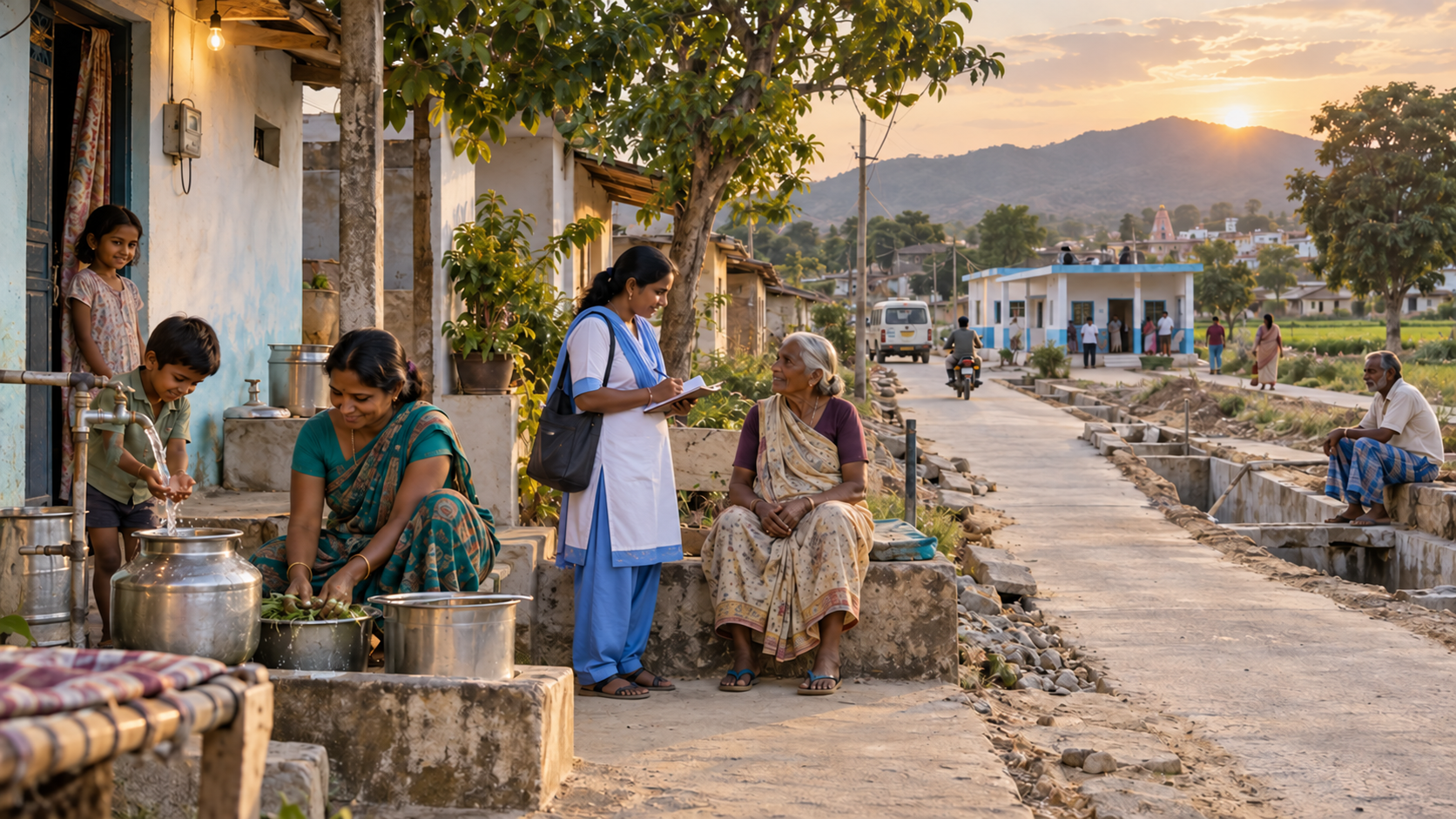
The domestic case for Modi’s service-oriented politics centres on a recognisable set of household needs: housing, sanitation, bank access, drinking water, electricity, cooking gas and digital connectivity. These are not abstract indicators. They shape how much time, health, security and practical choice a family possesses.
The important insight is that household welfare works as a chain. A dwelling provides greater security when it also has usable sanitation, dependable water and electricity. A bank account creates practical independence only when the holder can operate it and reach the services attached to it. Digital access becomes consequential when it opens opportunities rather than adding another unusable connection. The household, not the administrative category, is therefore the right unit of judgment.
You can test any such intervention through five questions:
- Reach: Did the intended family actually receive the house, account, connection or facility?
- Function: Does it work reliably enough to be used in ordinary life?
- Continuity: Can the household afford and maintain its use after initial delivery?
- Agency: Does it widen practical choices, particularly for people who previously depended on an intermediary?
- Correction: Is there an accessible way to report failure and obtain a remedy?
This ladder matters because counting assets can obscure the difference between formal inclusion and lived inclusion. A toilet without the conditions needed to use it, a bank account the holder cannot control, or a connection that does not function consistently may satisfy an administrative entry without completing the act of service.
The chosen priorities nevertheless tell us something important about the governing philosophy. They locate dignity in ordinary material conditions and place people at the margins within the national development story. What they do not establish by themselves is universal coverage, uniform quality or sole political attribution. When you encounter a success claim, look for the denominator, the geography, the time period, the rate of continued use and the method by which functioning was verified.
That insistence is not cynicism. It is how the idea of sewa remains answerable to the person it is meant to serve.
Pradhan Sevak is a demanding standard of power

Modi has repeatedly presented himself as a Pradhan Sevak, or principal servant, rather than simply a ruler. His leadership persona also emphasises energy, discipline and the translation of national ambition into concerns that households recognise.
From a Dharmic perspective, the language of service should not be treated as decorative humility. It makes a moral claim about the purpose of authority. Power is justified by duty toward those affected by it, especially those with the least ability to command attention. The greater the concentration and duration of power, the more demanding that duty becomes.
A service-based model of leadership therefore carries at least four obligations:
- Attention: See people whom a system routinely overlooks.
- Dignity: Treat a beneficiary as a citizen with agency, not as a passive recipient of generosity.
- Execution: Convert intention into a benefit that functions in daily life.
- Accountability: Permit scrutiny, acknowledge shortfalls and correct what does not work.
The first two obligations explain the moral appeal of Modi’s vocabulary. The last two determine whether that vocabulary describes governance. Housing, sanitation, banking, water, energy and connectivity identify what the administration has sought to prioritise; they do not provide programme-level performance data on their own.
This gives you a clean way to handle political disagreement. You need not deny the relevance of servant leadership, and you need not accept the phrase as self-validating. Treat Pradhan Sevak as a promise that can be tested. Ask what happened to the intended citizen, whether failures were visible, and whether the system could correct them.
The international record serves three different audiences

Modi’s public-service claim extends beyond domestic welfare. Its international dimension is easier to assess when you separate diaspora engagement, geopolitical positioning and assistance to people beyond India’s borders. They may reinforce one another, but they are not the same achievement.
The diaspora as a living bridge
Large engagements in New York’s Madison Square Garden, Houston and Washington conveyed a consistent message to overseas Indians: distance does not remove them from India’s national story. The diaspora was addressed not merely as a population living abroad, but as a bridge connecting Bharat with the wider world.
The emotional recognition is meaningful, particularly for people who preserve an attachment to India across generations. But crowd size should not be your final measure. Ask whether engagement produces durable channels through which overseas Indians can maintain cultural ties, contribute knowledge and communicate India’s interests after the gathering is over. A bridge is valuable because of what can cross it, not because its opening ceremony was impressive.
An independent voice across geopolitical divides
The geopolitical case rests on India’s attempt to engage several centres of power while speaking in its own voice. It includes partnerships with the United States, Europe, the Indo-Pacific and the Global South, alongside engagement with leaders situated across competing geopolitical alignments.
India’s G20 presidency supplied a concrete stage for that posture, including the African Union’s inclusion as a permanent member of the grouping. The relevant public-service question is not simply whether India appeared prominent. It is whether Indian leadership helped widen representation, preserve room for independent judgment and build cooperation in a divided international environment.
For an Indian citizen or member of the diaspora, greater national confidence can be a legitimate part of the record. It should still be examined through consequences. International respect is most valuable when it enlarges India’s ability to protect its interests, represent neglected concerns and help shape the terms of collective action.
Service that crosses national boundaries
The outward-facing meaning of sewa becomes clearest in humanitarian action. During the COVID-19 pandemic, India supplied vaccines and medicines internationally. During conflicts and natural disasters, Indian evacuation and assistance missions sometimes helped foreign citizens alongside Indians. Development partnerships with the Global South belong to the same outward-facing idea.
This is where the civilisational maxim Vasudhaiva Kutumbakam — the world is one family becomes a standard of conduct rather than a ceremonial phrase. Its test is consistency: does India retain the capacity and willingness to assist beyond its immediate circle when circumstances become difficult?
Humanitarian assistance, strategic partnership and diaspora engagement should not be collapsed into one general claim that India’s global stature has risen. Assess each separately. Assistance concerns people reached, statecraft concerns influence and independent choice, and diaspora policy concerns the durability of a human relationship. A strong performance in one cannot substitute for evidence in another.
Key takeaways for judging Modi’s record

- Begin with the full span of responsibility. Twenty-five years in elected executive office is evidence of continuity and endurance, but it also makes implementation and correction more important than announced intention.
- Measure domestic service at household level. For housing, sanitation, banking, water, electricity, cooking gas and digital connectivity, ask whether access became reliable, affordable and usable.
- Treat sewa as a testable promise. Calling the head of government a Pradhan Sevak is meaningful only when citizens can inspect delivery, expose failure and obtain correction.
- Separate international achievements. Diaspora connection, geopolitical autonomy and humanitarian assistance serve different purposes and require different evidence.
- Distinguish a demonstrated priority from a demonstrated outcome. A list of initiatives can establish governing direction. It cannot, without further data, prove universal success, equal quality or exclusive credit.
The most defensible reading is neither that Modi’s sewa vocabulary is empty nor that the vocabulary settles his record. It identifies a coherent conception of service: material dignity at home, recognition of overseas Indians, a more confident Indian voice and assistance extending beyond national borders. Each part then has to survive its own evidentiary test.
When the next claim about this legacy reaches you, write down five things: who was meant to benefit, what was actually delivered, whether it continued to function, what evidence verifies the outcome, and how failure could be corrected. If a claim cannot answer those questions, keep your judgment open. If it can, let the result — favourable or unfavourable — change your view. That is how sewa becomes a civic standard rather than a political slogan.
References

Leave a Reply
You must be logged in to post a comment.