
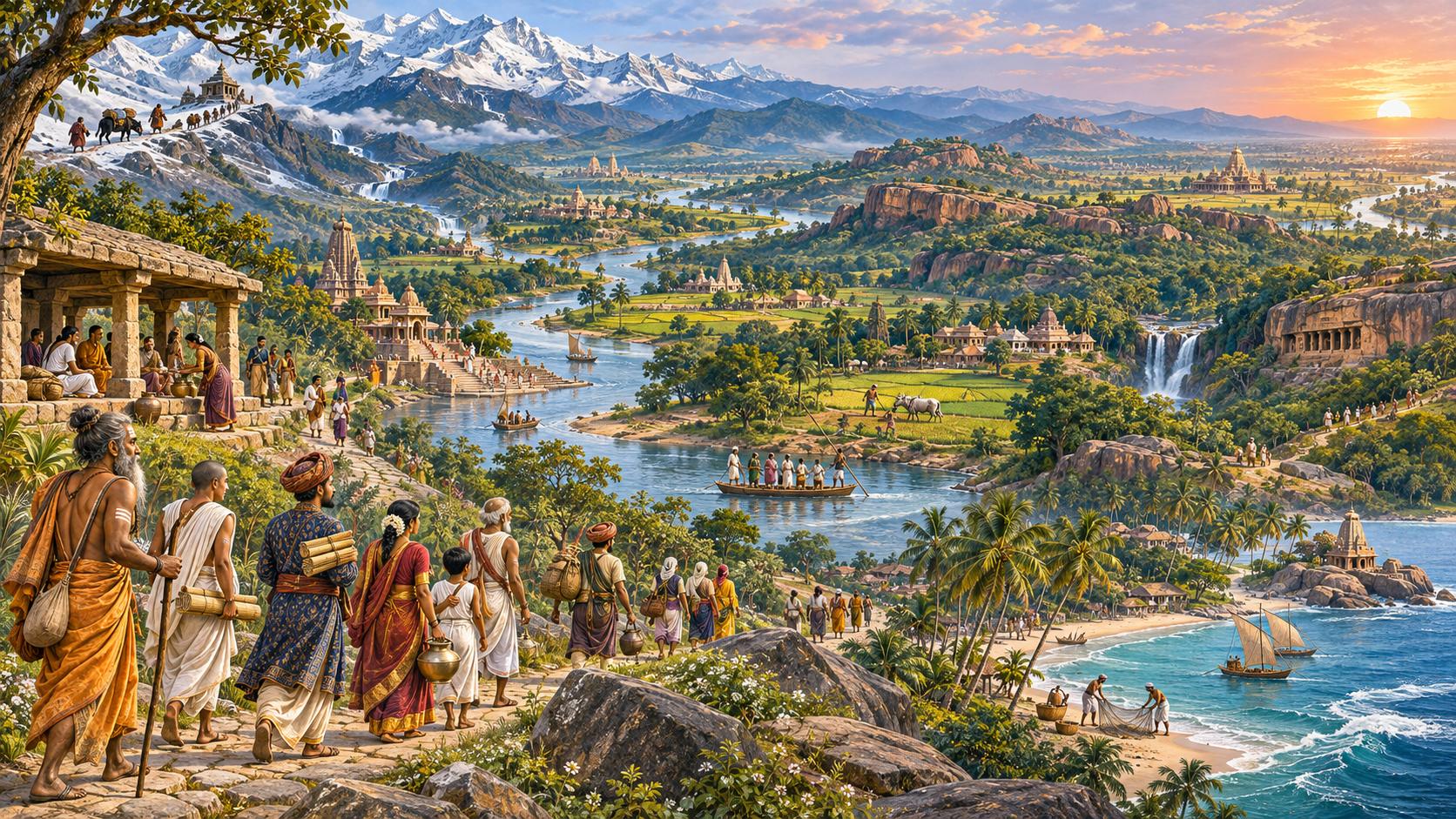
You may have heard two claims that seem impossible to reconcile: Bharat has long been one civilization, yet its regions were often governed by different kingdoms. They conflict only if unity is defined as permanent rule from one capital.
If you want to judge Bharatavarsha’s unity without falling back on either a slogan or a colonial-era assumption, look for the institutions that taught people to name, traverse, remember and revere the land as a whole. That test produces a clearer answer than counting how often every region appeared beneath the same crown.
Use the right test: unity is not uniformity
A modern state usually expresses unity through fixed borders, common citizenship, a central government and uniform administrative institutions. A civilization can possess those things, but it does not depend on them. Its continuity may instead be carried by sacred places, pilgrimage routes, stories, calendars, shared names, political ideals and habits of patronage.
This distinction matters because the question ‘Was the entire land ruled by one dynasty at every moment?’ is too narrow. A negative answer would establish political plurality, not civilizational absence. The more useful questions are these: Did people have a name for the larger land? Did they locate distant places inside a shared moral or sacred world? Did practices move people across regional boundaries? Did literature and political thought treat the wider geography as intelligible?
The old name Bharatavarsha and the continuing place of the Panchangam supply two parts of that answer. One names a civilizational space. The other situates human life within an ordered relation of time and place. The Constitution’s use of Bharat did not have to manufacture that name; it gave constitutional recognition to one already embedded in civilizational memory.
Regional difference does not defeat this argument. It helps identify what kind of unity existed. A living civilization does not require every Bharatiya bhasha, custom, temple practice or local calendar to become identical. It requires enough shared reference points for different communities to recognize one another as participants in a larger world.
| Evidence to examine | What it can establish | What it cannot establish by itself |
|---|---|---|
| The name Bharatavarsha and the Panchangam | A named civilizational space joined to an ordered understanding of place and time | That every locality used identical terminology or calculations |
| Tirthas, pilgrimage routes and sacred-place compendia | A wider geography that could be revered, catalogued and physically traversed | That every person visited every region |
| Literature in multiple Bharatiya bhashas | A portable memory of rivers, places, peoples and customs beyond one locality | That one language or literary form erased all others |
| Edicts, inscriptions, coins and the ideal of the Chakravartin | That rulers and political thinkers could conceive the country on a large scale | That one empire governed the entire land without interruption |
The last column is essential. A sound case for unity should not exaggerate its evidence. Bharatavarsha was not culturally coherent because it lacked rivalries, changing frontiers or strong regional identities. Its coherence is visible precisely in the structures that continued to connect those regions while political arrangements changed.
Pilgrimage turned geography into lived belonging
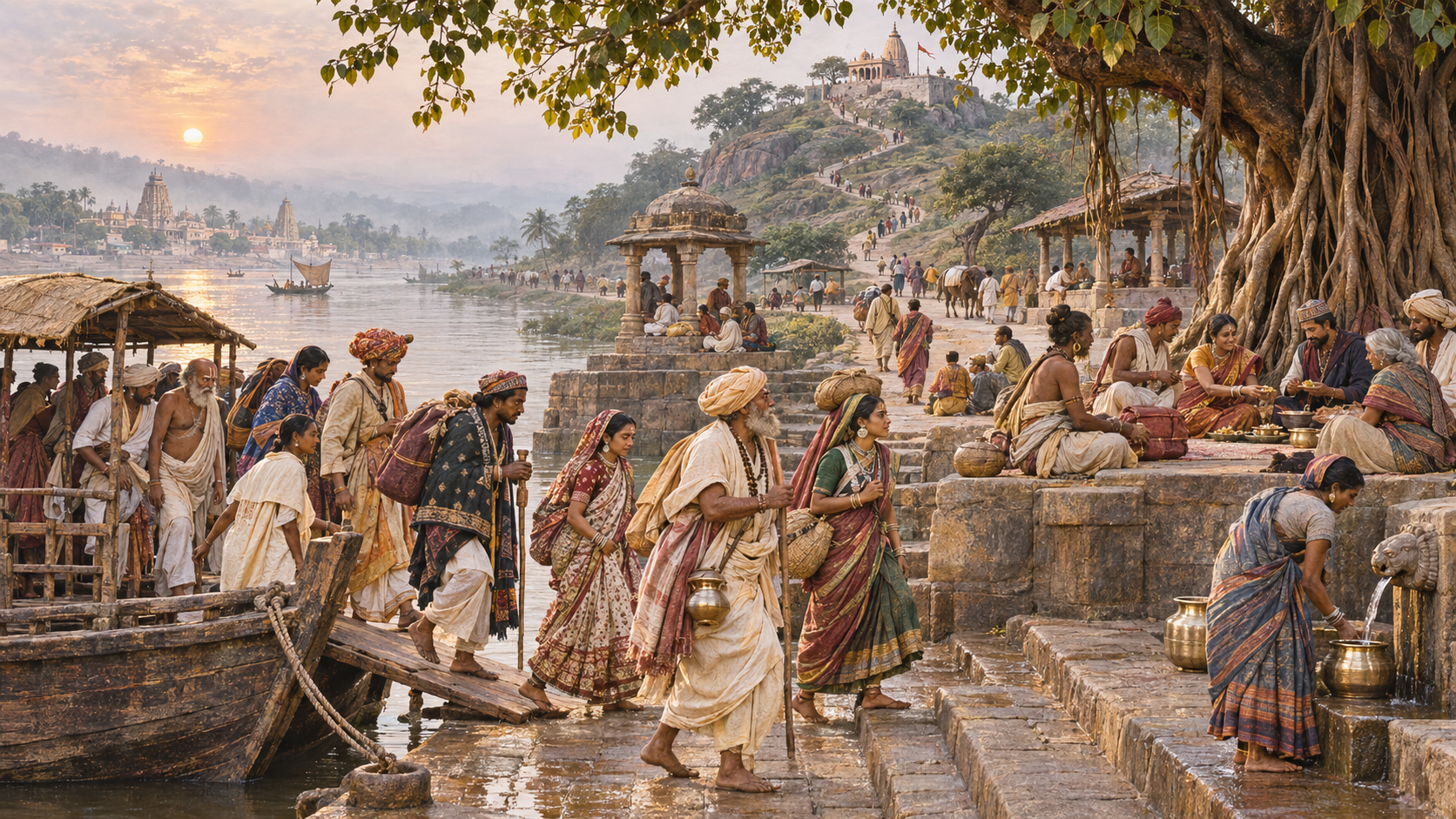
A map can show distance, but it cannot by itself create attachment. Tirtha-yatra does something more intimate: it turns distant rivers, mountains, towns and temples into destinations within a person’s sacred obligations and memory. A place need not belong to your kingdom, language region or everyday surroundings to become part of the world you hold sacred.
The dense network of tirtha-kshetras across the land therefore matters as more than a collection of religious sites. Routes connect the familiar to the distant. The journey gives the traveller direct knowledge of varied landscapes and customs. Local difference becomes a reason to undertake the journey, not a reason to deny the underlying relationship.
Compendia of sacred places in Sanskrit and other Bharatiya languages performed a related function. They made a large geography teachable. Such a list does not prove that every household knew every site or that every pilgrim completed a subcontinental circuit. It does show that distant locations could be gathered into one meaningful frame and transmitted to people who might never see them all.
Patronage reveals how seriously that frame could be taken. Ahilyabai Holkar’s eighteenth-century endowments at Kashi and other punya-kshetras are difficult to explain through local political interest alone. Her responsibility extended to sacred places outside the narrow territory from which she ruled. The act does not prove that every ruler shared the same priorities. It does reveal a form of civilizational custodianship whose field of concern was larger than a single kingdom.
You can apply this test to any pilgrimage tradition you encounter. Put its destinations on a map. Note which linguistic and former political boundaries the route crosses. Then ask what allows pilgrims, priests, patrons and local communities to recognize the distant sites as parts of one sacred itinerary. The route itself often answers the question more clearly than an abstract debate about national identity.
Calendars and literature carried the larger land in memory

Civilizational unity also needs forms that can travel without an army or bureaucracy. The Panchangam is one such form. It is not merely a list of dates. It relates ritual life to an ordered account of time and place, allowing local observance to participate in a wider temporal framework. Local usage can differ while the underlying civilizational grammar remains recognizable.
Literature performs a similar task through narrative and description. Across the literary inheritance associated with Valmiki, Veda Vyasa, Kalidasa, Sri Krishnadevaraya and Pandita Jagannatha Raja, the land appears through rivers, tirthas, cities, flora, fauna, clothing, customs and local traditions. These references make geography memorable. They allow a reader or listener to imagine places beyond immediate experience without reducing them to copies of home.
This is why linguistic plurality should not be treated as evidence of civilizational fragmentation. A shared geography does not require a single language. Different bhashas can preserve local textures while referring to rivers, sacred sites, stories and ideals known beyond their own regions. Repetition across languages may change the form of transmission without destroying the relationship being transmitted.
You can test this mechanism yourself with a regional literary work. Mark every river, city, forest, mountain, pilgrimage place or distant people it names. Separate local references from those beyond the author’s immediate political setting. Then ask what kind of map the work assumes its audience can understand. One place-name proves little, but a recurring pattern of cross-regional reference reveals the scale of the mental world in which the work operates.
Keep the conclusion precise. Literature does not prove that every community held one political opinion. A calendar does not prove that every locality observed every occasion identically. They establish something more durable: people could inhabit distinct local worlds while locating those worlds within a broader field of time, memory and sacred geography.
Political history confirms a horizon larger than one kingdom
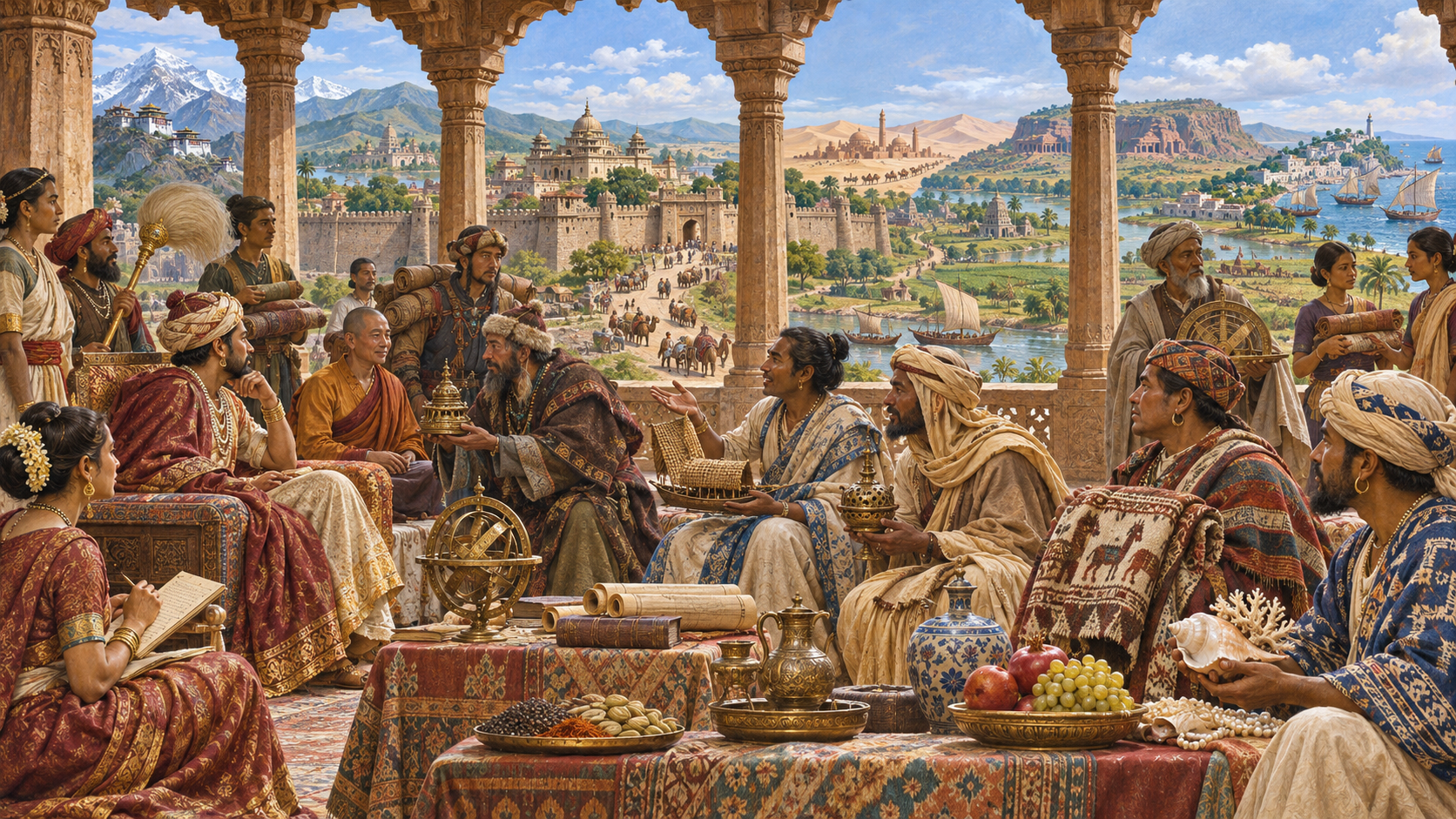
Political evidence belongs in the case, but it must be used carefully. A vast empire can join territories administratively without creating a civilization. Conversely, the collapse of an empire does not automatically dissolve the civilizational relationships that preceded or outlasted it. Political history becomes persuasive here when it converges with the geographic, ritual and literary evidence.
The surviving edicts, inscriptions, coins and official records of premodern Bharat show that large-scale political integration was not inconceivable. Chandragupta Maurya’s realm is one major instance of rulers treating an extensive country as a field of governance. The point is not that Mauryan administration remained unchanged forever. It is that the political imagination could operate at a scale much larger than an isolated regional kingdom.
The ancient ideal of the Chakravartin or Samrat sharpens that point. An ideal of paramount sovereignty is not evidence that such sovereignty existed continuously. It is evidence that political thought could conceive an encompassing order. A political ideal must have a comprehensible field in which it is supposed to operate; the aspiration itself therefore tells you something about how the larger land was imagined.
This gives you a disciplined way to handle the phrase political unity. Ask whether a claim concerns continuous administration, periodic imperial integration or an enduring ideal of paramount rule. These are different propositions. Bharat did not need an uninterrupted empire for all three to matter, but neither should evidence for one be casually used to assert another.
The same discipline exposes the weakness in the colonial-era proposition that political variety meant there was no prior unity at all. Within pro-Dharmic historiography, that proposition is understood as a colonial category later repeated by Marxist historians. You do not have to replace it with the equally crude claim that nothing ever changed. The stronger conclusion is that modern constitutional India gave a new political form to a country whose civilizational connections were already old, extensive and capable of surviving changes of dynasty.
This distinction also protects regional histories. Acknowledging a wider Bharatavarsha does not demote a region’s own kings, literature, customs or sacred places. Those particular inheritances are part of the evidence. Unity is visible in their relationships, not in their erasure.
Key takeaways: apply a five-question test
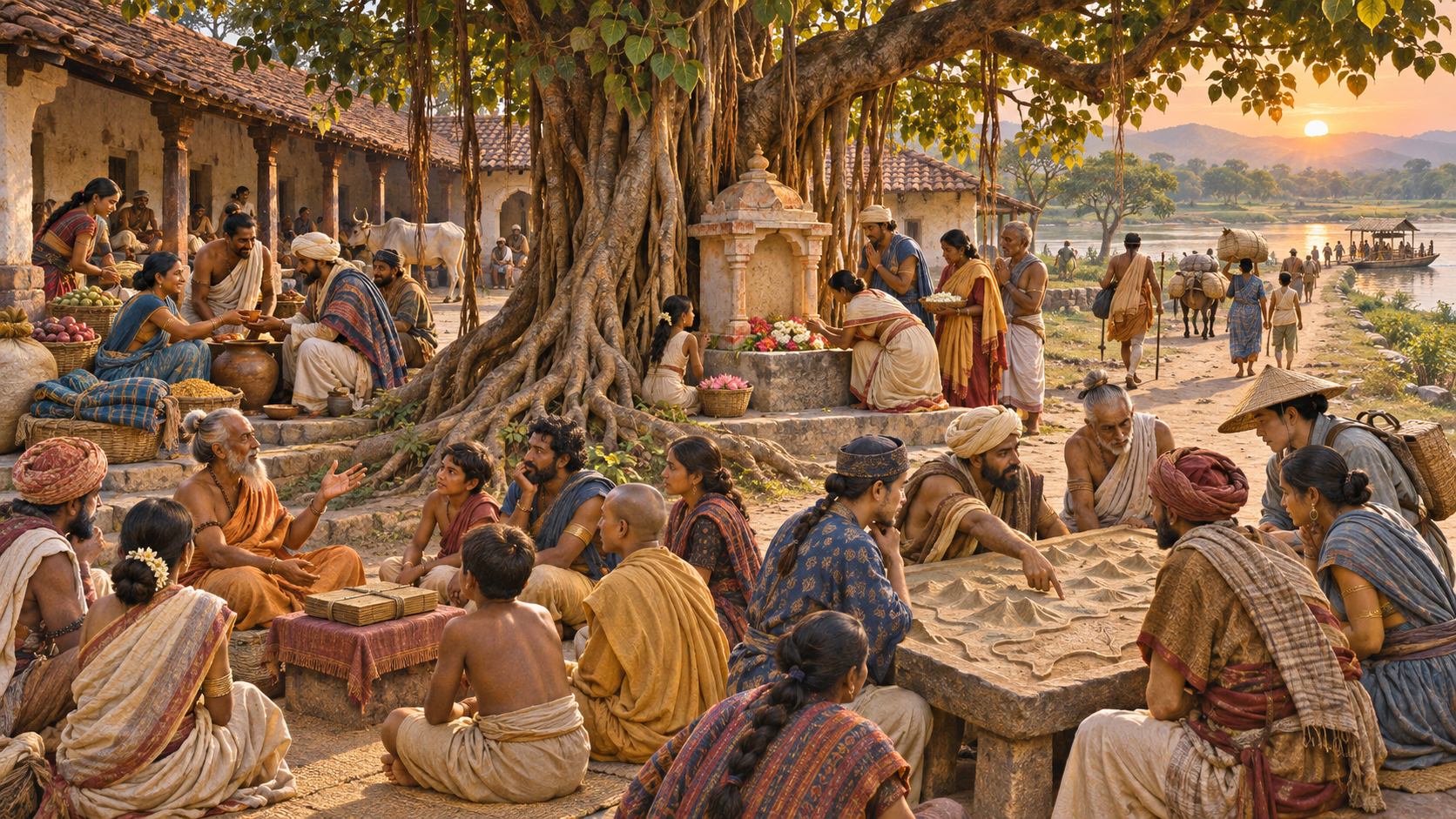
- What kind of unity is being discussed? Separate civilizational belonging, sacred geography, political ideals and continuous central administration.
- Could people name and imagine the larger land? Look for terms such as Bharatavarsha, geographic descriptions and place-lists rather than assuming a modern map was the only possible form of awareness.
- What moved across regions? Trace pilgrims, itineraries, stories, calendars, patronage and political symbols. Movement reveals how distant places became mutually intelligible.
- Do independent kinds of evidence converge? A pilgrimage route, a literary reference and an inscription establish more together than any one of them can establish alone.
- Has difference been mistaken for disunity? Variation in language, custom or kingship disproves uniformity. It disproves civilization-wide connection only when no larger relationships can be shown.
A 30-minute audit for a historical claim
- Write the claim in one sentence. Replace vague words such as united with the exact meaning intended: administered, imagined, traversed, revered or culturally connected.
- Find one item from sacred geography, one from literature or calendrical practice and one from political history.
- For each item, record two statements: what it establishes and what it cannot establish by itself.
- Check whether the three items point to the same scale of belonging. If they do not, narrow the claim rather than forcing agreement.
- Rewrite the conclusion so that it acknowledges both regional plurality and the larger relationships the evidence supports.
This audit is especially useful when you meet sweeping statements such as India was created by one empire, one colonial administration or one modern constitution. Add a question in the margin: created in which sense? The answer may be defensible for a particular administrative form while remaining false as a claim about civilizational consciousness.
Begin with one route, text or act of patronage connected to your own region. Follow its links beyond that region and mark what made those links intelligible. Bharatavarsha’s unity becomes clearest when you examine the relationships that people actually maintained, without demanding sameness and without mistaking political change for civilizational amnesia.
References

Leave a Reply
You must be logged in to post a comment.