
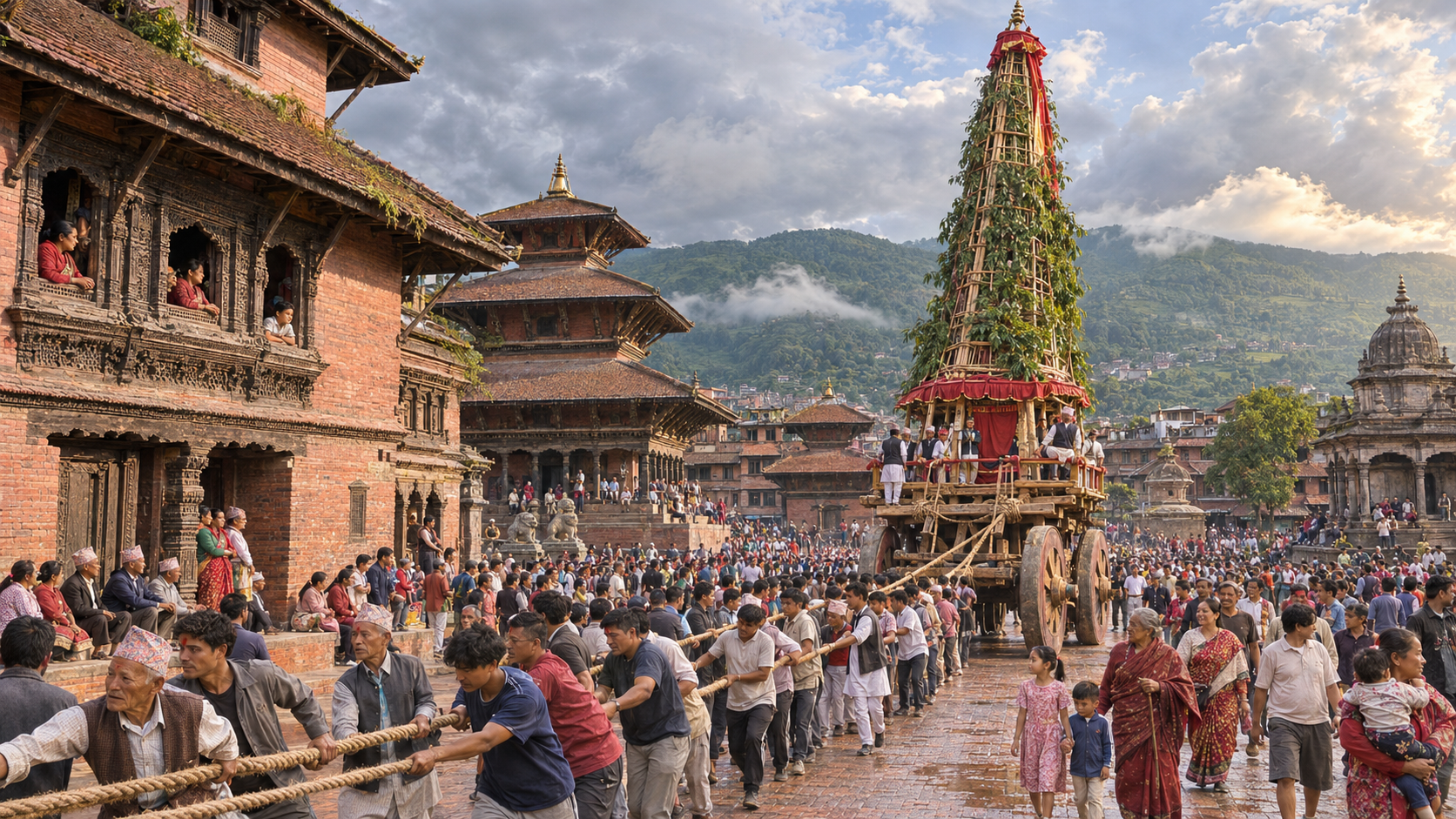
If you have encountered Rato Machhindranath Jatra as a colourful festival from Nepal, the obvious question is also the right one: what is the procession actually asking people to remember?
The answer begins with drought, but it does not end with a request for favourable weather. The jatra turns ecological dependence, the guru-disciple bond and the restoration of right order into a public act. Once you see those layers together, the festival stops looking like an isolated custom and starts revealing a distinctly Dharmic way of understanding the relationship between nature, spiritual power and community life.
Start with the drought, not the procession
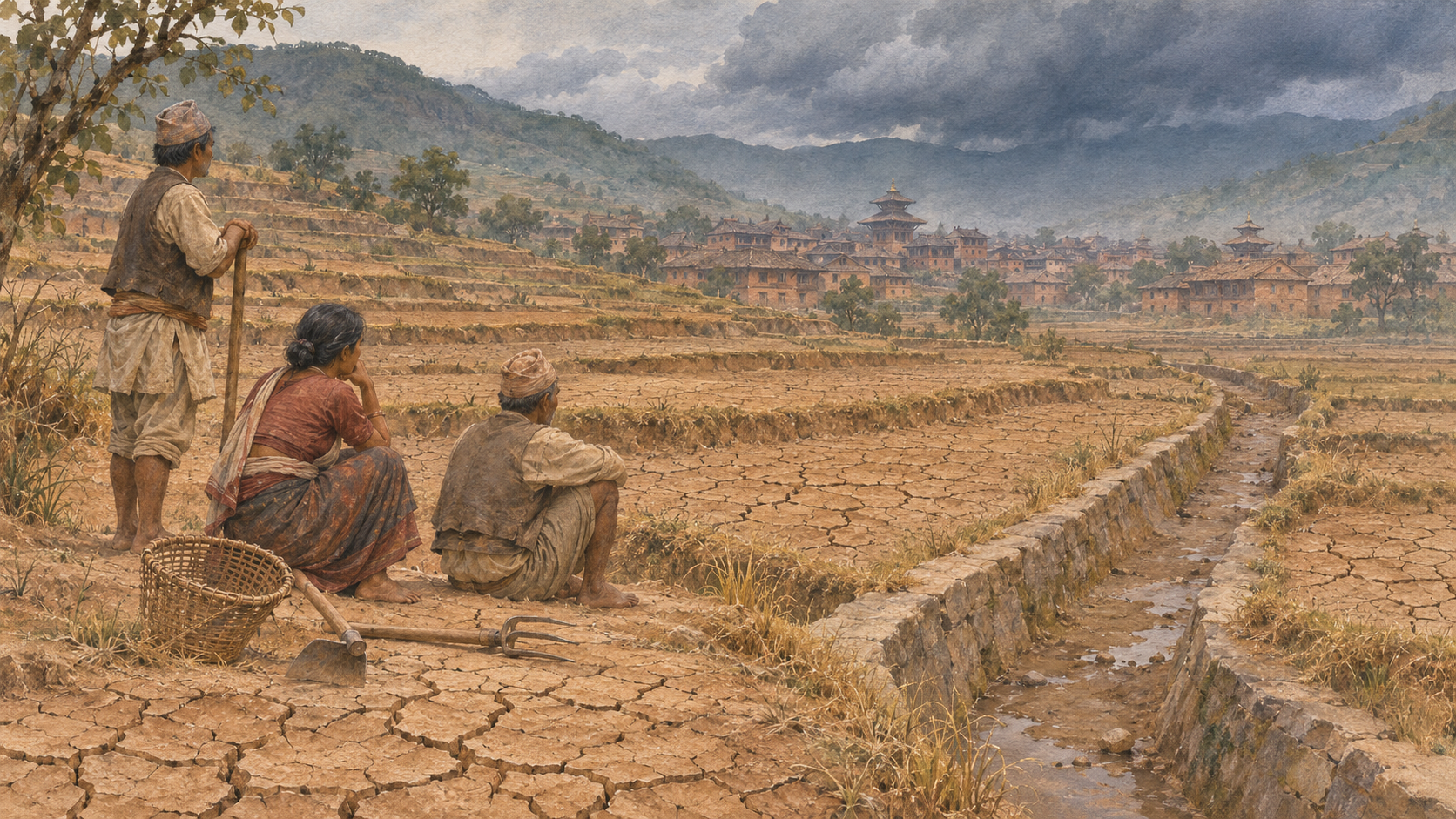
The remembered crisis is severe: waterways diminish, cultivated ground dries and the people of the Kathmandu Valley fear for their survival. This matters because rain is not decorative symbolism in the narrative. Water determines whether fields can produce food and whether a settled community can endure.
Within the Nath telling, the drought is understood as more than an accidental turn in the weather. It expresses a spiritual imbalance. A modern reader may be tempted to treat that as an outdated explanation of rainfall, but that misses the work the narrative performs. It is not offering a meteorological model. It is teaching that disturbances in the order of life have consequences, and that human beings should not imagine themselves spiritually separate from the land and water on which they depend.
You do not have to choose between understanding drought physically and taking its religious meaning seriously. One question asks how rain forms. The other asks how a community should respond when the conditions sustaining life break down. Rato Machhindranath Jatra preserves the second question in ritual form.
That distinction is useful whenever you encounter an agricultural festival. First identify the material concern beneath the ritual: water, food, soil, season or survival. Then ask what conduct the tradition connects with the restoration of balance. This keeps you from reducing a living observance either to spectacle or to primitive science.
The guru-disciple bond explains the turning point
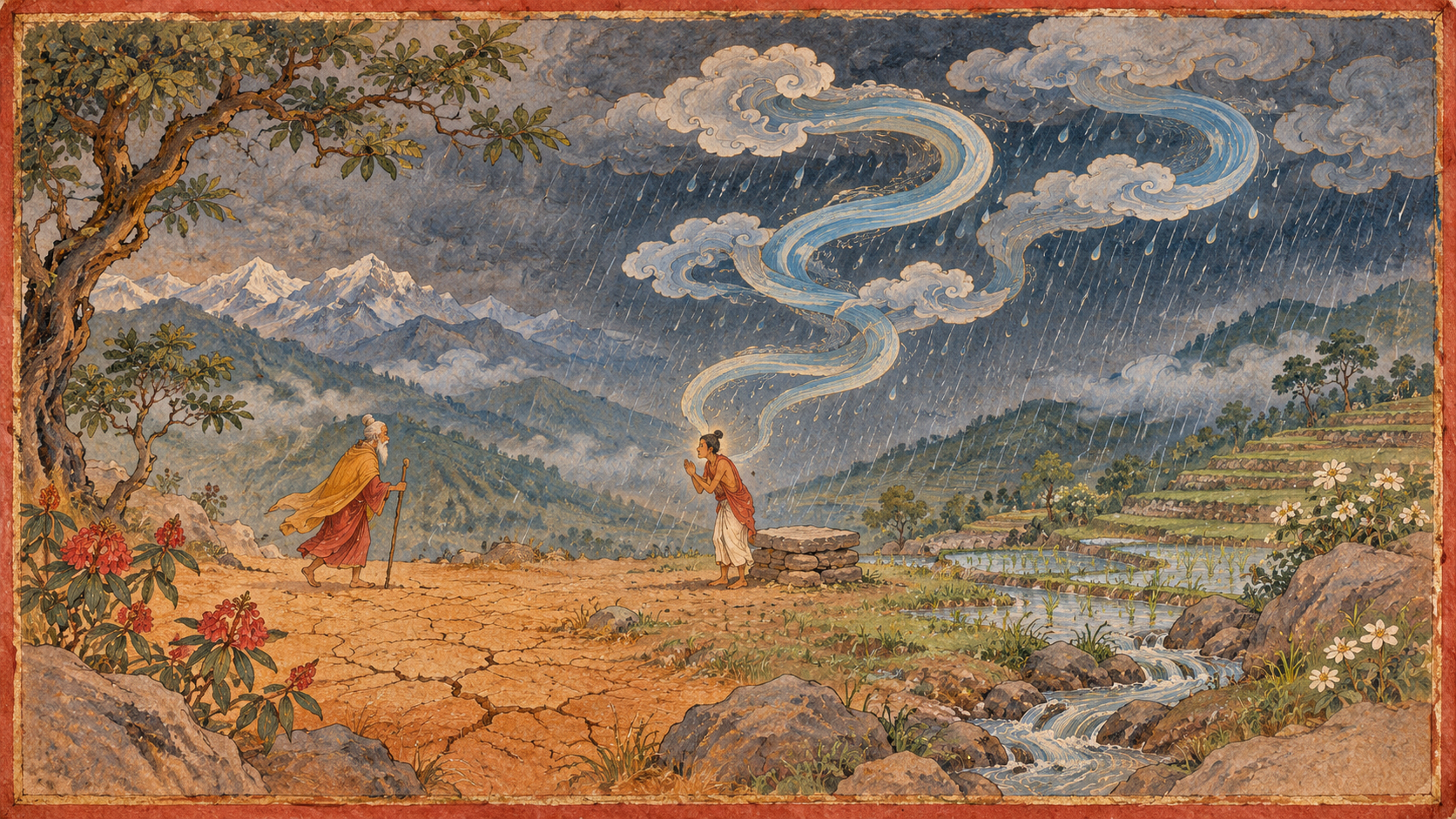
Machhindranath is the name form most visibly associated with the jatra; Matsyendranath is another form of the guru’s name. The drought narrative also introduces Gorakhnath, the renowned yogi and disciple, as part of the spiritual imbalance surrounding the crisis. Matsyendranath’s journey to the Kathmandu Valley brings the decisive change and the return of rain.
This relationship gives the festival a meaning that a simple label such as rain ritual cannot carry. Gorakhnath is not presented as an ordinary wrongdoer who can be defeated by greater force. He belongs to a lineage. The resolution therefore comes through the presence of the guru, whose authority can bring ascetic power back into right relationship.
The distinction is subtle but important. Dharmic traditions do not usually treat spiritual power as self-justifying. Tapas, yogic discipline or extraordinary capability can be real and still require right direction. Power becomes beneficial when it remains aligned with dharma; detached from that alignment, it can contribute to disorder.
When you read the festival through this lens, notice the sequence rather than searching only for a villain: imbalance appears, ordinary life suffers, the guru is brought into the situation, relationship is restored and the conditions of life return. The rain is both a physical blessing and the visible sign of repaired order.
The jatra joins ecology, memory and public space
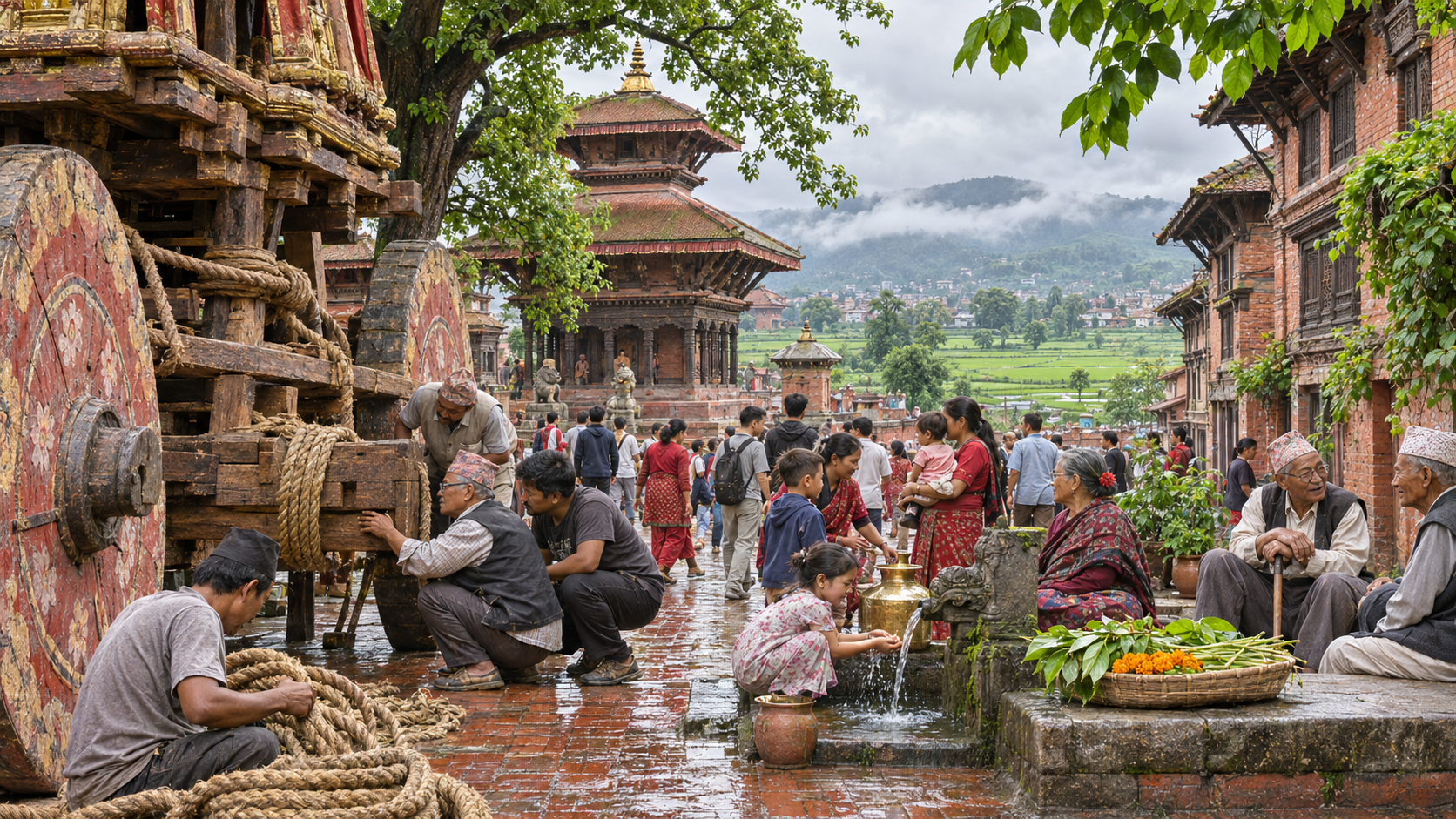
A jatra carries sacred memory into shared space. The teaching is not confined to a private meditation room or preserved only as an idea. It becomes something a community can gather around, witness and transmit. Movement through inhabited space declares that the sacred concerns the life of the settlement itself.
That public character changes what remembrance means. A narrated drought might remain a tale from the distant past. A recurring jatra requires people to remember together that water can fail, cultivation can become impossible and collective survival can become fragile. The observance makes dependence visible before a new emergency forces people to acknowledge it.
This is why agriculture cannot be treated as background scenery. The dry fields in the narrative explain the urgency of Matsyendranath’s arrival. Rain is grace precisely because it reaches crops, rivers and households. The festival’s spirituality is grounded rather than evasive: the restored order must be capable of sustaining embodied life.
The same lens can help you understand other Dharmic celebrations. Ask three connected questions. What natural condition makes life possible here? What rupture does the sacred narrative remember? What communal action keeps the lesson alive? Those questions reveal more than a catalogue of costumes, objects or ceremonial movements ever could.
How to witness the jatra without flattening its meaning
Before you watch, learn the narrative arc
Keep four elements in mind: drought, spiritual imbalance, the relationship between Gorakhnath and his guru, and the arrival of Matsyendranath as the turning point. This small amount of preparation will help you recognise that the public celebration is carrying a moral and ecological memory, not merely presenting an attractive scene.
During the observance, watch relationships
Do not focus only on the most visually dramatic moment. Notice how sacred presence, inhabited space and collective participation are brought together. Pay attention to who accepts responsibility, who makes room and how individual devotion becomes coordinated community action. The festival’s meaning lives as much in those relationships as in its visible symbols.
Let local explanations remain layered
Long-lived Dharmic traditions are rarely exhausted by one label. A participant may emphasise the guru, rain, compassion, lineage, local belonging or communal continuity. Ask which meaning matters to that person instead of demanding a single definition that cancels the rest. Variation does not automatically prove confusion; it can show how a tradition serves several forms of remembrance at once.
Practice ordinary ritual courtesy
If you attend in person, treat the event first as worship and only second as something to document. Follow local directions, avoid obstructing movement and ask before photographing people at close range. A useful test is simple: if getting the image requires someone else to interrupt devotion or ceremonial work, step back.
Key takeaways
- Rato Machhindranath Jatra remembers a drought that threatened the survival of the Kathmandu Valley, so water and cultivation belong at the centre of its meaning.
- The festival is not best read as an attempt at weather science. It expresses a Dharmic conviction that material life and spiritual order cannot be sealed apart.
- The relationship between Matsyendranath and Gorakhnath shows why spiritual power must remain oriented by the guru and aligned with dharma.
- The return of rain represents more than relief from scarcity; it marks the restoration of a life-sustaining order.
- A respectful observer looks beyond spectacle to the relationships among sacred presence, public space, ecological dependence and community memory.
The next time you encounter the jatra, begin with the dry field rather than the festive image. Follow the movement from scarcity to restored relationship, and ask what kind of responsibility the return of rain places on the community that receives it. That is where this ancient memory becomes a living lesson for you rather than a custom viewed from a distance.
References

Leave a Reply
You must be logged in to post a comment.