

Shravan 2026 is not represented by one date range or one uniform set of observances. Its calendar changes with regional lunar-month conventions, while its religious life extends from month-long disciplines to household vratas and commemorations of poets and saints.
The three source articles together offer a practical way to navigate that diversity. One explains the calendar and month-wide Shravan tradition, another documents the five Jivati Puja Fridays followed in Maharashtra and Gujarat, and the third places Tulsidas Jayanti on Shravan Shukla Saptami. Read together, they show how astronomy, regional custom, family inheritance and ethical purpose shape the observance of the month.
Why Shravan has more than one 2026 calendar
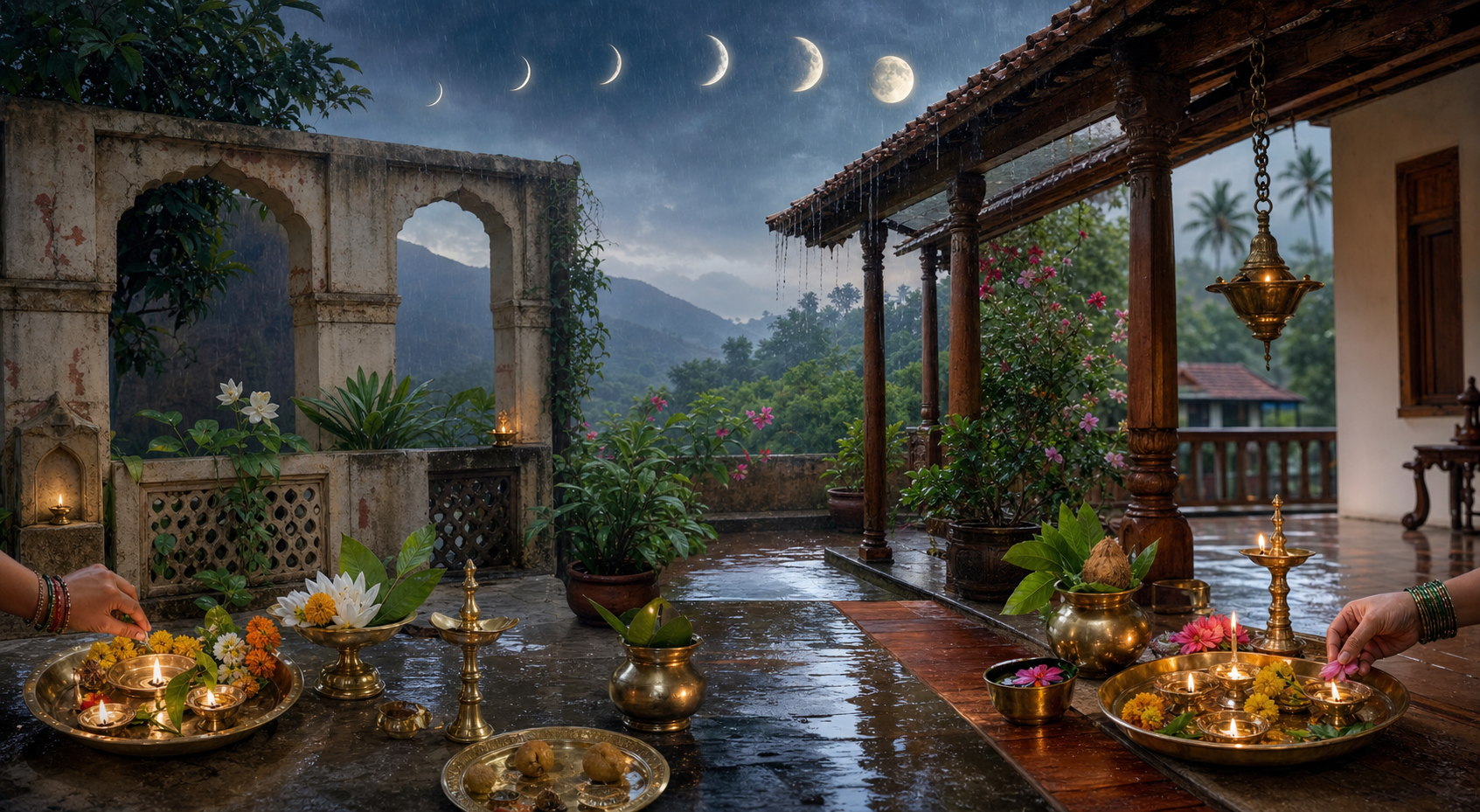
The apparent differences among Shravan calendars begin with two legitimate ways of naming lunar months. The Shravan Maas Mahatmya overview reports that an Amanta month begins after Amavasya and ends at the next Amavasya, while a Purnimanta month begins after Purnima and ends at the next Purnima. Purnimanta reckoning is common across much of northern India; Amanta reckoning is widely used in Maharashtra, Gujarat, Karnataka, Andhra Pradesh, Telangana and other regions, subject to local variation.
These systems name different portions of the same continuous lunar cycle. Purnimanta Shravan begins roughly a fortnight before Amanta Shravan, according to the month-wide source. Shravan Purnima therefore closes the month in the former system but occurs near the middle of the latter. A festival can consequently carry different month labels without being assigned to different astronomical events.
A second complication is that a tithi is not a midnight-to-midnight civil date. Both the Tulsidas Jayanti guide and the Shravan Maas article describe it as each 12-degree increase in the angular separation of the Moon and Sun. A tithi may begin or end during a civil day, and calendars may apply rules involving the tithi present at local sunrise. Location, astronomical calculations and lineage-specific practice can therefore affect the date assigned to an observance.
Key takeaways
- Shravan 2026 does not have one universally applicable Gregorian date range.
- Amanta and Purnimanta calendars are parallel regional conventions, not competing claims about the Moon.
- Festival decisions may depend on tithi boundaries, local sunrise and the rules of a community or sampradaya.
- A city-specific panchang and inherited family practice are more reliable than copying another region’s calendar dates.
The 2026 dates established by the sources
The sources provide a precise western Indian schedule and one tithi-based commemoration, but they do not establish a single worldwide Shravan timetable. The following dates should therefore be read with their reported calendar context intact.
| Calendar item | Reported 2026 timing | Context |
|---|---|---|
| Western Indian Shravan | Approximately August 13 to September 11 | The Jivati Puja source gives this range for the Amanta tradition followed in Maharashtra and Gujarat. |
| Jivati Puja Fridays | August 14, August 21, August 28, September 4 and September 11 | The five Shravan Fridays reported for Maharashtra and Gujarat; some households observe all five and others select one. |
| Tulsidas Jayanti | Wednesday, August 19 | The Tulsidas source identifies the day as Shravan Shukla Saptami and reports that most Indian calendars it consulted agree on the civil date. |
| Saptami boundary in New Delhi | Approximately 7:19 p.m. on August 19 | A location-specific timing reported by the Tulsidas article, not a clock time to apply worldwide. |
The western Shravan range and Friday sequence come from the Jivati Puja 2026 guide. The broader Shravan article deliberately avoids imposing year-specific dates because no range is correct for every region. Those positions are complementary rather than contradictory: one supplies dates for a defined regional convention, while the other warns against universalizing them.
A sacred month organized by recurring disciplines
Shravan is strongly associated with Lord Shiva in popular practice, but the month-wide source also records worship connected with Parvati, Vishnu, Lakshmi, Krishna, Ganesha, the Nagas, Surya and Hanuman. This range matters because it presents Shravan less as a single festival than as a calendar framework within which different communities emphasize different relationships, deities and duties.
The same source connects the month-name with Shravana Nakshatra and notes the symbolic resonance between Shravana and attentive hearing. That connection helps explain the importance given to katha, mantra, recitation and scriptural study. In a widely circulated recension described by the article, the Shravan Maas Mahatmya is a thirty-chapter cycle associated with an Ishvara-Sanatkumara dialogue in the Skanda Purana. It treats weekday and tithi observances alongside practices such as japa, Rudrabhisheka, regulated eating and voluntary restraint.
Its organizing principle is ethical as well as ritual. The source interprets sacred hearing as fruitful when it changes conduct, highlighting humility, patience, cleanliness, freedom from pretence and a willingness to listen without habitual fault-finding. Month-long discipline can therefore be understood as a repeated pattern: worship gives attention a form, fasting or dietary restraint limits excess, and service directs devotion toward the welfare of others.
The monsoon setting gives these practices additional texture. The articles describe rain-washed streets, seasonal vulnerability, simplified food and concern for living beings. They do not reduce Shravan to its weather, but they show why restraint, protection and interdependence can become especially visible during the rainy season.
Household care and public memory within the same month
Jivati Puja turns concern for children into a vrata
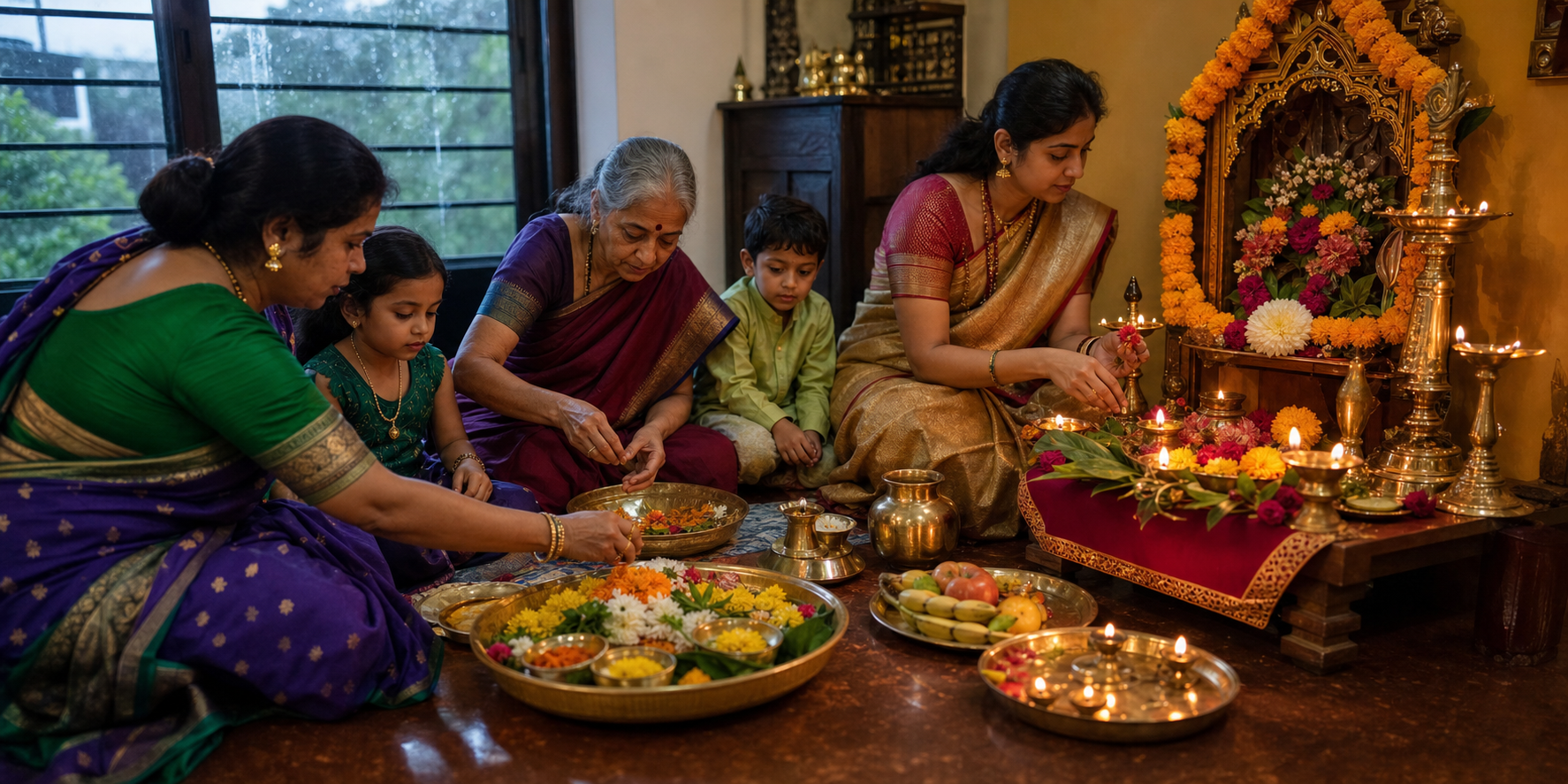
The Jivati source presents the Shravan Friday observance as one of western India’s intimate household traditions. Jivati or Jivantika is approached as a protective mother deity associated with life and children’s well-being. Some devotional explanations understand her as a form of Parvati, while regional practice can preserve her identity as a guardian goddess in the wider Shakta world. The source does not force those interpretations into a single definition.
Although married women and mothers have traditionally stood at the centre of the vrata, the article distinguishes historical ritual form from the wider work of caregiving. Fathers, grandparents, siblings and children may contribute to prayer, preparation, hospitality and service according to household custom. The core movement is from anxiety to responsibility: a family’s hope for protection is expressed through disciplined attention rather than left as an unspoken fear.
The article’s reading of a widely circulated Jivati print broadens that responsibility. Its reported imagery joins Narasimha and Prahlada, Krishna restraining Kaliya, Jara-Jivantika with children, and the planetary deities Budha and Brihaspati. In the interpretation presented by the source, these panels move from rescue and preservation toward discernment, education and mature character. Protection thus means more than surviving danger; it includes helping a child become thoughtful and responsible.
The source also draws an important boundary around devotional claims. Jivati Puja may offer spiritual reassurance and reinforce attentive parenting, but it is not presented as a replacement for vaccination, safe water, nutritious food, supervision, prenatal care or timely professional treatment. Practical care can be treated as part of the vow to protect life.
Tulsidas Jayanti makes literary remembrance an observance
Tulsidas Jayanti occupies another scale of Shravan life. The Tulsidas source places it on Shukla Paksha Saptami and interprets it not simply as a birthday celebration but as an occasion to revisit Rama-centred devotion, ethical vision and vernacular literature. Tulsidas is best known for the Ramcharitmanas and is traditionally associated with the Hanuman Chalisa; the source traces his influence through recitation, music, theatre, pilgrimage and household worship.
This commemoration also demonstrates how a stable ritual date can coexist with historical uncertainty. The article reports that traditional and scholarly publications use birth years including 1497, 1532 and 1543. It therefore advises against presenting a numbered anniversary as settled history, even though some 2026 calendars call the occasion the 529th birth anniversary by calculating from 1497. The observance itself does not require that dispute to be resolved because it follows the inherited association with Shravan Shukla Saptami.
Placed beside Jivati Puja, the Jayanti reveals the breadth of a lunar month as a cultural institution. A Friday household ritual can focus on the future of a child, while a Saptami commemoration renews collective memory of a poet-saint. Both use recurring calendar time to turn an enduring value – responsible care in one case, devotional and literary remembrance in the other – into a practice that can be transmitted.
How to prepare a reliable local observance plan
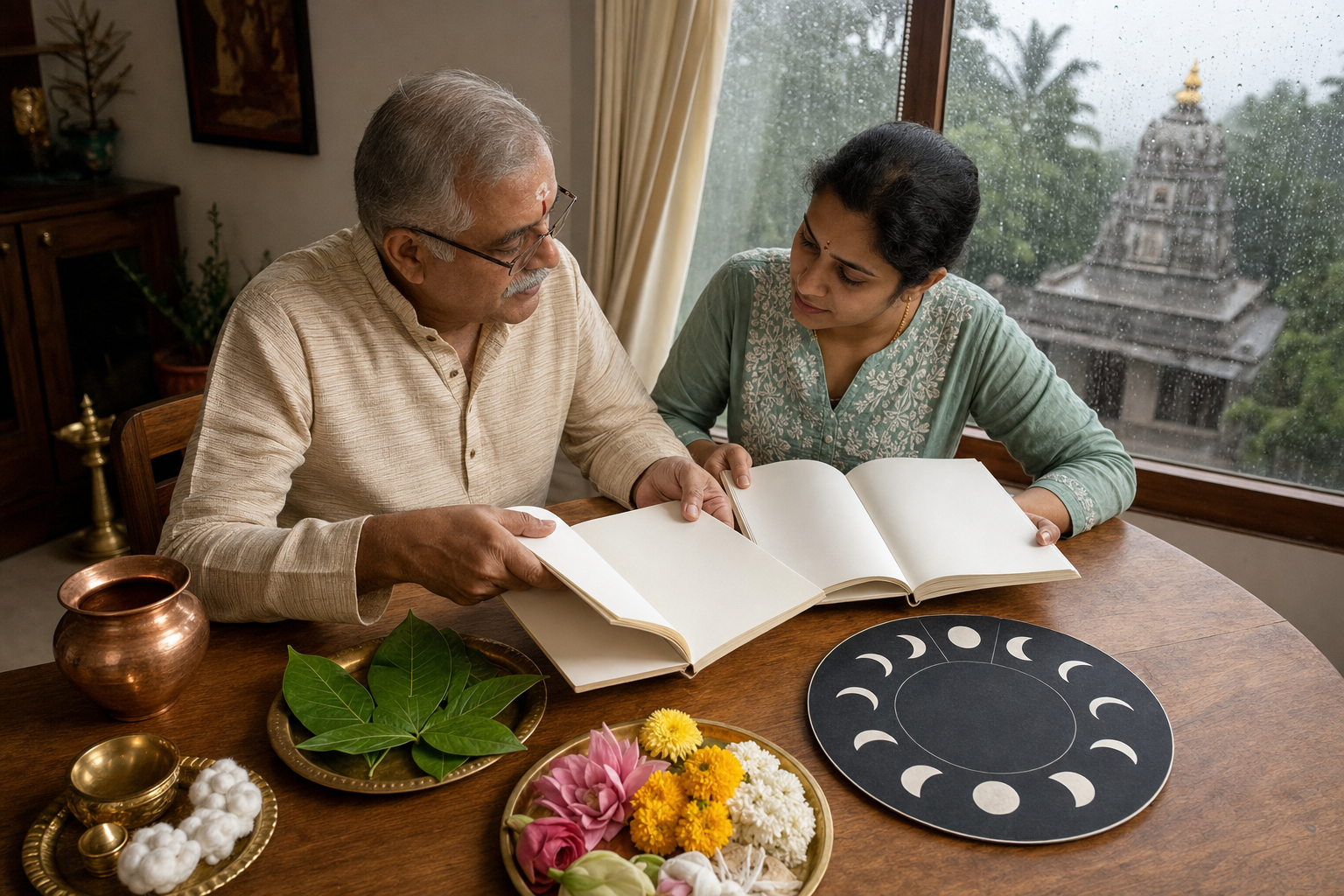
A useful Shravan calendar begins by separating astronomical timing from ritual choice. The sources support the following planning sequence:
- Identify whether the relevant family or temple follows Amanta, Purnimanta or another regional calendar convention.
- Consult a panchang calculated for the observer’s city, especially when a tithi begins or ends near sunrise or an observance lies near a month boundary.
- Check the rule for the particular observance rather than assuming that every vrata uses the same sunrise, weekday or tithi convention.
- Preserve the scope of published dates: the five Jivati Fridays apply to the reported Maharashtra-Gujarat Amanta context, while the New Delhi Saptami time applies only to that location-specific calculation.
- Let inherited household and sampradaya practice decide among documented alternatives, such as observing every Shravan Friday or selecting one principal Jivati vrata day.
- Connect the calendar to conduct through attentive worship, restraint, study, hospitality, caregiving or service appropriate to the tradition.
For Shravan 2026, the most dependable calendar will therefore be local without becoming narrow: astronomically suited to place, faithful to an inherited practice and attentive to the wider ethical purpose that gives each observance meaning.
References
- DharmaRenaissance Blog – Tulsidas Jayanti 2026: A Powerful Guide to His Life, Ramcharitmanas and Legacy
- DharmaRenaissance Blog – Shravan Maas Mahatmya: Powerful Meaning, Sacred Katha and Sawan Rituals Explained
- DharmaRenaissance Blog – Jivati Puja 2026: Complete Shravan Friday Guide for Maharashtra and Gujarat Families