

Shravan’s Monday Shiva vrata and Tuesday Mangala Gauri vrata create an adjacent weekly rhythm in 2026, but their civil dates depend on the calendar tradition being followed. Placing the two schedules side by side reveals both the regional differences and the weeks shared across the major lunar systems.
The apparent conflict among published dates is not a dispute over the observances themselves. It arises mainly because Purnimanta and Amanta calendars assign different portions of the same lunar cycle to the month named Shravan.
Key takeaways
- North Indian Purnimanta and western or southern Amanta calendars produce different starting dates for both weekly vratas.
- Each lunar schedule contains four Monday-Tuesday pairs, with the Shiva observance followed the next day by the Mangala Gauri observance.
- Two complete weekly pairs fall within Shravan under both lunar conventions in 2026.
- A household’s inherited calendar and a panchanga calculated for the devotee’s actual location should take precedence over a generic online date.
The two 2026 lunar schedules side by side
The source article on Shravan Somvar reports the Monday dates and the beginning and end of Shravan in each lunar convention. The Mangala Gauri article separately reports the corresponding Tuesday dates. Combining those findings produces the following weekly sequences.
| Calendar tradition | Reported Shravan span | Monday-Tuesday vrata pairs in 2026 | Common regional use |
|---|---|---|---|
| Purnimanta | 30 July to 28 August | 3-4 August; 10-11 August; 17-18 August; 24-25 August | Much of North India |
| Amanta or Amavasyanta | 13 August to 11 September | 17-18 August; 24-25 August; 31 August-1 September; 7-8 September | Maharashtra, Gujarat, Goa, Andhra Pradesh, Telangana and Karnataka, among other communities |
The first date in each pair is Shravan Somvar, dedicated to Shiva, and the second is the following Mangala Gauri Tuesday. The overlap is especially useful for mixed-regional families: 17-18 August and 24-25 August are complete Monday-Tuesday pairs under both lunar systems.
The Somvar source also reports a separate solar Saun sequence in Nepal: Mondays on 20 and 27 July and 3 and 10 August 2026. It does not supply a parallel set of Mangala Gauri Tuesday dates for that solar convention, so such dates should not be extrapolated from the Monday schedule.
Why Purnimanta and Amanta dates differ
Both systems follow the same Moon and the same succession of tithis. A tithi is determined by each successive 12-degree increase in the angular separation of the Moon and Sun, and it can begin or end at any hour rather than matching a civil day exactly.
The distinction lies at the boundary of the named month. Purnimanta reckoning ends a lunar month at Purnima, while Amanta reckoning ends it at Amavasya. Because a synodic lunar month lasts approximately 29.5 days, the two conventions can apply different month names to a dark fortnight even though the astronomical sequence remains continuous.
The Somvar report illustrates the difference with 3 August 2026 in New Delhi. That day is identified as Shravana under Purnimanta reckoning but Ashadha under Amanta reckoning. By 17 August, both systems call the month Shravana. This is why 3 August is the first Shravan Monday in the northern sequence, while 17 August is the first in the western and southern sequence.
Location adds another layer. The sources explain that traditional observance is generally evaluated with reference to local sunrise, while tithi boundaries depend on local astronomical calculations. A tithi close to a boundary can therefore affect the assigned day in distant cities. Devotees outside India, in particular, should use a panchanga configured for their city rather than mechanically copying an India-based calendar.
The devotional logic of the Monday-Tuesday rhythm
The Somvar article connects Monday, Somavara, with Soma and the Moon, which appears in Shiva’s iconography as the crescent. Monday worship occurs throughout the year in many traditions, but Mondays within Shravan receive heightened devotional importance.
The next day turns toward Mangala Gauri, an auspicious and protective form of Parvati. According to the Mangala Gauri source, the Tuesday vrata traditionally carries prayers for marital harmony, family welfare, longevity and prosperity. The article presents these as devotional aspirations, not guaranteed material outcomes.
Read together, the two observances express a complementary Shiva-Shakti pattern rather than a single combined ritual. Monday emphasizes Shiva, while Tuesday centers Gauri and women’s ritual agency. The sequence connects ascetic discipline with household flourishing, and stillness with sustaining activity, without treating either devotional focus as secondary.
Mangala Gauri Vratham is especially associated with married women and, in many Maharashtrian, Kannada and Telugu households, with the early years of marriage. The source reports a widespread practice of observing it through the first five Shravan seasons after marriage and then performing udyapana, while also cautioning that the duration is not universal. Family or sampradaya instructions may prescribe a different pattern.
How to plan the observances without mixing traditions
- Identify the governing calendar. The relevant question is not which online list appears most often, but whether the household, temple or sampradaya follows Purnimanta, Amanta or a regional solar convention.
- Localize the dates. Check the complete sequence against a reputable panchanga set for the actual city, especially when observing outside India or near a tithi boundary.
- Confirm the ritual scope of each day. Adjacent dates do not make the Monday and Tuesday rites interchangeable. Inherited directions from a knowledgeable elder, priest or tradition-bearer should guide the sankalpa, fasting practice and form of worship.
- Treat the vrata as more than food restriction. The Mangala Gauri source describes vrata as a vowed discipline that can include worship, mantra, sacred narrative, ethical restraint, charity, hospitality and careful speech, with fasting as only one possible component.
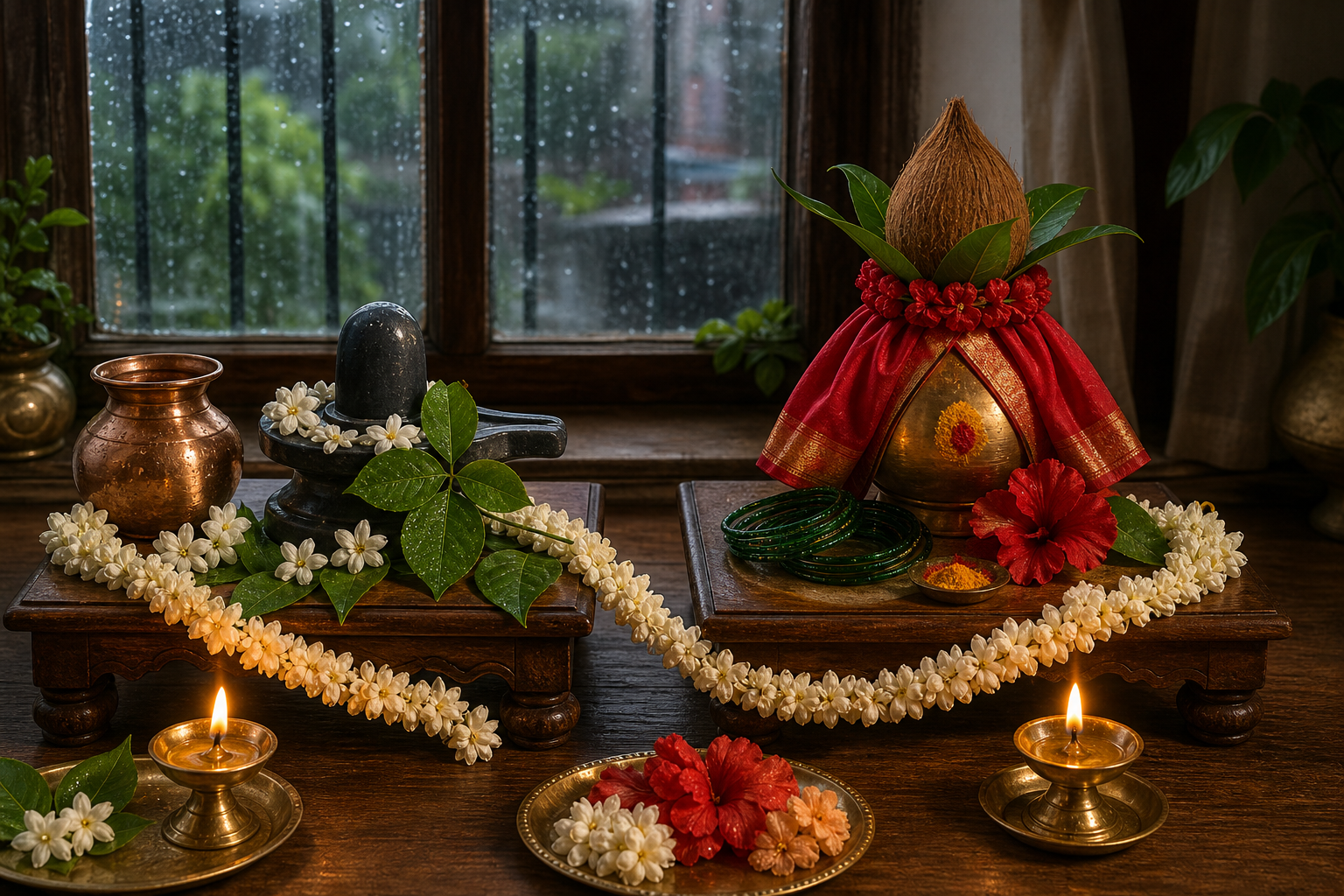
For a simple Mangala Gauri home observance, the Tuesday source lists an image or suitable murti, a stable altar, clean cloth, water, lamp, flowers, turmeric, kumkum, sandalwood paste, akshata, fruit and modest sattvic naivedya. It emphasizes cleanliness, attention and reverence over expense. More elaborate regional arrangements should be adopted only where they belong to the family’s established practice.
Before Shravan 2026 begins, documenting the chosen calendar, city, applicable date sequence and inherited ritual instructions can prevent mid-month confusion and keep the observances centered on devotion rather than competing date lists.


References
- DharmaRenaissance Blog – Mangala Gauri Puja 2026: Complete Dates, Vidhi, Meaning and Regional Guide
- DharmaRenaissance Blog – First Shravan Somvar 2026: Exact Dates, Regional Calendars and Complete Vrat Guide