
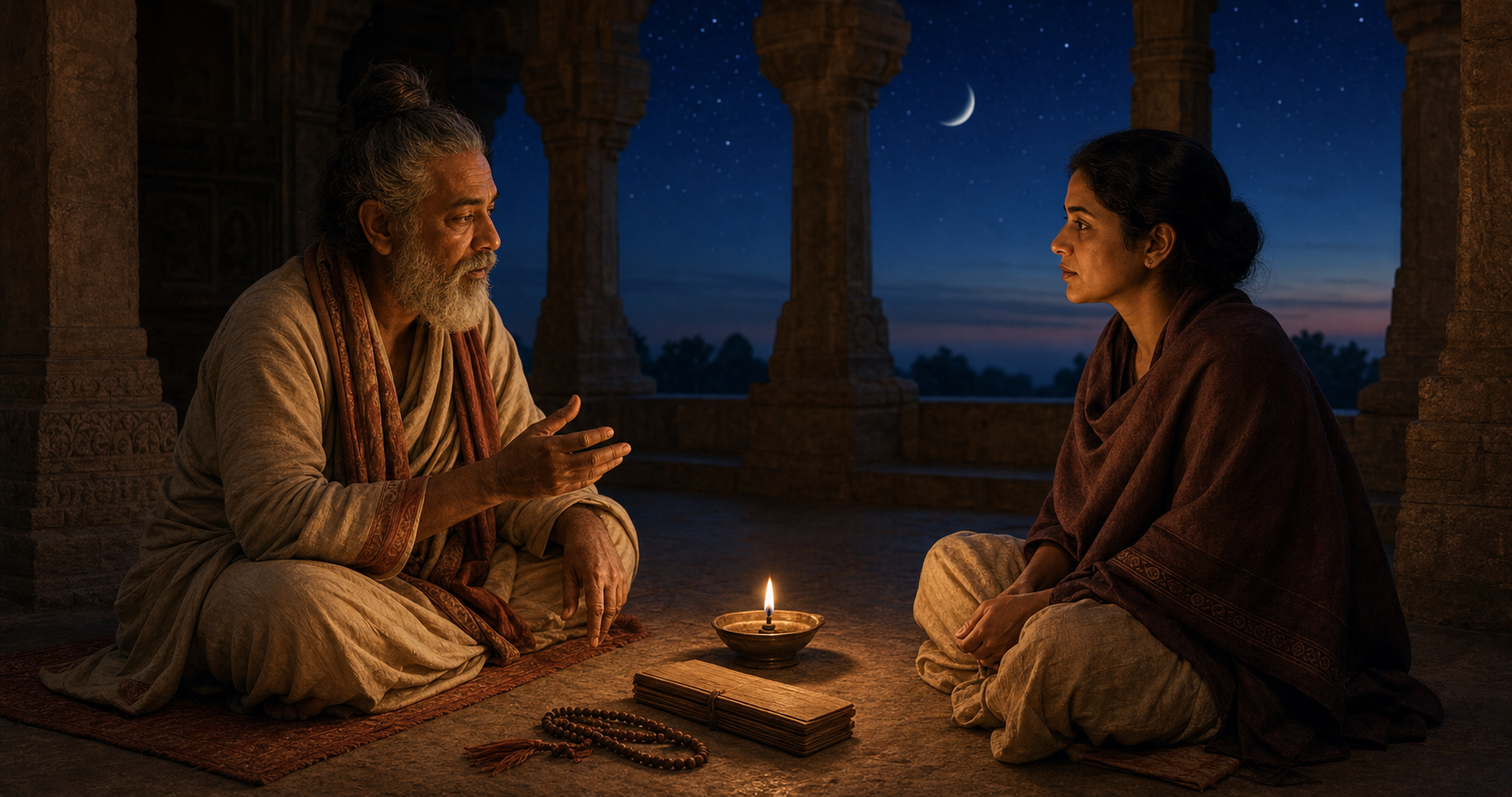
Choosing an advanced Shakta practice involves more than matching a birth star to a goddess. The central questions are whether the practice is public or lineage-restricted, what commitments the practitioner already carries, and whether a qualified teacher has conferred the necessary authorization.
The two source articles illuminate different parts of that decision. The nakshatra guide presents a symbolic way to explore the Mahavidyas, while the Pratyangira guide shows why attraction, astrological correspondence and ritual eligibility must not be treated as interchangeable.
Spiritual affinity, initiation and timing answer different questions
Several forms of selection are often compressed into the single question, “Which goddess should be worshipped?” A more careful approach separates at least three layers.
Spiritual affinity concerns the deity, symbolism or theological vision toward which a person feels drawn. Initiation concerns adhikara: eligibility or authorization to undertake a particular lineage-based discipline. Timing concerns when a permitted practice should begin or when a ritual should be performed. A birth-star table may contribute to the first question, but it does not independently settle the second or third.
This distinction is the clearest point of convergence between the sources. The Mahavidya article says its planetary correspondence cannot determine initiation or overrule a guru, kula devata, ishta devata, family tradition or established temple relationship. The Pratyangira article likewise stresses that educational material cannot confer adhikara or reproduce the contextual instruction traditionally given through diksha.
Key takeaways
- A janma-nakshatra correspondence can suggest a field for reflection; it does not issue a ritual command.
- Diksha governs eligibility for lineage-restricted practice and cannot be replaced by a calculation, book or webpage.
- Public temple worship, devotional prayer and initiated mantra sadhana are not equivalent undertakings.
- A deity-selection table does not by itself select an auspicious date or time for initiation.
- Existing obligations to a guru, lineage, family deity or chosen deity take priority over a generic correspondence.
What the birth-star method actually calculates

The nakshatra article describes a specific interpretive model. It begins with the janma nakshatra occupied by the natal Moon, identifies that nakshatra’s ruler in the Vimshottari dasha sequence, and connects the ruler with one of nine Mahavidyas.
In the reported 27-nakshatra framework, each lunar mansion spans 13 degrees 20 minutes and contains four padas of 3 degrees 20 minutes. The Vimshottari rulers repeat in a nine-part sequence, allowing the 27 nakshatras to be organized into nine groups of three. The method therefore has a tidy internal structure, but that structure should not be mistaken for a universal rule across all Shakta or Jyotisha traditions.
The article also warns against confusing a nakshatra’s Vimshottari ruler with its presiding deity. Planetary ruler, traditional devata, symbol, guna, pada and zodiacal position are distinct interpretive layers. The resulting Mahavidya assignment is an overlay joining two bodies of tradition, not an exhaustive definition of either one.
Accuracy matters especially when the Moon lies near a nakshatra boundary. According to the source, calculation requires the birth date, local time, birthplace, historical time-zone offset and a declared ayanamsha. Different settings may move a boundary-positioned Moon into a neighboring nakshatra. Uncertain birth data should therefore produce a qualified result rather than false ritual certainty.
There is a further limit that is easy to overlook: the reported table selects a contemplative association from the natal Moon. It does not supply an initiation date. Choosing a deity through a birth-star correspondence and choosing the time for a ritual are separate decisions, and the table addresses only the former.
The nine-graha map and its structural limitation

The following table reproduces the correspondence reported by the nakshatra article. It should be read as one lineage-dependent symbolic system rather than a compulsory classification.
| Vimshottari ruler | Nakshatras | Mahavidya in the reported system |
|---|---|---|
| Sun | Krittika, Uttara Phalguni, Uttara Ashadha | Matangi |
| Moon | Rohini, Hasta, Shravana | Bhuvaneshwari |
| Mars | Mrigashira, Chitra, Dhanishtha | Bagalamukhi |
| Mercury | Ashlesha, Jyeshtha, Revati | Tripura Sundari |
| Jupiter | Punarvasu, Vishakha, Purva Bhadrapada | Tara |
| Venus | Bharani, Purva Phalguni, Purva Ashadha | Kamala |
| Saturn | Pushya, Anuradha, Uttara Bhadrapada | Kali |
| Rahu | Ardra, Swati, Shatabhisha | Chinnamasta |
| Ketu | Ashwini, Magha, Moola | Dhumavati |
Bhairavi receives no nakshatra group in this arrangement. The source explains the omission arithmetically: the Dashamahavidya tradition contains ten goddesses, whereas the Vimshottari cycle supplies nine planetary rulers. Bhairavi’s absence from the grid does not make her secondary or unavailable; it exposes the inability of a nine-part astrological overlay to contain the whole tenfold tradition.
The same caution applies to the nine included forms. The source rejects reductions such as treating Kali merely as a Saturn remedy, Kamala as a route to money or Bagalamukhi as a means of winning disputes. A correspondence may open a contemplative doorway, but each Mahavidya exceeds the benefit, planet or temperament assigned to her in an introductory scheme.
Pratyangira shows why lineage comes before an online formula

Pratyangira is not an entry in the reported nine-graha Mahavidya table, but her case clarifies the limits of self-selection. The Pratyangira article describes her principally as a protective Tantric goddess associated with Shakti and commonly represented in a fierce, lion-faced form. Devotional traditions connect her with the reversal of hostile influences and the restoration of courage, while the article cautions that such religious interpretations are not scientific diagnoses of illness, conflict, financial loss or unusual perceptions.
The source distinguishes attendance at a temple ceremony from adopting an initiated Pratyangira mantra discipline. That distinction matters because a public image, festival or act of devotion does not automatically disclose the requirements of a restricted ritual system. Nor does a strong emotional response to fierce iconography establish readiness for every practice associated with that deity.
The article’s historical account reinforces this point. It reports that references to Pratyangira developed through multiple Purāṇic, ancillary Atharvavedic, Agamic and Tantric settings. It also describes differing mantras, visualizations, implements and theological identifications across sources and lineages. Consequently, there is no single online formula that can safely stand in for lineage context.
Diksha, in this setting, is not simply access to otherwise hidden syllables. As presented by the source, it supplies authorization and contextual instruction. The guru-lineage relationship identifies which ritual form is being transmitted, who is eligible for it and how its boundaries are understood. A nakshatra match cannot perform any of those functions.
The theology of fierceness also deserves careful interpretation. The Pratyangira article reads the terrifying form as protection directed against disorder rather than aggression against disliked people. Weapons, flame-like hair and the lion face may communicate restraint, discernment, alertness and the transformation of fear into steadiness. Such symbolism supports ethical self-discipline; it should not be converted into a promise of supernatural retaliation.
A responsible sequence for choosing an advanced practice

A sound selection process moves from established religious context toward optional astrological reflection, rather than beginning with a table and searching afterward for permission.
- Classify the proposed activity. Determine whether it is open devotional worship, a public temple observance or a lineage-restricted mantra and ritual discipline. The category affects whether formal authorization is relevant.
- Identify existing commitments. A relationship with a guru, lineage, family deity, chosen deity or temple tradition supplies context that a generalized correspondence cannot see.
- Clarify the purpose. The attraction may concern devotion, study, ethical transformation or a desire for help during distress. Reducing a goddess to a narrowly instrumental result can distort the theological meaning of the practice.
- Verify the natal calculation if it will be used. Confirm the birth data, time-zone history and ayanamsha, and acknowledge uncertainty near a nakshatra boundary.
- Treat the result as a question for reflection. The assigned Mahavidya may be studied symbolically and discussed with a qualified teacher. It should not be treated as a mandate to obtain or recite a restricted mantra independently.
- Seek lineage-specific direction before undertaking restricted practice. Authorization should concern the actual form and discipline being proposed, not merely a deity name shared by several traditions.
- Keep spiritual interpretation within appropriate limits. Religious care may provide meaning and emotional support, but persistent psychological, medical, legal or practical problems still require suitable professional assistance.
This sequence also prevents “advanced” from becoming a synonym for dramatic imagery or ritual intensity. Readiness is better assessed through authorization, steadiness, ethical purpose and the capacity to honor the obligations of a practice.
The constructive next step is therefore not to hunt for the most forceful mantra. It is to establish the practitioner’s actual religious context, use nakshatra symbolism modestly, and allow any deeper commitment to develop through informed lineage guidance.
References
- DharmaRenaissance Blog — Pratyangira Devi Sadhana: Complete Guide to Diksha, Mantra Initiation, and Guru Rules
- DharmaRenaissance Blog — Nakshatra-Based Mahavidya Sadhana: A Powerful Guide to Choosing Wisely