
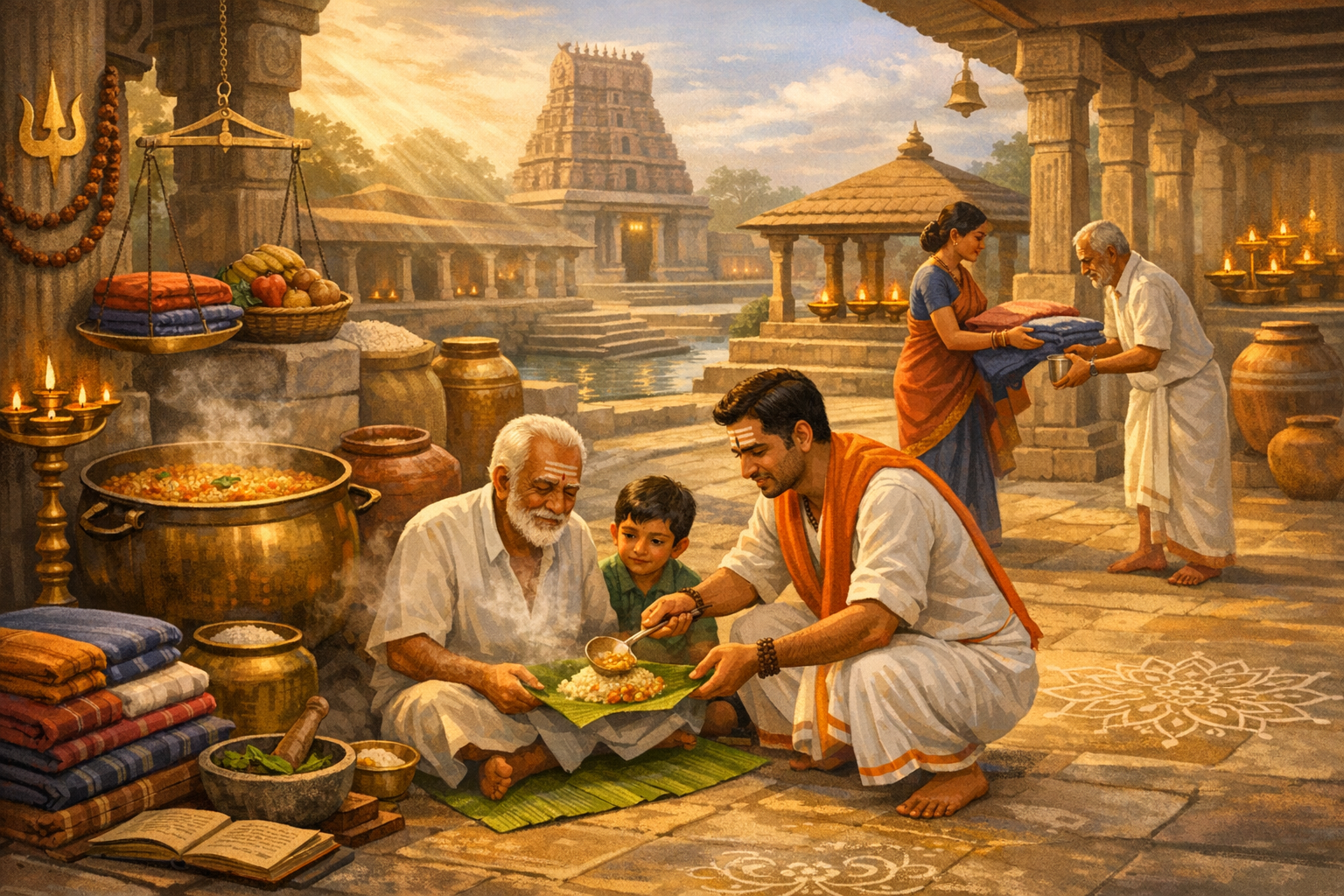
The Nayanarsrevered Shaivite saints of Tamil Nadu active largely between the 6th and 9th centuries CEtreated charity (dāna) and everyday service (seva) as inseparable from spiritual realization and social responsibility. Preserved in the Tevaram hymns of Appar (Tirunavukkarasar), Sambandar, and Sundarar, and in Sekkizhar’s 12th-century Periyapuranam, their lives present an ethic in which giving nourishes both society and the soul. In this Shaiva Siddhanta milieu, material support to the vulnerable, dignified hospitality for travelers and ascetics, and collective provisioning through temples and community kitchens formed a coherent soteriological practice: compassion as sadhana.
Within this tradition, Ahara (Food) givingAnnadānaoccupied pride of place. The Nayanars taught that offering nutritious food to the hungry is among the highest forms of charity because it preserves life, stabilizes the mind, and creates the conditions for dharma and contemplation. In the idiom cherished across Tamil Nadu, “Annadanam paramam dānam” captures why food security is sacred work. Even today, temple annadanam halls, roadside water sheds (thanneer pandal), and festival kitchens continue this lineage of care in visible, practical ways.
An ethical framework undergirds this giving. Classical dharmic guidanceshared across Shaiva sources and dharmashastrastresses the fitness of the recipient (pātra), the appropriateness of place (deśa) and time (kāla), the nature of the gift (dravya), and, above all, the intention (bhāva) and faith (śraddhā) of the giver. The Nayanars consistently model humility, anonymity where possible, and gratitude for the opportunity to serve. In this view, charity dissolves ahaṅkāra (ego) and refines bhakti (devotion), moving the practitioner from transactional help toward transformative seva.
Annadāna in practice appears luminously in the life of Ilayankudi Maranar Nayanar. Known for feeding devotees, mendicants, and the poor without distinction, he continued to cook even after losing his wealth, borrowing grain and gathering greens during storm and scarcity to honor an unexpected guest. The Periyapuranam remembers this scene not as miracle storytelling alone, but as an ethic: hospitality and food security are non-negotiable duties of a dharmic householder. The narrative affirms that steadfast generosity invites grace and regenerates community.
Vastradāna (the donation of clothing) receives an equally compelling exemplar in Amarneethi Nayanar. Celebrated for offering garments to ascetics and the poor with meticulous care, he is remembered for surrendering every last clothand even himselfwhen tested on a balance scale. The episode dramatizes a core Shaiva teaching: the worth of a gift lies not in its market value but in the giver’s interior freedom from possessiveness. The practical implication is unmistakable: clothing the cold is both humanitarian aid and spiritual discipline.
Atithi-sevāhonoring the unexpected guestreaches its most intense expression in the story of Siruthondar (Paranjothi), whose hospitality to Shiva in disguise is conveyed through powerful allegory. While the hagiography is hyperbolic, Shaiva commentators and temple traditions receive it as a pedagogical mirror: genuine hospitality places the guest’s dignity first, serves wholesome food without delay, and refuses spectacle. In contemporary terms, this maps onto dignified community feedingno intrusive photography, no shaming, and no discrimination.
Public endowments and infrastructure likewise appear as forms of dāna. Kochchenga Chola Nayanar (Kō-cceṅgaṇ Chola) is credited with building elevated “māḍa koil” temples that improved accessibility, regulated flow, and enabled stable provisioning. Temple endowments historically supported granaries, madapallis (temple kitchens), and water works. In the Nayanar ethos, building, maintaining, and transparently governing such institutions are acts of living dharma because they sustain annadanam and community care across generations.
Beyond food and clothing, Shaiva practice in Tamil country integrated aushadha-dāna (medicine), abhayadāna (protection), and jñāna/śikṣā-dāna (knowledge/education). Traditional mathams and temples offered simple remedies, distributed herbs, and kept first-aid stores; village tanks (eri/kuḷam), water pots under shade, and night lamps on caravan routes enhanced traveler safety and public health. Instruction in sacred hymns by odhuvars, and the patronage of learning, fulfilled the pedagogical dimension of dānanurturing minds while caring for bodies.
These practices converge into a taxonomy of giving that is both spiritual and technical: Ahara-dāna (food), Vastradāna (clothing), Aushadha-dāna (medicine), Jñāna/Śikṣā-dāna (education), Abhayadāna (safety/shelter), and Kārya-dāna (support for institutions and public works). The Nayanars insisted that each be pursued with justice, transparency, and humility, prioritizing the most vulnerable while nurturing a culture of mutual care. In modern terms, this means strong governance, published accounts, inclusive access, safe logistics, and a service posture that centers recipients’ needs rather than donors’ visibility.
Importantly, Nayanar charity radiates beyond sectarian lines. Their songs praise compassion to all beings (jīva-dayā), readers witness the feeding of strangers without interrogation, and hagiographies honor the sanctity of life itself. The ethos naturally resonates with other dharmic traditions: Buddhist dāna pāramitā emphasizes generosity as a perfection, Jain practice articulates a fourfold dānaahara (food), aushadha (medicine), jñāna (knowledge), and abhaya (fearlessness/protection)and Sikh seva finds its communal heart in langar and Vand Chhako. This shared vocabulary of compassion exemplifies Vasudhaiva Kutumbakam and strengthens unity among Hinduism, Buddhism, Jainism, and Sikhism.
From a policy and program design standpoint, the Nayanar blueprint is strikingly practical. Sustainable annadanam requires nutrient-dense menus, consistent supply chains, food safety protocols, and culturally respectful service. Public kitchens benefit from predictable schedules and equitable tokens to avoid crowding. Water stations near transit hubs reduce heat stress and dehydration. Seasonal clothing drives are most effective when sizes are tagged, distribution is discreet, and follow-up ensures fit and dignity. When medicine is shared, licensed oversight, expiry checks, and referral links to clinics are essential.
Financing and governance reflect Shaiva insistence on integrity. Small recurring gifts stabilize budgets better than sporadic campaigns, and endowments should be invested conservatively with audited disclosure. Volunteer management thrives on training and rota discipline; safety briefings, basic first-aid preparedness, and grievance redressal build trust. TechnologyQR codes for menus, anonymized beneficiary counts, feedback forms in multiple languagescan enhance efficiency without turning service into surveillance.
Relatable memory underscores why these principles matter. Many who have waited in a temple queue for prasāda recall the relief of a hot ladle of sambar rice on a rainy evening, the calm of shade and water on a blistering day, or the quiet kindness of a volunteer offering a clean shawl. Such moments exemplify the Nayanar thesis: when basic needs are met with respect, anxiety subsides, social bonds thicken, and the mind becomes available for reflection and worship.
Measurement, though secondary to intention, helps communities learn. Useful indicators include meals served per day, average wait time, nutrient adequacy of menus, utilization of water stations in heat waves, number of discreet clothing exchanges completed, and referrals made to health facilities. Qualitative feedbackcomfort, dignity, cultural appropriatenessshould be listened to carefully and guide iterative improvement.
Edge cases require prudence shaped by ahimsa and common sense. Distribute food that respects dietary rules and allergies; avoid goods that might endanger recipients or local ecologies; and coordinate with existing community kitchens to prevent duplication and waste. When conflicts arise between visibility and dignity, the Nayanar ethic answers clearly: choose dignity. Anonymous giving that prioritizes recipient welfare over publicity is the surest guardrail against performative charity.
Read alongside the Tevaram and the Periyapuranam, the Nayanars offer a comprehensive, humane, and operational philosophy of giving. Ahara-dāna anchors immediate relief; vastra, aushadha, and jñāna extend care across seasons and life stages; abhayadāna and kārya-dāna build resilient institutions and safer commons. Interwoven with the Bhakti Tradition and consonant with Buddhist, Jain, and Sikh ideals of generosity and seva, their guidance remains an actionable blueprint for social welfareone that advances spiritual growth by advancing human dignity.
In sum, the Nayanars teach that compassion is not an accessory to devotion; it is devotion made visible. When communities feed the hungry, clothe the cold, tend the sick, teach the eager, protect the vulnerable, and build institutions for the common good, they embody the heart of Shaiva dharma. Such charity strengthens social cohesion, deepens spiritual practice, and, in the unbroken Indian wisdom stream, affirms that service to living beings is service to the Divine.
Inspired by this post on Hindu Blog.
