
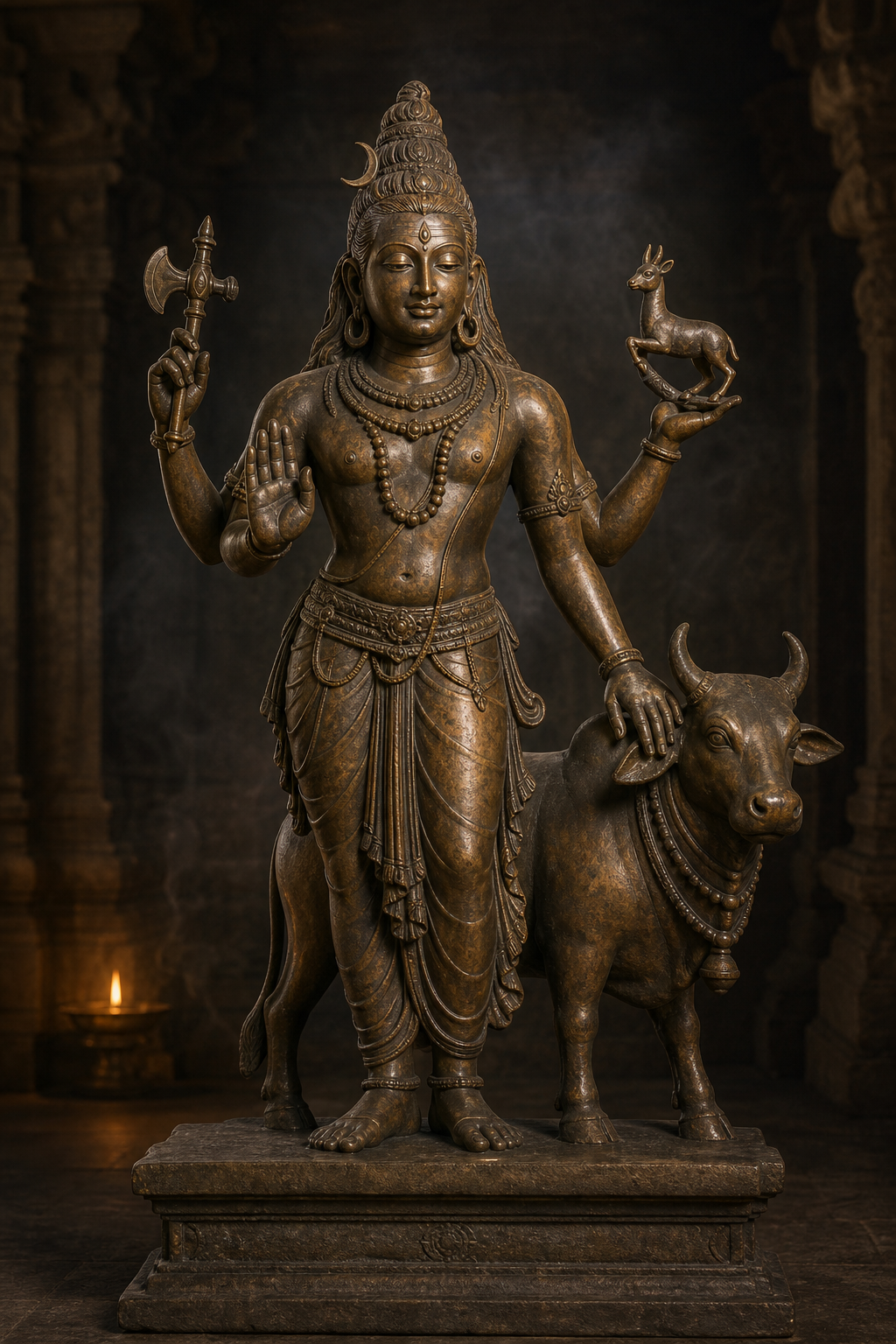
You recognize Shiva, and you recognize Nandi. Yet when they appear together, the correct name and meaning may still be unclear. Are you looking at Shiva with his vahana, a temple arrangement involving two separate images, or the distinctive standing form called Vrishabhavahana?
The answer comes from reading the relationship between the figures, not merely spotting a bull. Once you know where to look, the form becomes easier to identify and much harder to reduce to the vague label “Shiva and Nandi.”
Begin with the relationship, not an attribute checklist
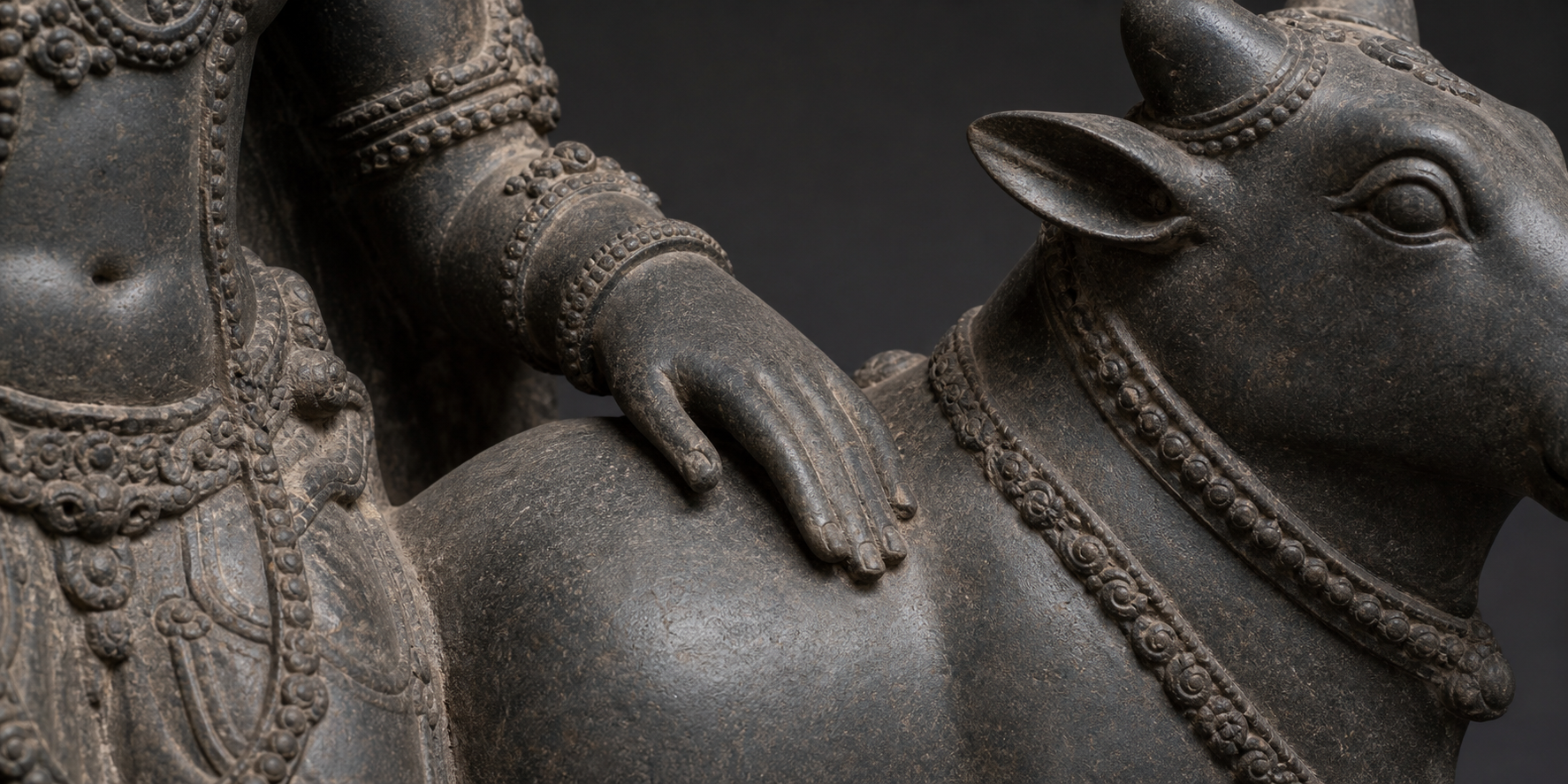
Vrishabhavahana joins two words: vrishabha, the bull, and vahana, the vehicle or bearer. A literal translation can mislead you, however, because the image need not resemble an ordinary riding scene. The form is distinguished by the standing presence of Shiva with the sacred bull in a calm, closely integrated composition.
Start by asking whether Shiva and the bull form one visual unit. Does the placement of the bull help establish Shiva’s stance? Is there contact, strong proximity, or a compositional line connecting them? Does the scene feel deliberately still rather than like an episode in motion? These clues are more useful than expecting every representation to repeat one rigid pose.
You should still confirm Shiva’s identity from the whole image. Familiar indicators can include matted hair, the third eye, the trident, or other Shaiva attributes, but any one feature may be absent, damaged, or rendered differently. A bull establishes a Shaiva context; it doesn’t, by itself, identify every sculpture as a particular Vrishabhavahana type.
This matters especially with weathered temple carvings and cropped photographs. A missing hand may once have made the relationship obvious. A tight crop may conceal a linga, another deity, or the fact that Nandi is actually a separate image. If the material evidence is incomplete, use a qualified description such as “Shiva with Nandi, possibly a Vrishabhavahana representation” until you can inspect the full setting.
Why vahana means more than transportation
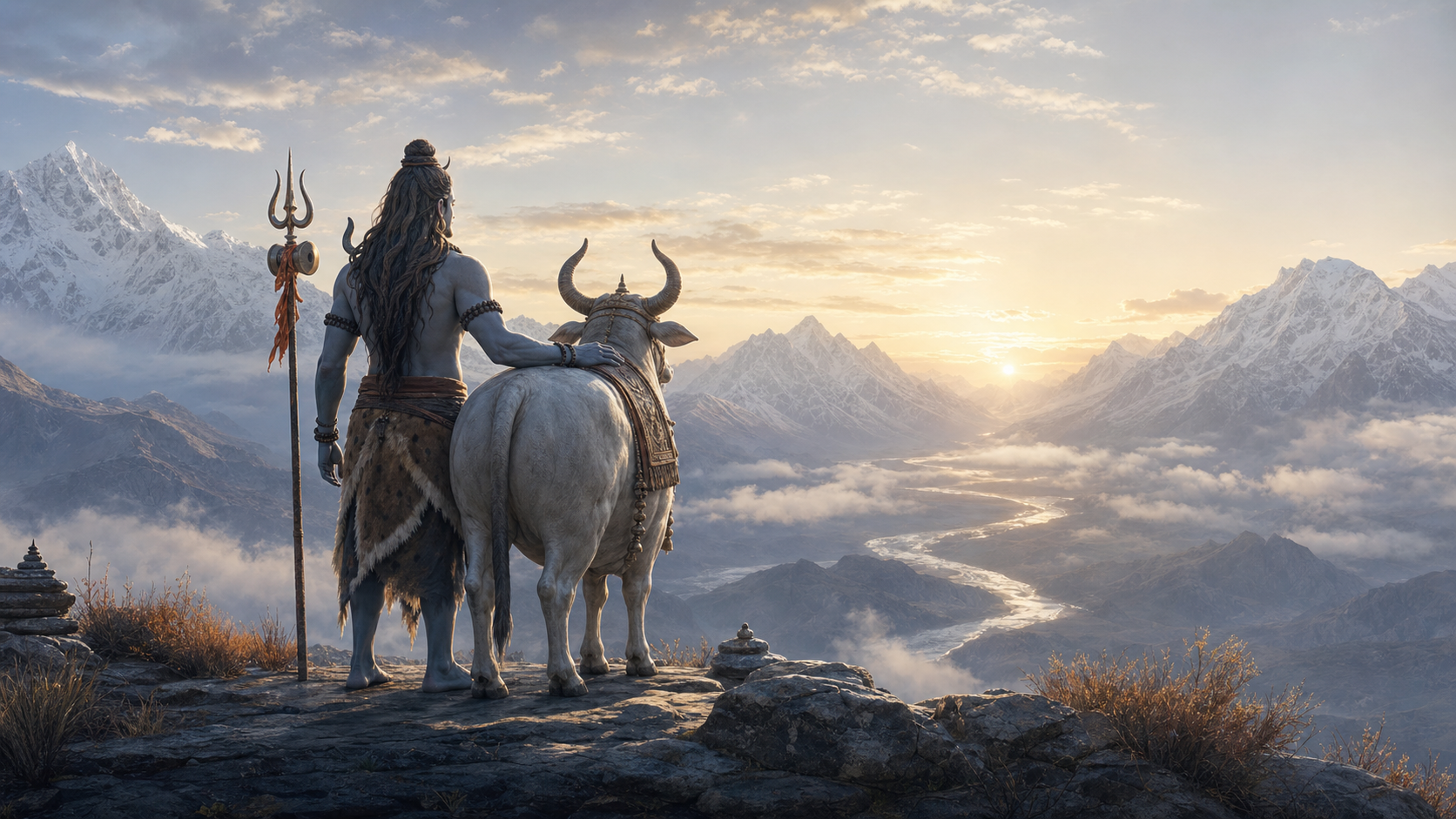
Calling Nandi Shiva’s “mount” is not wrong, but it is incomplete. In Hindu iconography, a vahana participates in the deity’s identity. It helps the devotee recognize who is present, and its visible character contributes to how that divine presence is understood.
That distinction is especially important here. The bull supplies an impression of weight, vitality, and physical strength. Shiva’s composed presence prevents those qualities from becoming a display of uncontrolled force. The image therefore permits a disciplined reading of power: strength is present, but strength is held within stillness.
Nandi is also more than background livestock or an ornamental identifier. He belongs to Shiva’s sacred world as a devoted attendant and companion. When the two figures are brought into close visual relation, the image can call your attention to loyalty, steadiness, service, and nearness to the divine. These meanings arise from the relationship; they shouldn’t be forced into an elaborate code in which every horn, hoof, ornament, or gesture is assigned an unsupported secret doctrine.
A useful interpretive discipline is to separate what you can see from what you infer. “The bull stands close to Shiva” is an observation. “The closeness evokes unwavering devotion” is a devotional interpretation. Both can be valuable, but keeping them distinct prevents a personal reflection from being presented as a universal iconographic rule.
Read a Vrishabhavahana image in five passes
Whether you encounter the form in a temple, museum, book, or photograph, use the same sequence. It keeps you from attaching a confident name to an incomplete view.
- Establish what belongs to the object. Determine whether Shiva and the bull are carved on the same base or presented as one composition. If they are separate images, find out whether their present placement is original, customary, or simply the result of a modern display.
- Identify Shiva from several clues. Look at the hairstyle, face, posture, attributes, ornaments, and surrounding figures. Don’t let one familiar symbol do all the work, particularly when the image is damaged.
- Trace the visual connection to the bull. Look for touch, bodily alignment, proximity, shared direction, and the way the figures balance one another. No single cue is mandatory; the point is to see whether the relationship organizes the composition.
- Decide whether the image is still or narrative. A composed standing presentation communicates differently from an image of travel, procession, combat, or a mythic episode. Action changes the iconographic question even when Shiva and Nandi remain identifiable.
- Interpret only after you have described. Write one plain sentence about what is visible before naming its meaning. For example: “The massive bull is calm beside the upright deity.” You can then consider how the image places strength under spiritual composure.
If you are studying several images, keep two columns in your notes: “visible feature” and “possible meaning.” Record condition problems as well. A broken arm, replacement pedestal, uncertain caption, or missing portion isn’t a minor inconvenience; it limits how definite your identification can be.
In a living temple, add one more step: listen to the local name. Iconographic terminology can be used broadly or narrowly, and temple tradition isn’t corrected simply by matching a sculpture against a modern checklist. Ask respectfully how the murti is addressed there, then compare that answer with what you can see.
Distinguish the form from other Shiva-and-Nandi arrangements
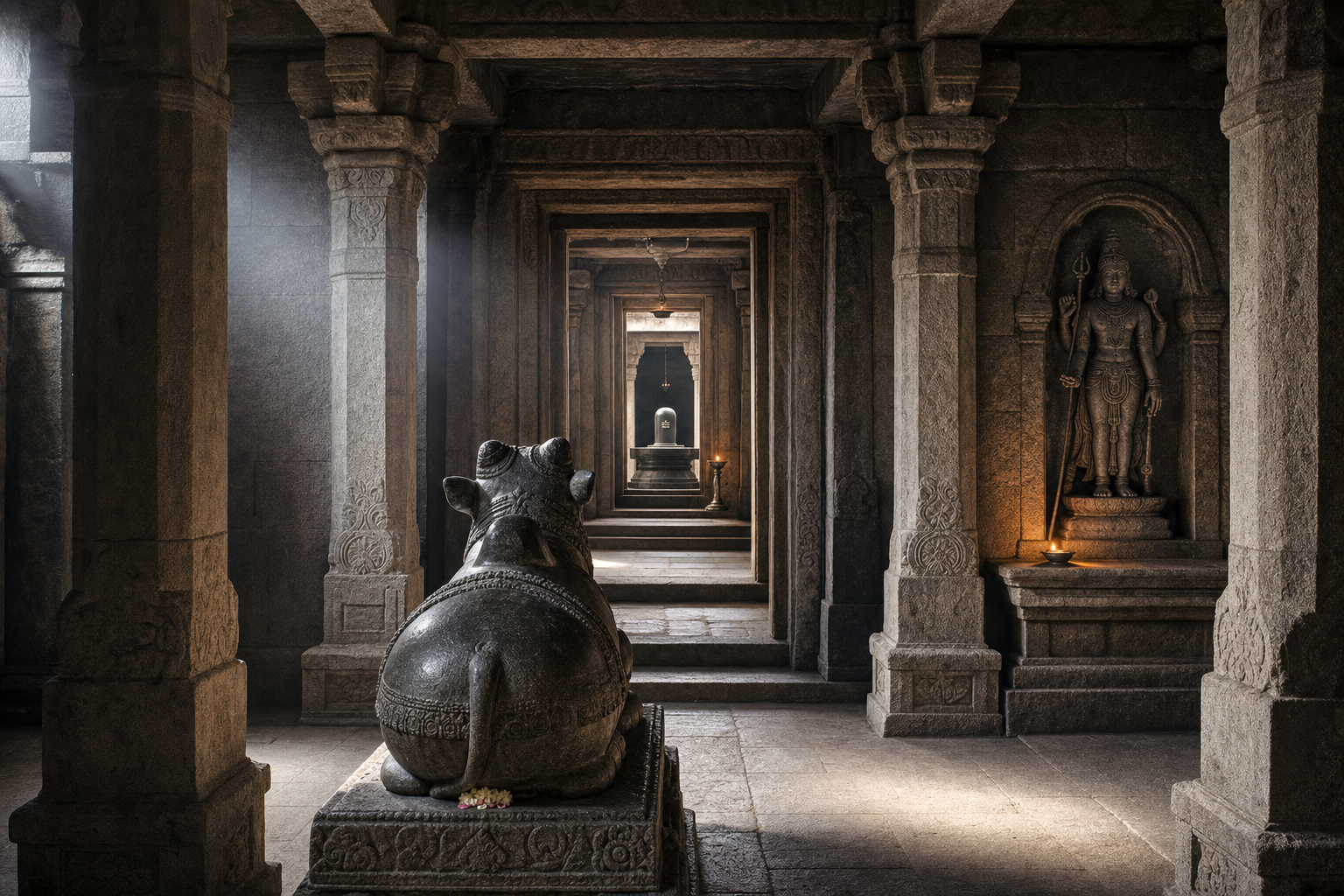
The most common error is to treat every appearance of Shiva and a bull as the same iconographic form. Use the arrangement itself to decide how specific your label can be.
| What you see | What it most safely indicates | What not to assume |
|---|---|---|
| Shiva standing in a deliberately close composition with the bull | A strong basis for considering the standing Vrishabhavahana form | That every surviving detail must match one fixed template |
| A linga in a shrine with a separate seated Nandi facing it | The familiar devotional alignment of Nandi toward Shiva | That the two objects together constitute one Vrishabhavahana murti |
| Nandi represented without an anthropomorphic Shiva figure | A sacred image of Nandi within a Shaiva setting | That Nandi alone is an image of Vrishabhavahana Shiva |
| Shiva visibly riding or being carried by the bull | A direct depiction of the vahana relationship | That its visual emphasis is identical to the composed standing-with-Nandi form |
| Shiva and a bull present in a larger event-filled scene | A possible narrative or processional context | That association alone settles the precise name of the scene |
Context often resolves what the isolated figure cannot. Look at neighboring panels, the direction figures face, the shrine’s central object, and any surviving inscription or reliable label. In a photograph, seek a wider view before making a final identification. The edge of the frame may contain the very feature that changes the answer.
Don’t confuse precision with rigidity. “Vrishabhavahana” can describe the broad theological relationship of Shiva and his bull, while a curator, devotee, or regional tradition may use a more specific name for a particular pose. When the context is uncertain, describe the visible arrangement first and apply the narrow label second.
Frequently asked questions
Is Vrishabhavahana another name for Nandi?
No. Nandi is Shiva’s sacred bull, attendant, and vahana. Vrishabhavahana identifies Shiva through his relationship with the bull. A Nandi image can stand independently in a Shaiva temple, while a Vrishabhavahana representation makes Shiva’s association with the bull central to the image.
Must Shiva be seated on the bull?
No. The word vahana can tempt you to look only for a rider and an animal. In the form considered here, the important feature is Shiva standing with Nandi in an intimate, composed presentation. The relationship can be expressed through presence and proximity rather than literal transport.
What is the safest way to explain its symbolism?
Begin with what the composition makes visible. The bull embodies palpable strength and steadiness; Shiva remains composed beside him. You can therefore speak of power governed by spiritual stillness and of Nandi’s devoted nearness to Shiva. Present more elaborate symbolic claims as interpretations unless a temple tradition, inscription, or authoritative textual context specifically supports them.
How should you approach the image in a temple?
Let darshan come before classification. Observe the complete sacred setting, follow the temple’s customs, and ask the local name if an attendant or knowledgeable devotee is available. Don’t touch the murti or take photographs unless that temple permits it. Iconographic understanding should deepen reverence, not turn worship into an exercise in collecting labels.
At your next encounter, pause before naming the image. Locate the bull, trace its relationship to Shiva, and decide whether you are seeing still presence, ritual alignment, or narrative action. If the composition brings standing Shiva and Nandi into deliberate, composed closeness, you have found the key to Vrishabhavahana: strength made sacred through steadiness.