
You may have followed the line around a temple sanctum, completed the expected circuit, and still wondered whether you did anything more than walk in a circle. That question matters. When attention drops out, a ritual can become mere movement. When its meaning is restored, the same movement can challenge the way you organise your life.
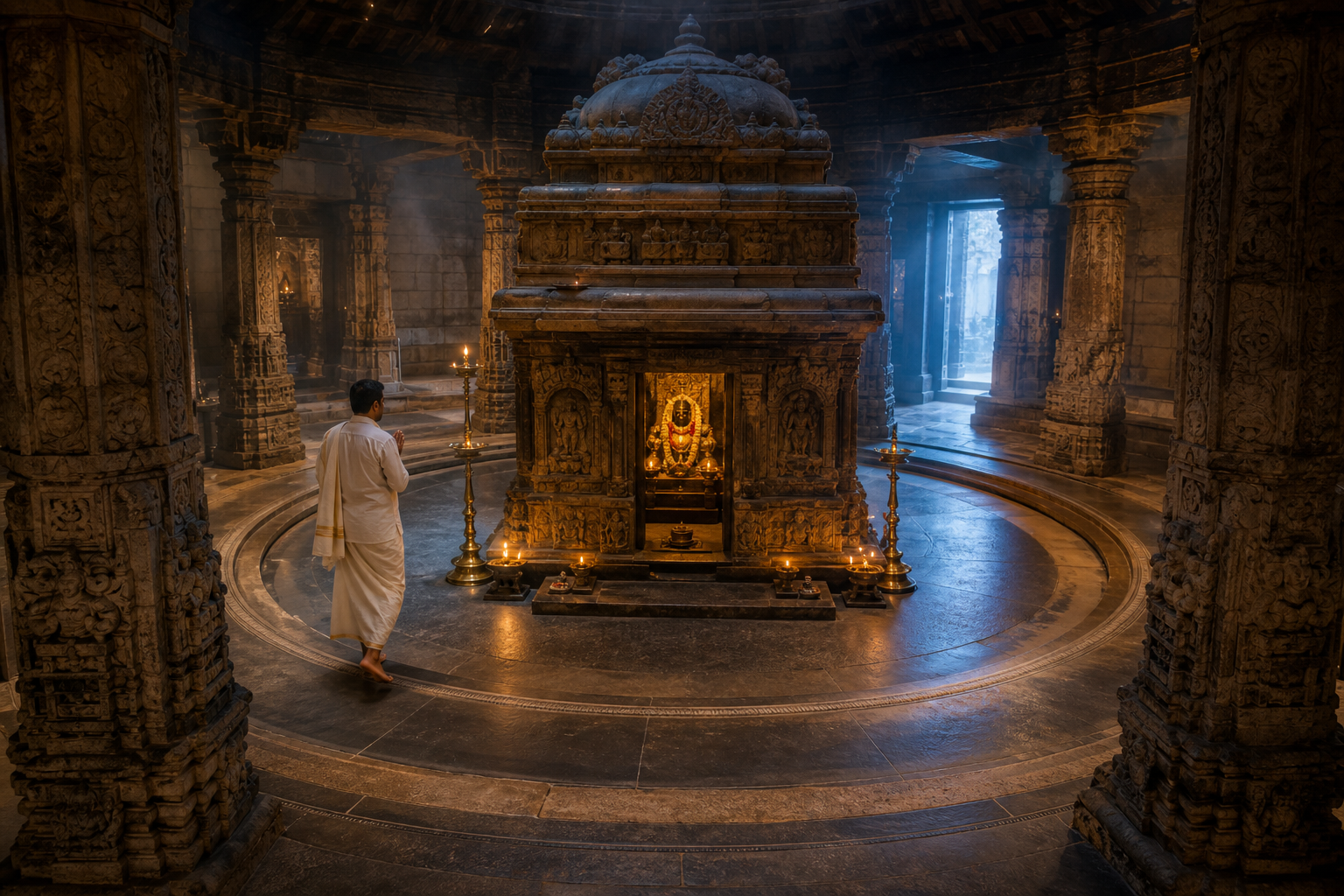
Pradakshinam is the sacred act of walking clockwise around the deity. Its central message is simple enough to remember inside the busiest temple: the Divine remains at the centre, while you move around that centre with humility, faith, and gratitude.
The centre does not move; you do
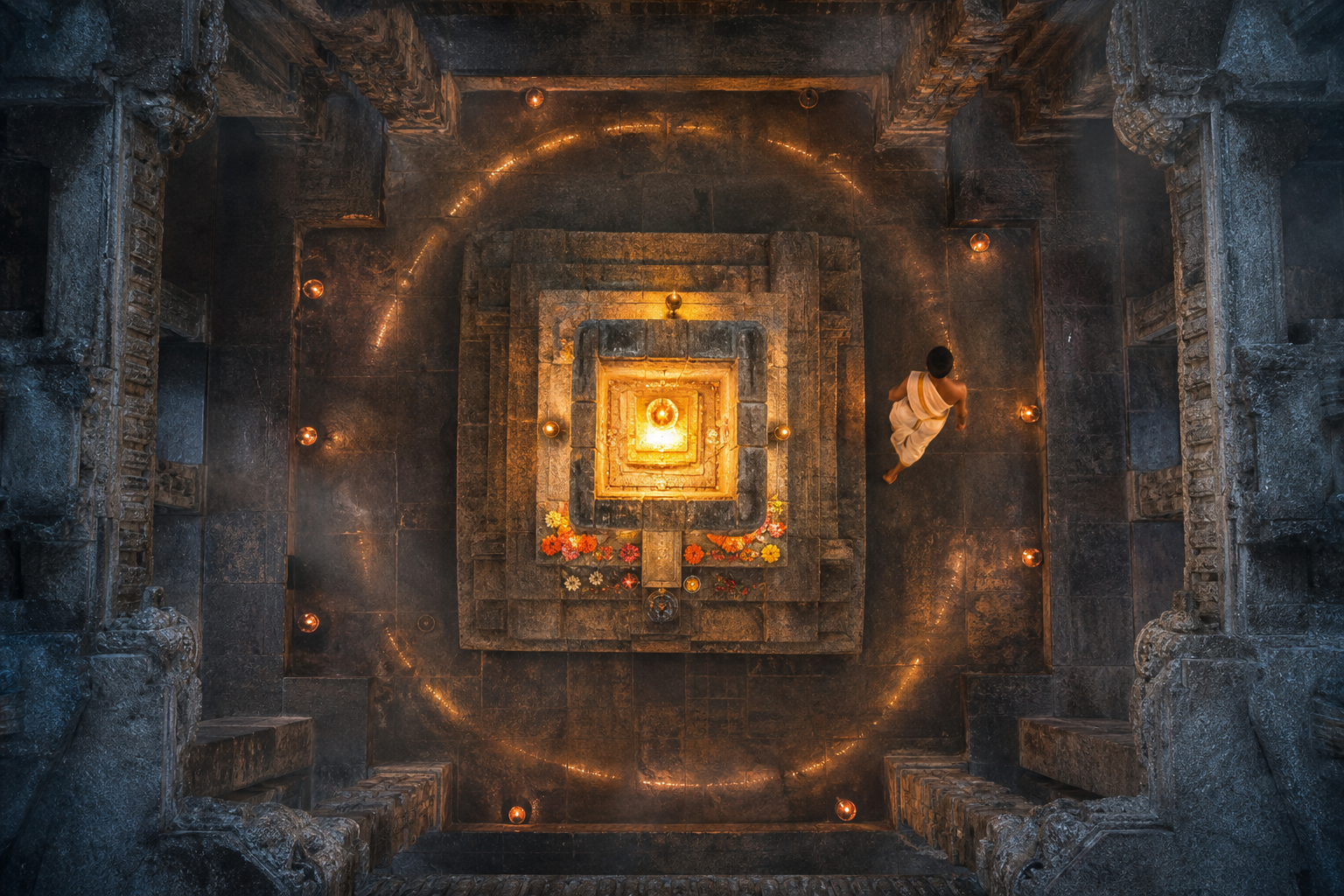
The physical arrangement of pradakshinam expresses its spiritual meaning before a word is spoken. The deity is not carried around the devotee. The devotee goes around the deity. Your body temporarily accepts what the ego often resists: you are not the fixed point around which everything else must turn.
This is why pradakshinam means more than showing respect to a sacred image. It trains you to place the Divine at the centre of your inner world. Your ambitions, fears, relationships, possessions, and opinions remain present, but they no longer occupy the position of ultimate authority. They must find their proper orbit around dharma.
That distinction is practical. Placing the Divine at the centre does not mean abandoning work, family, study, or public responsibility. It means refusing to let any one of them become an absolute. A career can be pursued without becoming your identity. Wealth can be used without becoming your master. An opinion can be defended without treating disagreement as a personal injury.
As you walk, bring one honest question into the circle: what currently sits at the centre of my life? The answer may be status, resentment, approval, anxiety, or control. You do not need to manufacture a devotional answer. Notice the real one. Pradakshinam becomes transformative when it reveals the distance between the centre you profess and the centre around which your daily choices actually revolve.
Why the clockwise movement should shape your attention
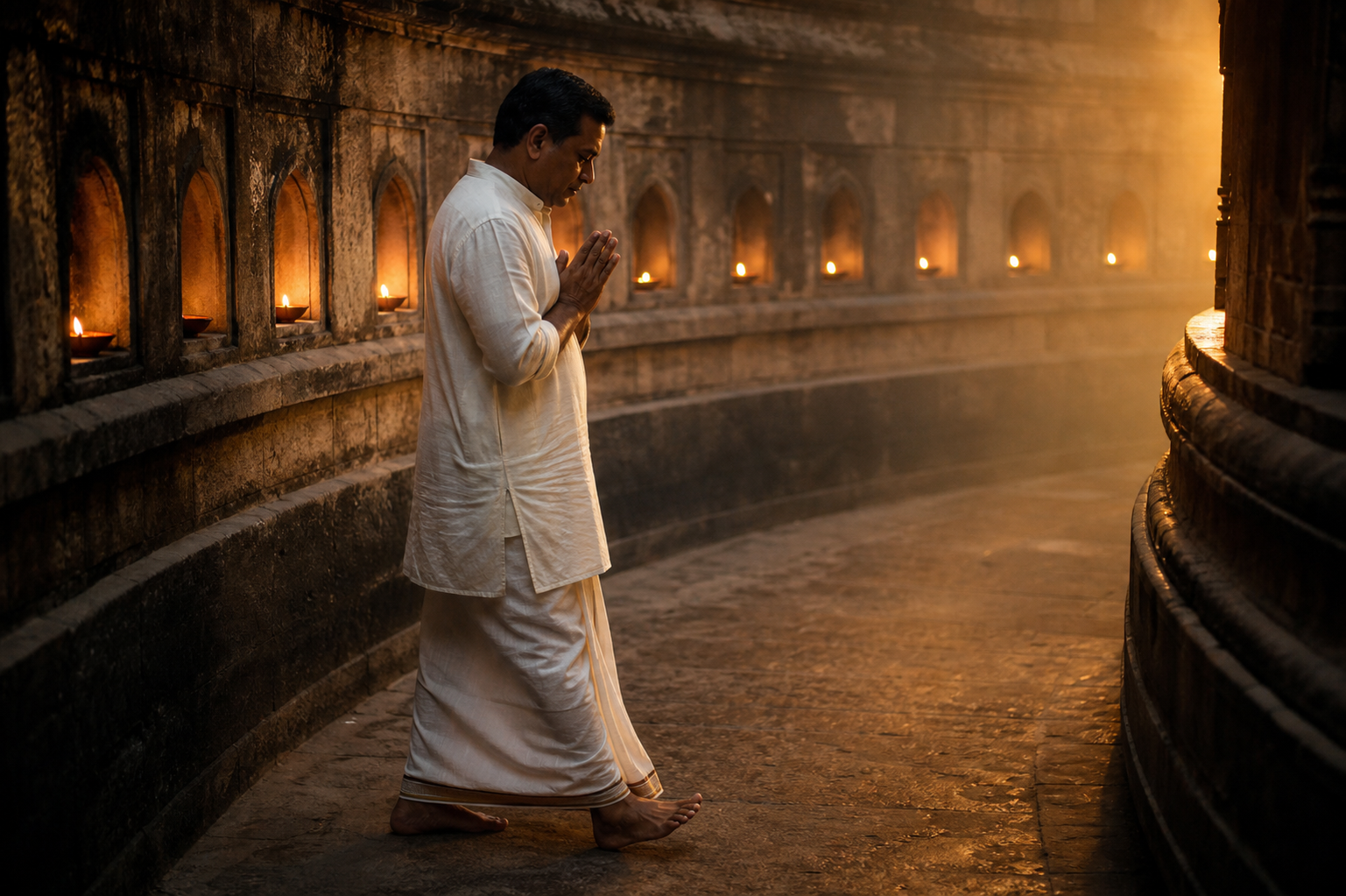
In a normal clockwise circuit, the shrine remains toward your right as you move. The consistent direction gives the body a stable orientation: your position changes, but your relationship to the sacred centre is maintained. That is the discipline hidden inside the movement.
You will see the sanctum from different points along the path. The deity remains the same, while your angle changes. Carry that observation into ordinary life. A difficult event may look different as your circumstances and emotions change, but dharma should remain the point by which you orient your response. Pradakshinam does not promise that every difficulty will disappear. It asks whether you can move through change without losing your centre.
The shared direction also asks you to surrender private impatience. In a crowded temple, walk with the flow rather than pushing past others to complete your circuit faster. If a temple has a prescribed route, a restricted passage, or instructions from its priests and attendants, follow them. Devotion is not strengthened by obstructing another devotee in order to protect your preferred performance of devotion.
How to turn a circuit into a deliberate spiritual practice
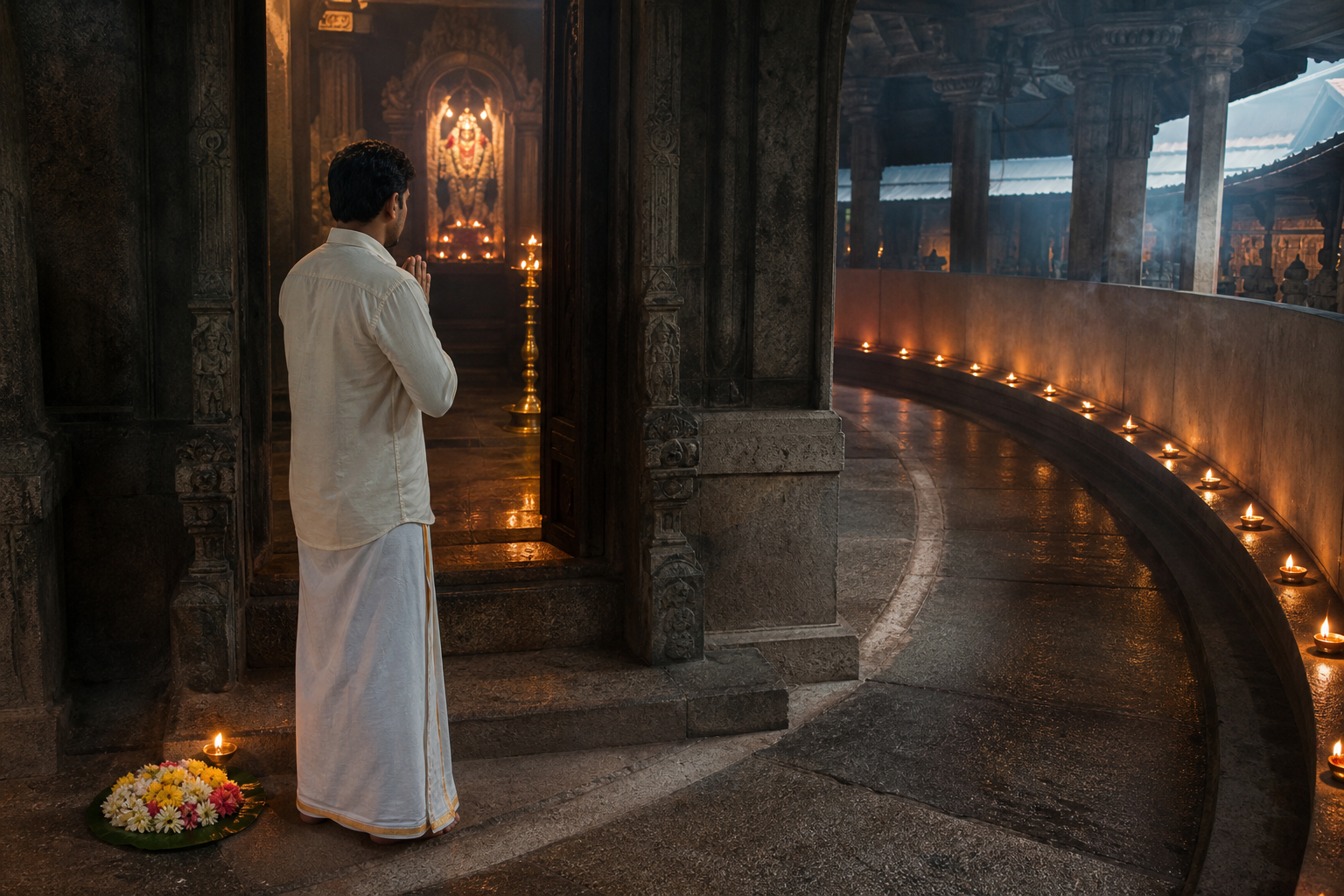
You do not need to make pradakshinam elaborate. One attentive circuit can teach more than several distracted ones. When the temple’s customs and the movement of the crowd permit, use this simple sequence:
- Pause before you begin. Let your attention settle on the deity. Recognise whom you are going around and why. Beginning mechanically usually means continuing mechanically.
- Choose one inner disposition. Gratitude, humility, surrender, or a sincere request for clarity is enough. Do not turn the circuit into a hurried catalogue of demands.
- Walk clockwise at a considerate pace. Keep the sacred centre in your awareness without competing with the people around you. Your pace should express steadiness, not urgency or display.
- Give the mind one anchor. You may repeat the deity’s name, use a mantra already belonging to your practice, or quietly attend to each step. When the mind wanders, return it without irritation.
- Complete the circle consciously. Notice your return to the point from which you began. Face the deity again and, where appropriate, offer pranam or Anjali Mudra rather than immediately turning toward your phone or the exit.
- Carry one consequence outside. If you prayed for forgiveness, identify the repair you owe. If you asked for clarity, stop feeding the distraction that obscures it. If you offered gratitude, express it through conduct toward someone who serves or depends on you.
The final step prevents the ritual from becoming self-contained. A physical circle ends where it began, but a spiritual practice should not return you unchanged to the same habits. Self-transformation need not arrive as a dramatic experience. It can begin as one corrected action performed after leaving the temple.
Four habits that empty pradakshinam of its meaning
The outward form deserves care, but form alone does not guarantee inward participation. Watch for these common habits:
- Treating rounds as spiritual currency. A count can support discipline when it belongs to a recognised observance or local custom. It should not become a bargain in which the Divine is expected to deliver a result because you accumulated enough circuits.
- Rushing to finish. Speed pulls attention toward completion rather than presence. If the temple is crowded, shorten what you privately intended instead of disturbing the shared space.
- Watching everyone except the mind. It is easy to assess another person’s clothing, pace, pronunciation, or ritual accuracy while your own attention is nowhere near the deity. Pradakshinam is an opportunity to reduce self-importance, not to give it a religious task.
- Leaving conduct untouched. Walking around the Divine while arranging the rest of life around anger, vanity, or convenience creates a contradiction. The point is not to feel guilty about that contradiction. The point is to see it clearly enough to change one decision.
Do not assume that every temple prescribes the same number of circuits or identical route. Architecture, deity, observance, and local tradition may affect what is done. When you are uncertain, follow temple signage, observe the established flow, or ask a priest or attendant. Humility includes accepting that a living tradition is learned in community rather than reconstructed from personal preference.
Key takeaways
- Pradakshinam places the deity physically and spiritually at the centre while the devotee moves around that centre.
- The practice trains you to let work, desire, fear, and identity orbit dharma instead of ruling it.
- Clockwise movement is not a race; keep a steady awareness of the sacred centre and respect the temple’s flow.
- Use a divine name, an established mantra, or attentive steps to bring the wandering mind back.
- Complete the practice through one dharmic action after leaving the temple.
At your next temple visit, do not begin by deciding how many rounds you can finish. Pause, identify what has been occupying the centre of your life, and make one attentive circuit. Then choose one action that places it back in its proper orbit. That is where pradakshinam continues after your feet stop moving.