
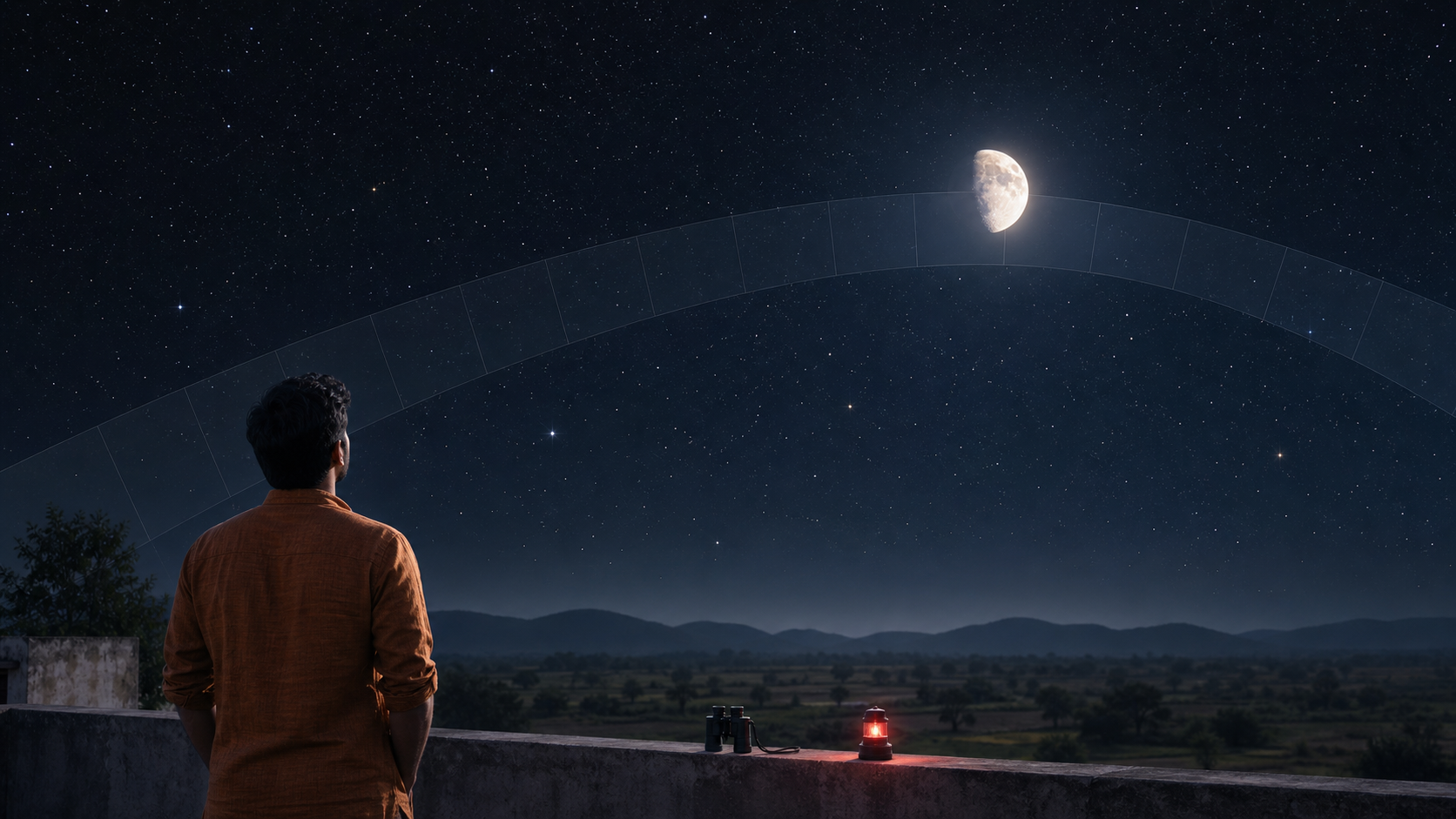
You check a Panchang and see that the Moon is in Rohini, Ardra, or Chitra. Then you step outside and find only the Moon, scattered stars, and no visible lines dividing one Nakshatra from another. The difficulty is not your eyesight. It comes from expecting a Nakshatra to look like a constellation.
You can make the system visible, but you must look for the right thing: the Moon’s movement against a stellar background. Once you separate the geometric sector, its traditional star anchor, and its Dharmic meaning, the Nakshatra map becomes both easier to observe and harder to misrepresent.
A Nakshatra is a longitude sector, not a sky picture
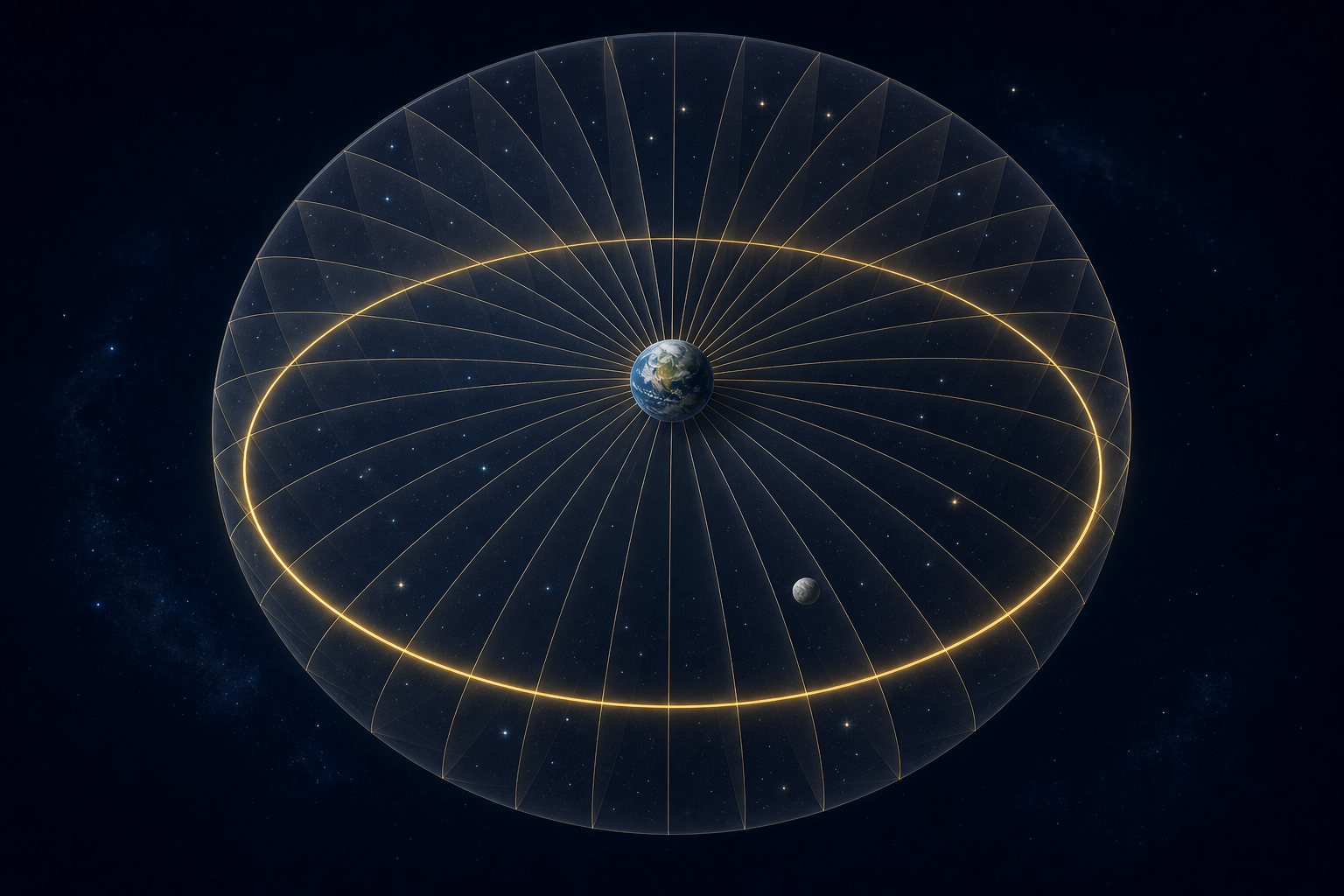
Begin with a circle. The Nakshatra system divides the ecliptic, the reference path used to measure celestial longitude, into 27 equal sectors of 13°20′ each. Multiply 13°20′ by 27 and you recover the full 360° circle.
The Moon completes a sidereal circuit in roughly 27.3 days. It therefore advances through about one Nakshatra during an ordinary day, although a boundary crossing can occur at any hour. This is the observable mechanism beneath the calendar: tonight’s Moon occupies one longitudinal sector; tomorrow night’s Moon will usually have moved into the next or close to it.
The borders themselves are invisible. They are mathematical divisions, much like lines of longitude on Earth. A traditional anchor such as Aldebaran for Rohini helps you recognise a region, but the star does not create the border, and the Moon need not appear to touch it. Some anchor stars also sit noticeably north or south of the ecliptic. Compare east-west celestial longitude rather than demanding an apparent conjunction.
This gives you three layers that should remain connected without being confused:
- The geometric layer: one of 27 equal divisions along the ecliptic.
- The observational layer: a star, cluster, or recognisable stellar region associated with that division.
- The interpretive layer: the deity, symbol, shakti, ritual use, and astrological rulership attached to the Nakshatra.
When a Panchang says the Moon is in Ardra, the astronomical claim is that its sidereal longitude falls within Ardra’s sector. It does not mean that the Moon must appear immediately beside Betelgeuse. Nor does a telescope measure Ardra’s association with Rudra, catharsis, or renewal. Those meanings belong to the interpretive layer of the same inherited system.
The word “Vedic” also names a layered intellectual history, not a single frozen catalogue. Nakshatra references emerge in the Rigveda and become more explicit in the Taittiriya Samhita, Atharva Veda, and Vedanga Jyotisha attributed to Lagadha. The Surya Siddhanta and the work associated with Aryabhata and Varahamihira belong to later developments in computation, celestial geometry, calendrical precision, and awareness of precession. Keeping that sequence in view prevents two opposite errors: treating Nakshatra astronomy as a recent invention, or projecting every later calculation and astrological convention unchanged into the earliest Vedic period.
Use the anchor stars as checkpoints, not borders
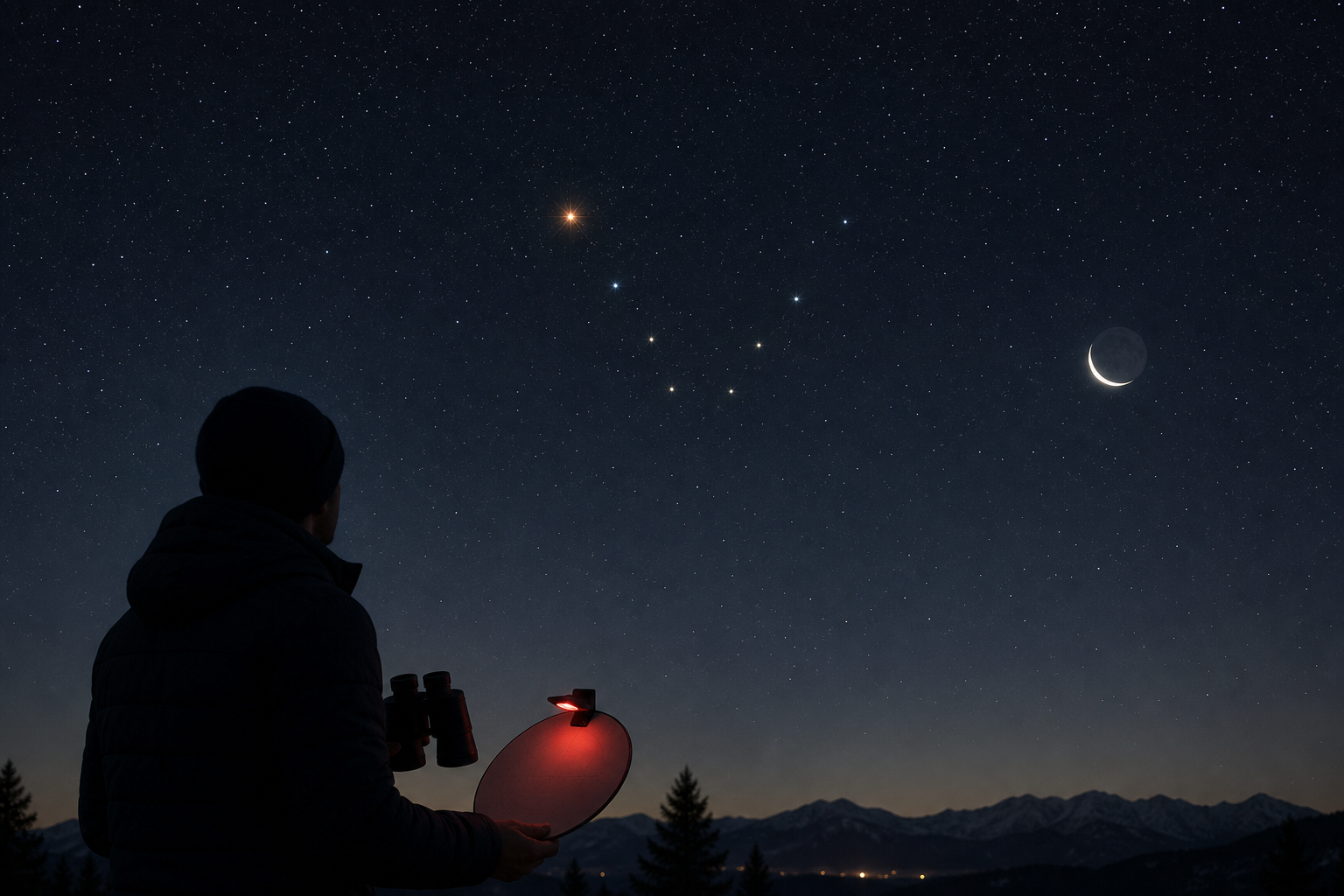
You do not have to memorise all 27 names before going outdoors. Start with a few well-known Nakshatra anchors and learn where they sit in the seasonal sky. Some are immediately conspicuous; others require a star chart and a darker location.
| Nakshatra | Traditional astronomical anchor | What to recognise |
|---|---|---|
| Krittika | The Pleiades | A compact and distinctive star cluster |
| Rohini | Aldebaran, α Tauri | A prominent star in the Taurus region |
| Ardra | Betelgeuse, α Orionis | A prominent star in the Orion region |
| Punarvasu | Castor and Pollux | The paired stars associated with Gemini |
| Magha | Regulus, α Leonis | The principal checkpoint in the Leo region |
| Chitra | Spica, α Virginis | A strong solitary checkpoint near the Virgo-Libra region |
| Swati | Arcturus, α Bootis | A useful demonstration that an anchor need not lie close to the Moon’s path in apparent latitude |
| Jyeshtha | Antares, α Scorpii | A prominent checkpoint in the Scorpius region |
| Shravana | Altair, α Aquilae | A recognisable checkpoint in Aquila |
| Revati | ζ Piscium | A subtler anchor for which a chart is especially useful |
The table is not a promise that every anchor will be visible tonight. Season, hour, weather, artificial light, obstructions, and your latitude all affect what you can see. It is also not a replacement for the equal-sector grid. Use the stars as mnemonic checkpoints within that grid, not as irregular fences around imagined patches of sky.
Krittika and Rohini make a particularly clear conceptual pair. Krittika is linked with the Pleiades and Agni; Rohini is anchored by Aldebaran and presided over by Prajapati. The visible cluster and star belong to astronomy. Agni, Prajapati, purification, fertility, and the respective astrological rulers belong to the symbolic and ritual grammar. You understand the tradition more accurately when you can identify which kind of claim you are making.
Follow the Moon for seven nights before memorising names
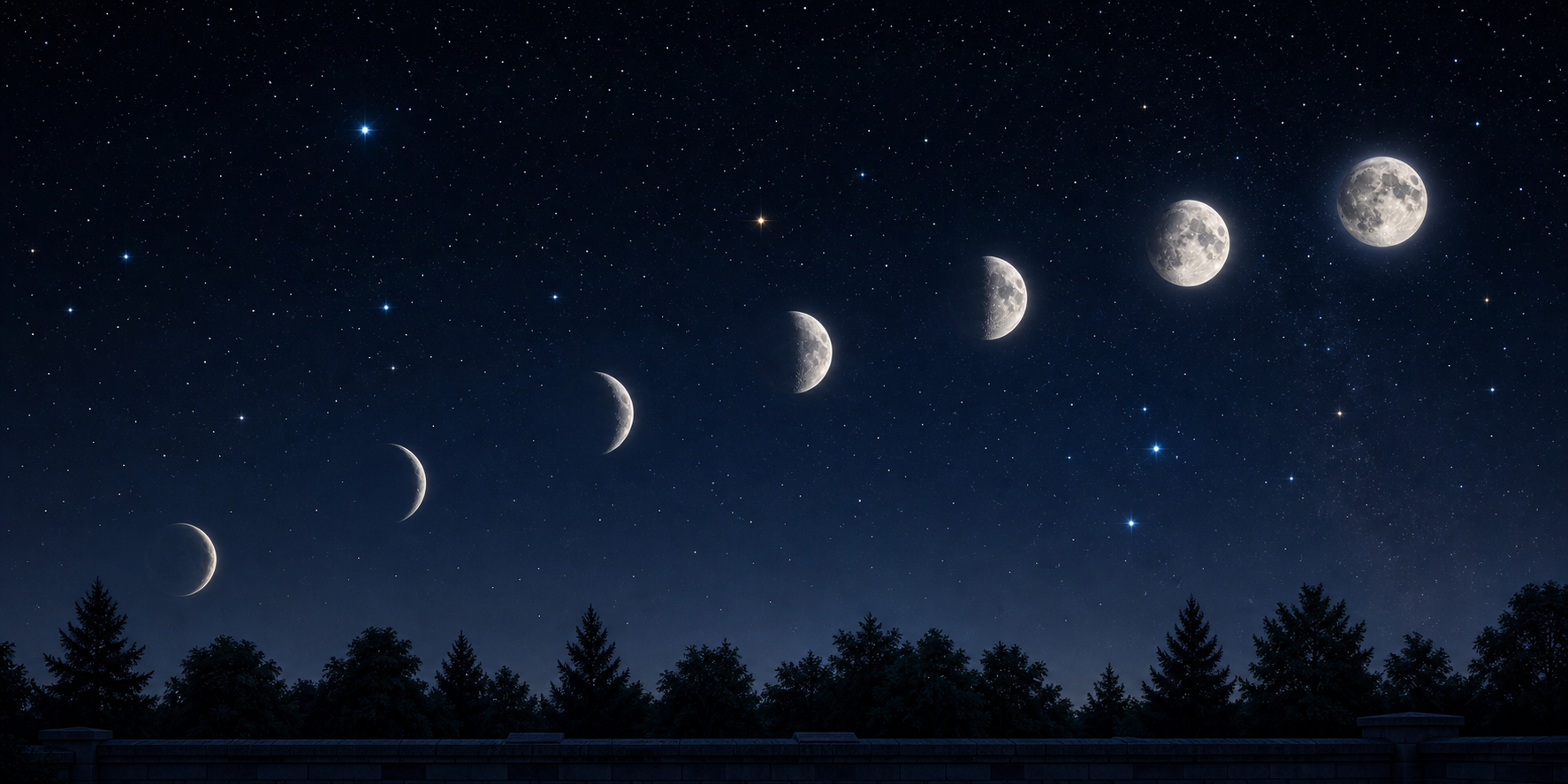
A single observation can show you the Moon. A sequence shows you the Nakshatra system. Set aside seven clear evenings, or seven usable evenings spread across a longer period if clouds intervene. You need a Panchang with transition times, a basic star chart or sky-identification tool, and a notebook. A telescope is unnecessary.
- Prepare the calendar entry. Before going outside, write down the Nakshatra given for your intended observation time. If the Panchang lists a transition that day, record the time and the names on both sides of it.
- Locate the Moon first. Do not begin by searching the whole sky for an unfamiliar Sanskrit name. Find the Moon, note the direction you face, and mark its approximate height above the horizon. If solar glare makes it difficult to see, resume when the Moon is readily visible.
- Record the surrounding pattern. Sketch two or three nearby stars or obvious stellar patterns. The sketch does not need artistic precision. Its purpose is to preserve relative position: left or right, higher or lower, and near or far.
- Identify the sector and anchor separately. Confirm the Moon’s Nakshatra from the Panchang, then look up that Nakshatra’s traditional anchor. If the anchor is below the horizon, seasonally unavailable, or far away in apparent latitude, write that down instead of forcing a visual match.
- Return at approximately the same local clock time. Compare the Moon with the previous night’s sketch. Its change against the stellar background is the key observation. The stars will largely preserve their pattern relative to one another while the Moon shifts eastward through roughly another Nakshatra.
- Treat boundary nights as valuable evidence. If the published transition occurs near your observation, note both the clock time and the Moon’s position. A label copied from the top of a daily calendar page may not describe the whole day.
- Plot the full run. After seven observations, place the Nakshatra names in order and draw arrows between the Moon’s nightly positions. You will have converted a memorised list into a measured sequence.
Use the same compact record each night: date, local time, location, Panchang Nakshatra, transition time if any, visible anchor, and a one-line position note. The location matters mainly for what is above your horizon and for interpreting the calendar’s clock times. The record also exposes simple mistakes, such as comparing observations made many hours apart or using a Panchang set to another time zone.
Do not judge the exercise by whether you can see a picture suggested by a Nakshatra’s symbol. Ashvini’s horse’s head, Bharani’s yoni, and Mrigashirsha’s deer head belong to symbolic identification; they are not modern constellation outlines that every observer is expected to trace. Your first success is simpler: you predict the Moon’s next sector, return outdoors, and see that its stellar background has changed in the expected direction.
Read a Panchang without mixing its measurements
The Nakshatra is only one of the five traditional limbs of a Panchang. The others are tithi, vara, yoga, and karana. They answer different calendrical questions, so two entries can change at different times without creating a contradiction.
Read the transition time, not only the daily label
A printed or digital Panchang often gives one prominent Nakshatra name for a date and then supplies an ending or transition time. If the Moon crosses a sector boundary during that date, observations made before and after the crossing properly receive different names. Match the entry to your actual observation time rather than treating the largest label on the page as valid from midnight to midnight.
This matters even more when you are checking a birth Nakshatra or a muhurta close to a transition. Preserve the recorded time, time zone, calendar location, and calculation convention. If two calculators disagree, inspect those inputs before concluding that the sky or tradition is inconsistent.
Keep the sidereal reference frame consistent
Nakshatras are tied to a stellar, or sidereal, framework. Precession creates an offset between a star-oriented zodiac and a season-oriented tropical zodiac. That correction is commonly discussed through ayanamsa. Different ayanamsa choices can matter when the Moon lies close to a 13°20′ boundary, so a result from one sidereal convention should not be silently combined with degrees from another convention or from a tropical chart.
You do not need to settle every technical debate to observe the Moon. You do need consistency. Record which Panchang or sidereal convention you used, keep it fixed throughout your observing run, and flag boundary cases rather than hiding them behind false precision.
Do not turn Abhijit into a second 28-part zodiac
Abhijit is sometimes included as a 28th, intercalary asterism for muhurta. That does not mean the standard 360° circle should be divided into 28 new equal sectors whenever Abhijit appears in a ritual calendar. Keep the ordinary 27-part astronomical grid intact unless the specific tradition and calculation you are following explicitly defines another procedure.
Let astronomy and sacred meaning answer different questions
Rohini can simultaneously denote a 13°20′ sector, a region anchored by Aldebaran, a mansion presided over by Prajapati, and an astrological period ruled by the Moon. Those statements are related, but they do not have the same method of verification. A position can be checked by calculation and observation. A deity, shakti, ethical quality, or ritual suitability is interpreted within a received Dharmic framework.
This distinction protects the tradition from two reductions. Nakshatras are not merely personality labels detached from the sky. They are also not exhausted by coordinate geometry, as though centuries of ritual, mythology, contemplation, and ethical interpretation were accidental decoration. The characteristic Indic achievement lies in holding measurement and meaning together without pretending they are identical.
That integrated timekeeping became part of a shared civilizational inheritance. Hindu practice developed Nakshatra-based ritual and calendrical uses; Buddhist and Jain communities also participated in related Indic lunisolar traditions; Sikh communities historically used Bikrami calendrical forms before modern solar reforms. Shared astronomical vocabulary does not erase doctrinal differences or imply that every community follows the same calendar today. It shows how a practical science of time could serve several paths rooted in Bharat.
Key takeaways for your next clear night
- A Nakshatra is one of 27 equal ecliptic sectors, each measuring 13°20′; it is not an irregular constellation boundary.
- The Moon’s roughly 27.3-day sidereal circuit makes its nightly movement the easiest way to see the system working.
- A traditional anchor such as the Pleiades, Aldebaran, Spica, or Antares identifies a stellar region; the Moon need not appear immediately beside it.
- Always match a Panchang entry to the observation time, especially on a day with a Nakshatra transition.
- Keep the same sidereal convention throughout a comparison and mark near-boundary results as convention-sensitive.
- Treat the astronomical, ritual, and astrological layers as connected but distinct forms of knowledge.
Tonight, do one small thing: find the Moon, write down its Nakshatra and local time, and sketch the nearest recognisable stars. Return at about the same time tomorrow. Once you see that first shift against the stellar background, the Nakshatra cycle stops being an inherited list and becomes a sky you can actually read.