
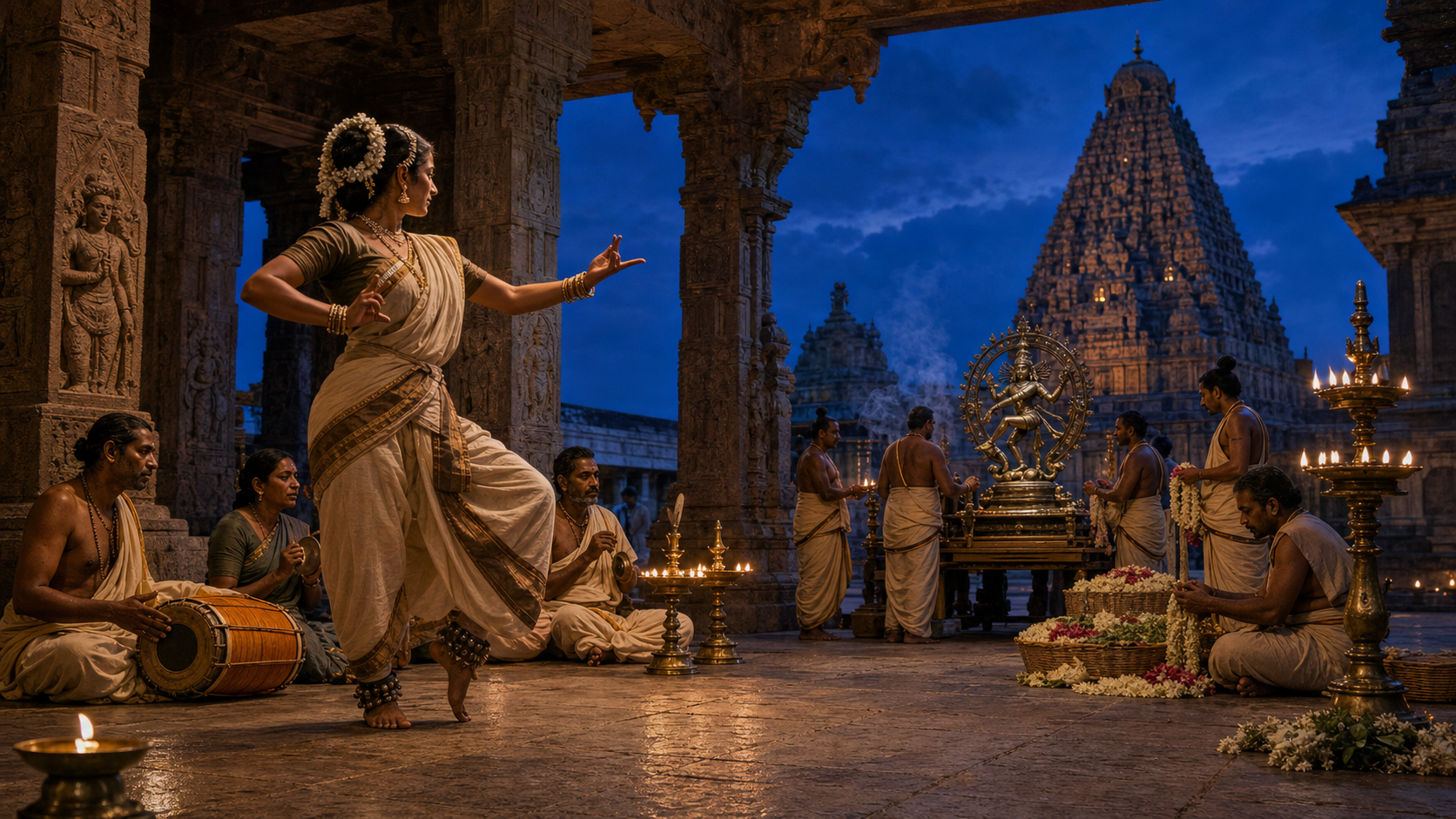
You may know the bronze Nataraja, Brihadeeshwara Temple’s soaring vimana, or the poised geometry of Bharatanatyam. The harder question is how these belonged together in Chola Thanjavur. Once you see that connection, you stop watching temple dance as decoration placed around worship.
In the Chola sacred world, trained movement could be an offering. The dancer’s technique, the musician’s rhythm, the patron’s endowment, the priest’s ritual and the deity’s procession all participated in one temple ecology. That is the lens you need if you want to understand Chola dance on its own devotional terms.
Begin with the temple’s clock, not the public stage
A modern audience usually encounters dance as a self-contained event: a scheduled performance begins, artists present a repertoire, and spectators respond. Chola temple dance belonged to a different order. Daily worship unfolded at prescribed sandhis, or junctions of the day, while seasonal festivals carried music, dance and sacred presence into the streets. The relevant question was not simply, “When does the performance start?” It was, “What act of worship is occurring now?”
This distinction changes what you notice. The dance was connected to a deity, a ritual occasion and an established sequence of service. During festivals, processions extended the sanctum’s sacred energy into civic space. Chola bronzes made divine presence mobile; the dancer responded not merely to an image as an artistic theme, but to a consecrated presence moving among devotees.
When you watch a temple performance or study one in sculpture, ask three practical questions:
- Which deity, festival or moment in the ritual day gives this dance its setting?
- Is the dancer addressing an audience, the deity, or both?
- How do music, lamps, procession, architecture and movement work together?
If you remove those relationships and examine movement alone, you may still appreciate virtuosity, but you will miss the Chola meaning of the act. Temple time turned performance into duty. Repetition turned duty into discipline. Intention turned discipline into worship.
Read technique as a devotional language
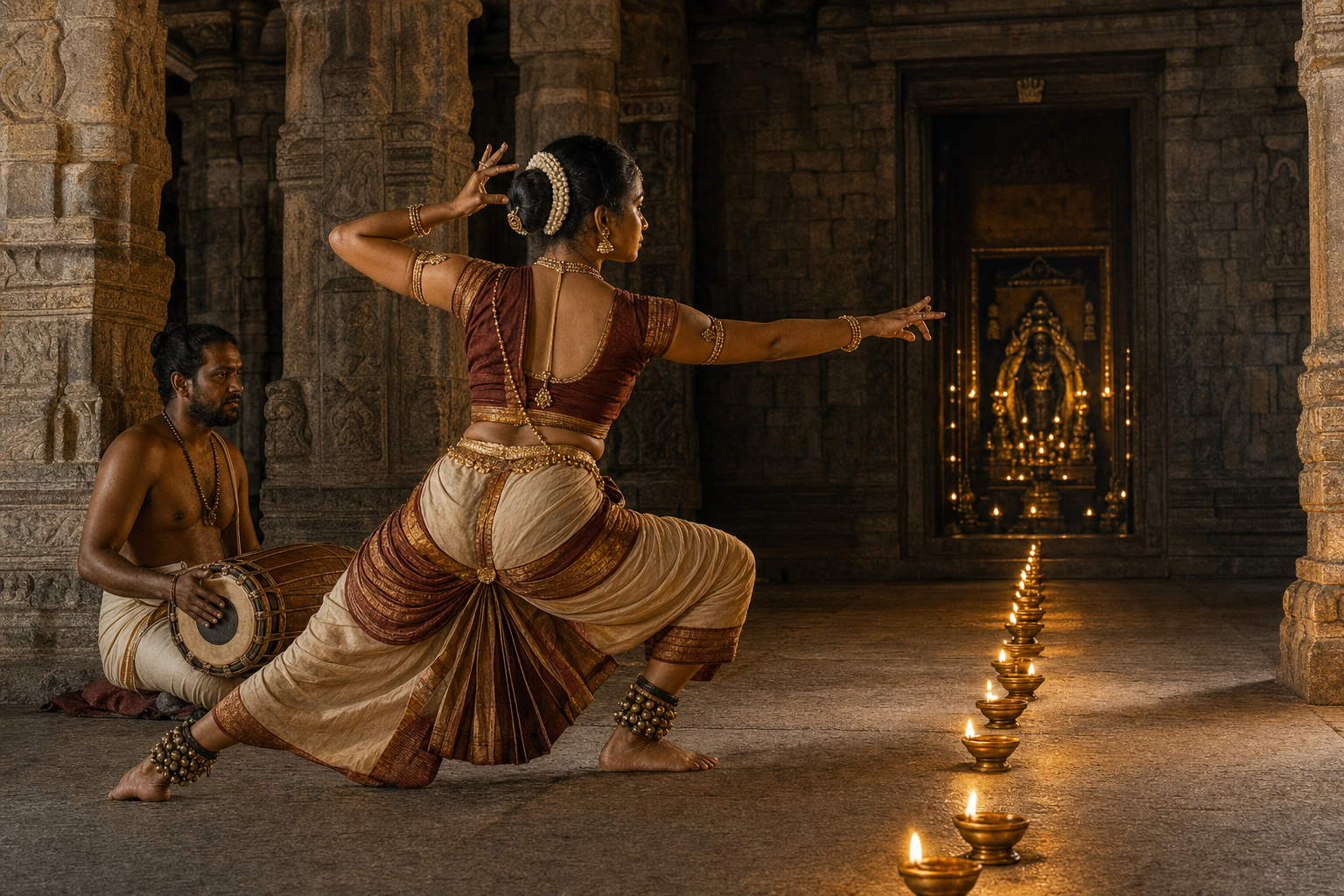
Calling sacred dance “prayer” does not mean that technical standards were unimportant. It means the opposite. An offering had to be cultivated carefully enough to carry meaning. Anga and upanga, the major and minor parts of the body, gave movement its articulation. Abhinaya communicated emotion and intention. Tandava and lasya supplied vigorous and graceful modes rather than two mutually exclusive categories.
These concepts help you look past costume and speed. Begin with the dancer’s base: is the body stable enough to make a gesture legible? Then follow the gaze, face and hands: do they direct attention toward a presence, character or action? Next, listen for the relationship between footwork and rhythm. Finally, ask whether vigour and grace illuminate the devotional subject or merely display ability.
That final distinction is subtle. Display and devotion are not automatic opposites; excellence can honour the deity. The issue is orientation. In the Chola imagination, Shiva as Nataraja did not dance for entertainment. His dance made cosmic order visible. The sacred artist’s task was therefore not to imitate a pleasant pose, but to let controlled movement point beyond the performer’s personality.
You can use the same test when viewing Chola sculpture. Do not treat a dancing figure as frozen choreography and move on. Notice the distribution of weight, the direction of the limbs and the balance between force and composure. Then imagine what changes when stone or bronze is answered by a living body, musical pulse and congregational attention. The visual object and the performed gesture belong to the same theological conversation, even though they are not interchangeable records of steps.
Mathura’s memory reveals what a dancer could offer
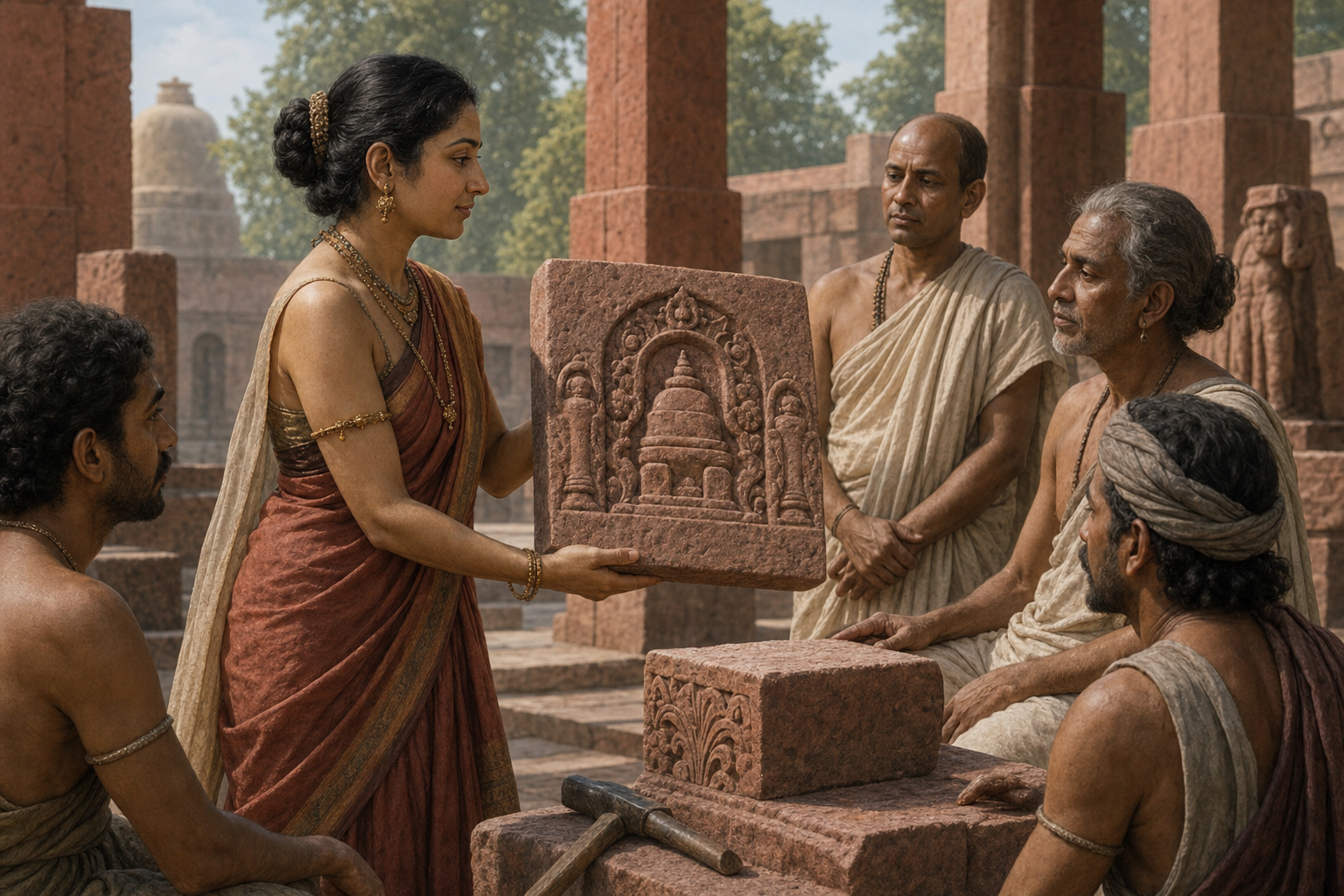
Mathura of Thanjavur gives this devotional ideal a human scale. Remembered as a tenth-century devotee of Shiva, she was born to Maran and Veniyammal and remained unmarried. Her life was associated with vrata, disciplined commitment, and seva, service offered beyond personal advancement. Accounts of her memory also connect her earnings and time with temple festivals and practical needs.
It is important to distinguish two layers of knowledge. The institutional presence of temple dancers under the Cholas has an epigraphic foundation. The intimate portrait of Mathura’s motives comes through the more concise field of sacred and local memory. You need not dismiss that memory, but you should not turn every remembered detail into an inscriptional fact. Historical care and devotional respect can coexist.
Mathura’s unmarried life should likewise be understood as her particular vow, not as a universal rule for sacred artists. The transferable lesson is single-mindedness. Her example joins three commitments that can still guide a dancer or devotee:
- Vrata: define the restraint or obligation that protects your purpose.
- Tapas: accept the sustained bodily and mental effort required to refine the offering.
- Seva: direct some part of your talent, time or resources toward a need larger than your reputation.
These words become useful only when you make them concrete. A dancer might decide which devotional text or form deserves serious study, maintain the discipline needed to present it clearly, and connect the resulting performance with an actual act of service. A devotee who is not an artist can apply the same pattern to music, festival work, teaching, food preparation or support for a lamp. The medium changes; the movement from vow to effort to offering does not.
See the institution that made sacred artistry possible
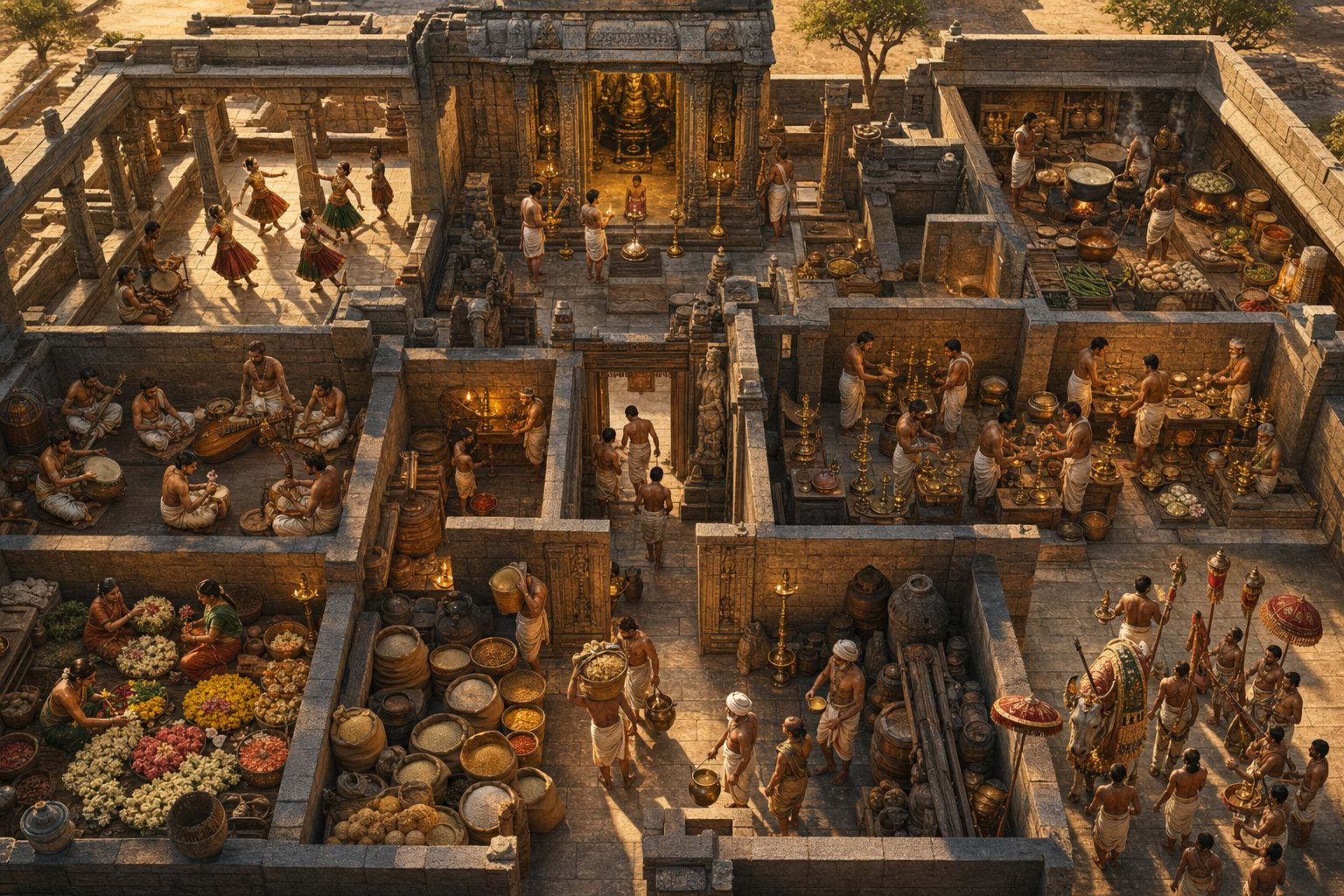
Romantic images of a solitary dancer communing with Shiva leave out the infrastructure that sustained the act. Rajaraja Chola I, whose reign is placed around 985–1014 CE, connected royal power, temple building and sacred culture on a monumental scale. At Rajarajesvaram, now widely known as Brihadeeshwara Temple, inscriptions record several hundred women attached to the temple. Their presence was organized rather than incidental.
Devaradiyar could have defined obligations, stipends, rights and standing within the temple economy. Other endowments maintained perpetual lamps and ritual feeding, while musicians also occupied organized roles. A festival required oil, food, rehearsal, skilled labour, timing and administration as surely as it required inward devotion. The Chola achievement lay partly in making these elements reinforce one another.
When you visit a Chola temple, look for the system rather than only the monument:
- Inscriptions can preserve appointments, gifts and obligations.
- Lamp endowments reveal how patrons planned for worship to continue beyond a single day.
- Feeding arrangements connect ritual merit with material care for a community.
- Mandapas and processional space show that worship could expand beyond the innermost shrine.
- Movable bronzes explain how sacred presence, music and dance could enter the streets together.
This institutional reading does not reduce bhakti to economics. It shows how devotion survives in time. Inspiration can produce one beautiful evening; endowment, training and assigned responsibility can sustain a liturgical cycle across generations.
Nor should “institutionalized” be mistaken for socially simple. Temple dancers occupied a complex socio-legal position involving ritual responsibility, livelihood, property and community standing. Respecting their artistry does not require pretending that every period, temple or individual experience was identical. It requires seeing them as historical actors with work, obligations and agency, not as anonymous ornaments around a royal monument.
Approach Bharatanatyam as an heir, not a time capsule
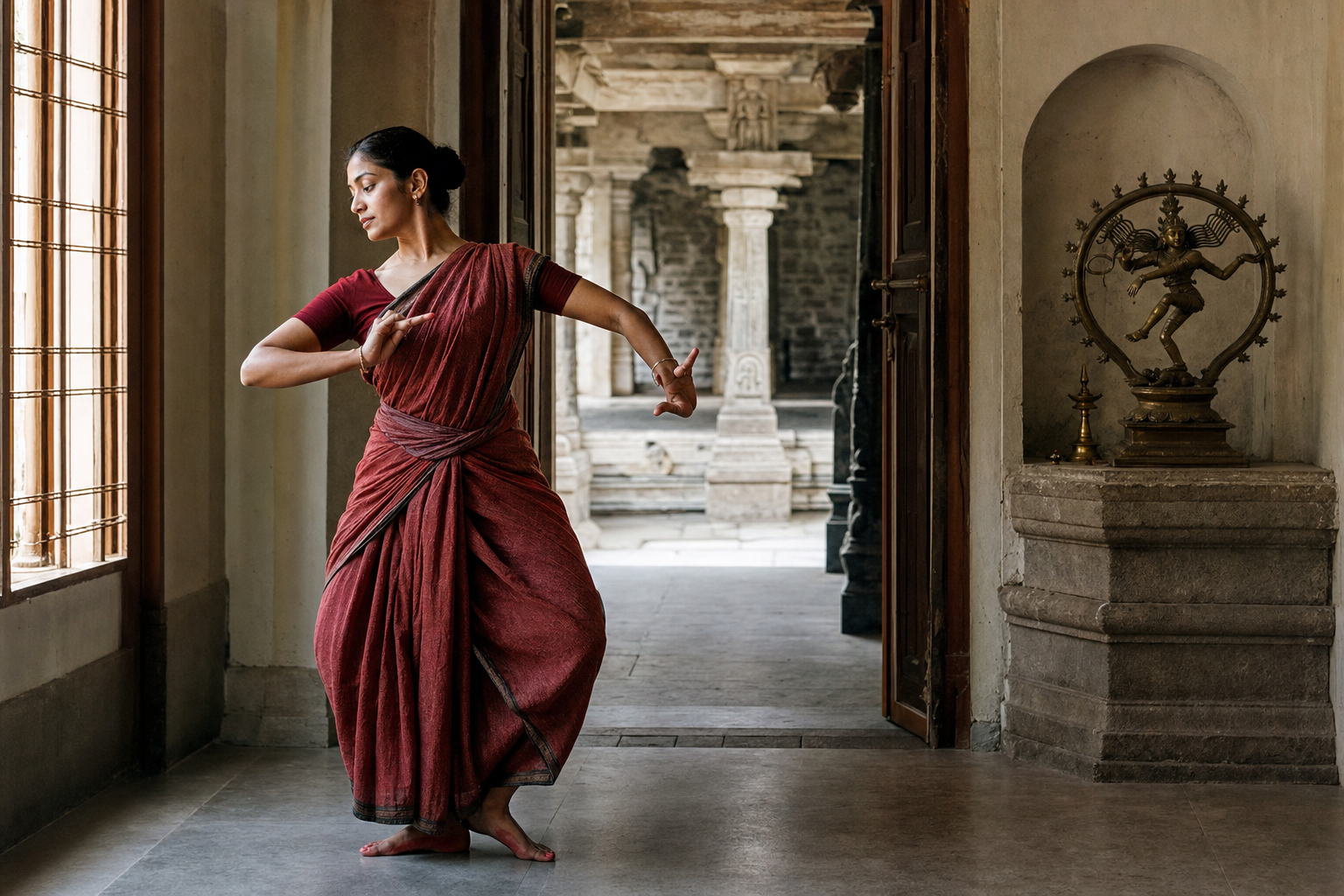
The living lineages that eventually contributed to Bharatanatyam crossed many centuries of change. Thanjavur court pedagogy associated with the Tanjore Quartet, the organization of the margam, and the disruptions of colonial-era anti-nautch campaigns all belong to the intervening history. A present-day Bharatanatyam recital can carry Chola devotional concepts without being an unchanged reproduction of a tenth-century temple service.
That distinction protects both history and practice. If you label every modern step “Chola” merely because it accompanies Shiva, you erase development. If you insist that historical change has severed every connection, you overlook continuities in abhinaya, disciplined embodiment, devotional subject matter and the understanding of art as sadhana.
Use this five-part method at your next temple visit, museum gallery or dance performance:
- Identify the sacred subject. Learn which form of the deity, episode or devotional relationship is being presented.
- Locate the ritual setting. Ask whether the work belongs to daily worship, a festival, a procession, a courtly repertoire or a modern stage.
- Watch relationships, not isolated poses. Connect gaze, gesture, rhythm, music, image and space.
- Separate evidence from inference. An inscription, a remembered life and a modern reconstruction can each teach you something, but they do not carry the same kind of historical proof.
- Find the offering. Ask what the artist’s discipline gives to the deity, the tradition and the gathered community.
Key takeaways
- Chola temple dance belonged to a ritual timetable and festival ecology, not an isolated entertainment programme.
- Technical precision mattered because the body had to communicate devotional meaning clearly.
- Mathura’s remembered life joins personal vow, sustained discipline and practical service without making her particular choices universal.
- Inscriptions, endowments, musicians, dancers, food and lamps reveal the material organization behind sacred beauty.
- Modern Bharatanatyam can inherit Chola devotional principles without serving as a literal reconstruction of Chola choreography.
The next time you meet Chola dance through a bronze, temple or recital, choose one gesture and follow it outward: from the performer’s body to rhythm, deity, ritual space and community. That small act of attention will bring you closer to the Chola insight that perfected movement becomes sacred when it is consciously given.