
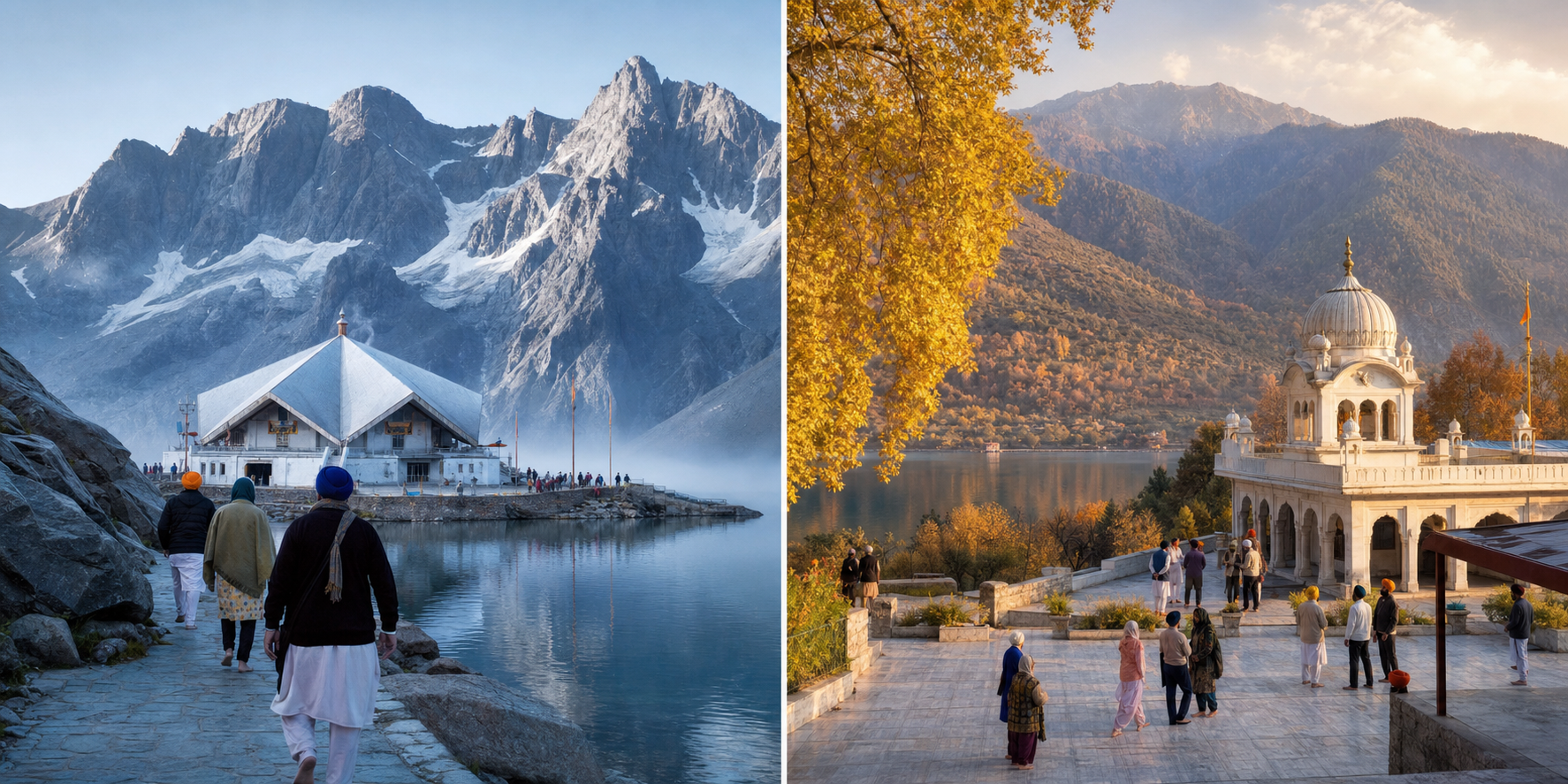
If you are trying to plan a Sikh pilgrimage that includes both Hemkund Sahib and Kashmir, begin by separating two very different journeys. Hemkund is a seasonal, high-altitude yatra to a defined shrine. Kashmir offers a wider network of gurdwaras, remembered encounters, historic sacrifice, local sangat, and contemplative landscapes.
That distinction changes everything: how you schedule the journey, what physical preparation you need, what you should expect to find, and how you conduct yourself when a meadow or lake carries spiritual meaning without becoming a formal shrine. You do not need to choose between devotion and careful planning. In these mountains, careful planning is part of devotion.
Key takeaways before you make the journey
- Plan Hemkund Sahib as a mountain ascent, not an ordinary gurdwara visit. The final climb begins at Ghangaria and reaches approximately 4,329 metres.
- Do not plan to sleep beside the Hemkund sarovar. Pilgrims return to Ghangaria after darshan.
- Keep an optional Valley of Flowers visit for a separate day. Combining it with the Hemkund ascent creates avoidable fatigue.
- Build a Kashmir pilgrimage around three devotional anchors: Chatti Padshahi in Srinagar, Mattan in Anantnag, and Chhevin Patshahi in Baramulla. Approach Gulmarg as part of the surrounding landscape of remembrance, not as an invented shrine.
- Read Sikh sacred geography through shabad, ardas, sangat, memory, and sewa. Natural grandeur can discipline attention, but scenery alone does not make a place sacred.
- Treat ecological restraint as sewa: remain on established paths, carry waste out, protect alpine plants, and use water and langar resources carefully.
Two landscapes ask two kinds of pilgrimage
Hemkund Sahib is a destination in the Garhwal Himalaya of Uttarakhand. The gurdwara stands beside an ice-fed lake in a basin encircled by seven peaks at approximately 4,329 metres. The name itself joins snow, hem, with lake, kund. The severe terrain is not incidental to the experience: physical ascent, limited time, changing weather, collective assistance, and disciplined return all shape the yatra.
Its devotional identification developed through an unusual meeting of text and terrain. Bachitra Natak, within the Dasam Granth, evokes a Hemkunt mountain associated with intense tapas and describes sapt sring, or seven peaks. During the nineteenth century, Pandit Tara Singh Narotam connected that imagery with the Badrinath region. In the 1930s, Sant Sohan Singh and Baba Modan Singh helped identify and mark the present location, encouraged by the literary and devotional work of Bhai Vir Singh. Repeated sewa then turned a remote alpine basin into an accessible seasonal pilgrimage.
This history is worth knowing because it guards against two shallow readings. Hemkund is neither merely a beautiful lake to which Sikh symbolism was later attached nor a location that can be understood from one textual phrase alone. Its sacred geography emerged through scriptural interpretation, topographic recognition, communal acceptance, labour, worship, and the continuing care of the sangat.
Kashmir works differently. Its Sikh landscape is distributed across inhabited places and remembered relationships. Janamsakhi and local traditions connect Guru Nanak with Mattan, where engagement with learned seekers is remembered near an ancient tirtha. Gurdwara Chatti Padshahi in Srinagar commemorates Guru Hargobind. Gurdwara Chhevin Patshahi in Baramulla gives the western part of the valley another historic anchor. Gulmarg belongs to this devotional map through proximity, movement, memory, and contemplation rather than through a claim that every beautiful meadow is a formal Sikh shrine.
| Question | Hemkund Sahib | Kashmir |
|---|---|---|
| What gives the journey its form? | A seasonal ascent to a gurdwara and glacial lake | A network of gurdwaras, remembered encounters, local communities, and landscapes |
| What is the main practical constraint? | Altitude, steep elevation gain, weather, and a same-day descent | Travel between dispersed locations and the need to verify current local conditions |
| What should you prepare? | Your body, equipment, pacing, and turnaround discipline | Your historical understanding, route sequence, etiquette, and willingness to listen |
| What is the central error to avoid? | Treating physical endurance as proof of faith | Turning scenery into vague spirituality or collapsing distinct traditions into one |
Plan Hemkund Sahib around altitude, not ambition
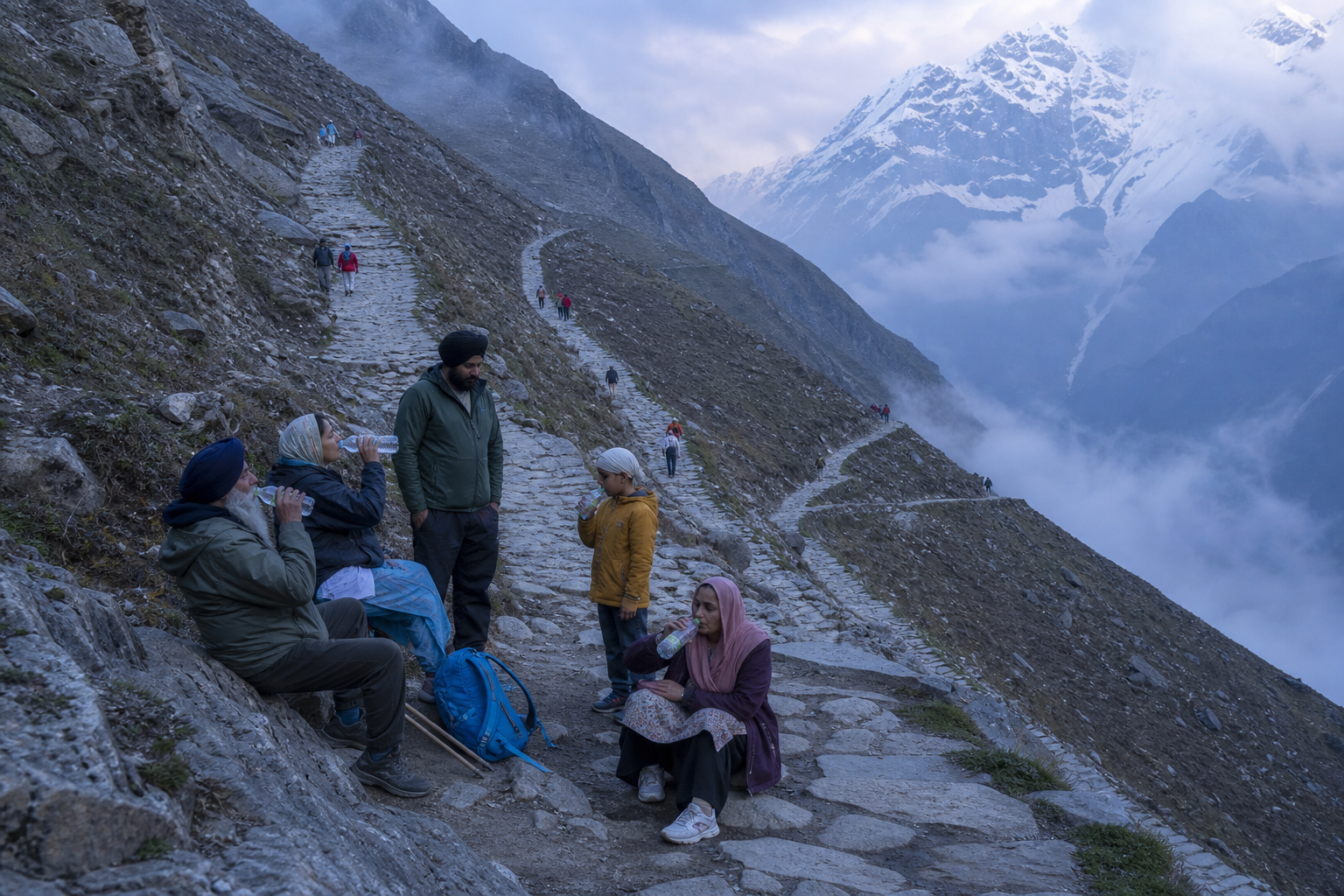
The usual approach follows the Rishikesh-Joshimath-Govindghat corridor. From Govindghat, the ground journey to Ghangaria, also called Govind Dham, has historically involved a trek of approximately 13 kilometres. Porters, pack animals, and seasonal helicopter services may reduce the physical burden, but none removes the need to respect altitude. Rapid transport can save your legs without giving your body time to adjust.
The decisive stage begins at Ghangaria. The approximately six-kilometre climb gains more than 1,200 metres before reaching the sarovar and gurdwara. That is a large elevation gain over a short distance. Even a person who walks regularly at lower altitude may find the gradient and thin air unexpectedly demanding.
A safer sequence for the yatra
- Use Rishikesh or Joshimath as a transit and rest stage. Recover from the road journey, review weather and trail information, and check that every pilgrim has suitable footwear, warm layers, and rain protection.
- Continue to Govindghat with time in hand. Do not construct a schedule that depends on every road transfer and trail service operating without delay.
- Reach Ghangaria and assess the group honestly. Older pilgrims and people with knee or back sensitivities may benefit from a rest day. Where available, dandi, kandi, porter, animal, or helicopter assistance can make the pilgrimage more inclusive.
- Begin the Hemkund ascent around dawn. Early movement provides more daylight and reduces exposure to the mist, sleet, wind, and other weather changes that often arrive later in a mountain day.
- Allow enough time for worship without delaying the descent. Attend ardas, kirtan, or paath as conditions permit, receive langar with restraint, and leave while a safe return to Ghangaria remains realistic.
- Visit the Valley of Flowers only on a separate day. A second outing can deepen your encounter with the region without turning the Hemkund day into an endurance contest.
No overnight stay is permitted at the lake, so the summit is never the end of the day’s work. Protect energy for the descent. A pilgrim who arrives exhausted, remains too long, and starts down late has allowed the emotional high point of the journey to obscure its most basic responsibility.
Know when devotion requires you to turn back
Headache, nausea, dizziness, and unusual fatigue can be signs of acute mountain sickness. If these appear during the ascent, stop climbing, tell your companion or nearby support personnel, and descend rather than trying to prove determination. Symptoms that intensify or do not improve warrant prompt medical attention. Altitude illness can become serious, and neither ardas nor willpower makes continued ascent safe.
Your mountain kit should include layered insulation, gloves, sun and wind protection, a waterproof outer shell, reliable footwear, and trekking poles if you use them comfortably. Morning brightness can turn into cold mist or sleet by midday, while wet rock and meltwater make careless foot placement more consequential. Carry water and simple necessities without loading yourself so heavily that the pack becomes another hazard.
Connectivity becomes intermittent beyond Joshimath, and power can be weather-dependent. Store essential route information offline, carry charged spare batteries, and give family a flexible return window instead of one falsely precise arrival time. Check local notices at Govindghat and Ghangaria each day; yesterday’s trail or weather report is not a promise about today.
A dip in the sarovar should never become a test of spiritual seriousness. Where immersion is permitted and conditions allow it, keep it brief and place personal safety and ecological care first. If the cold, altitude, or your health makes immersion doubtful, offer ardas from the shore. Darshan does not depend on taking an avoidable physical risk.
Travel through Kashmir by following memory, not monuments alone
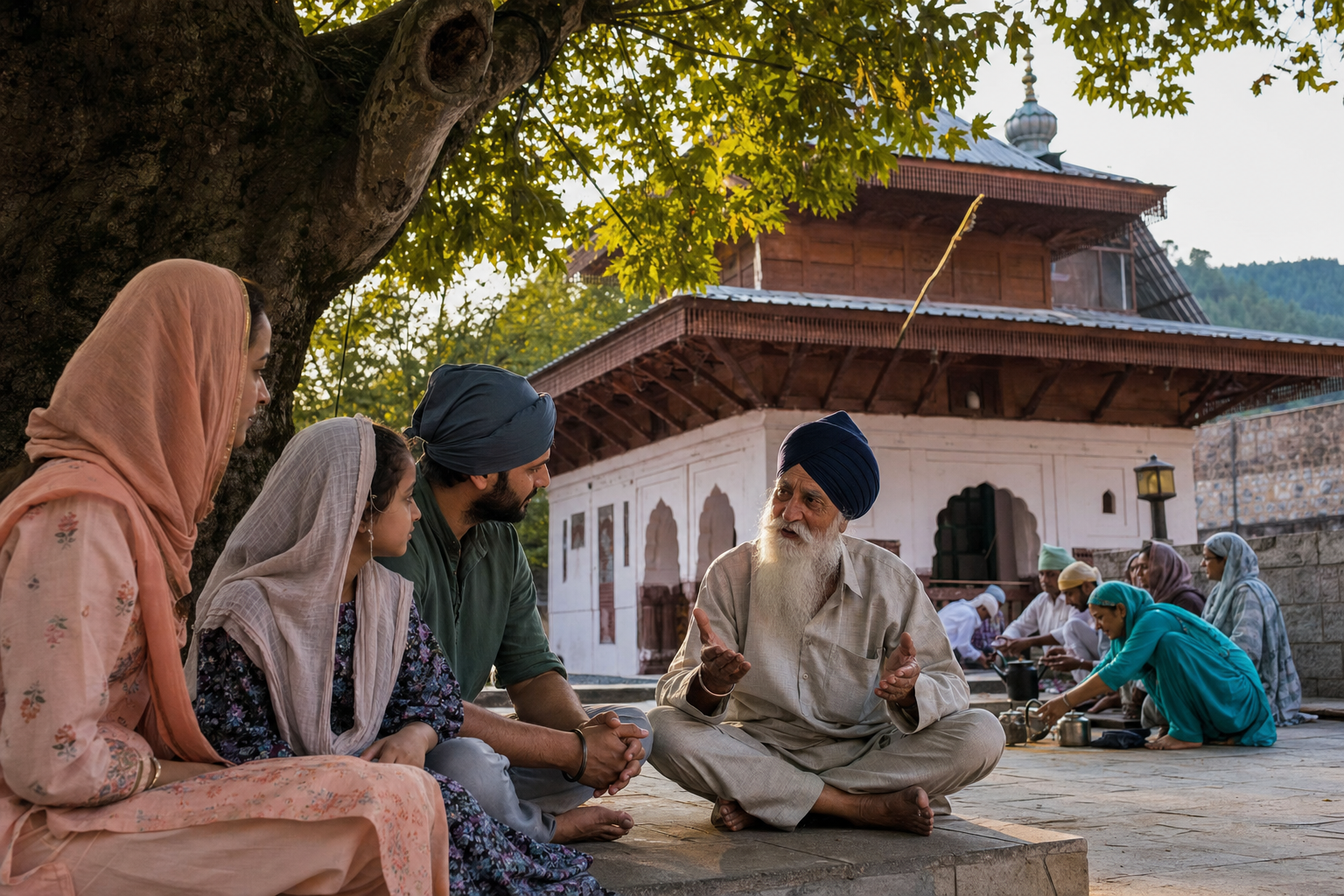
A useful Kashmir pilgrimage does not need a claim that every stop was visited by every Guru. It needs a clear distinction between commemorated gurdwaras, traditions carried through local memory, and landscapes that support contemplation. That distinction strengthens the journey because it lets each place speak in its proper register.
Srinagar: begin with Guru Hargobind’s remembered presence
Gurdwara Chatti Padshahi provides the strongest starting point in Srinagar. Its association with Guru Hargobind places dignity, spiritual authority, and engagement with worldly responsibility near the centre of the Kashmir circuit. Join the rhythm of the resident sangat rather than treating the gurdwara as a historical exhibit. Cover your head, remove footwear, sit without demanding a private experience, and let kirtan or paath determine the pace of the visit.
Kashmir also belongs to the moral memory of Guru Tegh Bahadur. During the seventeenth century, Kashmiri Pandits appealed to the Guru in the face of religious oppression. His martyrdom in Delhi became a defence of conscience extending beyond the rights of his own community. For a Dharmic pilgrim, that connection gives Kashmir more than sentimental significance: it asks whether you will defend another person’s freedom of worship as firmly as your own.
Mattan: enter a layered tirtha with precision and respect
At Mattan in Anantnag, Sikh memory meets an older Kashmiri Hindu sacred setting. Traditions remember Guru Nanak’s exchanges with learned people in the region. Approach the place as a layered encounter, not as evidence that one tradition absorbs the other. Ask which elements belong to the gurdwara’s remembrance and which belong to the ancient tirtha. That small act of attention prevents reverence from becoming appropriation.
Guru Nanak’s remembered mode of engagement also offers a practical model. You can enter a place of another Dharmic tradition without anxiety, listen seriously, preserve theological distinctions, and still recognise shared disciplines such as truthful conduct, compassion, restraint, and the search for liberation. Unity does not require blurred identities.
Baramulla and Gulmarg: let beauty lead to remembrance
Gurdwara Chhevin Patshahi in Baramulla gives the journey another commemorative centre and connects naturally with movement toward Gulmarg, which lies in Baramulla district. Visit the gurdwara as the devotional anchor. Then approach Gulmarg’s forests, meadows, snow, and open horizons as a field of attention rather than a substitute sanctuary.
Bhai Vir Singh, whose life from 1872 to 1957 helped shape the modern Sikh literary renaissance, gives you a disciplined way to make that distinction. In his spiritual imagination, hills, flowers, streams, and changing light do not ask to be worshipped as isolated forms. They can turn the mind toward naam, shabad, humility, and gratitude. Beauty begins the movement; remembrance and ethical conduct complete it.
At Gulmarg, try a simple practice. Stay on an established path and choose a place where sitting will not damage vegetation. Put the camera away for a few minutes. Listen before speaking. If it belongs to your practice, remember a shabad or recite a portion of Sukhmani Sahib. Notice whether the landscape is making you acquisitive – eager to possess images and experiences – or attentive. End by leaving the place cleaner and less disturbed than you found it.
Kashmir’s nineteenth-century political history adds another layer but should not swallow the devotional one. The Sikh Empire under Maharaja Ranjit Singh ended Afghan rule in 1819, after which Dogra governance shaped the region. That transition increased Punjabi-Kashmiri political, commercial, and social contact. Sikh sacred connections, however, cannot be reduced to the period of imperial power: traditions of the Gurus, local worship, oral memory, and the continuing sangat give the landscape its deeper continuity.
Before moving between these places, confirm current travel guidance, road conditions, opening times, and local advice. Kashmir’s sacred geography is enduring; a particular day’s movement is not. Keep enough flexibility to change the sequence without treating an altered itinerary as a failed pilgrimage.
Make etiquette and ecological sewa part of the route
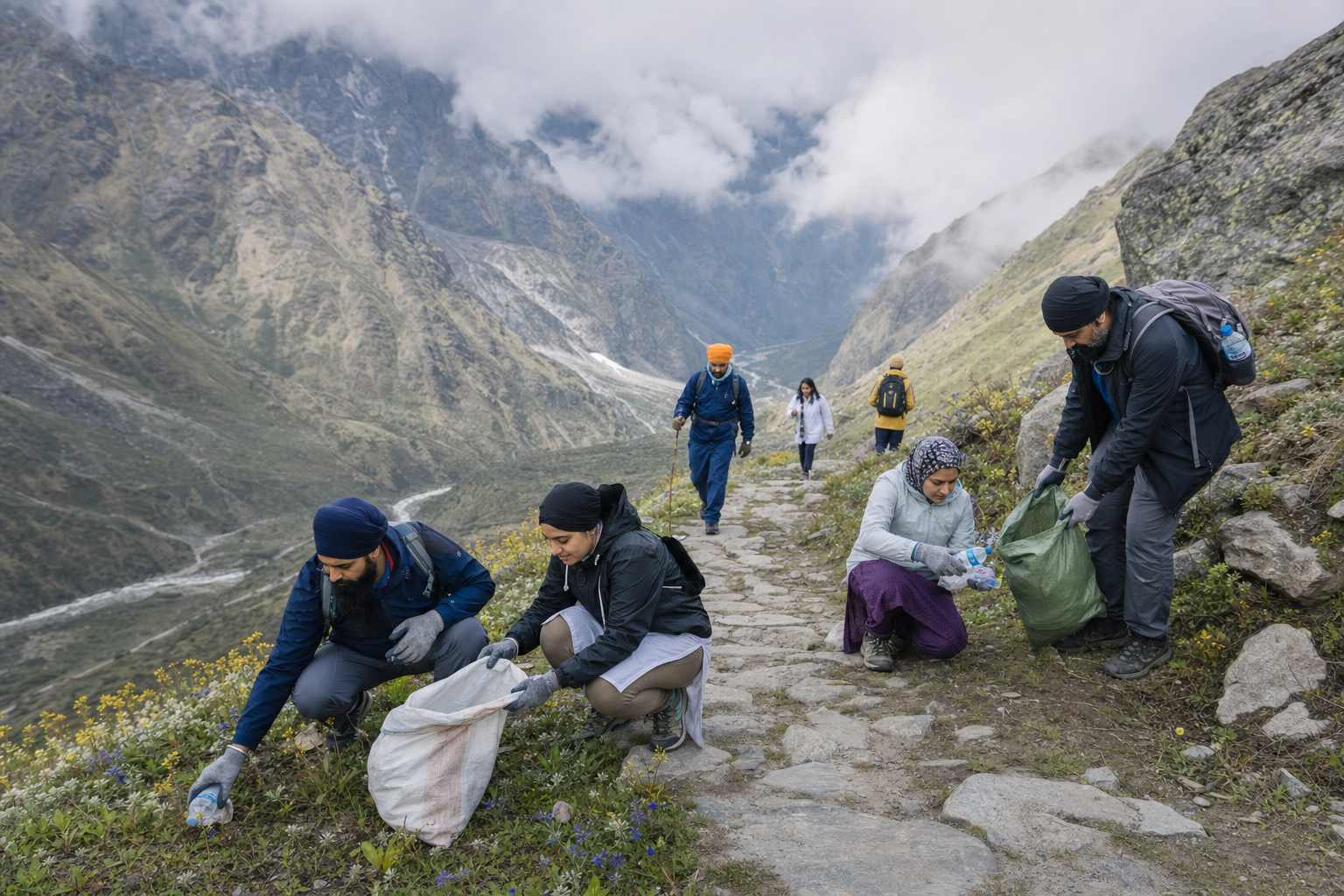
The common discipline at a gurdwara remains straightforward: cover your head, remove your footwear, dress modestly, avoid obstructive photography, and sit with the sangat rather than performing for the camera. Near the Hemkund sarovar, preserve quiet and follow local directions. At historic gurdwaras in Kashmir, ask permission before photographing worshippers, caretakers, inscriptions, or private devotional activity.
Langar at altitude is a logistical achievement, not an unlimited tourist amenity. Supplies have to move through difficult terrain, and water, fuel, sanitation, and waste all require attention. Take only what you will eat. Follow hygiene arrangements. Accept simplicity without complaint. If volunteers request help that you can safely provide, serve without turning sewa into a photograph of yourself serving.
Hemkund lies near the UNESCO-listed Valley of Flowers National Park and on the edge of the Nanda Devi Biosphere landscape. Its meadows, mosses, lichens, shrubs, and thin alpine soils recover slowly from trampling. The celebrated Brahma Kamal grows in this high-altitude environment, but admiration does not grant permission to pick it or leave the trail for a closer photograph.
- Carry your litter back rather than hiding it under stones or leaving it beside a full bin.
- Avoid unnecessary plastic before the trek begins; waste prevention is easier than waste removal at altitude.
- Stay on the marked trail even when a shortcut appears quicker. Repeated shortcuts widen erosion and damage vegetation.
- Use porter, dandi, kandi, animal, lodging, and other local services responsibly. Seasonal pilgrimage supports Garhwali households, while your clarity about the route, load, and conditions helps keep those arrangements safe.
- Do not pressure older relatives to walk for the sake of family pride. Assisted travel or turning back can preserve both dignity and health.
- Consult local notices about snow, landslides, river behaviour, bridge conditions, and weather. Infrastructure has improved, but a Himalayan path remains dynamic.
The nearby Lakshman Mandir makes Hemkund’s shared Dharmic setting visible. Sikh and Hindu pilgrims can use the same trail while maintaining the integrity of their respective forms of worship. The most credible expression of Sarbat da Bhala or Vasudhaiva Kutumbakam is not a slogan about all traditions being identical. It is concrete conduct: make space on the path, help the vulnerable, prevent harm, respect another sanctuary, and leave common resources fit for the next traveller.
The same precision matters in Kashmir, where Sikh, Hindu, Sufi, Kashmiri Shaiva, and Buddhist memories meet. Sikh naam, Sufi ishq, and Kashmiri Shaiva ideas such as spanda can illuminate a conversation, but they are not interchangeable labels for one doctrine. Listen for ethical resonance without erasing theological difference. That is a more durable form of interfaith respect than declaring sameness before anyone has been heard.
Your next step is simple. Decide first whether your body and available days support the Hemkund ascent; then add a weather buffer and a separate recovery or Valley of Flowers day. For Kashmir, write the three anchor names – Chatti Padshahi, Mattan, and Chhevin Patshahi – before adding Gulmarg. A route built in that order will keep the pilgrimage centred on remembrance, responsibility, and sewa even when mountains, weather, or roads require the plan to change.
References
- DharmaRenaissance Blog – Hemkund Sahib: Faith, Sacrifice, and a High-Altitude Pilgrimage of Unity in the Himalaya
- DharmaRenaissance Blog – Unveiling Bhai Vir Singh’s Gulmarg: Mystic Memory and the Sikh Sacred Landscape of Kashmir