
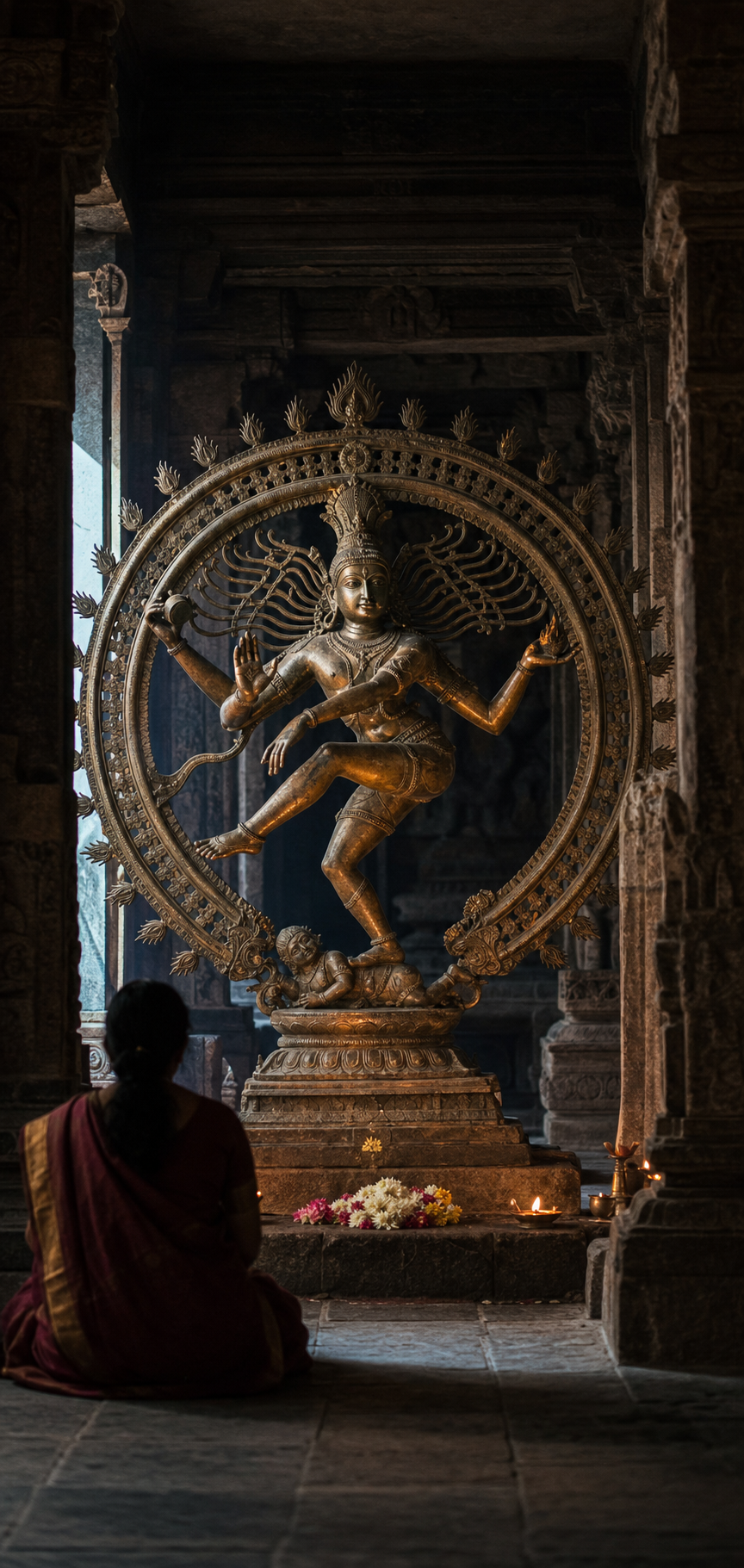
If you have stood before a Nataraja, a serene Buddha, or a Jina and thought, “I know this is sacred, but I do not know what I am meant to see,” the difficulty is not a lack of devotion. Sacred sculpture was made within a visual grammar of measure, posture, gesture, expression, attributes, material, ritual, and space. When you look only at the face or the ornament, most of that grammar disappears.
You do not need specialist training to recover it. You need to separate ritual presence from artistic vitality, read the body in the right order, and notice how the surrounding space directs your attention. That changes a temple visit or museum encounter from passive admiration into an intelligible form of darśana.
First separate recognition, vitality, and consecration
A sacred image can succeed in one register while remaining uncertain in another. This distinction prevents two common errors: assuming that every beautiful or ancient sculpture is a consecrated presence, and judging a consecrated mūrti as though its only purpose were to satisfy modern ideas of visual beauty.
| Register | Question to ask | What you should inspect |
|---|---|---|
| Iconographic identity | Who or what is represented? | Posture, attributes, hand gestures, vehicle, attendant figures, bodily marks, and regional conventions |
| Aesthetic vitality | Does the form make a state of consciousness perceptible? | Proportion, balance, movement, gaze, expression, contour, surface, and the handling of light |
| Ritual presence | Is this image established and approached as a living focus of worship? | Consecration, placement, liturgical use, offerings, local discipline, and the practice of the community caring for it |
In Hindu practice, prāṇa-pratiṣṭhā names the ritual establishment of presence in a mūrti. Chaitanya, in an aesthetic sense, describes the enlivened quality that appears when proportion, expression, gesture, and grace cohere. The two belong to the same sacred ecology, but they are not interchangeable. An unconsecrated bronze in a museum may possess extraordinary aesthetic vitality; its beauty alone does not establish its ritual status. Conversely, the significance of a consecrated mūrti does not depend on whether a modern visitor prefers its style.
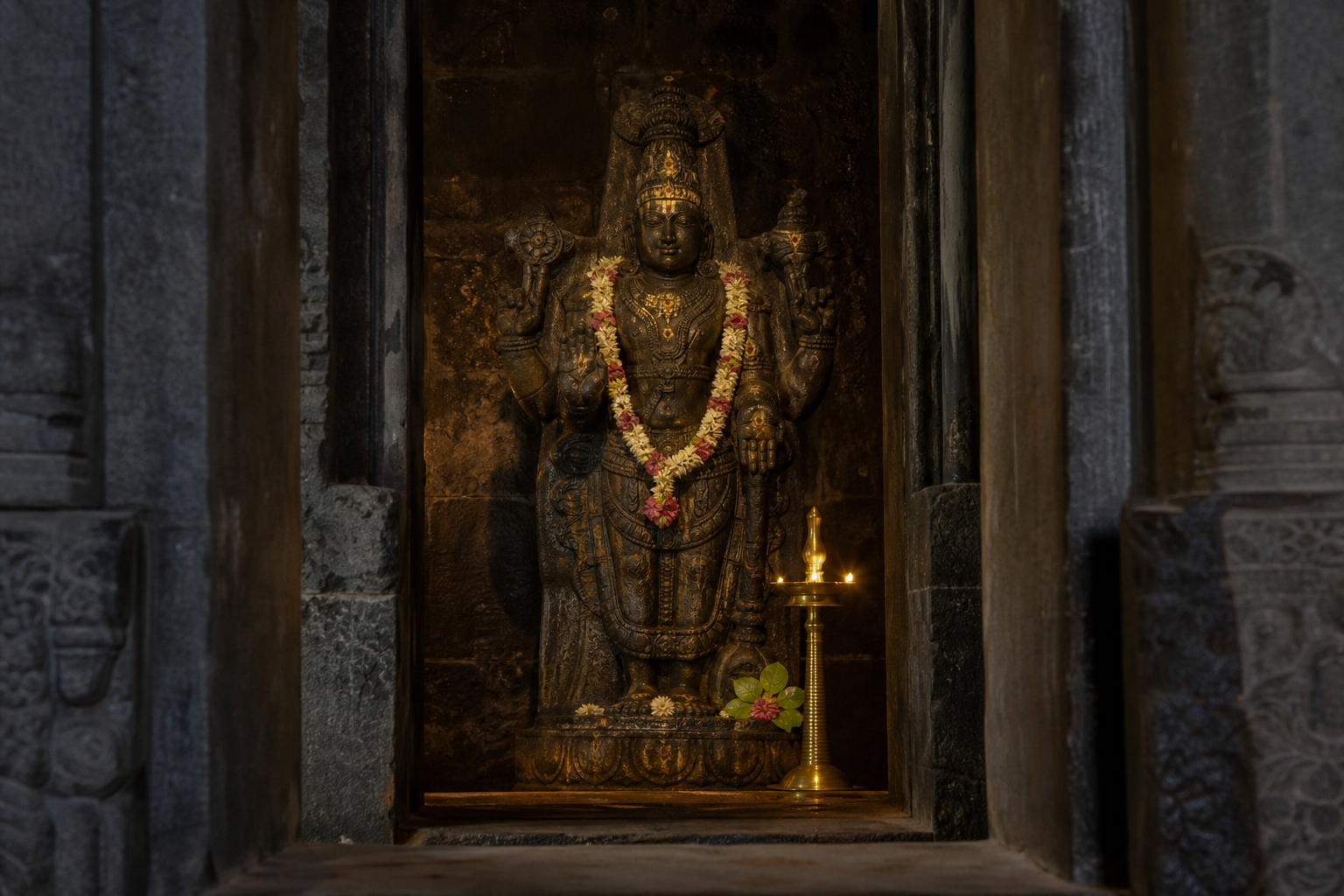
The mūrti also functions as an ālambana, a support around which attention can gather. That makes your first question practical rather than theoretical: what kind of encounter is this place asking you to enter? In an active shrine, worship, local etiquette, ritual sequence, and the direction of darśana come first. In a museum, you may have freer access to contour, material, and technique, but the display does not reproduce the mūrti’s liturgical life.
Do not use the word “alive” loosely. Decide whether you mean accurate iconography, convincing artistic presence, or consecrated ritual life. Once you name the register, you can look carefully without reducing devotion to craftsmanship or craftsmanship to sentiment.
Use the six limbs of art as a viewing method
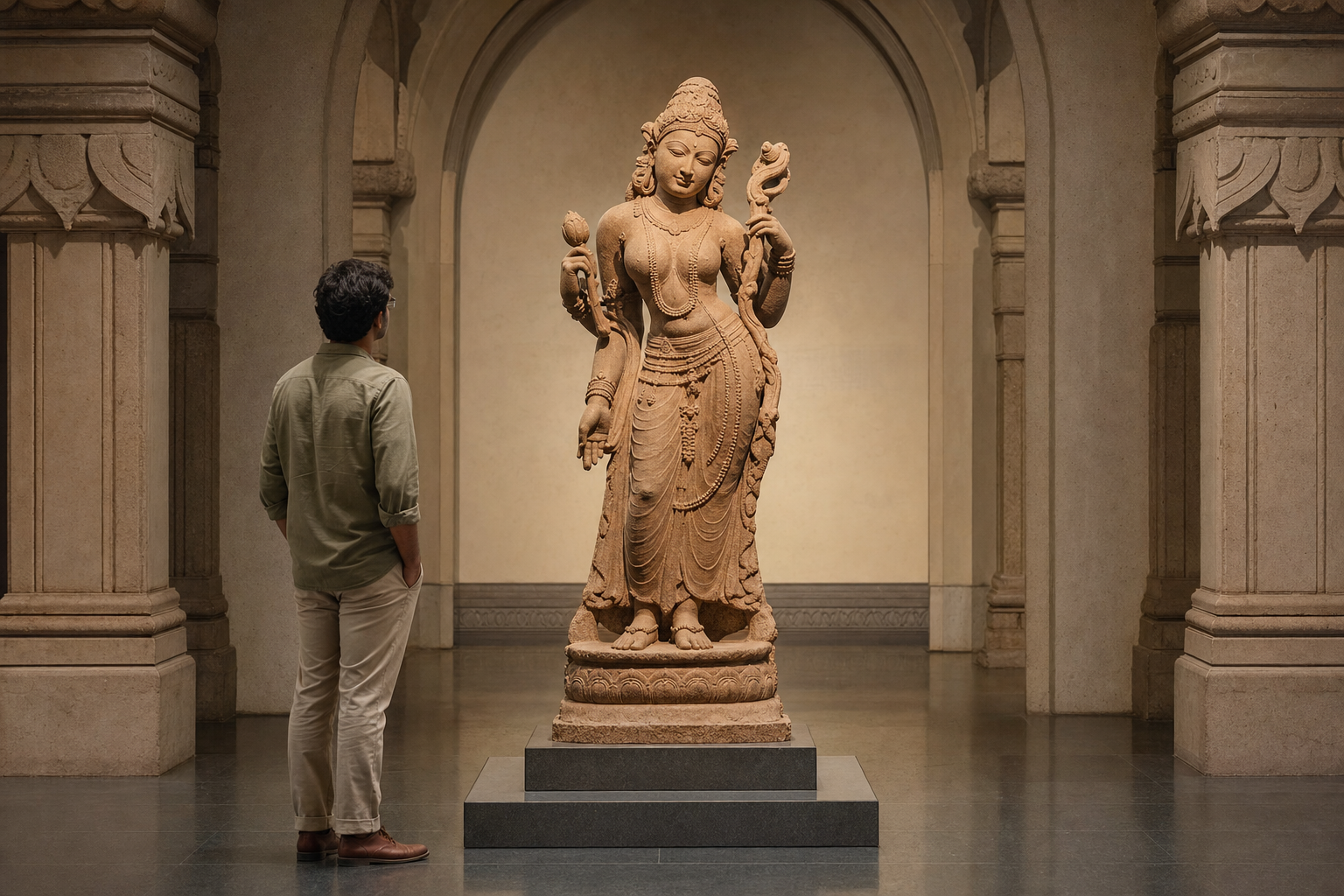
Classical Hindu aesthetics does not isolate sculpture from painting, dance, drama, music, or architecture. Within the Chitra-sūtra of the Vishnudharmottara Purana, these arts participate in a connected discipline: measure supports movement, movement carries expression, and expression becomes perceptible through an ordered form. The six limbs traditionally associated with painting therefore offer a useful way to examine sculpture.
- Rūpa-bheda: discrimination of forms. Begin by determining what kind of form you are seeing. Is the figure standing in complete stability, bending through a sequence of curves, seated in meditation, dancing, guarding, blessing, teaching, or renouncing? Do not rush to the face. The whole bodily type establishes the image’s first meaning.
- Pramāṇa: proportion and measure. Look for the internal system joining head, torso, limbs, hands, and stance. Sacred proportion is not simply ordinary anatomy copied into stone. It is a canonical ordering designed to make a particular mode of being visible.
- Bhāva: expressive state. Ask what the body communicates before you assign an emotion to the face. Assurance may reside in an open palm and a stable axis. Equanimity may emerge from symmetry and restrained eyelids. Energy may come from opposed diagonals even when the facial expression remains composed.
- Lāvaṇya-yojana: the infusion of grace. Notice how contours continue through the figure, how a plane receives light, and whether ornament strengthens or interrupts the body’s rhythm. Grace is not prettiness added after construction. It is the quality that prevents correct parts from feeling mechanically assembled.
- Sādṛśya: resemblance. Ask what kind of likeness is intended. A sacred image need not be a portrait of an individual. Its resemblance may lie in fidelity to a recognised divine form, an awakened condition, a Jina’s equanimity, or the characteristic marks through which a community knows the presence represented.
- Varṇika-bhaṅga: the handling of colour and pigments. This limb applies most directly to painting, painted sculpture, and surface colour, but it also trains you to notice material appearance. Stone hue, metallic sheen, surviving colour, ritual substances, polish, and patina all affect how planes and details become visible. Do not assume that the bare surface now before you necessarily represents the image’s original appearance.
Pramāṇa deserves special care because it is easily mistaken for a demand that all sacred bodies look alike. Modular units such as aṅgula and tāla organise major limbs, minor limbs, and smaller features, but proportional systems vary among lineages preserved in works such as the Mānasāra, Mayamata, and Śilpa-prakāśa. A form should therefore be judged through its own internal rhythm, not forced into one supposedly universal template.
You do not need to carry a ruler. Find the figure’s governing axis. See whether the head establishes a convincing scale for the torso, whether the shoulders and pelvis support the turn, and whether a lifted arm or leg is balanced elsewhere. Then move from aṅga, the major bodily divisions, through pratyaṅga, the connecting or secondary parts, to upāṅga, the finer features. Looking in that order stops jewellery, fingers, or facial charm from distracting you from a weak or powerful total construction.
Do not confuse naturalism with life. A body can be anatomically plausible yet aesthetically inert. Another can depart from everyday bodily proportions while making stability, compassion, play, or cosmic movement unmistakable. The better test is coherence: does every formal decision participate in the same bhāva?
Movement and stillness require different kinds of attention
Read motion through its counterforces
Movement in sacred sculpture is not created by placing limbs in dramatic positions at random. The body draws on a disciplined vocabulary shared with performance: sthāna provides the postural base, karaṇa coordinates bodily action, and hasta and dṛṣṭi organise hand gesture and gaze. A convincing image gives every outward thrust a structural answer.
- For a standing Viṣṇu in samapāda, begin with the equal placement and vertical stability of the body. The śaṅkha, cakra, gadā, and padma are not detachable identifiers; their ordered distribution extends the sense of cosmic command around the central axis.
- For Kṛṣṇa in tribhaṅga, trace the successive changes of direction rather than looking for one decorative curve. Head, torso, and lower body counter one another, allowing repose and play to inhabit the same stance.
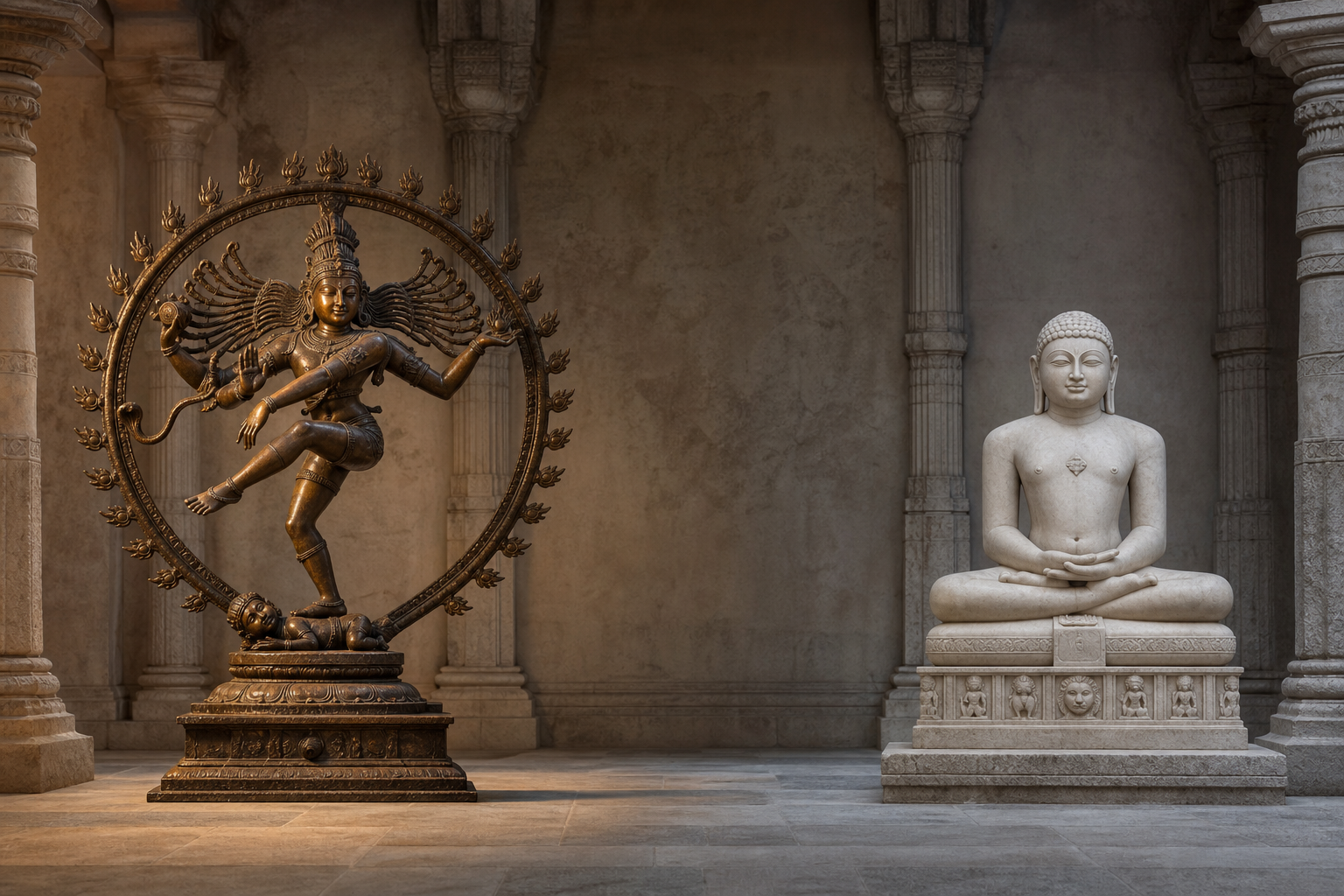
- For Śiva Naṭarāja, read the entire armature before decoding individual hands. The ring provides a containing order, while the raised leg and sweeping limbs create crossing diagonals. Abhaya steadies the encounter, agni signifies dissolution, gajahasta draws the composition downward, and the lifted foot offers refuge. Boundless motion becomes legible because it is held inside a precise balance.
The practical rule is simple: identify the base before interpreting the extremities. If you start with a hand symbol in isolation, you may recognise an attribute while missing the action of the whole body. Follow the line from supporting foot through hip, spine, shoulder, hand, and gaze. Where does the movement begin, where is it resisted, and where does it resolve?
Read stillness through restraint
Stillness is not the absence of artistic life. It is often the more demanding achievement because the sculptor cannot rely on sweeping limbs or abundant narrative. In Gupta-period Sārnāth Buddha images, the robe can appear almost immaterial, the eyelids descend, and the outer contour proceeds with little interruption. The reduction of visible incident concentrates attention on inward composure.
A Jina in kāyotsarga or padmāsana makes a related but distinct demand. Symmetry, restrained features, and the refusal of anecdotal action establish equanimity. Look for very small decisions: the set of the shoulders, the relation of chin to chest, the continuity of the torso, and the degree to which the gaze turns away from ordinary distraction. If you expect theatrical expression, you will misread disciplined quiet as lifelessness.
Hoysala sculpture asks for the reverse adjustment. Its profusion of figures, jewellery, friezes, and undercut detail can overwhelm a hurried eye. Instead of treating abundance as clutter, locate the repeated bands, axial anchors, and rhythmic intervals that keep the surface intelligible. Sārnāth restraint, Jain quietude, and Hoysala profusion use different amounts of visual information, but each can make a coherent state palpable.
This is where bhāva, dhvani, and rasa become practical rather than abstract terms. Bhāva is the state embodied by the form. Dhvani is its power of suggestion beyond literal description. Rasa is the clarified experience available to a receptive beholder, the sahṛdaya. You complete the encounter, but that does not mean projecting any private feeling you please. Your response should remain answerable to the sculpture’s posture, proportion, gesture, expression, and context.
When a sculpture leaves you unmoved, return to those visible causes before declaring it dead or pretending to feel reverence. Ask which state the form is trying to make intelligible and which formal decisions carry it. Sacred respect does not require counterfeit emotion; it requires disciplined attention.
Let material, temple space, and tradition complete the encounter
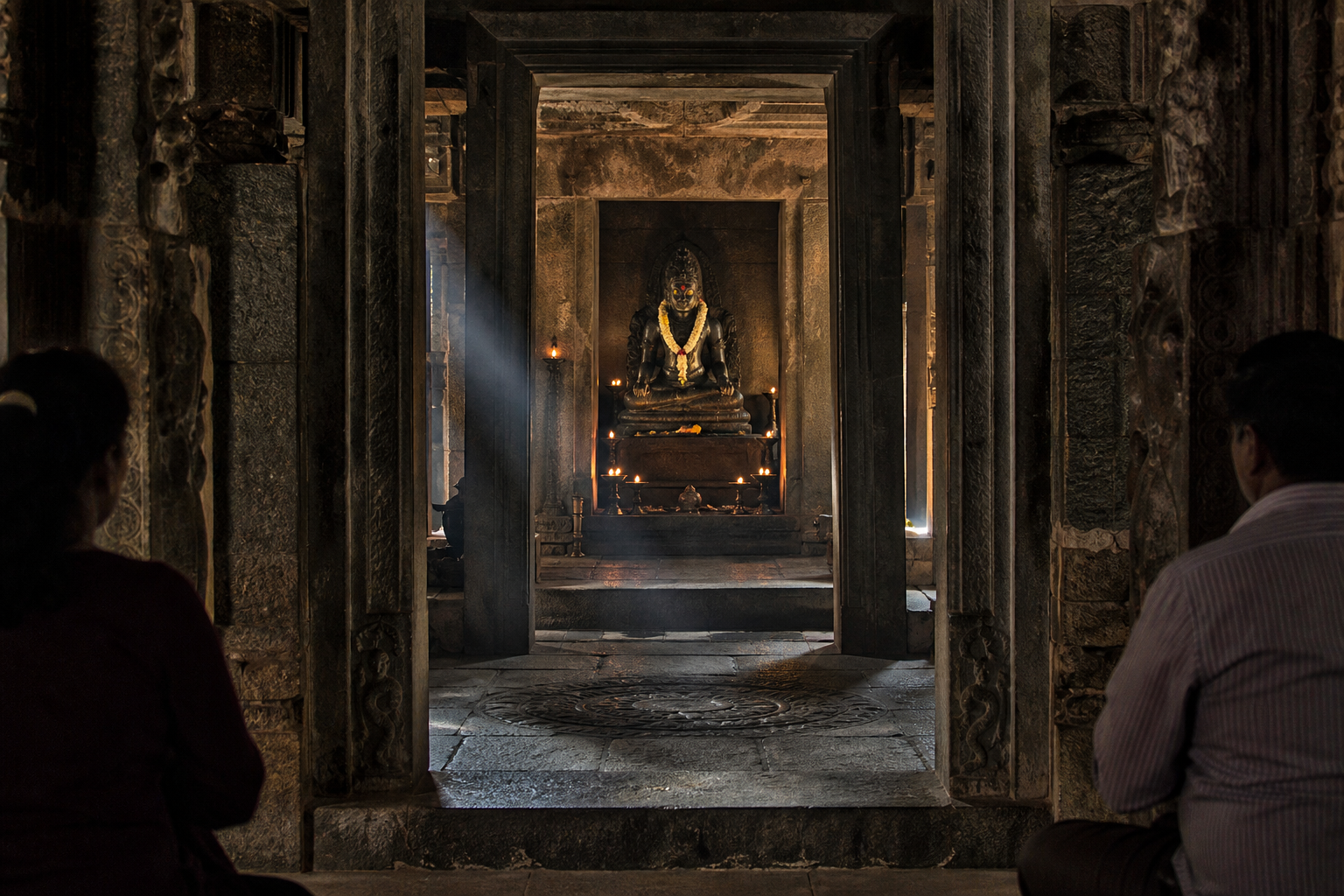
A sacred image does not end at its physical edges. Temple plans establish axes, thresholds, compressed and expanded spaces, routes of circumambulation, and changing conditions of light. In a Drāviḍa temple, the concentrated volume of the garbhagṛha gathers attention around the principal mūrti, while subsidiary shrines, processional paths, and gopura imagery broaden the field of meaning. In many Nāgara temples, the ascent of the śikhara draws the gaze upward while the body encounters the sacred structure through movement around it. Architecture and sculpture work as a shared choreography.
This is why a cropped photograph can teach you iconography while concealing the intended encounter. It may remove the sculpture’s scale, directional gaze, architectural conversation, changing shadows, and relation to your moving body. Use photographs for study, but do not mistake photographic access for the whole work.
Material also determines what kind of life a surface can carry. Chola bronzes begin with a form modelled in wax, enclosed in clay, and replaced by molten pañcaloha. That process allows continuous contours, poised projecting limbs, detailed ornaments, and a surface that responds to moving light. Regional stones require different solutions: khandolite and laterite in Odisha, chloritic schist in Hoysala regions, and granite in Tamilakam do not receive the chisel in the same way. Roughing, planing, undercutting, abrasion, and polish turn the properties of each material into part of the image’s visual language.
When you inspect technique, ask what the material permits and resists. Does the sculptor use mass, broad plane, deep shadow, fine undercutting, or a nearly unbroken contour? Does ornament clarify bodily movement or bury it? Does polish help light travel across the form? Also distinguish present condition from intended design. Erosion, broken attributes, lost pigment, or later surface deposits can obscure a grammar that was once easier to read.
Do not flatten the Dharmic traditions into one image theology
Hindu, Buddhist, Jain, and Sikh traditions share deep concerns with disciplined form, transformed attention, and sacred presence, but they do not assign identical roles to images. Hindu mūrti traditions join iconography, ritual establishment, worship, and darśana in varied sectarian and regional ways. Jain images often render the Jina’s liberation through radical composure. Buddhist traditions have used both iconic figures and signs such as the empty throne, the Bodhi tree, and footprints. Sikh tradition centres the living Word rather than a figural mūrti, while sanctified space, Gurmukhi calligraphy, and the sonic architecture of Kīrtan carry aesthetic and devotional force.
The practical consequence is important: do not apply the ritual vocabulary of one tradition indiscriminately to another. First ask which medium the community treats as primary in that setting: consecrated form, symbolic sign, Word, sound, architectural space, or some ordered relation among them. Shared Dharmic aesthetics becomes more meaningful when genuine differences are preserved.
A viewing practice for your next encounter
- Establish the context. Determine whether you are in an active shrine, a temple complex, an archaeological setting, or a museum. In a place of worship, follow local etiquette and the community’s ritual order before beginning visual analysis.
- Identify the form. Use the label, shrine tradition, or reliable iconographic information to recognise the figure, posture, and principal attributes. Do not guess solely from facial appearance.
- Find the base and axis. Locate the supporting foot, seat, pedestal, or central vertical. Notice how the body’s weight is established before following any projecting limbs.
- Move from the whole to the details. Read the major bodily divisions first, their connections second, and hands, eyes, ornaments, and smaller marks last. This reveals whether the details reinforce the governing rhythm.
- Connect gesture, gaze, and attribute. Ask where each hand directs you, what the eyes attend to, and how the attributes alter the figure’s surrounding space. Interpret relationships, not isolated symbols.
- Allow the setting to act. Where permitted, change your position, observe how light alters the planes, and follow the appropriate path around the image. Delay photography until you have completed one uninterrupted viewing.
- Stop naming and attend. After analysing the form, become quiet. Notice whether the image makes assurance, serenity, compassion, play, power, or renunciation clearer to you. Do not demand a dramatic sensation. The relevant question is whether your attention has become more exact.
This sequence works because it joins knowledge and receptivity. Technical analysis without openness can turn sacred art into a diagram. Emotion without attention can turn it into a screen for private projection. Living sculpture becomes legible where disciplined form, situated practice, and a prepared beholder meet.
Key takeaways
- Aesthetically enlivened sculpture and a ritually consecrated mūrti are related realities, not interchangeable labels.
- Read a sacred body from its base and governing axis outward; proportion, posture, gesture, gaze, and attributes should form one coherent statement.
- Canonical proportion is not ordinary anatomical realism, and different śilpa lineages should not be forced into one universal template.
- Movement becomes convincing through counterforces, while stillness becomes convincing through restraint, symmetry, and minute expressive decisions.
- Material, architecture, ritual use, light, and the viewer’s movement belong to the work’s meaning rather than serving as incidental background.
- Respect differences among Hindu, Buddhist, Jain, and Sikh sacred aesthetics; shared Dharmic concerns do not erase distinct approaches to image, symbol, Word, sound, and presence.
At your next encounter, choose one image and resist the urge to collect it quickly with your phone. Find its axis, follow its weight, connect its hands to its gaze, and let its space determine how you approach. One sculpture read patiently will teach you more than a gallery passed in haste.