
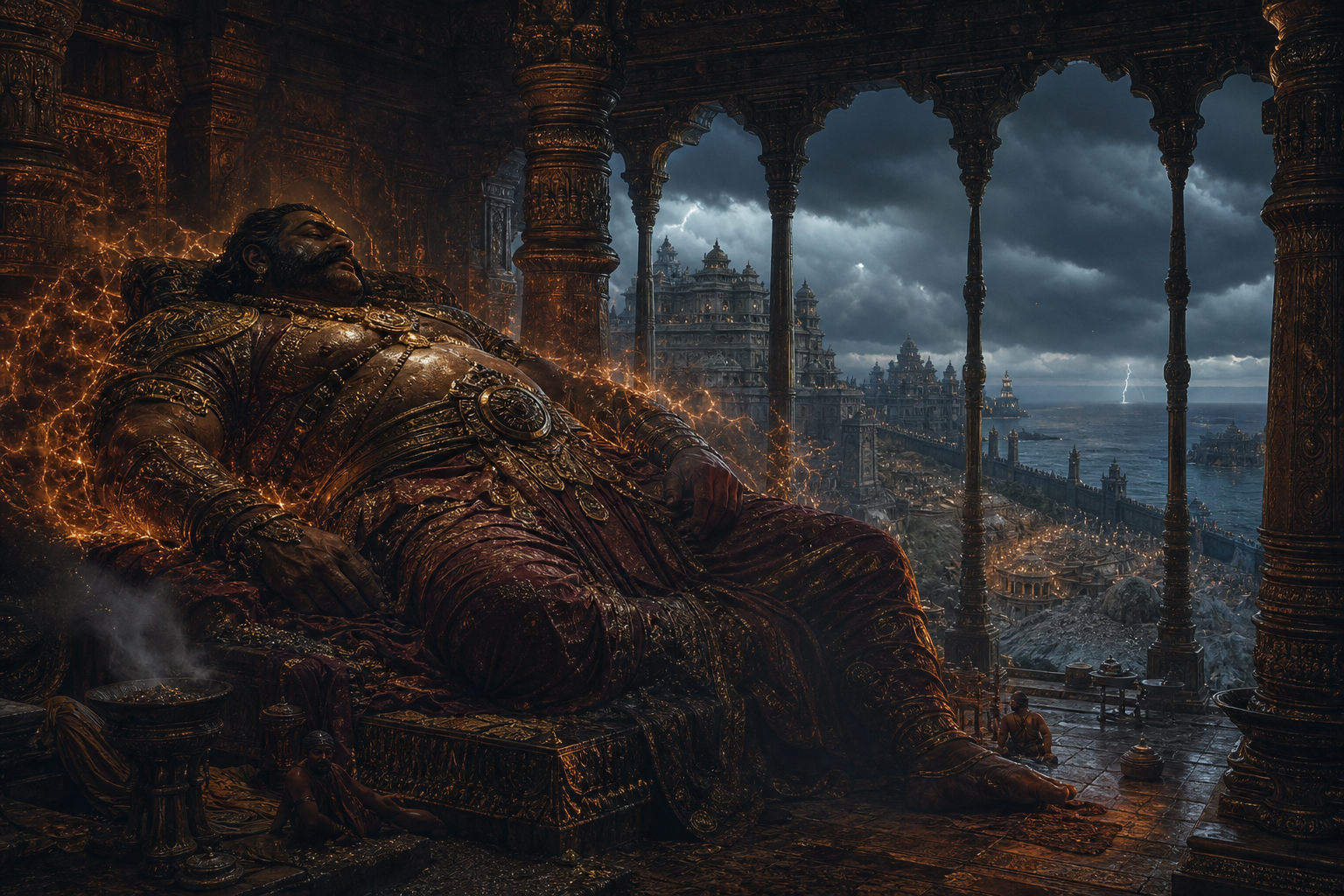
If you are trying to decide whether Kumbhakarna’s sleep is a curse, a protection, or a military liability, the clean answer is that it becomes all three at different levels. The limit protects the world from continuous destructive power, leaves Lanka without its strongest warrior for long periods, and exposes the moral weakness of strength placed at the service of adharma.
That distinction matters beyond the battlefield. Kumbhakarna gives you a practical way to judge restraints, reserves of power, and divided loyalties: ask what a limit prevents, what dependency it creates, who can override it, and whether the power released by that override still serves a righteous end.
Keep the three meanings of Kumbhakarna’s sleep separate
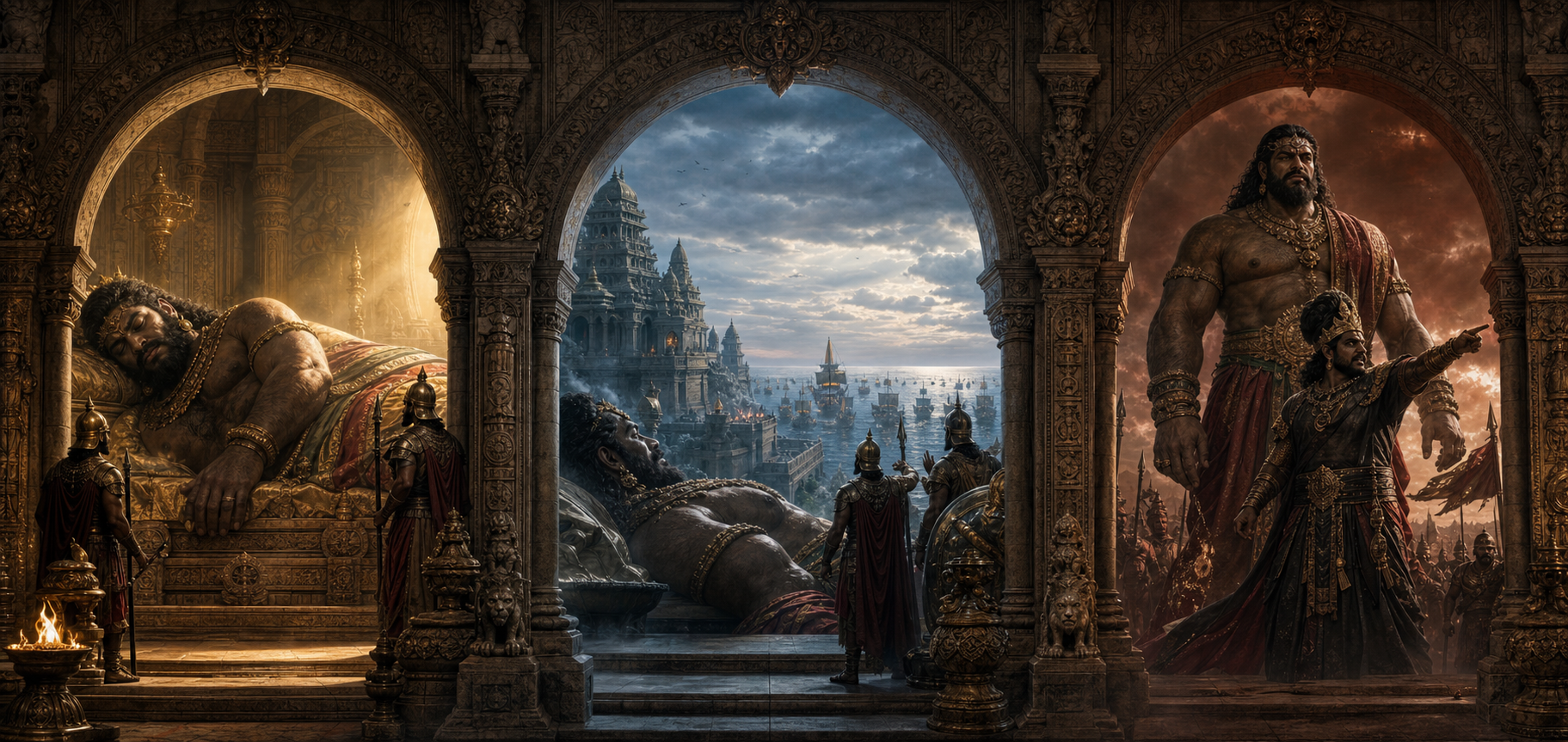
Kumbhakarna’s slumber is easy to flatten into a simple punishment for excess. That reading catches the imagery of heaviness, appetite, and inertia, but it misses the structure of the episode. His sleep operates simultaneously as a metaphysical restraint, a strategic disability, and an ethical symbol.
- Metaphysically, sleep prevents overwhelming force from remaining permanently active.
- Strategically, the same sleep makes Lanka’s greatest physical asset unavailable when circumstances change.
- Ethically, Kumbhakarna can recognize Ravana’s wrongdoing while remaining insufficiently free of loyalty to resist it.
The origin of the sleep is not identical in every tradition. The Valmiki Ramayana places the boon episode after Kumbhakarna’s austerities: the devas fear the consequences of his power, and Saraswati confounds his speech. Several later retellings sharpen the scene into the memorable shift from indrāsana, the seat of Indra, to nidrāsana, the seat of sleep. Other strands emphasize a divine penalty for earlier excesses. You should therefore distinguish the stable meaning from the variable narrative detail. The stable element is that six months of sleep followed by only a brief waking interval places a ceiling on otherwise destabilizing might.
This makes the boon more than a verbal trick. It is a settlement between individual potency and cosmic order. Kumbhakarna is not deprived of agency or annihilated before he acts. His capacity is bounded so that it cannot dominate creation without interruption. Restraint, in this sense, is not evidence that strength has failed. It is the condition under which dangerous strength can exist without becoming absolute.
When you encounter the indrāsana-nidrāsana episode in a discourse, classroom, or family retelling, do not make the pun carry the entire interpretation. Use it to notice the power of vāk, or consequential speech, but then ask the larger question: why does cosmic order answer a demand for greater status by limiting availability? The answer is that dharma does not measure power only by how much it can accomplish. It also measures power by what prevents it from becoming ruinous.
How a protective limit becomes a military vulnerability
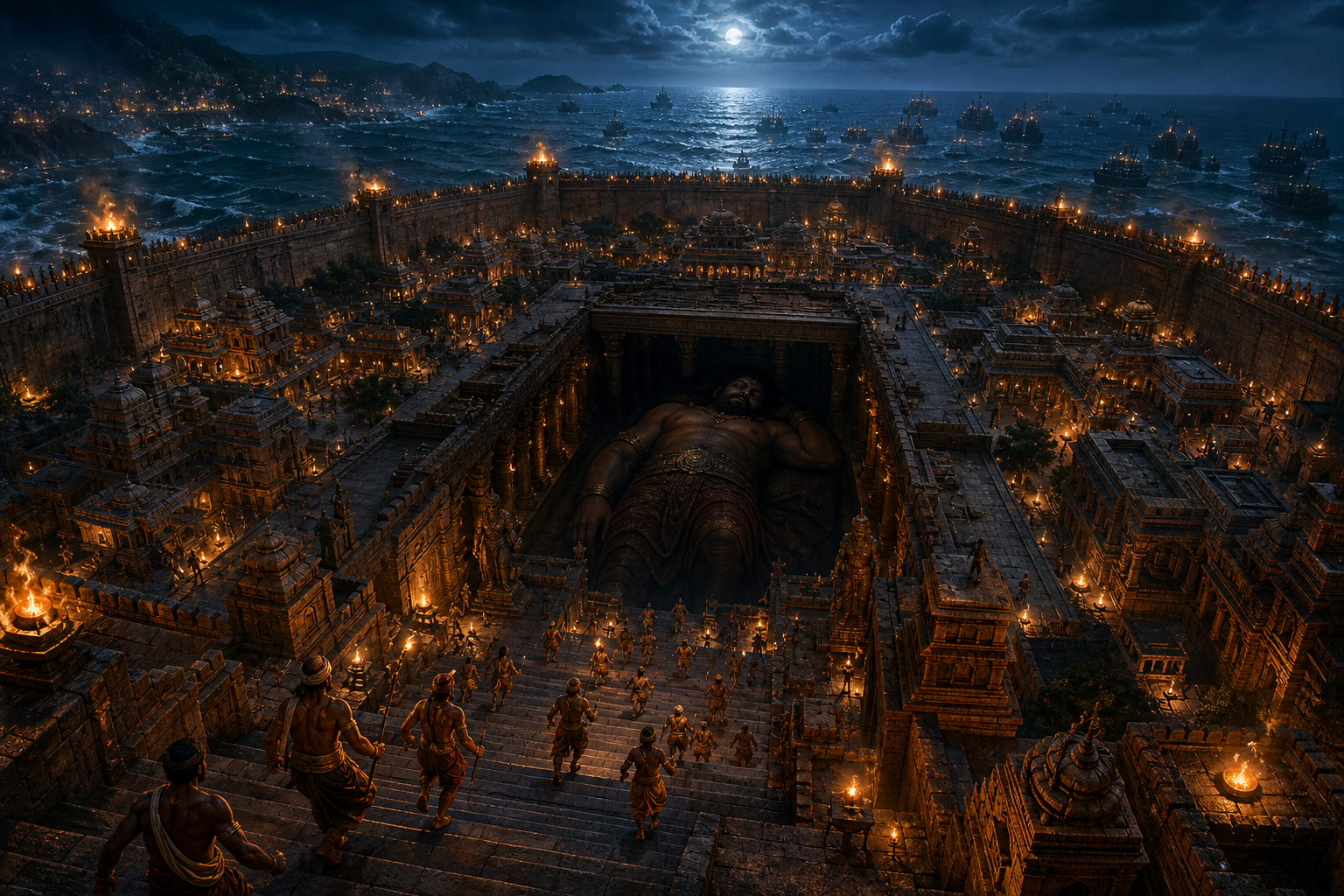
A restraint can be beneficial at one level and dangerous at another. Kumbhakarna’s long dormancy shields the wider world from his uninterrupted activity, but Lanka experiences that same dormancy as a readiness problem. Ravana cannot call upon his brother through an ordinary command. He must first force a transition that the boon itself resists.
The extraordinary awakening makes that dependency visible. Drums and conches sound; elephants, chariots, torches, iron prongs, food, and drink are brought into the effort. The spectacle is not incidental. Lanka’s supposedly decisive reserve requires a vast mobilization merely to become available. By the time Ravana orders the awakening, the crisis has already advanced far enough that patience, counsel, and an orderly response have given way to emergency activation.
Four strategic weaknesses follow from that arrangement:
- Predictable unavailability: a six-month sleep cycle sharply restricts when the warrior can answer a threat. Power that cannot be summoned when conditions change is not equivalent to power already under command.
- High activation cost: Lanka has to divert people, animals, provisions, and attention to waking its defender before it can use him.
- A vulnerable transition: abrupt awakening restores enormous physical force, but it does not create the calm conditions needed for independent judgment. Urgency belongs to Ravana, so Ravana also frames the purpose of the awakening.
- Dependence on one exceptional asset: reliance on a single giant leaves no graceful response when that asset is dormant, slow to mobilize, or lost.
The lesson is more precise than the familiar warning not to become complacent. If you deliberately hold strength in reserve, you need to inspect the entire path from restraint to action. Who recognizes the need to activate it? What preparation is required? Who can refuse a wrongful command? What happens if the reserve is released before wise deliberation is possible? A limit that reduces harm during ordinary conditions can become a point of failure when its override belongs to an undisciplined authority.
Kumbhakarna remains devastating after he reaches the field. He scatters forces and threatens morale, but raw momentum cannot reverse the moral and strategic position Ravana has created. Rama meets the onslaught with composure and directed force, progressively disabling the giant before ending his advance. The contrast is not strength against weakness. It is concentrated violence under a compromised command against force governed by measure, timing, and dharmic purpose.
Use that contrast when evaluating power in your own community or institution. Do not ask only who is strongest. Ask whose strength is available without panic, whose judgment survives activation, and whose authority gives the action its direction. Readiness without moral clarity is dangerous, but moral intention without readiness is fragile. A durable arrangement needs both.
The deeper failure is loyalty that cannot correct wrongdoing
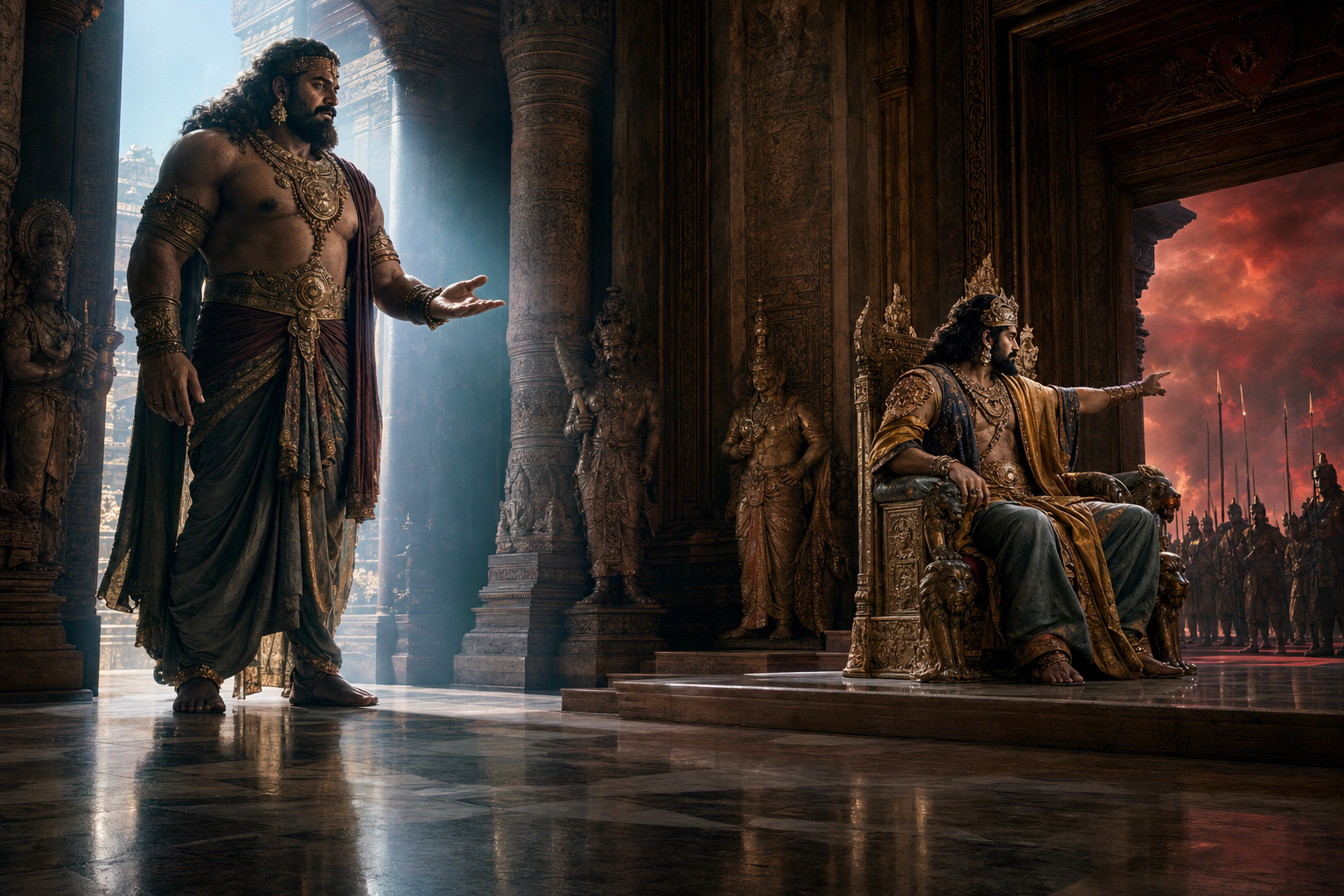
Kumbhakarna is not portrayed as incapable of moral recognition. He reproves Ravana for abducting Sita and understands that the decision has brought grave consequences upon Lanka. Yet he ultimately chooses to fight for his brother, interpreting kinship and warrior-duty as obligations he must honor even inside an unrighteous cause.
This is why his tragedy is not adequately explained by tamas or drowsiness. Once awake, he can see the wrong. His remaining bondage is relational. He knows that Ravana’s act is indefensible, but he does not carry that judgment far enough to withdraw his strength from Ravana’s war.
The episode asks you to separate three things that are often confused:
- Loving a person is not the same as supporting that person’s action. Kinship can require counsel, protection, or compassion without requiring participation in adharma.
- Role-duty is not permission to ignore the moral order around the role. Kshatra-dharma can explain Kumbhakarna’s impulse to defend Lanka, but it does not make Sita’s abduction righteous or erase the purpose for which his martial power is being used.
- Courage inside a bad decision is not a substitute for correcting the decision. Heroic conduct on the battlefield cannot repair a cause that was corrupted before battle began.
That hierarchy of duties is the point to carry into a real decision. When loyalty pulls you toward a course you already judge to be wrong, do not wait for the crisis to define your boundary. State the wrong clearly while alternatives remain. Decide what support you can still offer the person and what support you must withhold from the action. If you postpone that distinction until everyone is mobilized, loyalty, fear, reputation, and urgency will make withdrawal much harder.
Kumbhakarna and Vibhishana illuminate two different responses to the same ruler. Both can discern the problem, but discernment becomes dharmically effective only when it changes conduct. You therefore should not measure moral clarity by how accurately someone criticizes a wrongful policy in private. The harder measure is whether that person will stop lending status, skill, force, or silence to it.
Use the sleep metaphor without mistaking rest for adharma
The symbolism of sleep needs one important boundary. Ordinary physical rest is not a moral defect, and constant activity is not sattva. Treating exhaustion as virtue would invert the lesson. Kumbhakarna’s sleep matters because it represents power submerged in heaviness, excess, and interrupted awareness, not because every period of bodily rest is spiritually suspect.
Through the language of the guṇas, tamas describes inertia, obscurity, and heaviness; rajas supplies movement and drive; sattva supports lucidity and balance. Kumbhakarna’s huge appetites and long dormancy make tamas an obvious interpretive lens, but the character cannot be reduced to a single guṇa. His rebuke of Ravana shows a degree of moral perception. His rush into battle shows formidable rajas. What is missing is the sustained clarity that would order loyalty and energy toward a dharmic end.
Related warnings appear across Dharmic traditions without becoming identical doctrines. Buddhism names thīna-middha, sloth and torpor, among the hindrances to insight. Jain thought warns against pramāda, or heedlessness, as an obstacle to right conduct. Sikh teachings value wakeful surat and sustained simran. Each vocabulary joins ethical action to some form of cultivated awareness. The shared point is not that sleep is sinful. It is that strength, vows, and good intentions become unreliable when awareness is intermittent.
You can turn that symbolism into a five-question test:
- What harm does this restraint prevent? If you cannot name the excess being bounded, the restraint may be mere incapacity rather than wise self-limitation.
- What dependency does the restraint create? Identify the people, timing, provisions, or permissions required to move from dormancy to useful action.
- Who controls the exception? A safeguard is only as sound as the authority permitted to suspend it.
- Does clarity return before power is released? Build deliberation into activation. Do not let urgency determine both the diagnosis and the response.
- Which duty governs the action? Name the higher obligation when loyalty to a person, family, role, or institution conflicts with protection of the innocent and refusal of adharma.
This test also helps you distinguish restraint from avoidance. Restraint remains conscious: it knows what it is limiting, why the limit exists, and under what conditions action becomes right. Avoidance postpones discernment until external pressure forces movement. Kumbhakarna’s pattern becomes dangerous at the point where a protective limit is overridden by someone else’s emergency and his power enters a cause he has already judged to be wrong.
Key takeaways
- Kumbhakarna’s six-month sleep is protective at the cosmic level and disabling at the strategic level; those meanings do not cancel each other.
- The indrāsana-nidrāsana wordplay belongs to particular retellings, while the broader moral structure is the divine limitation of potentially ruinous power.
- Lanka’s awakening effort reveals that dormant strength carries activation costs, transition risks, and dependence on whoever commands it.
- Kumbhakarna’s ability to condemn Ravana yet fight for him shows that discernment is incomplete until it changes what support you are willing to provide.
- The sleep metaphor warns against heedlessness, not healthy rest. Dharmic restraint must remain conscious, purposeful, and answerable to a higher duty.
Before you lend your strength to a person or cause, write down two answers: what wrong are you refusing, and what relationship or duty are you still prepared to honor? If those answers cannot be separated, pause before urgency decides for you. Kumbhakarna’s warning is that immense power does not overcome a blurred moral boundary. It only enlarges the consequences.