
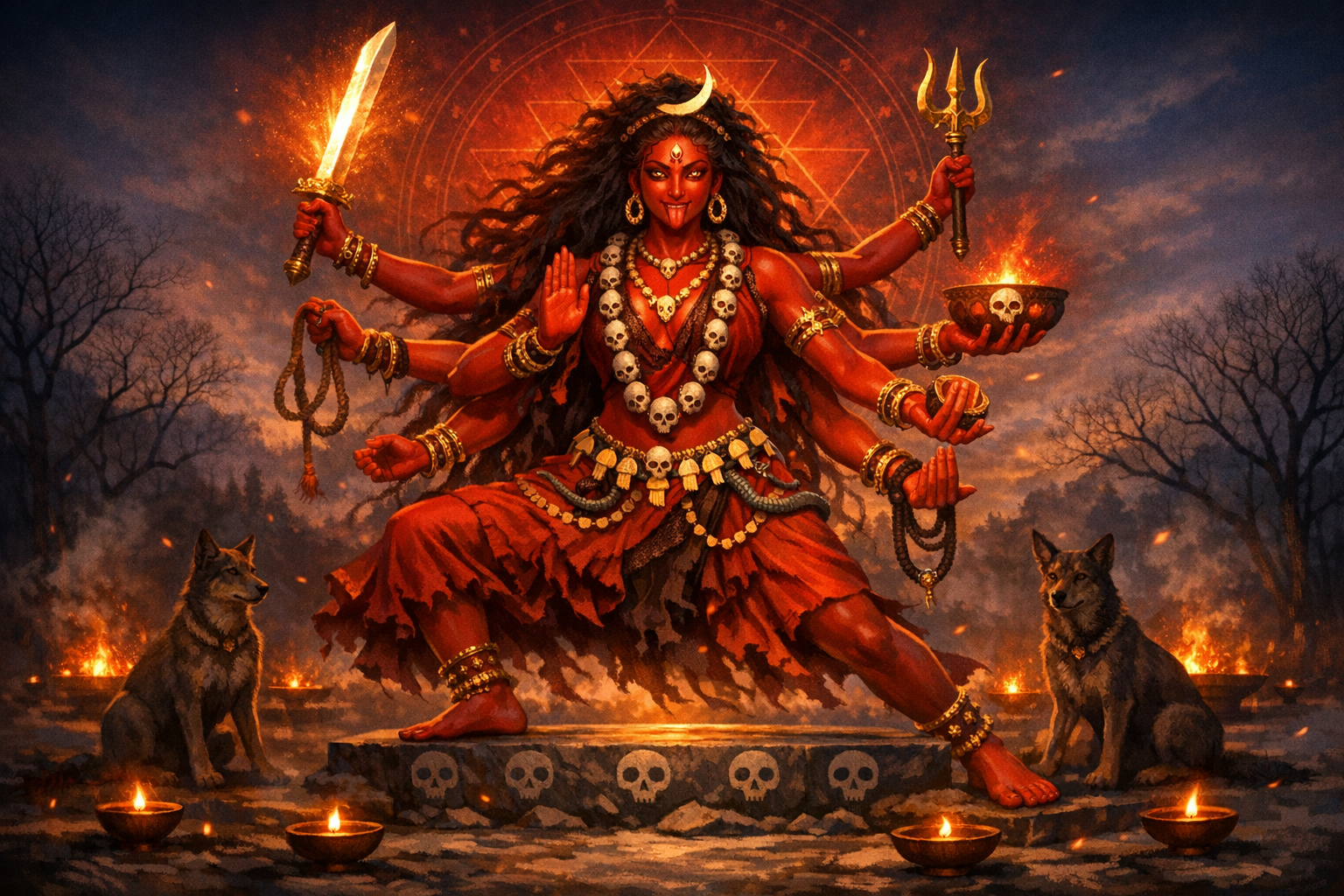
Rakta Chamunda, often translated as the Red Warrior Goddess, occupies a singular place within the Shakta tradition for both her esoteric depth and her vivid, fearsome beauty. The compound name discloses her essence: Rakta, signifying red, vitality, and blood; and Chamunda, the vanquisher of the demons Chanda and Munda. Far from being only a deity of destruction, this form encodes a sophisticated tantric grammar of protection, transformation, and awakened ferocity that severs ignorance while restoring cosmic order (ṛta).
Classical sources locate Chamunda squarely within the Devi Mahatmya (Markandeya Purana), where she emerges to annihilate Chanda and Munda and thereby earn the epithet Chamunda. Later Puranas and the Agamas, together with the Shilpa Shastras, elaborate her attributes and establish ritual parameters. Rakta Chamunda can be understood as a chromatic and energetic emphasis of this form: the red saturation highlights rajas (dynamic potency), the flow of prāṇa, and the life-force reclaimed from chaos. In this reading, “red” is not merely chromatic; it is ontologicalsymbolizing that primal, creative heat (tapas) which protects dharma by transmuting tamas (inertia) into purposeful action.
Within the wider pantheon, Chamunda stands among the Saptamatrikas in many North and Central Indian sculptural panels and is equally revered across Eastern and Southern India in powerful independent shrines. In Newar Buddhism of the Kathmandu Valley, the Matrikas (including Chamunda) are integrated as protective mother goddesses, demonstrating a porous sacred ecosystem among dharmic traditions. The Sikh martial imagination in the Dasam Granth’s Chandi compositions, while distinct in doctrine and practice, likewise venerates the ideal of righteous shakti. These resonances speak to a civilizational vocabulary in which fierce divine protection is honored without erasing doctrinal diversity among Hinduism, Buddhism, Jainism, and Sikhism.
For art historians, temple-goers, and curators, Rakta Chamunda’s iconography is both a field manual and a meditation. Standard markers include a crimson or blood-red complexion; a gaunt, emaciated (krishodara) body or sometimes a youthful, blazing (raudra) countenance; three eyes denoting omniscience; disheveled matted locks (jata) crowned by a crescent; and a lolling tongue that drinks down intoxicationsanger, fear, and delusionat their source. She is frequently garlanded with skulls or severed heads (mundamala), girdled with a belt of severed hands, and adorned with serpents and bone ornaments, all of which signify mastery over mortality and karmic residues.
The stance is typically alidha or pratyalidha (martial postures known from classical iconography), or pretasana (seated upon a corpse). The “corpse” below is a profound emblem: in tantric semiotics, it is the inert ego and the sum of unexamined tendencies (vasanas) over which awareness must triumph. This is related to the well-known Panchamundi Asana symbolismfive skulls or five “dead” elements representing subjugation of the five sheaths or five elementswhere the goddess is enthroned upon the conquered field of lower impulses. The setting is often the cremation ground (shmashana), dotted with funeral pyres, jackals, spirits, and wayward winds, reinforcing the insight that freedom is found not by fleeing impermanence but by transfiguring it.
The hands and implements vary by textual lineage and region. Rakta Chamunda frequently bears the khadga (sword), trishula (trident), kapala (skull-cup), pasa (noose), damaru (drum), and occasionally a severed head, spear, or club (khatvanga). The skull-cup, brimming with blood or wine, symbolizes the reabsorption of scattered energies into clear awareness. The noose curbs egoic oscillation; the trident stabilizes the three gunas; the sword of knowledge (jnana-khadga) cleanly severs ignorance. Jackals, her familiar companions, are not merely macabre: in many local idioms, they are dharma’s night-watchers, teaching discernment amidst fearan established thread in Goddess Chamunda jackals symbolism.
Color is not decorative here; it is doctrine. The dominance of red in Rakta Chamundapigments, garments, and offeringsaffirms the sanctity of embodied life and ethically harnessed passion. In the ritual sphere, hibiscus blossoms, red cloth, and red sandal paste are preferred, emphasizing auspicious ferocity (mangala-raudra). Where esoteric rites persist, schools may interpret the famed Panchamakara in internalized, symbolic modes consonant with contemporary ethical frameworks, while public temple worship typically follows sattvika upacharas (pure offerings) with deep reverence for local codes.
Name-variants in Southern India such as Raktheswari or Rakta Chamundi appear in temples and living performance traditions. In Kerala, for example, powerful red-offering rites (guruthy) at certain Bhagavathy shrines articulate a distinctly Rakta ethos rooted in protection and healing; the Theyyam tradition celebrates Raktha Chamundi with exacting costume, mudra, and drum patterns that transmit iconographic knowledge through sound and movement. In Karnataka and the Deccan, Chamundeshwari of Mysuru, while not always presented explicitly as Rakta Chamunda, preserves continuous memory of the slaying of Chanda and Munda, with seasonal rituals, processional iconography, and martial hymns evoking the same narrative energy.
Textual guidance for icon makers (sthapatis) emerges across the Agamas, the Vishnudharmottara Purana (iconographic sections), the Agni Purana, and regional Shilpa Shastras. These prescribe proportions, hand-positions, and attribute-pairings while leaving room for regional aesthetics. The lean, sunken-bellied form often associated with Chamunda represents the energy beyond nourishment, the tapas that needs no external fuel. Conversely, some rakta forms pulse with muscular dynamism, indicating that the same red principle infuses both ascetic stillness and righteous action.
In sculpture and painting, curators can identify Rakta Chamunda by a cluster of cues: red polychromy or pigments; the presence of the severed heads garland and skull-cup; a cremation-ground substrate with jackals and pyres; emaciated or flame-like physique; and weapons of subjugation and insight. Relief panels sometimes place Chanda and Munda underfoot or depict their severed heads. In multi-deity ensembles, she is often the gaunt Matrika distinct from the fuller-bodied mothers. Comparative analysis with Kali helps: while both share raudra iconography, Rakta Chamunda’s emaciated asceticism and irrefutable cremation-ground setting are especially diagnostic.
Ritually, Navaratri’s Ashtami and Navami are prominent occasions for recitation of the Devi Mahatmya and the Navarna mantra“Om Aim Hrim Klim Chamundayai Viche”with commentarial traditions linking its seed-syllables to specific awakenings (aim for Saraswati’s discernment, hrim for heart-centered shakti, klim for attraction to truth). Red blossoms and lamps underscore the protective vow (raksha-sankalpa) invoked at the goddess’s feet. In many regions, Saturday or Tuesday votive rites align with local calendars for Shakta deities, and protective homas are offered for household and community well-being.
Theologically, Rakta Chamunda reframes the unsettling. Bones, flames, night-creatures, and the corpse-throne might, at first glance, suggest annihilation; yet the icon teaches that annihilation aimed at avidya (delusion) is compassion’s most precise instrument. The lolling tongue, often read as a sign of blood-thirst, is equally the unmasking of shocked ahamkara (ego) confronted by truth. The mundamala does not glorify violence; it enumerates the broken “heads” of pride, greed, cruelty, hatred, jealousy, and feareach conquered not by cruelty but by lucid, uncompromising awareness.
Intertraditionally, kindred protective wisdom appears in the Newar Buddhist shrines to the Matrikas, in Jain narratives that domesticate fierce local deities through vows of ahiṁsa and moral discipline, and in the Sikh exaltation of shaurya (valor) yoked to dharma. The convergent concern is unmistakable: to sanctify strength without severing compassion, and to defend the vulnerable without enshrining hatred. In this way, Rakta Chamunda’s iconography contributes to a broader dharmic ethic of protective grace.
From an art-historical perspective, early medieval panels in Central and Western India, the Odisha sculptural canons, and the yogini-temples of Khajuraho and Hirapur provide comparative material for studying Chamunda types, including rakta-influenced palettes and attributes. Museum displays that contextualize these works with Devi Mahatmya readings, regional ritual photographs, and performance video (e.g., Theyyam) help viewers translate symbol into experience. When a visitor recognizes the corpse-seat as the tamed ego, or the jackal as vigilance rather than terror, the sculpture ceases to be alien; it becomes an ally in inner work.
For contemporary practitioners, Rakta Chamunda offers a disciplined template for engaging life’s heat without being scorched by it: speak clearly (the sword), restrain reactivity (the noose), rhythmize the breath and mind (the damaru), and stabilize the gunas (the trident). Seva undertaken in this spiritprotecting the vulnerable, confronting injustice without malice, and transforming anger into fearless claritybecomes lived tantra consonant with ahimsa and shared civic ethics.
In sum, the idol form of Rakta Chamunda is a precise visual theology. Red declares that life’s intensity is sacred; the cremation ground proclaims that impermanence is the true sanctuary; the weapons and ornaments describe the skillful means by which confusion is undone. Read together, these elements reveal not a goddess of destruction, but a goddess of lucid protectionone whose tantric symbolism, regional living traditions, and shared dharmic resonances continue to animate South Asia’s sacred imagination.
Inspired by this post on Hindu Blog.
