
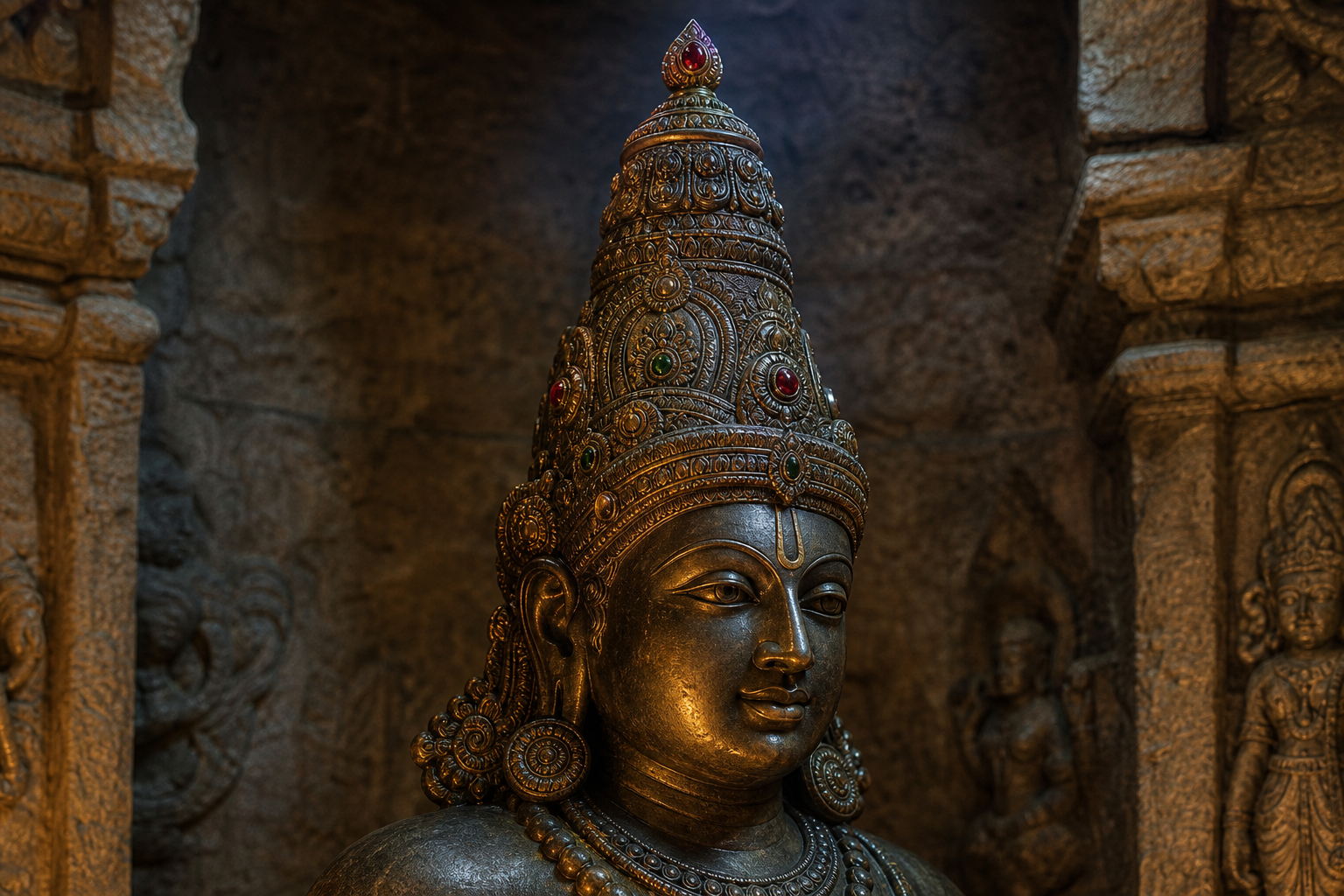
You are standing before a murti, studying the face, mudras, weapons, and vahana, when your gaze reaches a small form above the crown. It may look like a jewel, lotus bud, crescent, plume, or mere point of light. Is it decorative, or does it complete the sacred image?
Learning to read that summit gives you a practical way into Hindu iconography. The chudamani can identify a figure, finish the vertical structure of a murti, express divine sovereignty, and direct attention toward the highest point of awareness. Once you know where to look, a detail that was easy to overlook becomes one of the most concentrated signs in the entire composition.
Begin with the vertical axis, not the sparkle
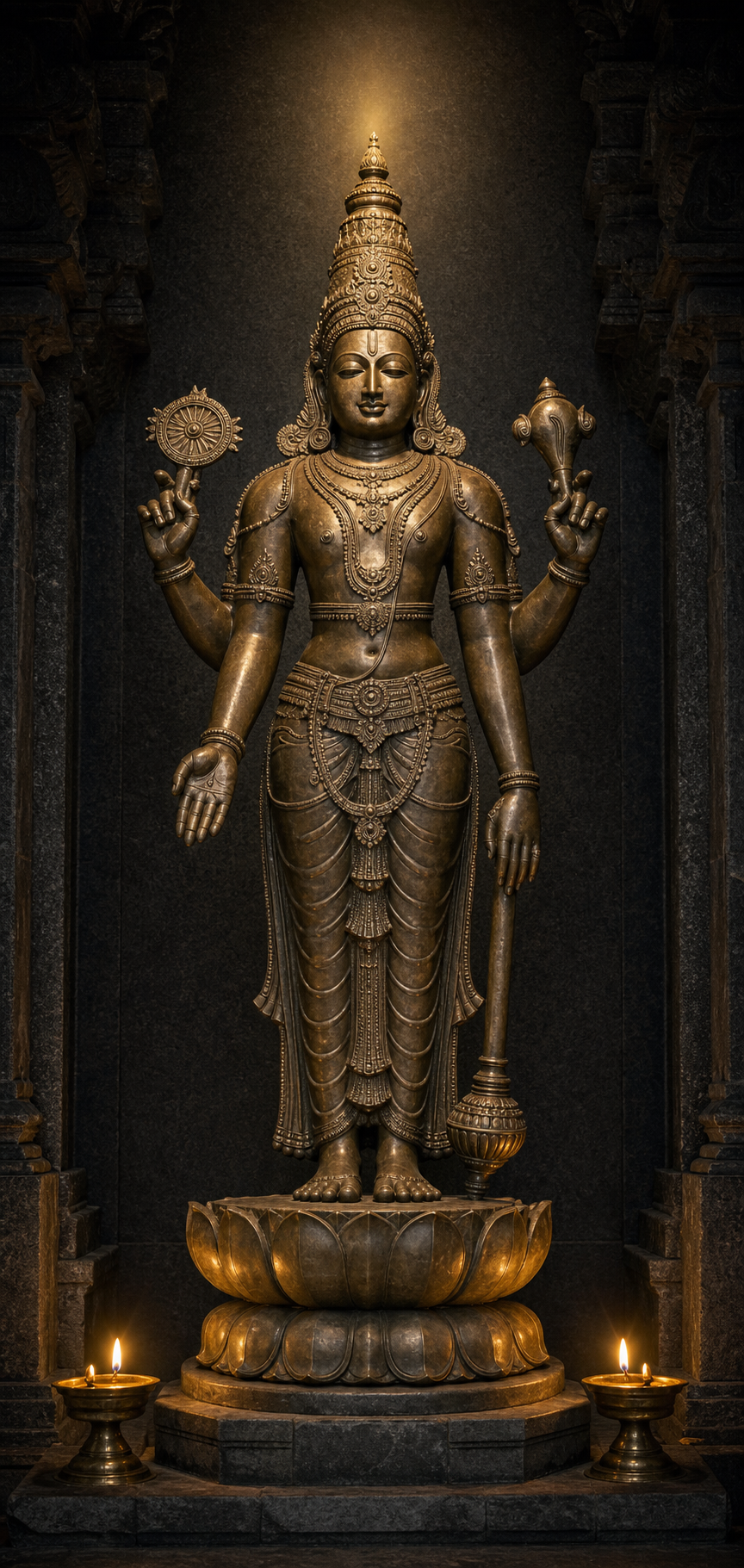
The Sanskrit name gives you the first clue: chuda denotes a crest or topknot, while mani means jewel. In its narrow sense, a chudamani is the jewel placed at that crest. In a wider iconographic reading, related apex signs can perform a comparable compositional role even when they are a crescent, plume, flame, or lotus-like finial rather than a literal gemstone.
Do not begin by asking whether the object looks expensive. Begin by finding how the image rises. The chudamani matters because of its position and relationship to the whole figure, not simply because it resembles jewellery.
- Trace the central line upward from the pedestal through the torso, throat, face, and forehead. In a frontal image, the crown usually continues this axis.
- Identify the structure on the head. Is it a tiered royal crown, a mass of matted locks, an arranged coiffure, or a plume-bearing headdress?
- Find the point where that structure resolves. Look for a bud, faceted gem, crescent, finial, plume, or pinpoint highlight at the summit.
- Notice what happens beyond it. If a halo or prabhamandala surrounds the head, the apex often mediates between the embodied form and the open radiance around it.
This method still works when brilliance has faded. A copper-alloy crest may be modelled rather than gem-set; a painted one may survive as a tiny highlight; a wood or stucco image may use a glass cabochon. The material changes, but the axial function remains visible.
At the same time, do not label every high point a chudamani. A weapon raised above the head, an architectural projection behind the figure, and a secondary ornament at the side of a crown have different jobs. The decisive question is whether the feature culminates the deity’s crown or coiffure and visually resolves the upward movement of the image.
Read the crest through the deity’s iconographic language
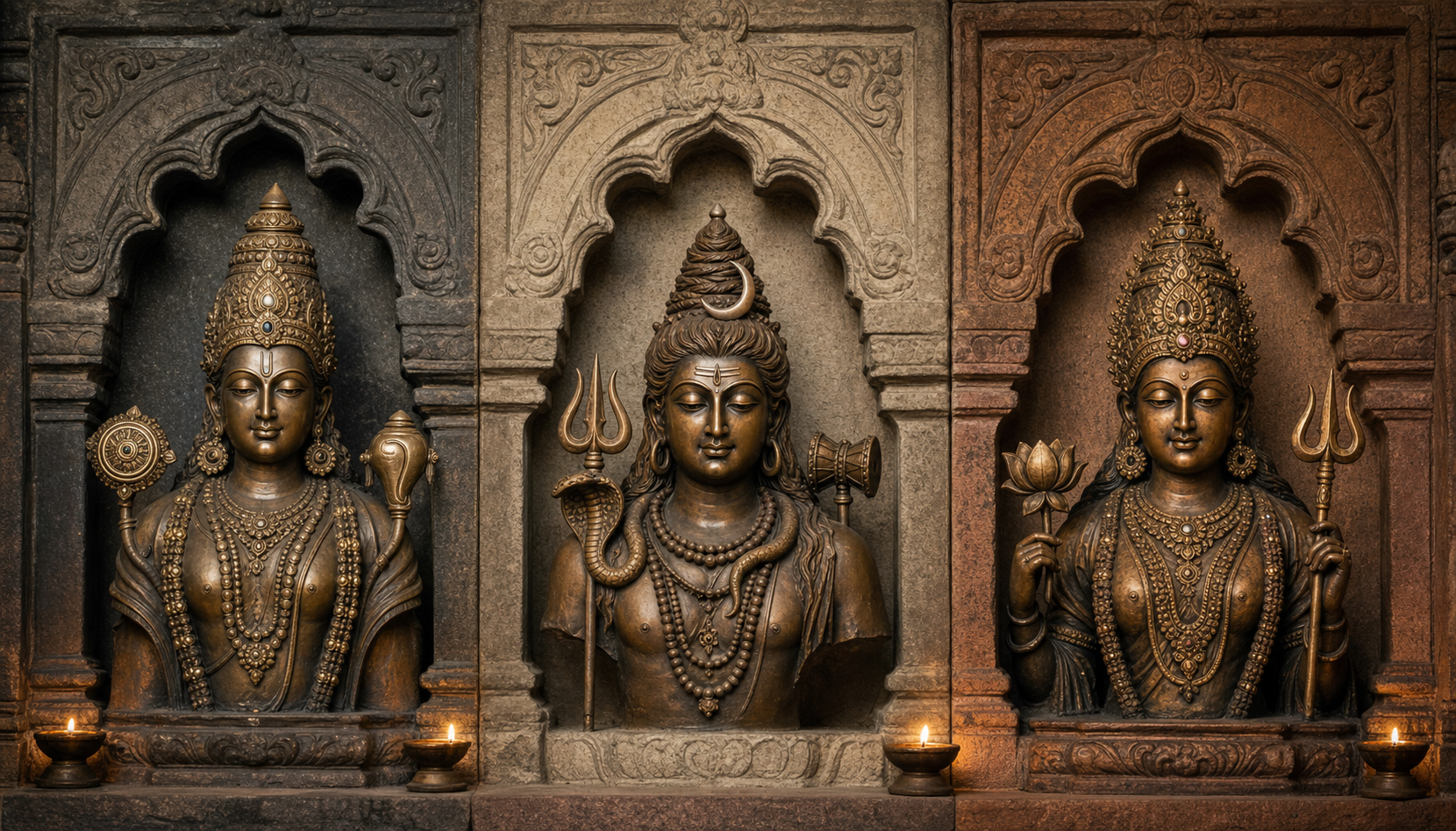
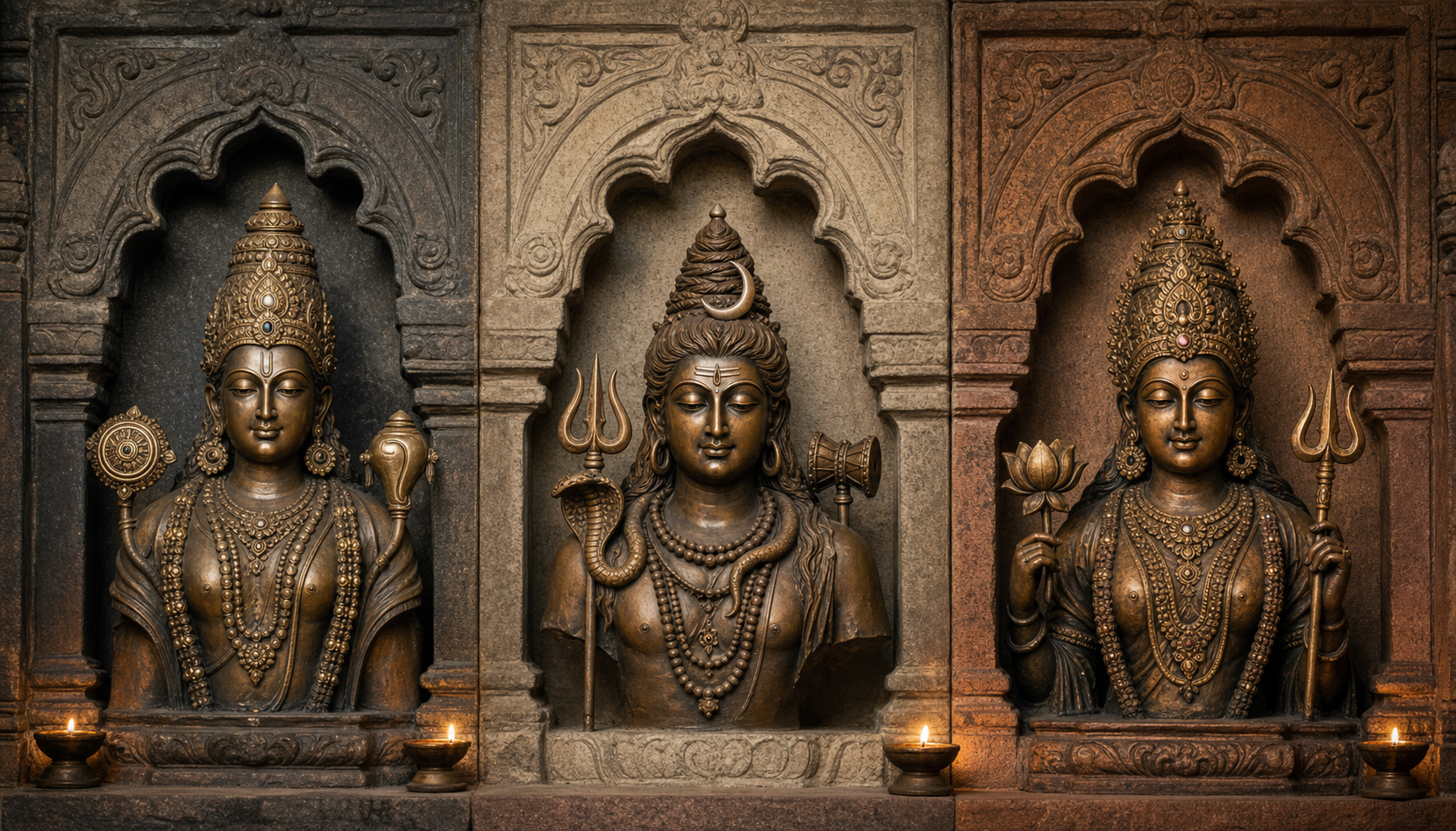
There is no single chudamani shape that applies to every Hindu image. Vaishnava, Shaiva, and Shakta traditions give the summit different forms because the crown must belong to the deity’s complete iconographic identity. Use the crest together with the face, attributes, posture, and head arrangement; never use it as a solitary identification test.
| Iconographic setting | What to look for | How to read it |
|---|---|---|
| Vaishnava image | A karaanda-makuta or kiritamukuta tapering to a bud-like or faceted terminal jewel | The crest completes a royal crown and concentrates its symmetry, dignity, and radiance at one point. |
| Krishna image | The peacock plume of the mor-mukut at the upper edge of the headdress | The plume can perform a parallel crestal function, but it should not be carelessly renamed a literal gemstone. |
| Shaiva image | A jata-makuta crowned by the crescent, or chuda-chandra | The luminous crescent resolves the mass of matted locks and marks Shiva’s distinctive sacred identity. |
| Shakta image | A tall mukuta terminating in a prominent upper jewel | The culminating gem intensifies the goddess’s shakti, auspiciousness, and sovereignty. |
| Painted image | A tiny dot or sharp highlight at the peak of the crown | What appears to be a painterly glint may carry the same function as a sculpted crest jewel. |
The distinction between a literal ornament and a functional analogue is important. Krishna’s peacock plume and Shiva’s crescent do not become interchangeable merely because both occupy a summit. Each belongs to a different theological and visual language. Their kinship lies in what they do within the composition: they gather attention, complete the head form, and make the apex memorable.
For Nataraja, pay special attention to the relationship between movement and culmination. The flying locks create outward energy, while the crescent remains a precise crestal sign. In a standing Vishnu, the effect is different: the narrowing tiers of the crown guide the eye steadily toward a composed terminal point. The form of ascent tells you something about the character of the manifestation before you.
The jewel can signify identity, ascent, and sovereignty
A personal ornament can become proof
The best-known narrative use occurs in the Ramayana. Sita entrusts her chudamani to Hanuman as an unmistakable token for Rama. Once removed from the body and carried across distance, the ornament becomes more than adornment: it bears identity, truth, remembrance, and assurance.
This episode gives you a useful interpretive rule. When a crest jewel is given, received, or recognized in a sacred narrative, ask what relationship it verifies. An intimate object can do what a verbal message alone cannot: establish who sent it and make fidelity tangible. The ornament’s location at the crown strengthens the act, because something associated with dignity and personhood becomes a pledge.
The summit turns visual ascent into contemplation
In symbolic readings, the chudamani acts as a bindu at the sahasrara, the crown center of awareness. The image rises from its base through body, gesture, face, crown, and final point. That progression lets the eye move from substantial form toward increasing subtlety.
The crest therefore expresses more than physical height. It can evoke one-pointed attention, tejas or radiant potency, and the vertical world-axis passing through the deity’s form. When a halo is present, the jewel marks the place where ordered embodiment seems to open into surrounding luminosity. You need not force this reading onto every regional image, but you should test it against the composition: does the sculpture or painting deliberately lead your eye to a concentrated summit?
Divine kingship is offered, not merely displayed
A crown conveys rule; its uppermost jewel brings that rule to completion. In Vaishnava and Shakta imagery especially, the chudamani can proclaim majesty, auspiciousness, and authority. Yet temple worship changes the meaning of that splendour. The finest crown is placed upon the deity as an offering, so royal dignity is acknowledged as belonging ultimately to the divine.
This is why the chudamani should not be reduced to evidence of luxury. Gold, gems, and polished surfaces matter because they make radiance perceptible. Their religious work lies in concentrating light and attention at the place where the form culminates.
Canon, craftsmanship, and worship meet at the crown
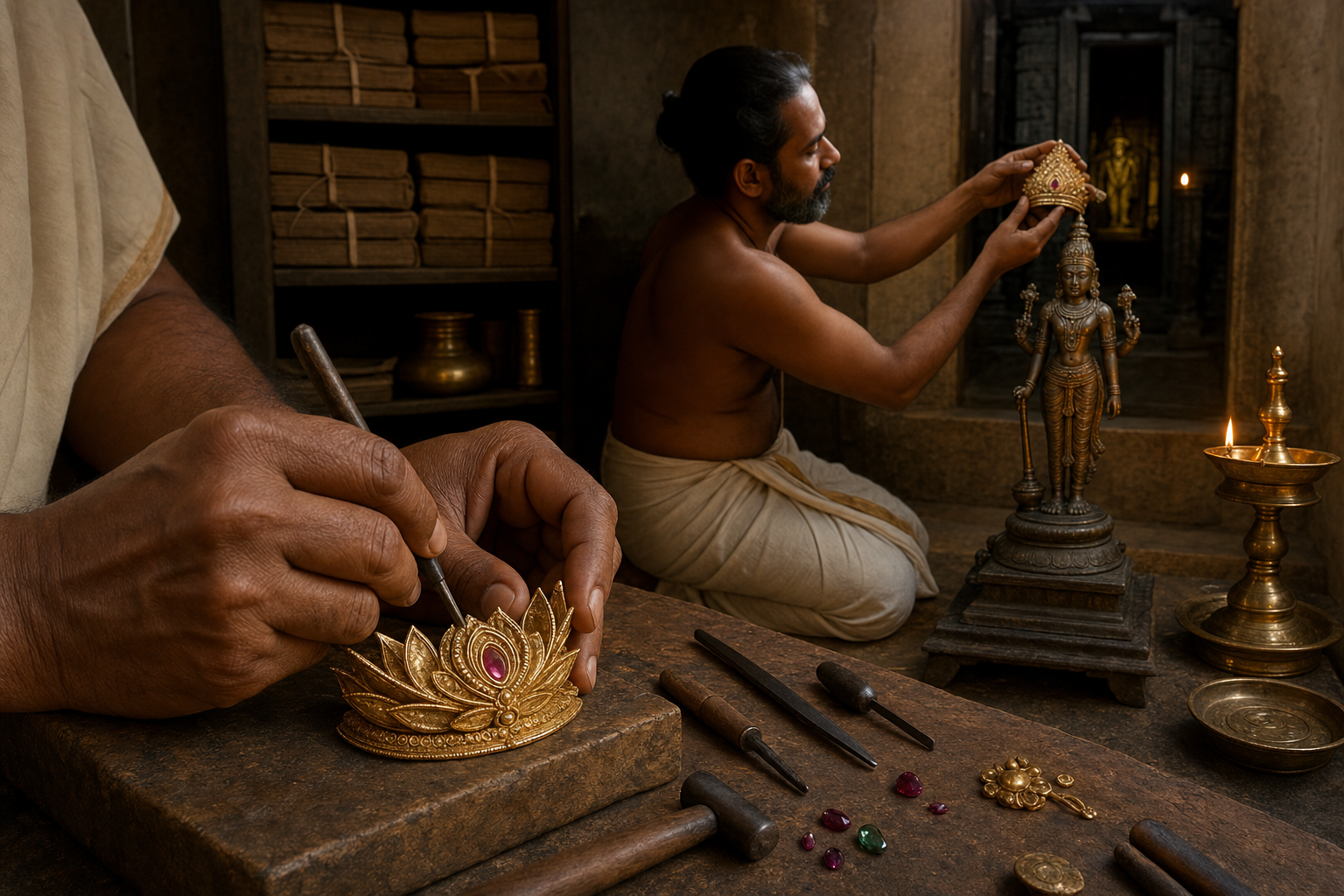
A successful crest looks effortless because the whole crown has prepared for it. The Manasara, Mayamata, and Silparatna belong to the technical world in which the mukuta is governed by proportion, axial order, and canonical measurement. The terminal ratna is not simply added wherever space remains. Its diameter, profile, and height must harmonize with the crown and the larger tala system of the figure.
When you examine a sculpture, look beneath the top jewel. A tiered crown often narrows in controlled stages before resolving in a lotus-bud or gem-like form. If the terminal looks convincing, it is usually because the sculptor has organized everything below it to support that conclusion. This is sacred geometry experienced as visual coherence rather than as a set of measurements visible to the viewer.
Regional styles handle that resolution differently. Gupta and post-Gupta conical crowns naturally draw the eye toward a jewelled apex. Pala-Sena works from Bengal and Bihar develop tall mukutas with crisp, lotus-like crests. Chola bronzes often give Vishnu a karaanda-makuta capped by a bud form, while Nataraja’s coiffure uses the crescent as its crestal sign. Hoysala and Vijayanagara crowns may multiply the tiers before bringing them to an elegant point. Khmer, Javanese, and Sri Lankan sacred images also use concentrated jewel, lotus, or flame forms at the head’s summit.
Treat these forms as stylistic clues, not as a shortcut for dating or identifying an object. First establish the deity through attributes and posture. Then compare crown construction, apex shape, modelling, and regional context. A damaged or later crest can mislead you if you let one feature carry more certainty than it can bear.
Material tells a second story. Living crowns have used gold, rock crystal, ruby, diamond, emerald, and navaratna arrangements, with techniques including kundan setting and granulation. South Indian bronzes can model the crest directly in copper alloy through lost-wax casting, sometimes adding inlay or gilding. Painters create the effect with a concentrated highlight, while wood and stucco traditions can use glass to produce lustre. In every case, the craft pursues the same visual result: a small area of unusually concentrated light.
That brilliance is also vulnerable. Lac holding stones can deteriorate, gilding can wear away, and replacement jewels can blur the history of an object. In a museum, read the label before assuming that every bright insert is original. Look separately at the underlying sculpted form, the surviving surface, and any later addition. Even when the gemstone is missing, the designed culmination may remain legible.
In living worship, the crest is not a static museum detail. During alankara and forms of abhishekam involving panchamrita, crowns and their upper ornaments may be cleansed, removed, and reset within the larger discipline of Shodasha Upachara. Festival observances can include kireeta-abhisheka for an utsava murti. Practices vary by temple and lineage, but the governing idea is clear: crown, mantra, ritual action, and sacred measure belong to one consecrated whole.
Recognize a Dharmic family resemblance without erasing differences
The Hindu chudamani belongs to a wider Dharmic sensitivity to the spiritual significance of the head’s summit. Buddhist images may use the ushnisha and a flame-like finial to announce awakened awareness. Jain presentations can emphasize the perfected Tirthankara through the sirascakra and chhatra above the head. In Sikh heritage, the kalgi on a royal turban has signified sovereignty and moral authority.
These are analogies of position and function, not claims that distinct traditions teach the same doctrine or use the same symbol. The ushnisha is not a Hindu crown jewel, the Jain chhatra is not Shiva’s crescent, and the Sikh kalgi is not a sculpted ratna. What they reveal together is a civilizational pattern: the summit can mark consummation, awakened status, rightful authority, or the passage from ordinary appearance to sacred distinction.
Key takeaways for your next darshan or museum visit
- Follow the central axis of the figure upward before studying the ornament’s material or brilliance.
- Identify the crown or coiffure first. A jewel, crescent, plume, and flame may occupy comparable positions without having identical meanings.
- Read the apex with the deity’s other signs. Vishnu’s crown, Shiva’s jata-makuta, Krishna’s peacock plume, and a goddess’s towering mukuta belong to distinct iconographic systems.
- Notice how the crown narrows. The tiers below the crest often explain why the final point feels stable, radiant, and complete.
- If the jewel is missing or worn, look for the modelled bud, terminal shape, painted highlight, or surviving relationship to the halo.
- Distinguish theological kinship from equivalence when comparing Hindu, Buddhist, Jain, and Sikh apex signs.
- Allow your gaze to rest at the summit for a few moments. The chudamani is designed not only to be identified, but to gather attention into stillness.
The next time you stand before a sacred image, give its highest point ten unhurried seconds before moving on. Trace how the entire form prepares for that final light. What first seemed like a minor ornament may show you how Hindu sacred art turns crown, craft, devotion, and consciousness into one coherent act of seeing.