
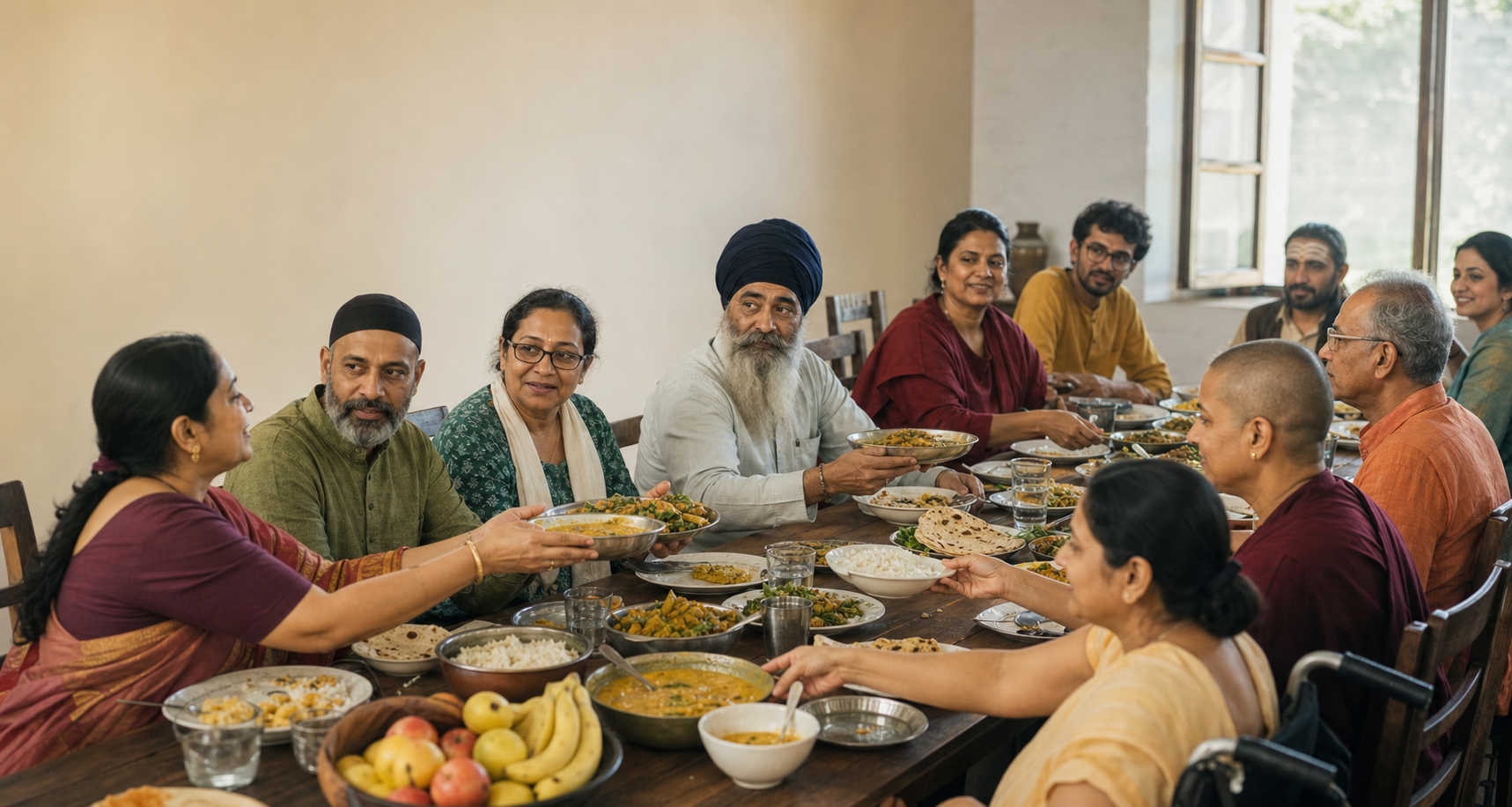
Your temple committee, neighbourhood association, extended family, or inter-Dharmic group may have reached the point where every meeting begins with old injuries. Calling another formal discussion can simply give everyone a new occasion to rehearse the same positions. A shared meal offers a different first task: receive, serve, eat, and only then speak.
You do not have to pretend the conflict has disappeared. You need a setting in which opponents can become guests without surrendering their convictions. Dharmic traditions provide a practical pattern: treat food as a gift, make dignity visible, share the same fare, and let service come before argument.
Use the meal to lower hostility, not to bypass the truth
A reconciliation meal works by changing what people are being asked to do. In a debate, each person must defend a position. At a shared table, each person must make room, receive something from another, and attend to ordinary human needs. Those small acts do not settle the dispute, but they can reduce the social distance that prevents honest conversation from beginning.
The moral foundation matters. Annam Brahma, Atithi Devo Bhava, and Vasudhaiva Kutumbakam place nourishment, hospitality, and human relationship within a sacred order. Food is not merely bait for attendance. The guest is not a problem to be managed. Feeding another person recognizes the same sustaining life in giver and receiver.
This is why hospitality can achieve something that a clever opening speech cannot. An adversary who enters as a guest is temporarily released from the demand to prove strength. A host who serves is also released from the need to dominate. Each has a role with duties, and those duties create a limited but real field of trust.
That trust has limits. Eating together is not forgiveness, agreement, restitution, or accountability. It cannot substitute for them. Its proper purpose is smaller and more useful: to establish enough moral relationship for harder work to become possible.
Before planning the menu, decide whether a shared meal is suitable. Ask four questions:
- Can everyone attend without intimidation? A person should not have to sit beside someone who is threatening, coercing, or targeting them.
- Can the hosts protect equal dignity? If one faction will control the invitations, seating, microphone, photographs, and public account of the event, the meal will reproduce the conflict.
- Is renewed contact a realistic goal? The first aim should be recognition and a next step, not a forced confession, apology, or declaration of unity.
- Can the food be accepted in good conscience? Dietary, ritual, ethical, allergy-related, and fasting constraints must be learned before the meal, not challenged at the table.
If threats, abuse, or immediate danger are present, begin with protection and qualified mediation appropriate to the situation. Do not use sacred hospitality to pressure a vulnerable person into proximity. Reconciliation without safety becomes another demand placed on the injured party.
Build dignity into the invitation, menu, and room
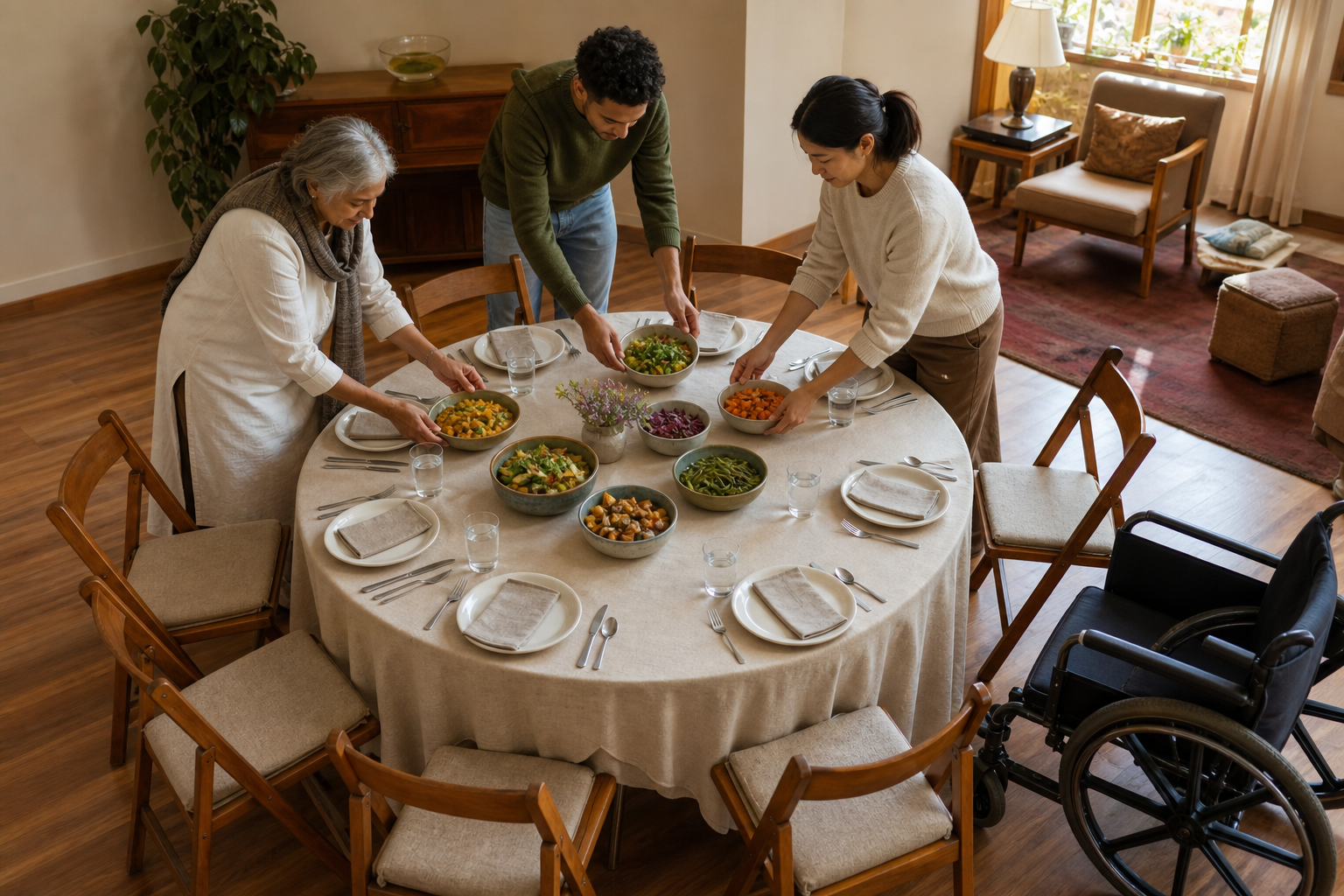
People notice hierarchy long before they hear a message about equality. Who receives a personal invitation, who enters through which door, who sits on a platform, who is served first, and who appears in the photographs will communicate the real purpose of the gathering. Design those details before announcing the event.
A sound plan has seven parts:
- State a modest purpose. An invitation can say: “We are not gathering to settle every dispute. We are gathering to receive one another with dignity, share food, and identify one act we can do together.” That promise is credible because it does not demand an emotional result in advance.
- Choose a common vegetarian foundation. A simple vegetarian meal generally widens participation across Hindu, Buddhist, Jain, and Sikh settings while reducing avoidable ethical friction. Fresh, light, nourishing food also fits the sattvika qualities associated in Bhagavad Gita 17.8-10 with clarity and steadiness. Use that principle to support a calm gathering, not to judge the character of guests.
- Ask about constraints privately. Do not infer a person’s practice from a community label. Ask each invitee what they cannot eat, how strictly separation or preparation matters, and whether a fast affects participation. If one common preparation cannot meet every need, adapt the service openly rather than asking someone to compromise at the table.
- Make equality physical. Use the same quality of food, utensils, portions, and seating for every group. Avoid a special meal for dignitaries. If the room requires a raised seat or reserved place for accessibility, explain its practical purpose so that accommodation is not mistaken for rank.
- Mix service before mixing arguments. Invite willing participants from different sides to serve together. Serving water, passing plates, and offering another helping create a cooperative rhythm before contested subjects enter the room.
- Protect the vulnerable first. Arrange accessible seating, safe entry and exit, and assistance for anyone who needs it. A tradition of serving others before oneself loses its force if the elderly, disabled, socially isolated, or otherwise vulnerable have to compete for attention.
- Control publicity. Tell guests in advance whether photographs, recordings, media, or public statements are planned. Obtain consent rather than treating attendance as permission. A reconciliation meal should not turn a person’s vulnerability into someone else’s proof of virtue.
Keep the food generous but unshowy. Frugal abundance communicates that everyone will receive enough without creating a contest in display. The point is not culinary prestige. It is the quiet assurance that no guest must bargain for a place or a share.
Uniformity must never become another form of exclusion. Sharing the same food is a powerful ideal, but the deeper rule is dignified nourishment. When an honest dietary restriction requires an adapted plate, protect the person from scrutiny and preserve as much of the shared service as possible.
Learn from each tradition without flattening its practice
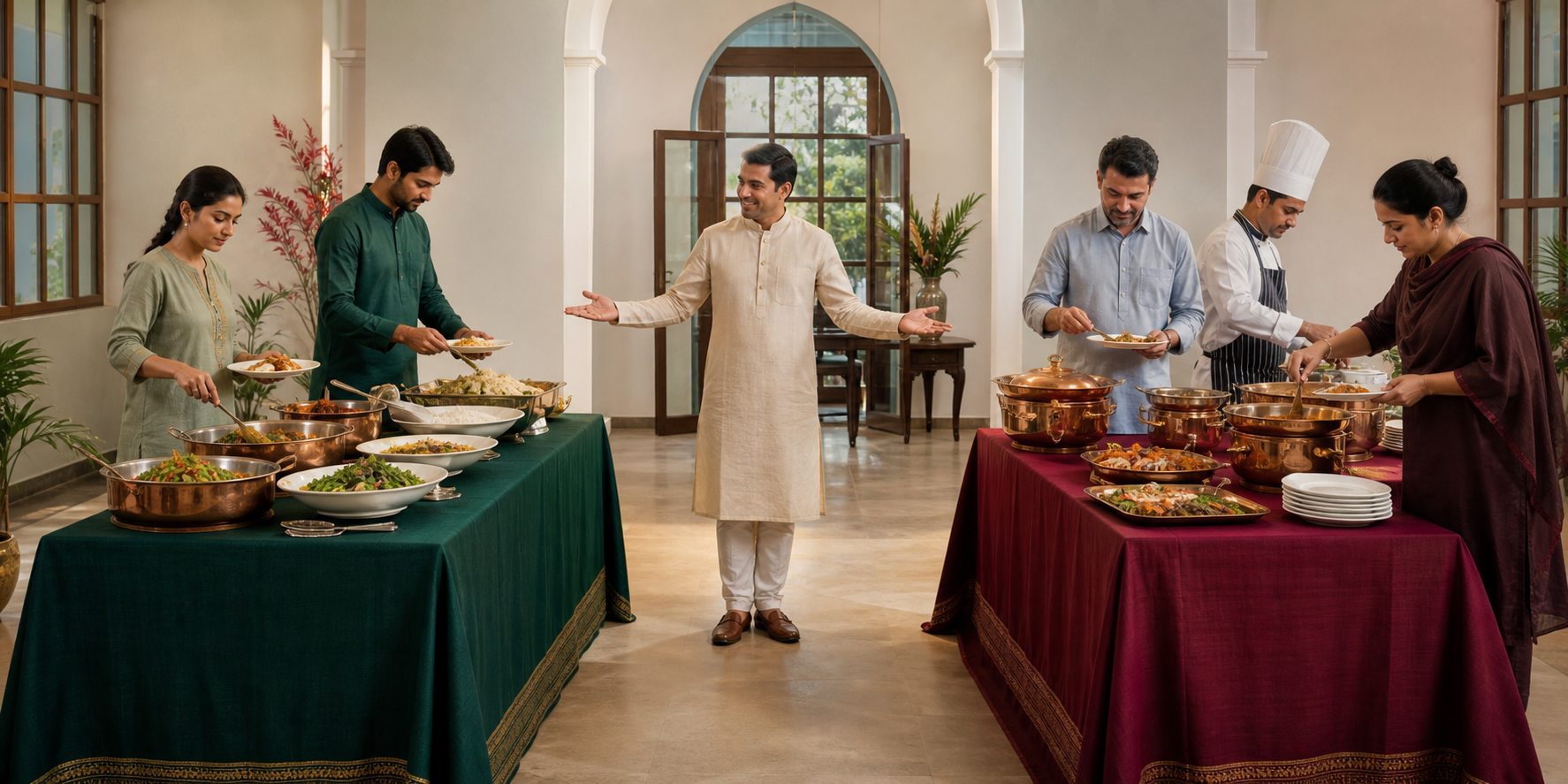
Hindu, Sikh, Jain, and Buddhist food practices converge on generosity and reduced status, but they are not interchangeable labels for a generic community lunch. A host should borrow their disciplines with care, preserving the meaning of the setting in which the meal is held.
- Hindu anna-dana and prasada teach sanctified giving. Food is offered without humiliating the receiver, and temple kitchens allow strangers to enter a shared ritual rhythm. Prasada has a particular devotional meaning because it is connected with an offering; do not use the name merely to make an ordinary meal sound sacred.
- Sikh langar makes equality concrete. People sit together, receive the same food, and participate in seva. Its power lies not only in an open kitchen but in a social arrangement that refuses privileged dining. If you invoke the langar model, reproduce its discipline of equal service rather than borrowing only its name.
- Jain anna-satras and anna-kshetras place hospitality under ahimsa. Nourishing life impartially is inseparable from avoiding harm. The practical lesson for a mixed gathering is clear: inclusion cannot require a conscientious guest to violate an ethical food discipline.
- Buddhist dana trains generosity and interdependence. Giving and receiving are both relational acts. A reconciliation meal should therefore allow every community to contribute something without turning contribution into a claim of ownership.
These disciplines are visible across temple kitchens, bhandaras, Sikh langar, Jain food centres, and Buddhist dana. Each places a restraint on ego: the host cannot humiliate, the leader cannot reserve superior treatment, and the guest is not reduced to a recipient of favour.
The Ramayana also gives hospitality a relational role. Guha’s reception of Rama turns an encounter across social boundaries into fraternity. Shabari’s offering expresses devotion without worldly rank. The acceptance of Sugriva and Vibhishana shows that trust can reconfigure relationships and make cooperation conceivable. None of these episodes should be reduced to the slogan that food automatically ends conflict. Their practical lesson is that recognition and welcome often have to precede alliance.
Use language that belongs to the actual setting. At a Hindu temple, explain prasada and anna-dana accurately. At a gurudwara, follow the discipline and guidance of langar. In a Jain or Buddhist institution, let that community define its own practice. At a genuinely shared venue, plain language such as common meal, seva, dana, hospitality, and ahimsa may be more respectful than placing every tradition under one ritual term.
Run the meal in five deliberate stages

A meal does not become reconciling merely because opponents are in the same room. Without a sequence, people may form separate clusters, leaders may perform for an audience, and the old dispute may take over before anyone has experienced hospitality. Give the gathering a simple ritual shape.
- Receive each person before assigning a category. Have trusted co-hosts greet guests by name. If two communities are in conflict, include a host trusted by each. Deal with dietary arrangements and seating quietly rather than announcing someone’s needs to the room.
- Frame the gathering briefly. Avoid a keynote address. State three rules: no one must surrender a belief to remain at the table; no person or community may be demeaned; and the immediate task is to receive and serve before debating. Then move to the meal.
- Let service establish the first relationship. Hosts and recognized leaders should serve before they eat. Invite willing guests to join the service across group lines, but do not force symbolic pairings. Seat people in mixed groups where consent and safety allow, while preventing the room from splitting into rival camps.
- Allow ordinary conversation while people eat. Do not open with the most disputed question. Ask about names, places, families, service work, festivals, or the food itself. This is not evasion. It gives people concrete knowledge of one another before abstractions and accusations return.
- Open one bounded conversation after everyone has been served. Use a prompt that calls for understanding and action rather than a verdict. Ask: “What do you want people here to understand about how this conflict affects ordinary life?” Follow it with: “What is one useful act we can complete together without pretending our disagreements are over?” End by naming the act, its willing participants, and who will convene the next contact.
When the room becomes tense
A host should expect discomfort. The purpose is not to eliminate every hard statement; it is to prevent contempt, intimidation, and disorder from taking control.
- If someone launches an accusation during service, acknowledge that the concern exists and defer the argument: “That question matters, but we have not agreed to settle it in the serving line. Let us finish receiving everyone, and we will return to it during the conversation.”
- If someone insults a guest or community, pause and name the conduct plainly. Do not ask the target to absorb humiliation for the sake of harmony. Restate the boundary before continuing.
- If the food arrangement fails, apologize without debating the person’s dietary rule. Find an acceptable alternative and correct the process for the next gathering. Sacred intention does not make unsuitable food suitable.
- If someone leaves, let one trusted host check on that person privately while another keeps the room steady. Do not turn the departure into a public judgment or chase the person with cameras and questions.
- If agreement is impossible, close with the narrow truth that remains: everyone was received, the disagreement is still present, and any further contact will require the stated boundaries to be honoured.
Do not improvise these responses only after a crisis. Agree on them with the co-hosts beforehand. A calm boundary is easier to maintain when every host knows who will speak, who will support a distressed guest, and which conduct ends the gathering.
Turn one meal into a relationship that can bear disagreement
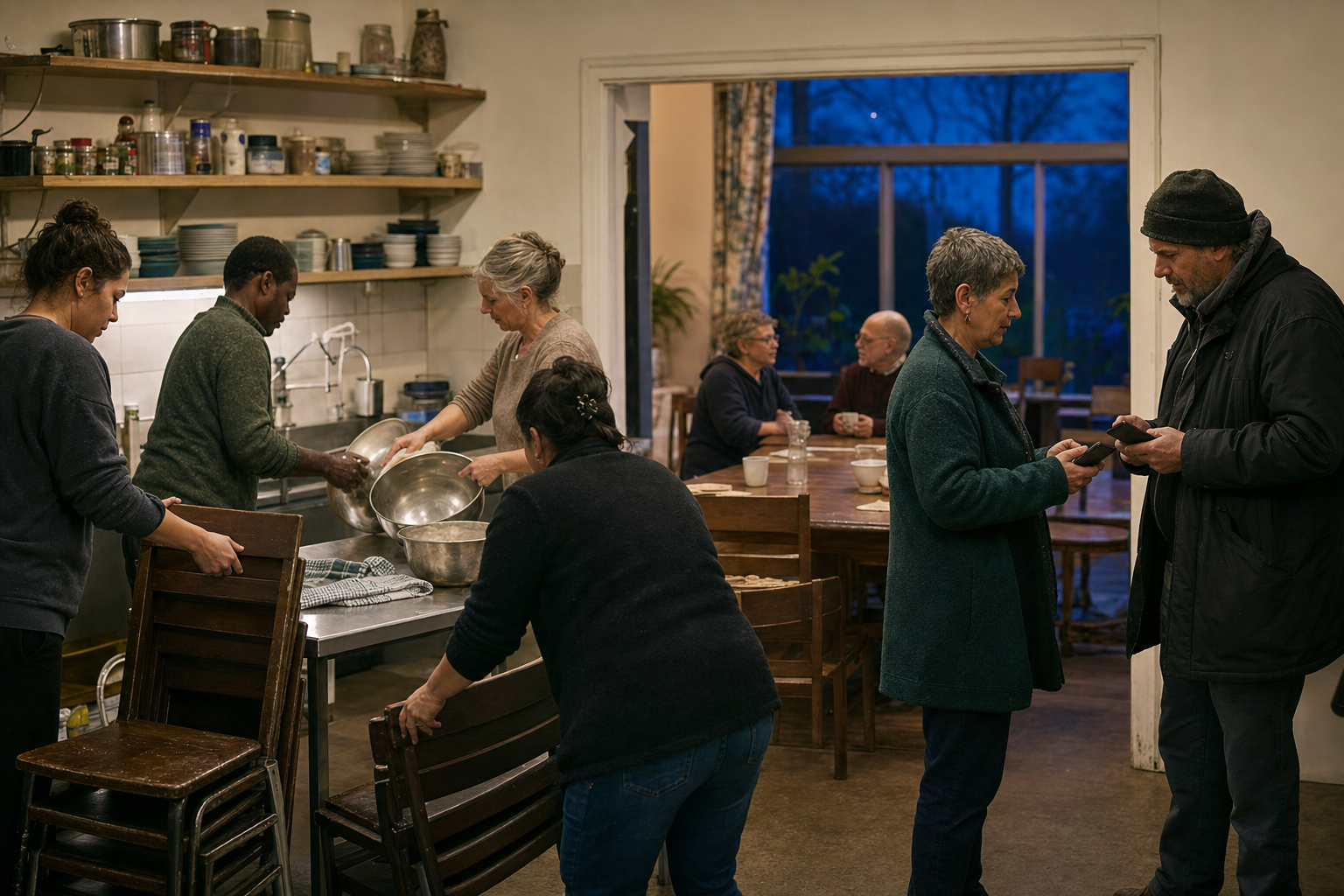
The weakest ending is a group photograph followed by silence. Before people leave, choose one next act that does not require ideological agreement. It might be another meal hosted by different participants, shared kitchen seva, or a community food service in which members of both groups work side by side.
Judge the gathering by observable changes, not by emotional theatre. Useful signs include:
- Guests accepted food or service from someone they had previously treated only as a representative of the opposing side.
- Participants used one another’s names instead of speaking entirely through group labels.
- Dietary and ritual commitments were honoured without ridicule or public pressure.
- A difficult concern was expressed without the gathering collapsing into abuse.
- People volunteered for a specific shared task or another meeting.
- Responsibility for hosting the next contact moved beyond the original organizers.
An apology, embrace, or declaration of unity may be sincere, but none should be demanded as evidence of success. The more reliable achievement is a relationship capable of carrying another encounter. Repetition matters because trust grows when dignified treatment proves to be a pattern rather than a staged exception.
Keep a record of practical commitments, not personal disclosures. Note the next host, task, venue, dietary requirements, and agreed boundaries. If the meal exposed a failure, such as unequal seating or an ignored food restriction, name the specific failure and correct it before extending the next invitation. Defending good intentions will not restore the dignity that poor design damaged.
Key takeaways
- A shared meal prepares the ground for reconciliation; it does not replace truth, accountability, mediation, or safety.
- The invitation should promise dignified contact and one achievable next step, not instant unity.
- A simple vegetarian menu, privately confirmed dietary needs, equal seating, and service before speech remove predictable sources of friction.
- Prasada, langar, Jain food-giving, and Buddhist dana have distinct meanings. Preserve their disciplines instead of using sacred names as decoration.
- Success is visible when people can serve, speak, disagree within boundaries, and return for another shared task.
If you are deciding what to do now, do not announce a grand peace summit. Choose a trusted co-host from each side, agree on one inclusive menu and one honest sentence of purpose, and identify the next act of seva before sending the invitations. The meal matters when dharma becomes something people can receive from one another.