
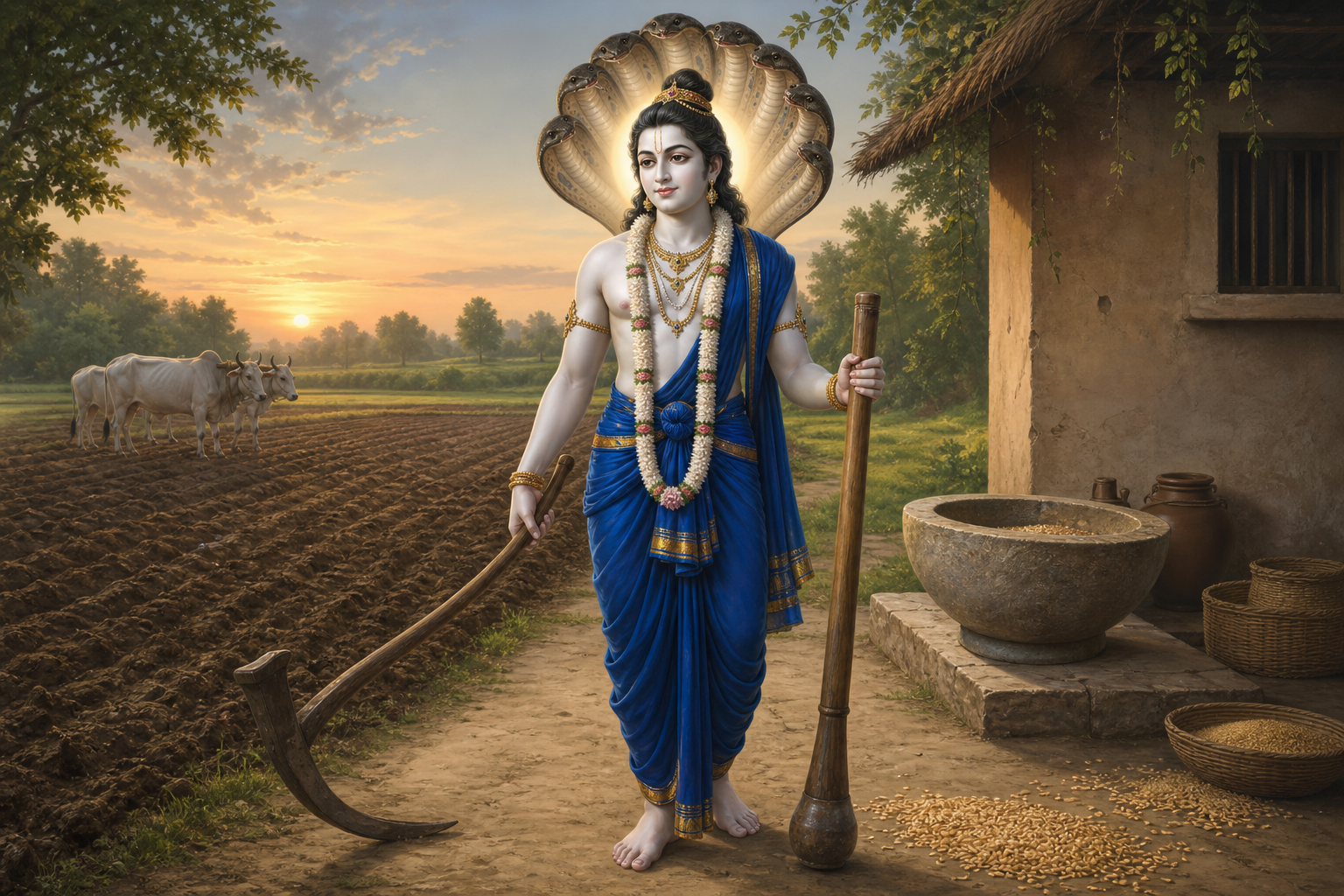
You are looking at a temple sculpture, bronze, painting, or coin. Balarama holds a curved plough in one hand and what appears to be a plain rod in the other. Is that second object a mace, a staff, or something else?
The answer changes the meaning of the image. Read the straight object as Balarama’s musala, or grain pestle, and the icon joins cultivation, food preparation, household labor, protection, and moral restraint. You can make that identification without guesswork if you begin with the object’s silhouette and then check its companion attribute.
Start with the silhouette: musala, gada, or hala?
Key takeaways
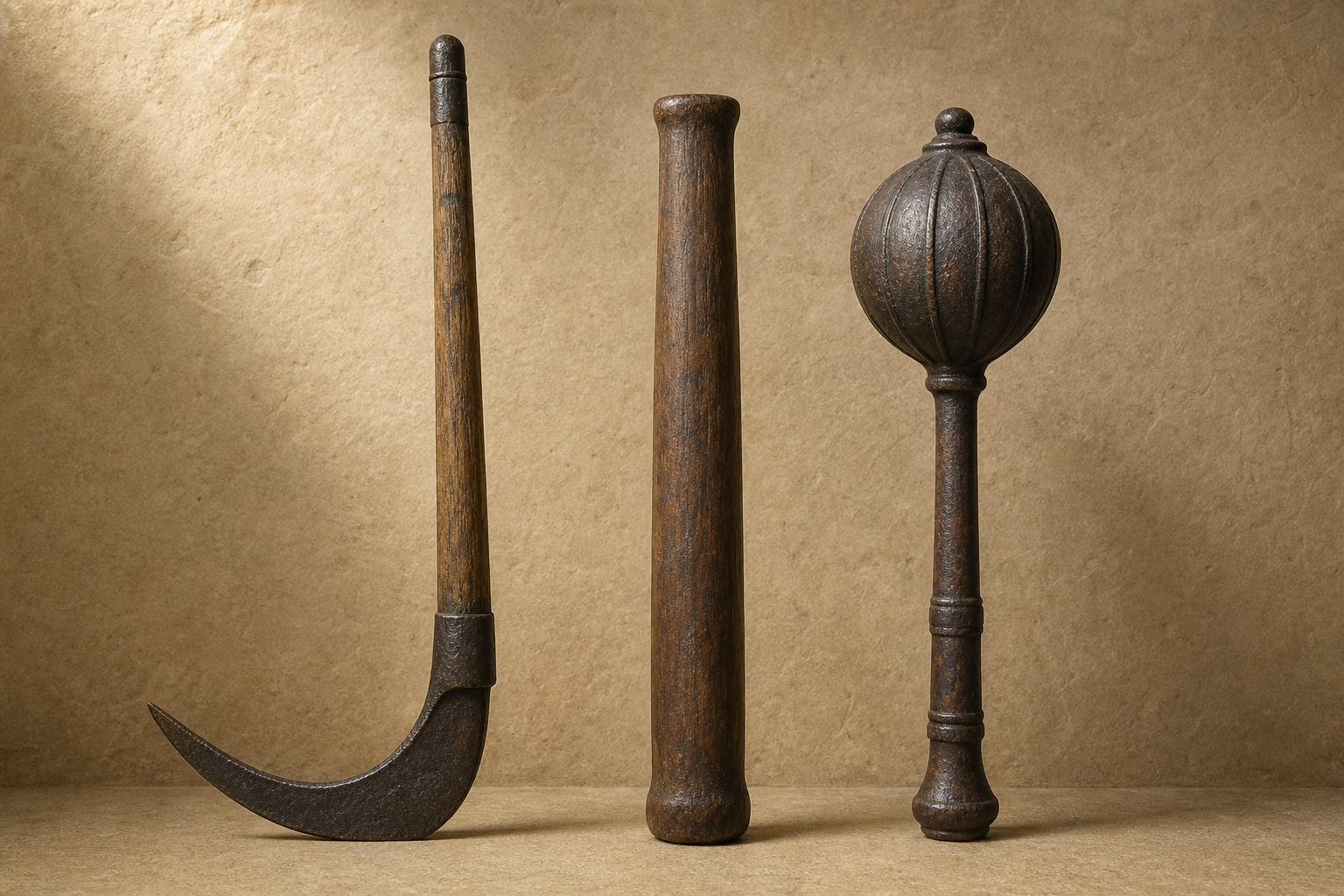
- Musala: Look for a long, straight cylinder of nearly uniform thickness, usually with a rounded or only slightly expanded end.
- Gada: Look for a clearly enlarged, bulbous head that concentrates the visual weight at one end.
- Hala: Look for the curved line or blade of a plough rather than a straight pounding implement.
- Balarama: A curved plough paired with a plain, straight pestle is the strongest combined cue. Use the two attributes together rather than identifying the figure from the rod alone.
The classical Sanskrit word mūṣala, often written without diacritics as musala, denotes a pestle or club and belongs naturally beside the ulūkhala, or mortar. Across much of South India, the corresponding household object is widely remembered as the ulakkai. These terms matter because the English word club preserves the martial possibility but can hide the object’s agrarian origin. Pestle preserves that origin but may understate its role as a divine weapon.
For a catalogue, caption, or lesson, musala (pestle-club) is therefore more informative than either mace or staff. If the end of the object has broken away, record the identification as probable rather than certain. A surviving straight fragment is not enough by itself; the accompanying plough, figure, and scene must carry more of the identification.
Why Balarama carries both the plough and the pestle
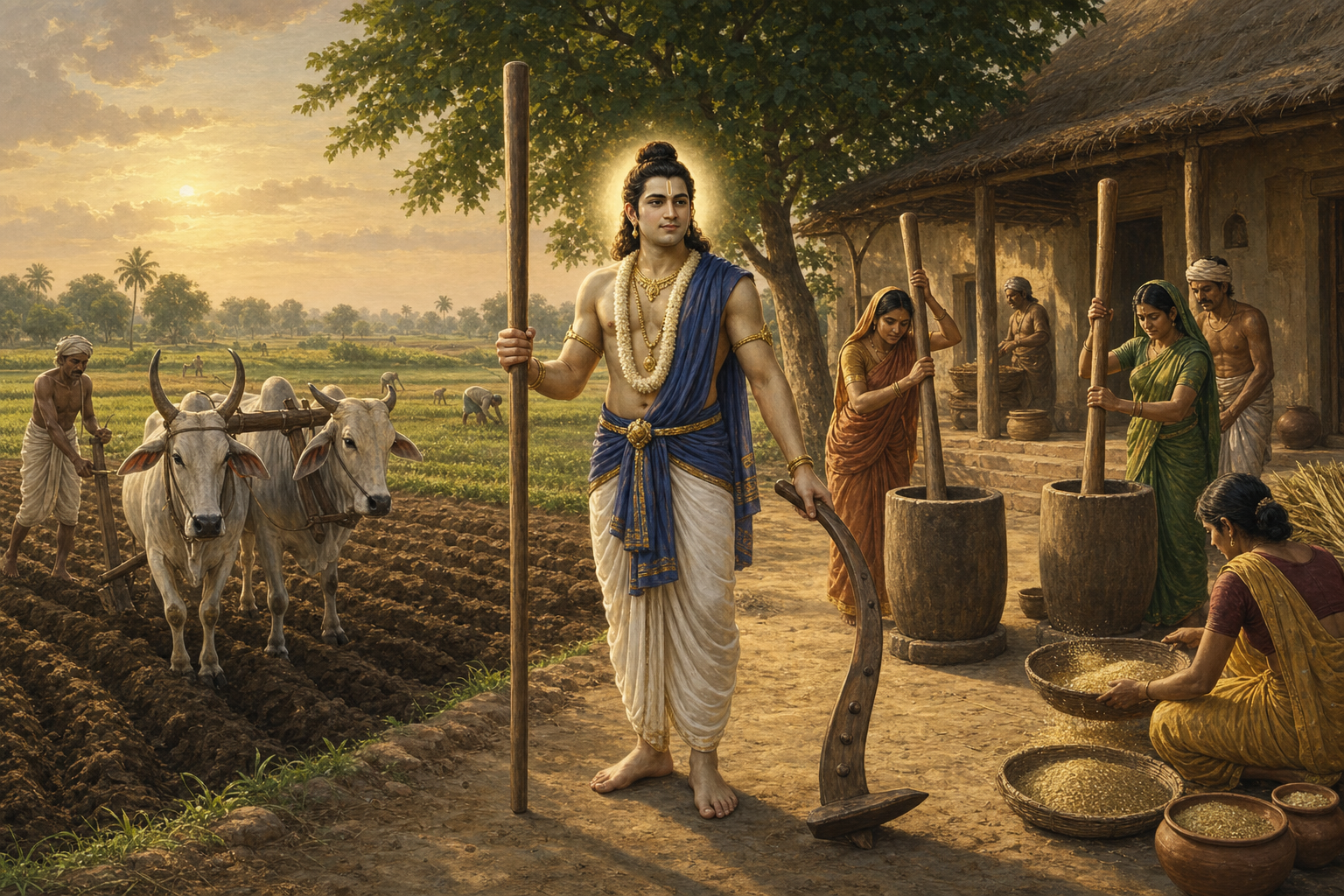
Balarama is celebrated as Hala-muṣala-dhara, the bearer of the plough and pestle. The title is not simply a list of two weapons. It expresses two connected stages of agrarian life. The plough prepares the earth for cultivation. The pestle processes what the field yields so that grain can enter the life of the household as nourishment.
Follow the pair as a sequence: the soil is opened, the crop is raised, the harvest is processed, and the community is fed. The musala belongs to the later part of that chain. It stands between stored produce and usable food, converting the field’s potential into sustenance through repeated labor. That is why calling both objects merely Balarama’s weapons strips away half of their visual grammar.
The pairing also prevents a sentimental reading of agriculture. Cultivation does not endure through fertility alone. Fields, herds, stores, workers, and households require stability and protection. Balarama’s attributes place productive labor and protective strength in the same pair of hands. Power remains legitimate because it answers to the life it safeguards.
This is also why the ordinary form of the musala should not be treated as an artistic failure. Its plainness is the point. A familiar implement from the working household enters sacred space without needing to disguise its origin. The movement once used to pound grain becomes part of the deity’s iconographic presence. Domestic work is not scenery around the sacred; it can itself carry sacred agency.
If you are preparing an educational label, keep both meanings in one sentence: Balarama holds the grain pestle as an emblem of nourishment transformed by labor and of strength disciplined in its defense. Describing only the kitchen implement loses its protective force. Describing only the weapon loses the fields and households that give that force a purpose.
The shape communicates disciplined rather than theatrical power
The musala and gada do not merely look different; their shapes imply different uses. A gada gathers much of its mass in a prominent head, making that end visually and mechanically dominant. A musala spreads its mass along a more continuous shaft. Its arc therefore reads as steadier and more controllable, while the heavy-headed mace emphasizes concentrated impact and tip speed.
This distinction helps you understand why iconographers preserve the musala’s unsegmented profile. The straight line communicates endurance, grip, bodily coordination, and calibrated force. The artist does not need spikes, a giant head, or elaborate surface decoration to make the attribute powerful. Its authority comes from recognizable function.
In medieval Tamil bronzes, the musala may appear as a plain vertical or diagonal staff beside Balarama’s elaborate crown, sacred thread, and ornaments. The contrast is meaningful: the bearer can be richly adorned while the implement remains direct and workmanlike. North Indian stone sculpture and painted traditions also retain the straight form, allowing the same basic identification method to travel across regions and media.
The relevant ideal of kṣatra is protective valor, not aggression detached from duty. When you encounter the musala as a weapon, ask what the image places around it. The companion plough supplies the answer: strength is accountable to cultivation, food, and communal continuity. The icon does not glorify force floating free of society; it binds force to the people and resources on which society depends.
There are legitimate resonances here with other Dharmic traditions, but the comparison should remain precise. Jain and Buddhist ethics measure strength through restraint and non-harm, while the Sikh principle of kirat karo honors honest, sustaining labor. These parallels illuminate a shared ethical concern: strength should serve life. They do not make Balarama’s musala a common icon of Hinduism, Buddhism, Jainism, and Sikhism. Compare the ethical logic, not the ownership of the symbol.
The Mausala Parva prevents an overly comfortable reading

You may associate the word musala first with the Mausala Parva and the destruction of the Yadavas. That association matters, but it should not be used as an identification shortcut or confused with Balarama’s standing pair of attributes.
The tragic episode centers on an iron bolt brought forth under a curse, ground down, and cast into the sea. Its material returns through eraka grass, which becomes an instrument of internecine violence among the Yadavas. A hard remnant also enters the chain of events culminating in Krishna’s departure from the mortal realm.
That narrative does not mean every musala in Balarama’s hand is principally an emblem of catastrophe. The two uses occupy different registers. In Balarama’s stable iconographic pairing, the pestle accompanies the plough and joins nourishment to guardianship. In the Mausala Parva, the musala motif exposes consequence, hubris, and the destructive turn of power within the movement of kāla, or time.
Holding both registers together produces a stronger interpretation than choosing only one. The implement that helps sustain a community can become destructive when power loses restraint and collective bonds collapse. Dharma is not guaranteed by possessing strength or by invoking a sacred object. Strength must remain rightly directed; karma carries consequences, and no social order stands outside time.
If you are teaching this material, introduce it in three stages. Begin with the household pestle, then show its place beside Balarama’s plough, and only then turn to the Mausala Parva. Reversing that order encourages readers to see doom before they have understood food, labor, and protection. The tragic narrative sharpens the agrarian symbolism; it should not erase it.
A responsible method for reading Balarama images
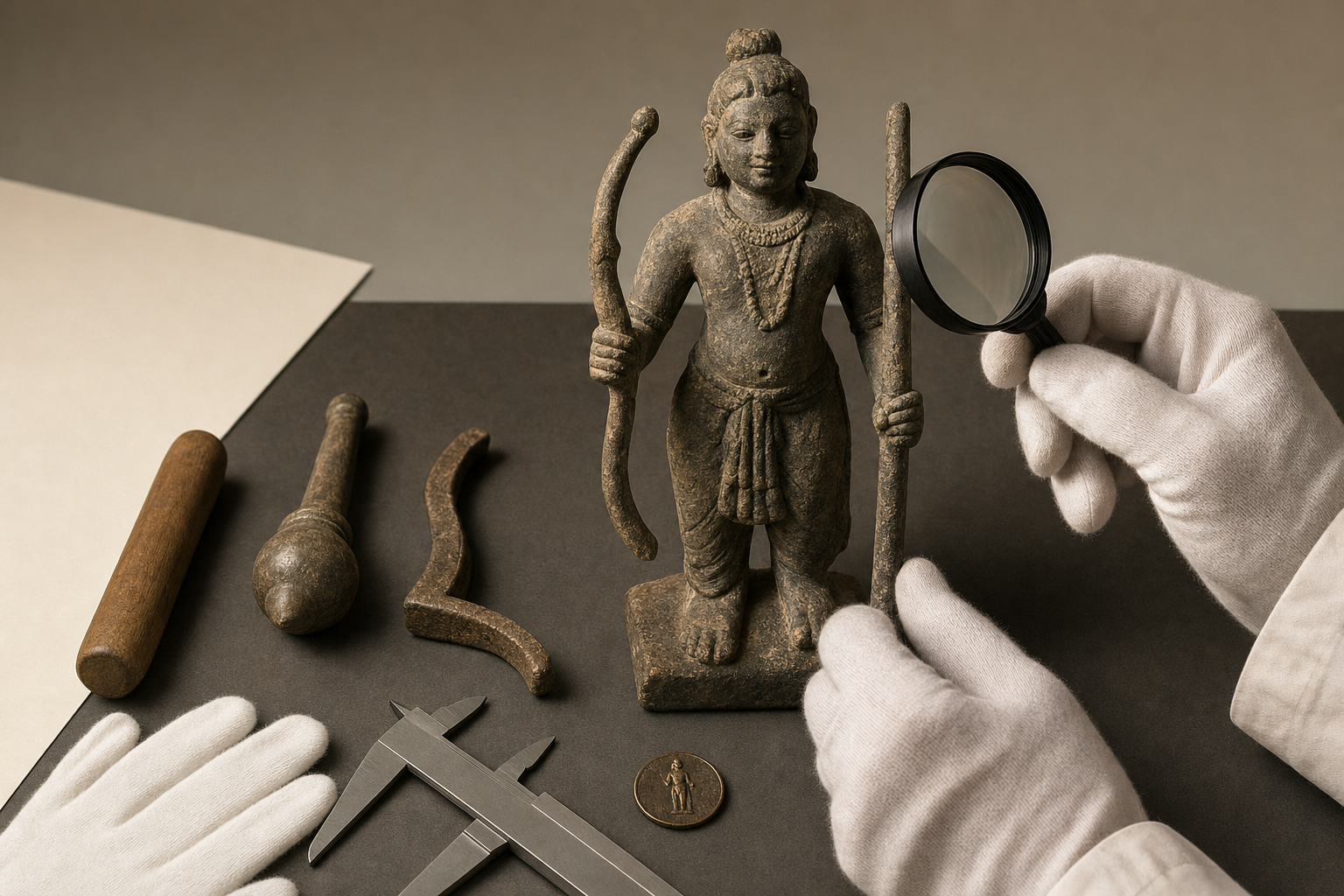
Iconographic confidence should come from converging clues. Use this sequence when examining a sculpture, photograph, coin, painting, or ritual image:
- Trace the outline. Decide whether the object is straight and nearly uniform, enlarged into a mace head, or curved like a plough. Do this before relying on a caption.
- Check the other hand. A musala becomes much easier to identify when a hala is present. The curved and straight attributes were designed to be read as a pair.
- Separate object from scene. A standing divine figure carrying plough and pestle belongs to a different visual situation from a narrative panel of Yadava conflict involving transformed eraka grass.
- Use ornaments as supporting evidence. In some South Indian bronzes, Balarama stands in samabhanga with a kīrīṭa-makuṭa, yajñopavīta, and abundant jewelry. These features can support an identification, but they do not replace the attributes and are not individually exclusive to Balarama.
- Notice the visual contrast. The curved plough and rectilinear pestle may be accentuated in ritual adornment. That contrast expresses cultivation and transformation even when the implements are ceremonially decorated.
- State the evidence before the interpretation. First record what is visible: a plain cylindrical object, a slightly flared end, a companion plough, or a damaged hand. Then explain its agrarian and protective meanings. This keeps symbolism from substituting for observation.
Local ritual context needs the same care. Balarama observances may be associated with Shravana Purnima in some places, while other regions and sampradayas follow different calendars and forms of worship. If you are documenting a living temple, use that temple’s own identification and calendar rather than projecting one regional practice onto all Balarama traditions.
The next time you meet this image, begin with one concrete distinction: a musala carries its substance along the shaft, while a gada announces itself through its head. Then look for the plough. If you are writing the label, keep the full meaning intact: name the object as a grain pestle, acknowledge its martial capacity, and connect its strength to the fields, labor, and households it exists to protect.