
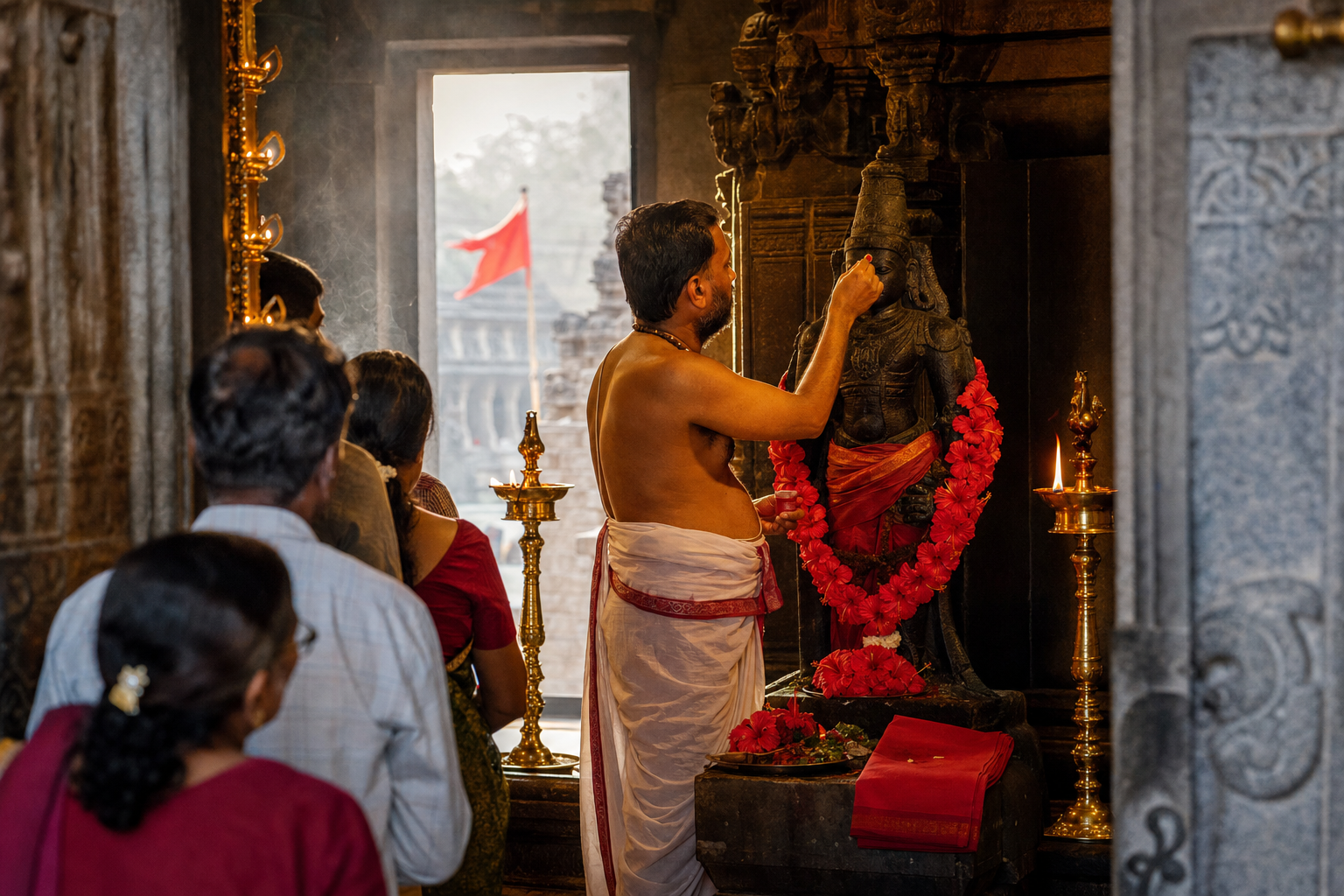
You enter a temple and see red everywhere: kumkum on the murti, hibiscus at the sanctum, a cloth tied near the Goddess, threads around devotees’ wrists, and perhaps a scarlet flag above the shrine. If you are unsure whether these objects all mean the same thing, the short answer is no. They belong to one symbolic family, but each performs a different ritual task.
Learning to read those differences changes how you approach darshan. You can identify what red is doing in a particular rite, choose an appropriate offering, and participate without treating a living temple custom as mere decoration.
Key takeaways
- Red commonly signifies Shakti, auspiciousness, vitality and devotion, but its precise meaning depends on the deity, rite and region.
- Kumkum, flowers, cloth, threads and flags are not interchangeable. One may mark blessing, another may serve as an offering, and another may embody a vow or protective relationship.
- Shakta temples generally make especially strong use of red. Vaishnava and Shaiva shrines may organize their visual language around other colors.
- Follow the custom of the temple you are visiting. Ask before applying powder to a murti, tying a thread, draping cloth or leaving an offering.
- Use temple-approved or clearly labeled non-toxic powders. A substance should not be assumed safe merely because it is described as traditional.
Red is a ritual action, not just a temple color
Red first points toward Shakti: the divine energy through which life moves, forms arise and protection becomes active. That is why the color is especially prominent in worship of the Goddess. Durga, Kali and Tripura Sundari may be represented with red garments, flowers or ornamentation, making protective and creative power immediately visible.
The color also carries the sense of mangala, or auspiciousness. Here, auspicious does not simply mean pleasant or lucky. It describes a beginning, relationship or action placed in right alignment. A red mark received after worship can therefore be both a blessing and a reminder: what began in the sanctum should continue in the devotee’s conduct.
Red is also associated with rajas, the quality of movement, vigor and activity. This does not make every appearance of red a celebration of restless passion. Temple ritual directs energy. Mantra, offering, gesture and darshan gather an active quality and orient it toward devotion, protection or righteous action. Red becomes spiritually meaningful because it participates in that discipline.
That difference is easy to notice when you look at the verbs surrounding the color. Red is offered as a flower, applied as a mark, worn as a garment, tied as a vow and raised as a flag. The same hue can therefore communicate surrender, blessing, guardianship, continuity or victory according to what people are doing with it.
Agamic liturgical traditions connect colors with particular deities, qualities and ritual purposes, while Shakta traditions give red a close relationship with the kinetic presence of the Goddess. Older terms such as aruna and rohita also evoke dawn, flame and vital force. These associations help explain why red feels at home beside the lamp: both direct attention toward energy becoming visible.
Red’s intensity naturally catches the eye. Inside a ritual sequence, that visual emphasis can support ekagrata, or one-pointed attention. The flower, flame, mantra and movement of the priest create a coordinated field rather than a collection of unrelated sensory effects. When you visit, let that sequence guide your attention before trying to photograph or intellectually decode every object.
How to read the red objects you actually encounter
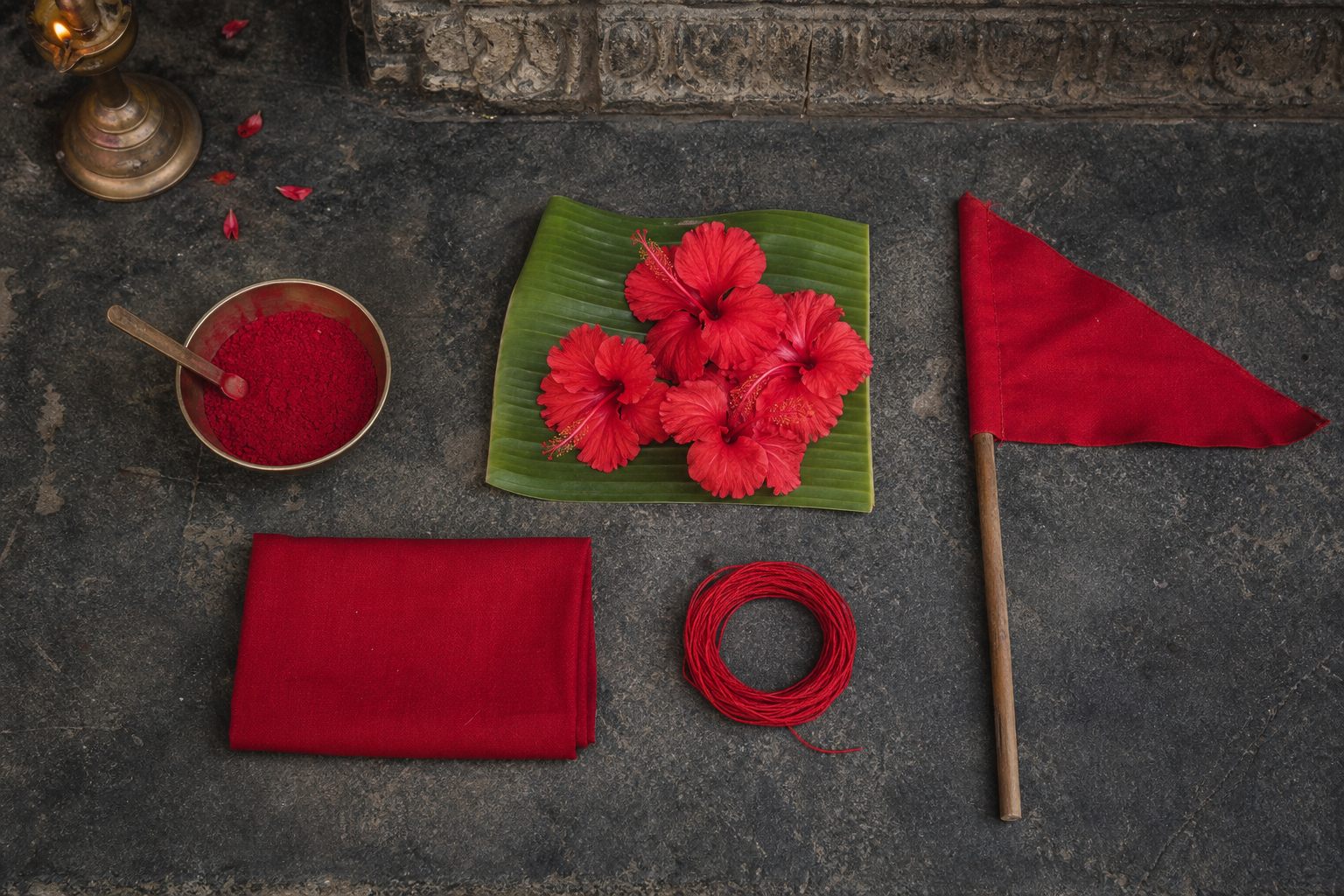
Kumkum, sindoor and the forehead mark
Kumkum and sindoor are among the most visible red substances in temple life, but the terms should not be treated as universally identical. Kumkum is traditionally made by transforming turmeric’s yellow color with an alkaline substance such as slaked lime. Formulations vary, and many contemporary temples use plant-derived or mineral-safe products.
Sindoor is especially prominent in North Indian settings. Vermilion was historically made with mercury sulfide, although the brilliant powders sold or distributed now may use different ingredients. Sindoor can carry marital and festival associations in addition to its use in deity worship. Bengal’s sindoor khela on Vijayadashami, for example, ritually shares auspiciousness among married women and the Goddess. That context should not be projected onto every red mark in every temple.
When red powder is given as prasada and placed on the forehead, the gesture brings the blessing of worship onto the devotee’s body. Its position near the ajna region also connects outward ritual with inward attention and receptivity. Receive it reverentially. If you do not know how or where it is applied in that community, watch the devotees ahead of you or ask a temple attendant.
Flowers offered during archana
Red hibiscus is particularly associated with Durga and Kali. Red lotus and locally available red blossoms may also appear in archana and pushpanjali. Their role is not simply to match a visual theme. A fresh flower offers color, fragrance, form and impermanence together; the devotee gives something beautiful rather than merely looking at it.
In kumkumarchana, names of the Goddess are recited while kumkum, petals or both are offered in a repeated rhythm. The meaning lies in the union of name, intention, movement and material. If a temple invites you to participate, follow its supplied sequence. Do not substitute a flower solely because its color seems appropriate. Temples may restrict species, quantities or the place where offerings are deposited.
Cloth, sacred thread and the temple flag
A lal chunri or red sari offered to the Goddess becomes part of alankara, the devotional adornment of the deity. Such a textile can embody gratitude, a petition or the fulfillment of a vow. It should be handed over through the temple’s established process rather than draped on an image without permission.
A red thread tied around a wrist, tree or designated sacred object often marks protection or a vow. Its meaning comes from the sankalpa, the intention associated with the act, not from the fiber alone. Before tying anything, check that the location is approved. A tree covered in threads may represent a recognized practice at one shrine and unauthorized clutter at another.
A red dhwaja, or flag, works at a more public scale. Raised at the temple or on its flagstaff, it may communicate protective presence, steadfast guardianship and vijaya, or victory. Unlike a private forehead mark, the flag tells an entire community that worship continues and that the sacred center remains active.
Red at thresholds and in seasonal decoration
Red may also appear in toranas, rangoli or kolam designs, temporary festival ornamentation and rakta-chandana, or red sandal paste. In Tamil Nadu and other parts of South India, red ochre known as kaavi or geru has also been used to define thresholds and selected surfaces. A red boundary should be noticed before it is crossed or touched: it may organize sacred space rather than invite interaction.
The restrained garbhagriha and the vivid offerings around it are not necessarily in tension. Temporary color can concentrate the eye while the architecture protects the sanctum’s gravity. The useful question is not, “Why is the temple so red?” but, “Where has red been placed, by whom, and as part of which rite?”
The deity and the region determine the emphasis
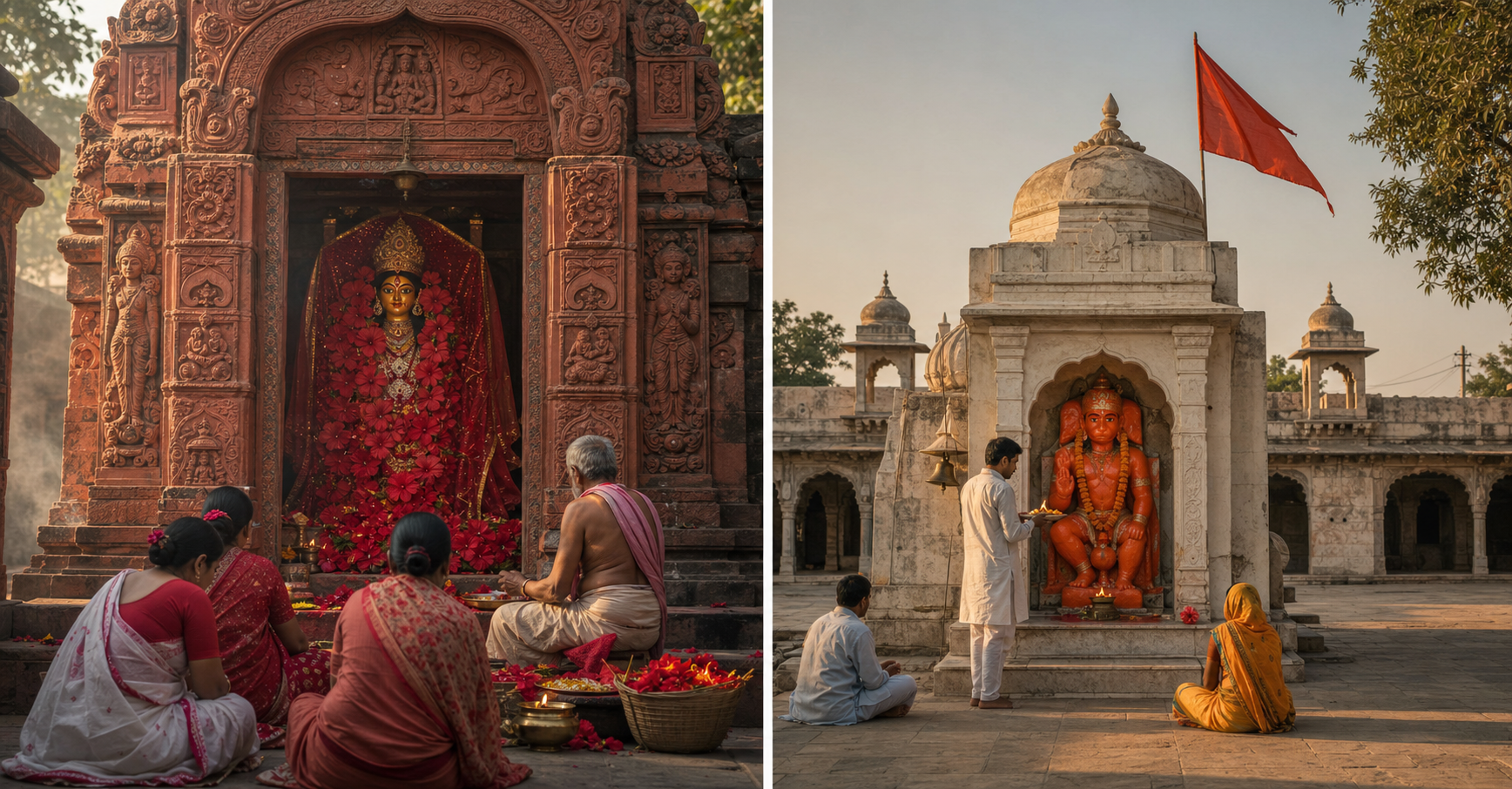
There is no pan-Hindu rule requiring every temple to give red the same prominence. Shakta shrines tend to foreground red because of its relationship with the Goddess and active divine power. Many Vaishnava temples give greater visual weight to white and yellow, associated with purity and prosperity. Shaiva worship often makes white vibhuti, the luminosity of sacred ash, especially prominent.
These differences are not competing verdicts about which color is holier. A temple’s palette expresses its theology, ritual calendar and inherited discipline. The absence of strong red decoration does not imply an absence of Shakti, just as the presence of red does not automatically identify every shrine as Shakta.
Regional practice then gives the symbolism a more precise grammar. Amman temples in Tamil Nadu are known for vibrant kumkumarchanai. At Kamakhya in Assam, red cloth used during the Ambubachi Mela participates in a theology of the Goddess, the earth and cyclical fertility. Bengal’s Vijayadashami observance gives sindoor a communal and marital setting.
Hanuman shrines provide another distinct use. A popular devotional account tells how Hanuman covered his body in sindoor for Rama’s well-being, explaining the offering of vermilion in this setting. Treat that account as the living tradition it is rather than as a universal explanation for red powder at every temple.
Festival time can also alter what you see. During Navaratri and Durga Puja, red garments, garlands, powder and alankara make the Goddess’s protective grace especially visible. A shrine that appears comparatively restrained during an ordinary week may become chromatically intense during its festival cycle. If you want to understand the difference, ask what observance is underway rather than assuming the decoration is permanent.
Red should not be collapsed into saffron either. The hues often appear together, but saffron or kesari has strong associations with renunciation, valor and sacred aspiration. Hindu, Buddhist, Jain and Sikh settings all use warm colors, yet each tradition gives them its own discipline. Vajrayana maroon, Jain lay offerings of kumkum or saffron, and the Sikh kesari of the Nishan Sahib may resonate with courage and devotion without becoming interchangeable ritual codes.
How to participate without guessing
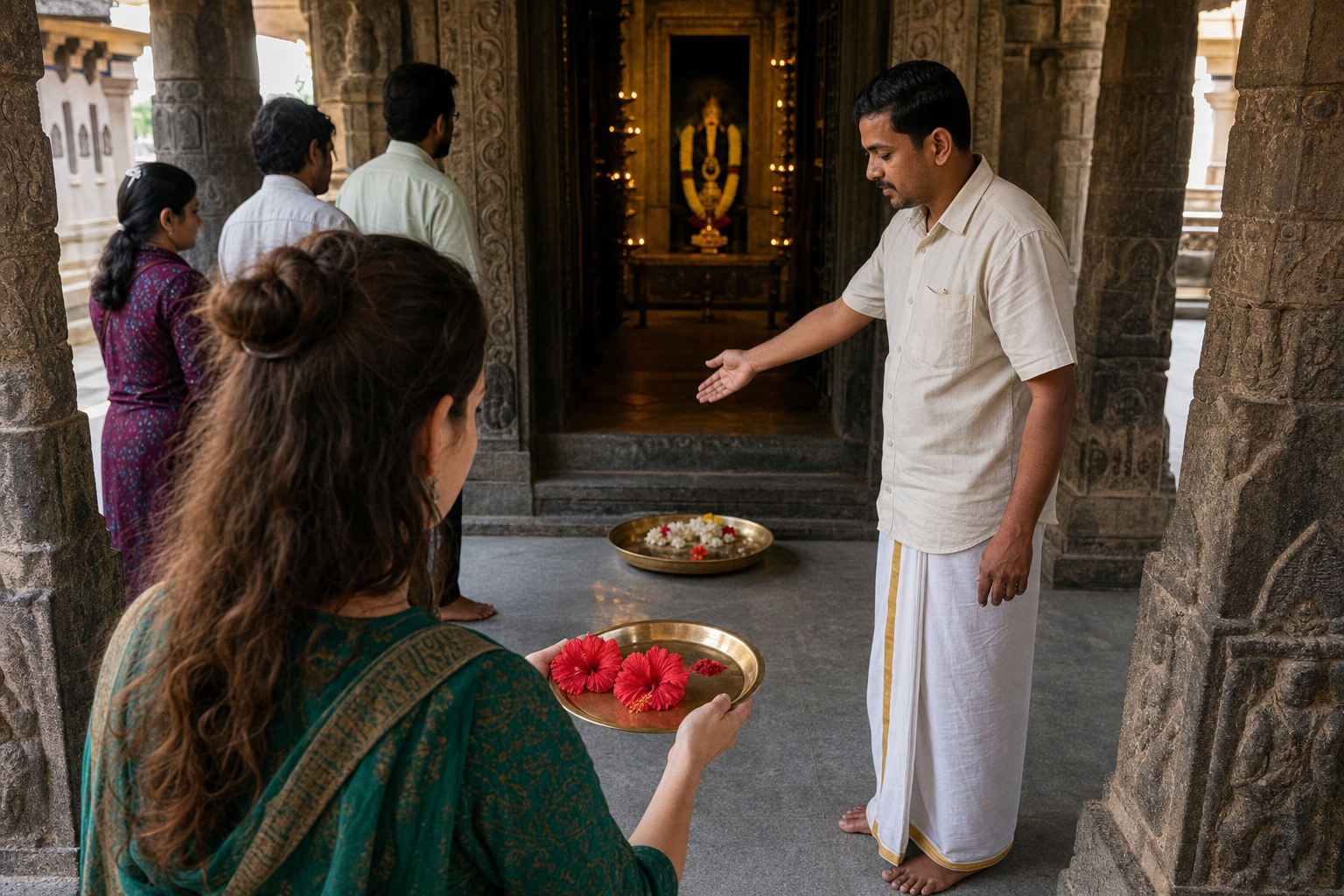
You do not need to master every regional custom before entering a temple. You do need to let the temple define its own practice. A simple sequence will prevent most avoidable mistakes:
- Identify the deity and the occasion. Read the shrine name, notice the festival announcement, or ask which form of the deity is being worshipped. This gives you the context needed to interpret the color.
- Observe before acting. Watch where flowers are handed over, where powder is received and whether cloth or thread is accepted. A queue often reveals the local protocol more accurately than assumptions brought from another region.
- Choose an offering the shrine actually uses. Red hibiscus may be appropriate at a Durga, Kali or Amman temple, but color alone does not guarantee acceptance. Purchase from an authorized temple counter or ask before bringing your own material.
- Give the offering to the designated person or place. Do not apply kumkum to a murti, drape a chunri, tie a thread or place flowers inside the sanctum unless you are invited to do so.
- Receive the mark as prasada, not as a costume accessory. If kumkum is offered, follow the local gesture. If you prefer not to apply it or have a concern about the material, ask how it may be received respectfully without putting it on your skin.
- Carry the sankalpa beyond the visit. If the red thread or mark represents protection, devotion or a fulfilled vow, connect it to one concrete action: completing the promised seva, keeping a discipline, supporting the temple, or repairing the relationship named in your prayer.
This last step matters. Temple symbolism is weakened when the object is preserved but the obligation is forgotten. Red represents activated devotion. Its proper continuation is not endless display but dharmic conduct.
The yogic association of red with muladhara offers a useful inward parallel. Muladhara is commonly represented in red and understood as the grounded base at which kundalini Shakti rests before awakening through sadhana. In this frame, red joins stability with ignition. You can use that insight during darshan by becoming physically still, gathering your attention and deciding where your energy should be directed after you leave.
Safe materials are part of sacred stewardship
Color alone cannot tell you what a powder contains. Because vermilion was historically made with mercury sulfide, do not assume that an unlabeled scarlet product is safe merely because it is sold for ritual use. The immediate safe choice is to use the temple’s approved material or a clearly labeled non-toxic, plant-derived or mineral-safe formulation.
Kumkum’s traditional connection with turmeric does not mean every commercial red powder has the same ingredients or manufacturing process. If you are buying it for household puja, read the label, keep the container identified, and choose a trusted artisan or supplier who discloses the formulation. Do not bring an unknown powder for communal application.
This is not a modern concern opposed to tradition. Choosing non-toxic ritual materials expresses ahimsa and care for devotees and the environment. Responsible sourcing protects the human body while preserving the devotional function of the offering.
On your next temple visit, ask three questions before interpreting or using red: Which deity is being worshipped? What ritual action is the color serving? What does this temple ask devotees to do? Those questions turn a striking visual impression into informed participation. Once you can see red as Shakti offered, blessing received and intention carried into action, the temple’s color begins to speak in its own grammar.