-
Is Life Easy or Difficult? An Evidence-Backed Dharmic Guide to Joy, Suffering, and Mastery

Is life easy or difficult? A dharmic analysis shows the question spans two complementary levels: the conventional reality of dukkha (unsatisfactoriness) and the ultimate discovery of ananda (joy). Buddhism’s Four Noble Truths, the Yoga Sutra, Vedanta’s ananda doctrine, Jain anekantavada, and Sikh Chardi Kala together form a unified method for transforming difficulty into resilience while…
-
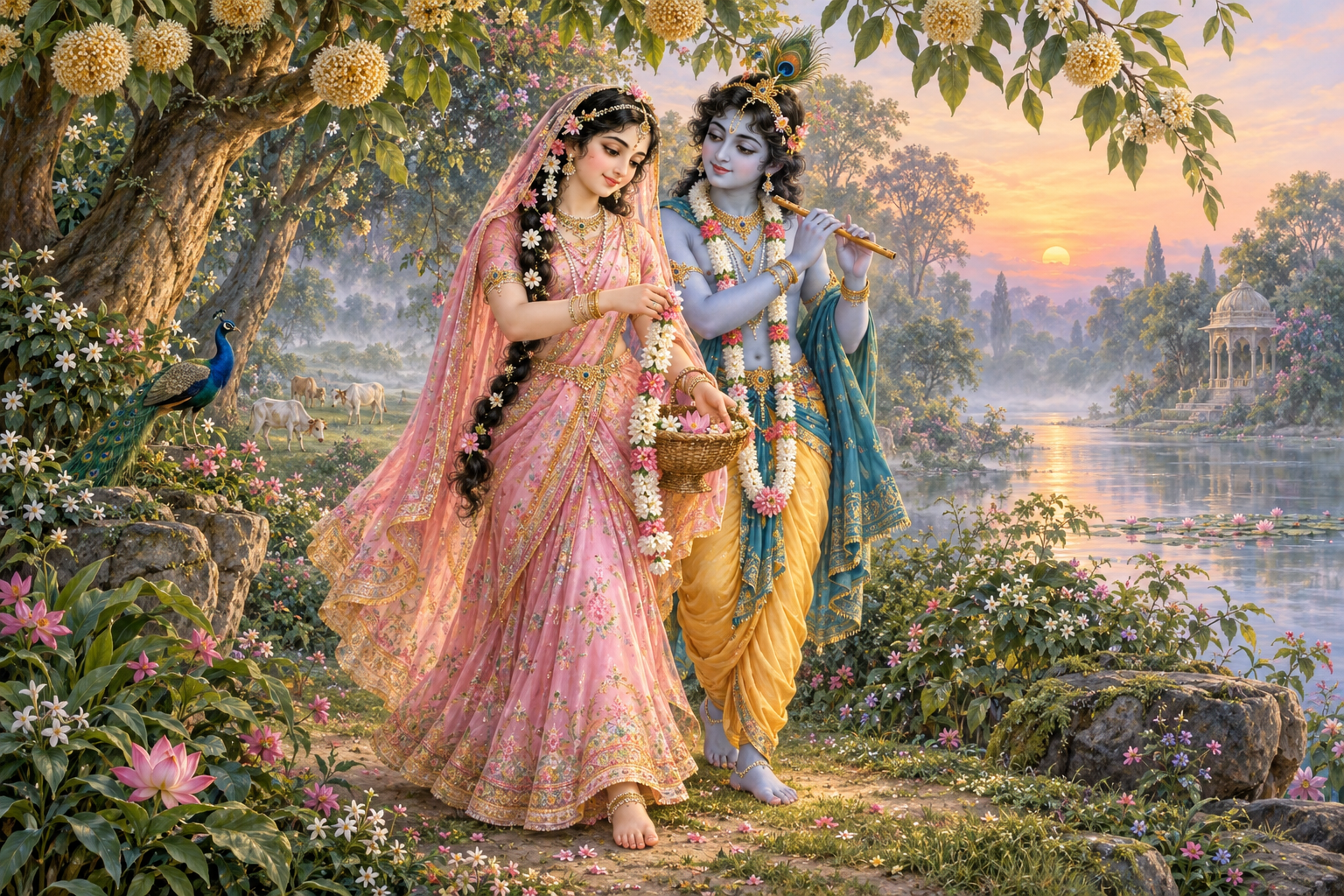
Eternal Longing, Infinite Union: Decoding Radha–Krishna’s Divine Love and Sacred Separation

This long-form exploration decodes why Radha–Krishna’s love is revered not as a tragic failure of union but as a sacred pedagogy of longing. Drawing on Srimad Bhagavatham, Gīta Govinda, and Gaudiya Vaishnava theology, it explains how vipralambha (separation) heightens devotion and refines ethical action. The article clarifies key concepts—rasa, sambhoga, vipralambha, and mahābhāva—while situating them…
-
Shiva’s Damaru: Decoding the Cosmic Rhythm of Creation, Balance, and Transformation

This long-form exploration decodes Shiva’s Damaru as a compact, technical map of creation, balance, and transformation in Hindu philosophy. It explains Nāda-Brahma, the A-U-M schema, and the panchakritya while situating the drum’s meaning within linguistic tradition via the Maheshvara Sutras and Panini’s grammar. Readers gain an acoustical and yogic understanding of the instrument, including how…
-
May 21, 2026 Panchang: Shukla Panchami to Sashti, Sacred Auspicious Times, Nakshatra & Rashi

May 21, 2026 is marked in most regions by Shukla Paksha Panchami until 1:45 PM, followed by Shukla Paksha Sashti, bringing a day well-suited to learning, counsel, and steady progress. The overview clarifies how tithi is computed, why its boundary matters for vratas and sankalpa, and how to plan tasks within the intended lunar segment.…
-
Reclaiming Voice from Shame: Trauma‑Informed Assertiveness Guided by Dharmic Principles

Many adults taught that their feelings did not matter struggle to speak up, not because they lack maturity, but because their nervous systems learned that silence equals safety. This article reframes learned silence as an adaptive response and outlines a trauma-informed path to assertiveness grounded in nervous system regulation, emotional literacy, and boundary setting. It…
-
Ananda Tandava Unveiled: Decoding Shiva Nataraja’s Blissful Cosmic Dance and Living Wisdom

Ananda Tandava, Shiva Nataraja’s blissful dance, is a complete grammar of Hindu philosophy translated into gesture, rhythm, and form. This comprehensive overview traces its roots in the Agamas, Puranas, and Bhakti hymns, and explains how the five divine acts (panchakritya) appear in Nataraja’s iconography. Readers learn how Chidambaram’s Chidambara Rahasya and the Pancha Sabhas embody…
-
From Sadhana to Etiquette: Angas of Bhakti for Daily Practice and Interfaith Dharmic Harmony

This in-depth reflection on a Sat Sanga with HH Krishna Kshetra Swami (09.05.2026) unpacks the Angas of Bhakti—how sadhana (disciplined daily practice) and Vaishnava etiquette (sadachara) jointly mature devotional life. Readers gain a clear map of foundational and potent practices from the Gaudiya tradition, learn practical routines for japa, kirtana, and study, and see how…
-
Hare Kṛṣṇa as a Heartfelt Cry: Surrender, Bhakti, and Dharmic Unity in Practice

The mantra Hare Kṛṣṇa, Hare Kṛṣṇa can be read as a concise theology of surrender: “O the energy of the Lord, O the Lord, please accept me.” Situated within the bhakti tradition, this cry for acceptance aligns with Lord Caitanya’s emphasis on humility and constant kīrtana. The piece explores how śaraṇāgati in the Bhagavad Gītā,…
-
Srila Prabhupada’s 1976 Vrindavan Marathon: Seva, Scholarship, and Global Sankirtana

In 1976 at Vrindavan, Srila Prabhupada’s day began at mangal arotik and ended past midnight with a Mathura pandal program before more than twenty thousand attendees. Eyewitness details—such as the right-hand lesson during a morning walk—reveal how subtle etiquette conveyed dharmic principles. His apology for speaking in Hindi at the pandal highlighted humility and inclusive…
-
Bond of Love with HG Akuti dd: Profound insights on Bhakti, Seva, and Dharmic Unity

This in-depth preview examines the Bond of Love Interview Series featuring HG Akuti dd, streamed by Vaishnavi Ministry on July 11, 2025, and situates it within the global evolution of ISKCON’s Bhakti Tradition. The analysis shows how love-centered devotion (prema-bhakti), seva, and the Guru-Shishya Tradition converge to strengthen community resilience in digital settings. Cross-dharmic parallels—maitrī…
-
Surrender that Liberates: How Dāsa‑Bhāva Shapes Bhakti, Seva, and Dharmic Unity

The Bhakti concept of “dasa” (dāsa)—a chosen identity of loving service and surrender—anchors Hindu spirituality in a disciplined ethic of humility, seva, and śaraṇāgati. Grounded in scriptural sources like the Bhagavad Gita and Srimad Bhagavatham, dāsya-bhāva appears across Vaishnava, Śaiva, and Śākta traditions and is elaborated by Ramanujacharya, Madhvacharya, and Chaitanya Mahaprabhu. It flourishes in…
-
Ramayana’s Unfinished Truth: Why Rama and Sita Don’t Get a Fairy-Tale Ending (and Dharma’s Lesson)

Ramayana is not a fairy tale about bliss after victory; it is a rigorous meditation on dharma under the pressures of love, power, and public trust. The narrative after Ravana’s defeat intensifies into a study of rajadharma, where Rama’s personal anguish and public duty collide. Sita’s trials—Agni Pariksha, exile, and her return to Mother Earth—expose…
-
Why Ramanujacharya Asked ‘Have You Loved?’—Bhakti, Emotional Maturity, and Divine Grace

A classic teaching story about Sri Ramanujacharya turns on a simple question: “Have you ever loved anybody?” Rather than prescribing abstract doctrine, he points to love (prema) as the formative ground of bhakti. In Vishishtadvaita Vedanta, devotion matures through lived relationship, culminating in prapatti (surrender) supported by divine grace. The distinction between kama (desire) and…
-
Adi Granth as an Ecumenical Beacon: Guru Granth Sahib’s Universal Wisdom for Dharmic Harmony

This essay presents the Adi Granth, enshrined today as the Guru Granth Sahib, as a uniquely oecumenical scripture whose language, music, and ethics resonate across Hindu, Buddhist, Jain, and Sikh traditions. It traces the canon’s historical formation, its multivocal authorship, and its raga-based architecture to explain why the text travels so well across communities. Theological…
-
May 20, 2026 Panchang: Shukla Chaturthi to Panchami—Auspicious Timings, Expert Ritual Guide

On Wednesday, May 20, 2026, Shukla Paksha Chaturthi prevails until 3:56 PM and then transitions to Shukla Paksha Panchami. This comprehensive Panchang guide explains how to compute good times using the universal eight-part daylight method and how to avoid Rahu Kalam, Yamaganda, and Gulika Kalam for new beginnings. It highlights the strength of Abhijit Muhurta…
-
Upadhi in Hindu Thought: Unmasking Limiting Adjuncts that Veil Reality and Freedom

Upadhi—“limiting adjunct”—explains how unconditioned reality appears delimited without itself changing. In Advaita Vedānta, it clarifies the jīva–Īśvara distinction, the role of avidyā and māyā, and why body–mind vestures only seem to bind the Self. Classic analogies—pot-space, crystal-and-flower, and reflections of the sun—demonstrate avaccheda-vāda and pratibimba-vāda. Taittirīya Upaniṣad’s pañca-kośa viveka and the three-body model present a…
-
From Cosmic Ocean to Cosmic Web: How Scientific Cosmology Can Enrich Dharmic Faith

This evidence-based reflection shows how the Srimad-Bhagavatam’s image of a “cosmic ocean” aligns, at the level of metaphor, with the cosmic web mapped by modern astronomy. It explains what science reliably says about origins and possible endings—Big Bang, dark matter, dark energy, and competing end-of-universe scenarios—while clarifying where responsible uncertainty remains. It places these insights…
-
Tripura Tandava of Shiva: Decoding the Sixteen-Armed Dance of Cosmic Dissolution

Tripura Tandava, often aligned with Shiva’s role as Tripurāntaka, encapsulates the precise instant of cosmic dissolution where triadic structures resolve into pure awareness. Grounded in the pañcakṛtya framework, it brings together saṁhāra (dissolution) and tirodhāna (concealment) to culminate in laya (absorption). The post examines Purāṇic narratives, āgamic iconography—including the striking sixteen-armed convention—and the dance grammar…