
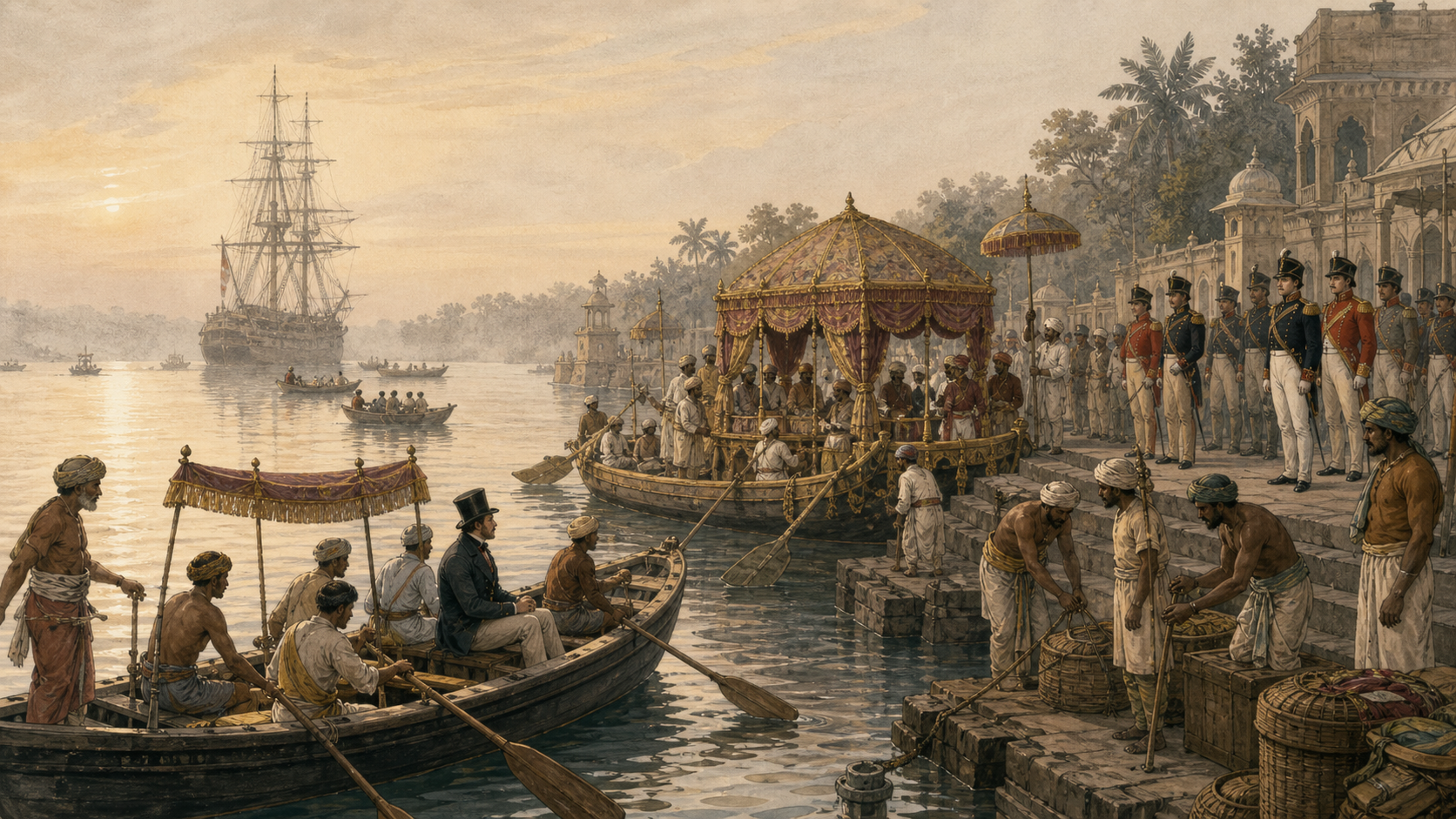
If you want to understand how the East India Company acquired political authority in Bharat, battle maps and revenue settlements tell only part of the story. Viscount Valentia’s arrival in 1803 exposes another mechanism: power made visible through boats, uniforms, attendants, gifts, invitations and carefully managed access.
The useful question isn’t simply why an aristocratic visitor received lavish treatment. It is what that treatment accomplished. Follow the sequence closely and you can see a commercial corporation presenting itself as a sovereign order before anyone needed to state the claim outright.
Follow the journey from open sea to managed access
At first light on 1 January 1803, Valentia sighted the southernmost Nicobar island from the Minerva. An approach attempted two hours later proved impracticable. A landing on the western side became possible three days afterward. These details place the voyage within the connected maritime world of the Bay of Bengal, the Andaman Sea and India’s eastern littoral.
The important change came as the vessel turned north. On 17 January, Valentia saw from a distance what he called the ‘black pagoda of Jagarnaut,’ locating the voyage within the sacred landscape associated with Puri. The Minerva then reached the mouth of the Hooghly, where he sent a letter to Governor-General Marquis Wellesley.
That letter changed the character of the journey. The sea had imposed its own hazards and delays; Company hospitality now began to determine transport, timing, ceremony and human contact. On 25 January at Saugor, or Sagar, Valentia received an invitation to a grand gathering at the new Government House. At seven the following morning, he left the Minerva in Wellesley’s state barge.
When you read a colonial itinerary, mark this kind of hinge. Ask who authorizes the next movement, who supplies the transport, who chooses the audience and who remains outside the arranged route. The answers often reveal more about practical power than a formal title does.
The geography also deserves three separate labels. The Nicobars belonged to the voyage’s maritime geography. The sight of Puri introduced a sacred geography that long predated Company authority. The Hooghly opened a political corridor into an expanding Company network. Collapsing all three into a picturesque travel scene would hide the transition that matters.
Wellesley’s barge was a moving claim to authority
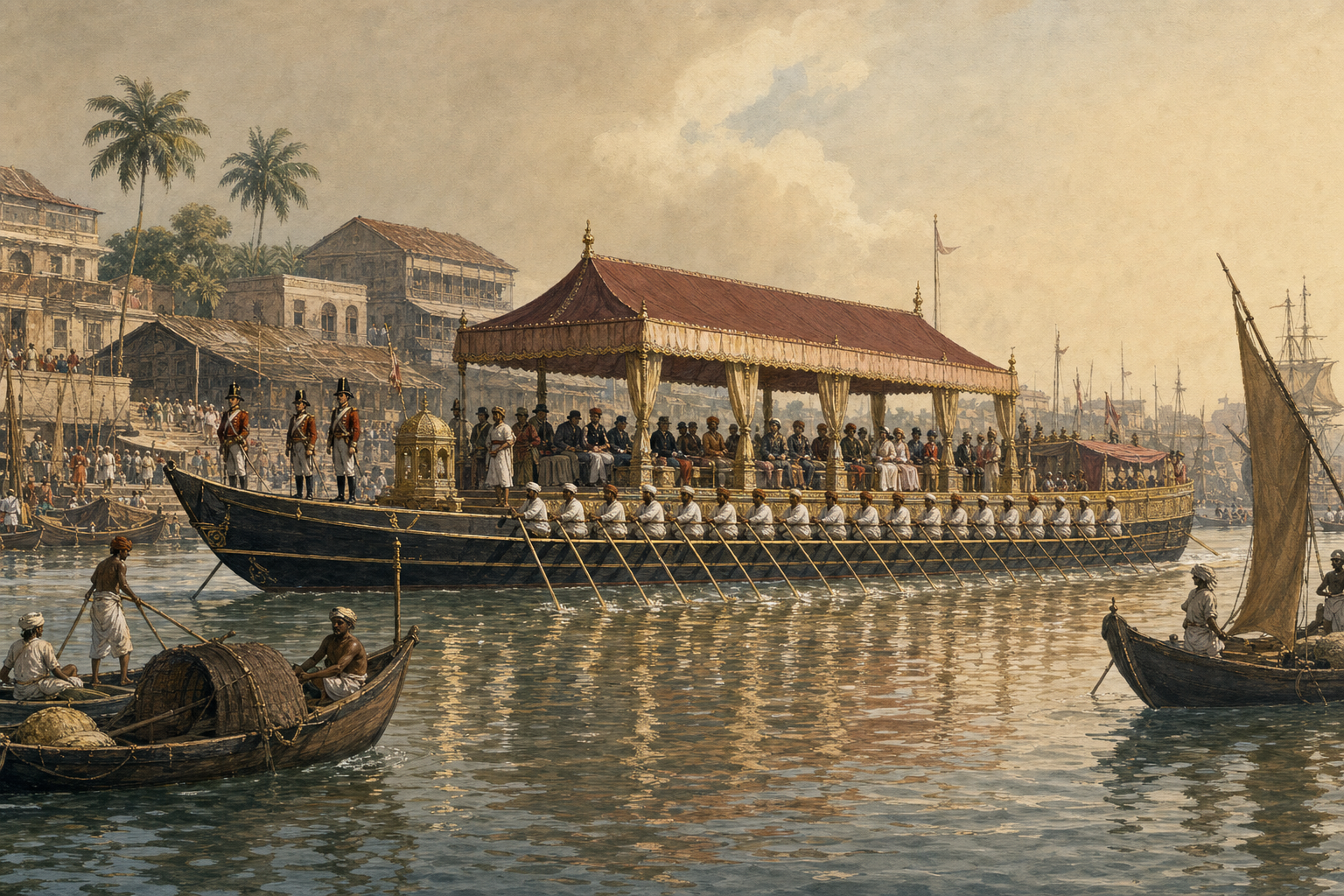
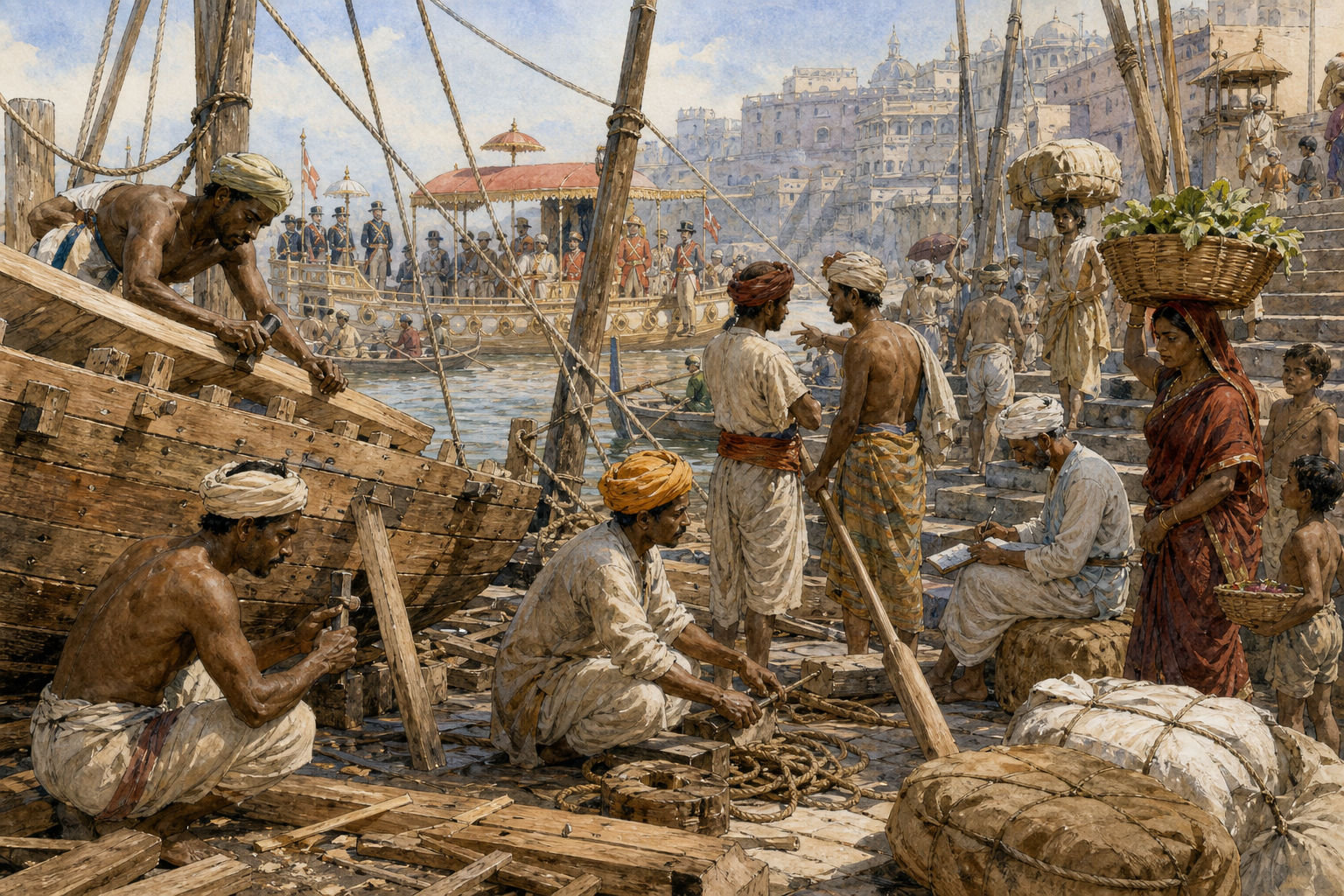
The state barge was long, narrow and decorated in green and gold. A gilt eagle occupied its prow and a carved tiger its stern. Twenty oarsmen, dressed in scarlet robes and rose-coloured turbans, propelled it with conspicuous speed. Each element helped turn a transfer from ship to shore into a public performance.
Start with initiative. Wellesley didn’t merely permit Valentia to come ashore; he sent the craft that would carry him. The guest therefore entered through a channel created and controlled by his host. Transport doubled as reception, and reception established the first hierarchy of the visit.
Then notice the visual grammar. The eagle, tiger, gold ornament, vivid clothing and disciplined rowing placed British heraldic imagery beside forms of royal display familiar on the subcontinent. You don’t have to assign a fixed meaning to every colour or carving to recognize the cumulative effect. The craft made rank immediately legible.
Finally, keep the oarsmen in view. Ceremonial power is never produced by symbols alone. It depends on organized labour: people rowing, carrying, announcing, guarding, grooming animals and managing the route. Their coordination made the visitor’s elevated position appear effortless. If you notice only the noble passenger, the mechanism disappears.
This doesn’t mean the barge itself conferred sovereignty. It means spectacle helped naturalize an unequal order. A hierarchy that arrives in motion, colour and disciplined service can feel established before its legal or military foundations are examined.
Hospitality operated as political infrastructure
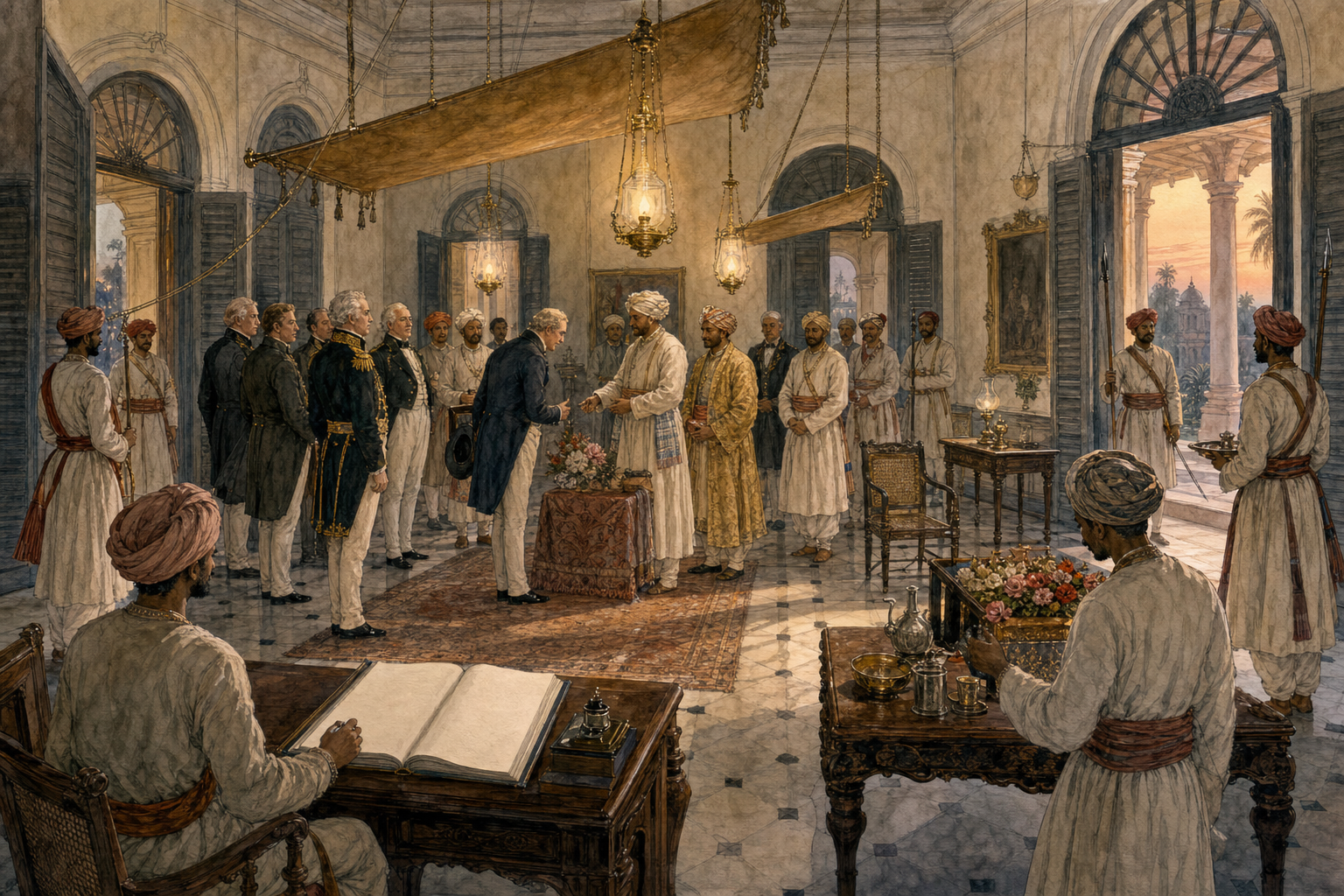
The barge was only the opening movement. Across India, Valentia received ornate palanquins, elephants, fine horses and an extensive retinue that included harikaras, chubdars, soontaburdars and khidmatgars. Company officials understood his aristocratic standing and cultivated him accordingly.
It would be too simple to call every courtesy a bribe. Gift-giving, reciprocal obligation and ceremonial hospitality had established places in South Asian political life. Yet it would be equally misleading to treat the arrangements as socially neutral. Whoever supplied transport, attendants and introductions could shape what the visitor saw, whom he met and how comfortably he moved.
The origins of the gifts make that tension sharper. Descendants of dispossessed princes, prominent nobles and local elites all participated. They occupied different positions, but each had reason to understand that prestige, proximity and reciprocity could influence access within the new order. A gift might express courtesy, seek recognition, preserve dignity, open a channel or serve several of those purposes at once.
Company officials had their own calculations. A well-received aristocratic visitor could carry impressions, relationships and information through British networks. Lavish hospitality therefore worked in two directions: it elevated Valentia while also advertising the competence, resources and social reach of the officials hosting him.
Use three tests when you encounter such a reception. First, identify what the guest received: mobility, protection, comfort, information or an audience. Second, identify what the host gained: prestige, favourable attention, intelligence or a relationship. Third, ask who paid, laboured or waited outside the exchange. That final question prevents elite reciprocity from being mistaken for the condition of society as a whole.
This is why ceremony belongs inside political history. Force establishes what a regime can compel. Revenue determines what it can extract. Managed hospitality determines who can approach power, how status is recognized and which relationships become useful. Company expansion relied on all three, even when only the first two appear on a conventional timeline.
The ‘old woman’ metaphor translated corporate rule into kinship
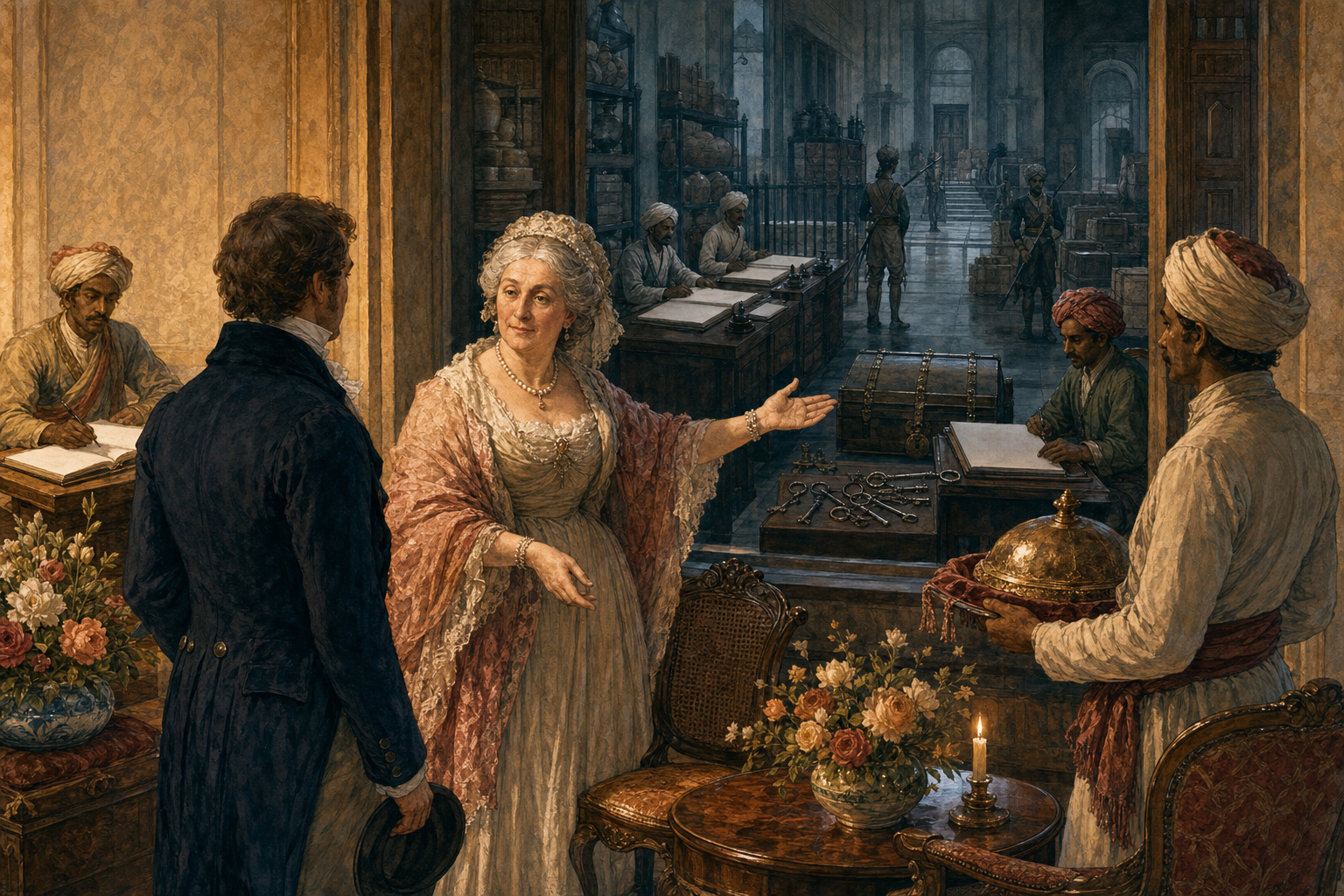
Lucknow supplied the most revealing phrase of the journey. A personal envoy announced Valentia’s arrival with these words:
Message delivered by a personal envoy in Lucknow
Valentia understood the formulation through a local personification of the Company as an elderly woman. Governors-General became her children, while dignitaries connected to them could be placed within an extended circle of kinship. The visiting lord was thus introduced through relationship rather than through a constitutional definition of the corporation.
That interpretation needs careful limits. One European traveller’s explanation cannot prove that every community, court or speaker in India understood the Company in precisely the same way. The stronger conclusion is narrower: participants in this encounter used a familial idiom to make an impersonal foreign corporation socially intelligible.
The metaphor performed two political tasks. It translated an unfamiliar institution into a recognizable hierarchy of elders, descendants and dependants. It also softened the appearance of domination. A corporation that controlled military, legal and revenue power could enter ordinary speech as a senior relative rather than as an armed commercial state.
Kinship language doesn’t necessarily prove affection, consent or submission. Courtly speakers could use familiar forms pragmatically while pursuing their own interests. But the language still shows which structure had to be acknowledged. To be someone’s child, grandchild or dependent is to occupy a place in a hierarchy, even when the relationship is metaphorical.
Carry that test beyond this episode. Whenever a powerful institution is called a parent, guardian, benefactor or member of the family, ask what the metaphor leaves unsaid. Which rights become favours? Which obligations become loyalty? Which forms of coercion disappear behind the warmth of domestic language? In Lucknow, the image of the old Company matriarch made distant corporate authority familiar without making it equal.
Read through the colonial gaze without surrendering Bharat to it
Valentia’s encounters in the Nicobars combined curiosity with assumptions typical of European travel writing in his period. Treating his classifications as neutral anthropology would reproduce those assumptions. Discarding every observation would lose evidence about routes, ceremonies and the colonial habit of framing cultural difference.
A better reading separates four layers. First, isolate the event: where the traveller went, when he moved and what was physically arranged. Second, identify the judgement he attached to people or practices. Third, ask what political function the encounter served. Fourth, look for the people and institutions pushed to the edge of his field of vision.
This method changes what you notice. The Nicobars cease to be merely an exotic prelude. The distant sacred landmark near Puri becomes more than scenery. The Hooghly is no longer just a river approach. The barge is no longer decorative transport, and the attendants are no longer colourful background. Each belongs to a different system of movement, meaning, labour or authority.
The same discipline matters when considering dharmic continuity. Temple networks, monastic institutions, knowledge traditions and household practices helped Hindu, Buddhist, Jain and Sikh communities preserve religious and social life through political disruption. Their endurance doesn’t mean these traditions were identical, nor does it mean extraction and coercion left them untouched.
Acharya Jadunath Sarkar emphasized the damage that prolonged instability and coercive taxation could inflict on public life and creative capacity. Whether you accept every part of that wider interpretation or not, it guards against a common mistake: ornate courts and spectacular receptions aren’t proof of broad civic autonomy. Elite magnificence can coexist with constrained communities.
Puri’s sacred horizon is therefore not a decorative counterpoint to Company ceremony. It represents a civilizational geography that the visitor approached but didn’t create. The Company could organize his entry, surround him with status and reshape political relationships. It couldn’t plausibly claim to have produced the sacred landscape, inherited traditions or community memory through which Bharat understood itself.
<!– wp:heading {