
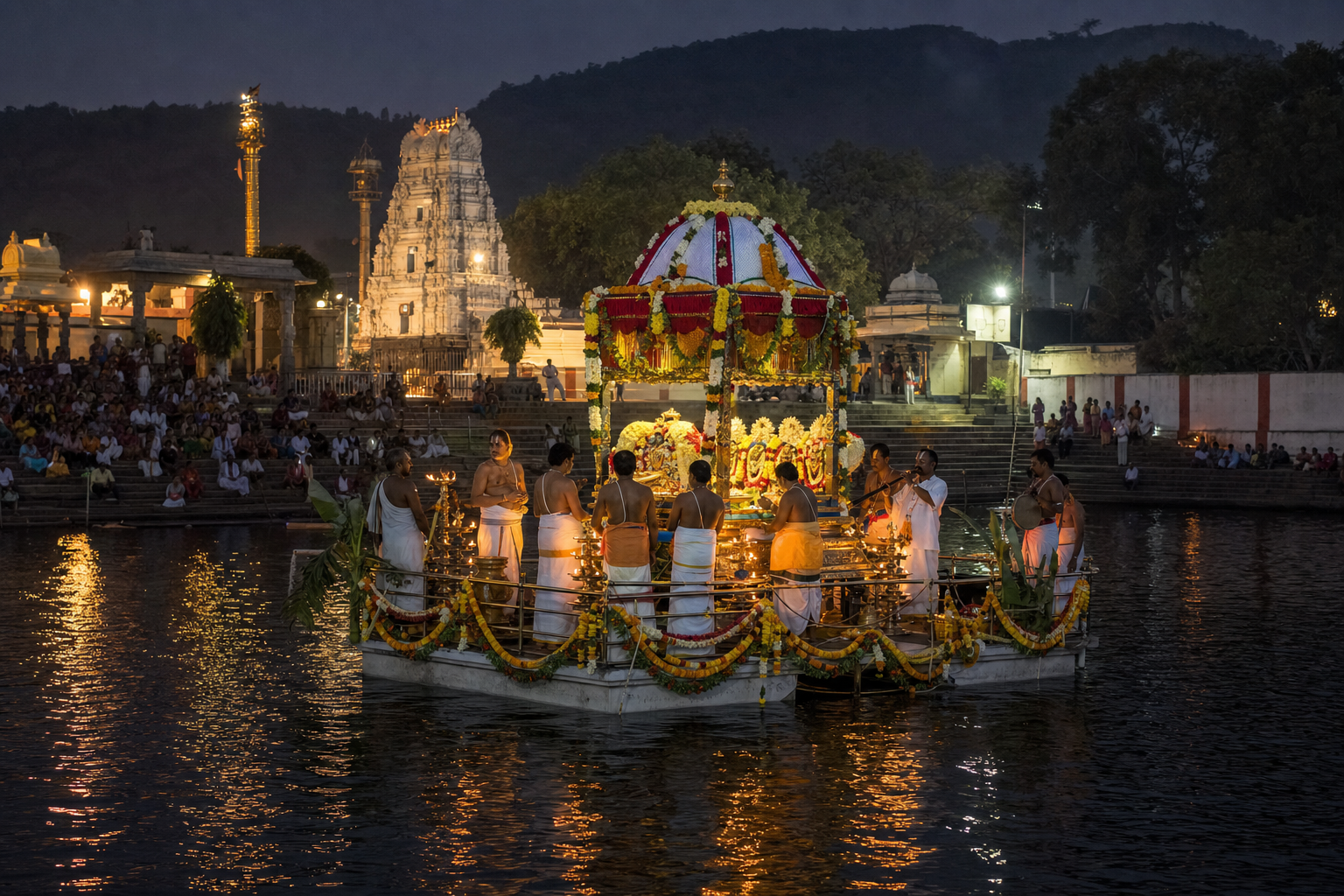
If you found the Kapileswara Swamy Temple float festival while planning a Tirupati pilgrimage, check the year before you arrange your journey. The widely circulated dates of 29 December 2025 to 2 January 2026 belong to a completed five-day observance, not a standing annual timetable.
The festival is still worth understanding before a future visit. Its heart is not merely a decorated boat or an illuminated temple tank. It is darshan in motion: the deities come forth in procession, enter the pushkarini, and move through sacred rounds while worship, music, water, light, and a gathered community become part of one ritual field.
Key takeaways for a future visit
- The 2025-26 Teppotsavam took place from 29 December 2025 through 2 January 2026. Treat those dates as a record of that edition, not as confirmation of the next one.
- On the opening day, Sri Vinayaka Swamy and Sri Chandrasekhara Swamy were taken in procession to the pushkarini and completed nine sacred rounds on the water.
- A future edition may have its own daily sequence. Confirm both the festival dates and the observances planned for the particular day you want to attend.
- Arriving early can make ordinary darshan easier during a period of heavy footfall, but it does not replace checking the announced festival timing.
- Your participation matters: follow temple directions, keep movement routes clear, reduce waste, and let worship take priority over photography.
Read the 2025-26 schedule correctly
The dated programme gives you a clear picture of the festival’s scale. It ran for five days at Sri Kapileswara Swamy Temple in Tirupati, Andhra Pradesh, with the observances centred on the temple pushkarini.
The most specific sequence belongs to 29 December 2025. Sri Vinayaka Swamy and Sri Chandrasekhara Swamy were ceremonially brought to the tank, after which the deities made nine circumambulatory rounds upon the water. The celebrations then continued through 2 January 2026, although a separate deity-by-deity programme for the remaining days is not available in the supplied schedule.
That distinction matters when you plan. Do not assume that every day reproduces the opening procession, features the same deities, or follows the same number of rounds. Once a new edition is announced, choose your day only after reading its daily programme. If your main purpose is a particular darshan rather than the general atmosphere of Teppotsavam, the day-specific sequence is the decisive information.
Separate two questions as well: when should you arrive for ordinary temple access, and when does the float observance begin? Early arrival is sensible when footfall is expected to be high, and the morning can offer a quieter setting for darshan. It should not be treated as evidence that the water procession itself occurs in the morning.
What to notice when the deities enter the pushkarini
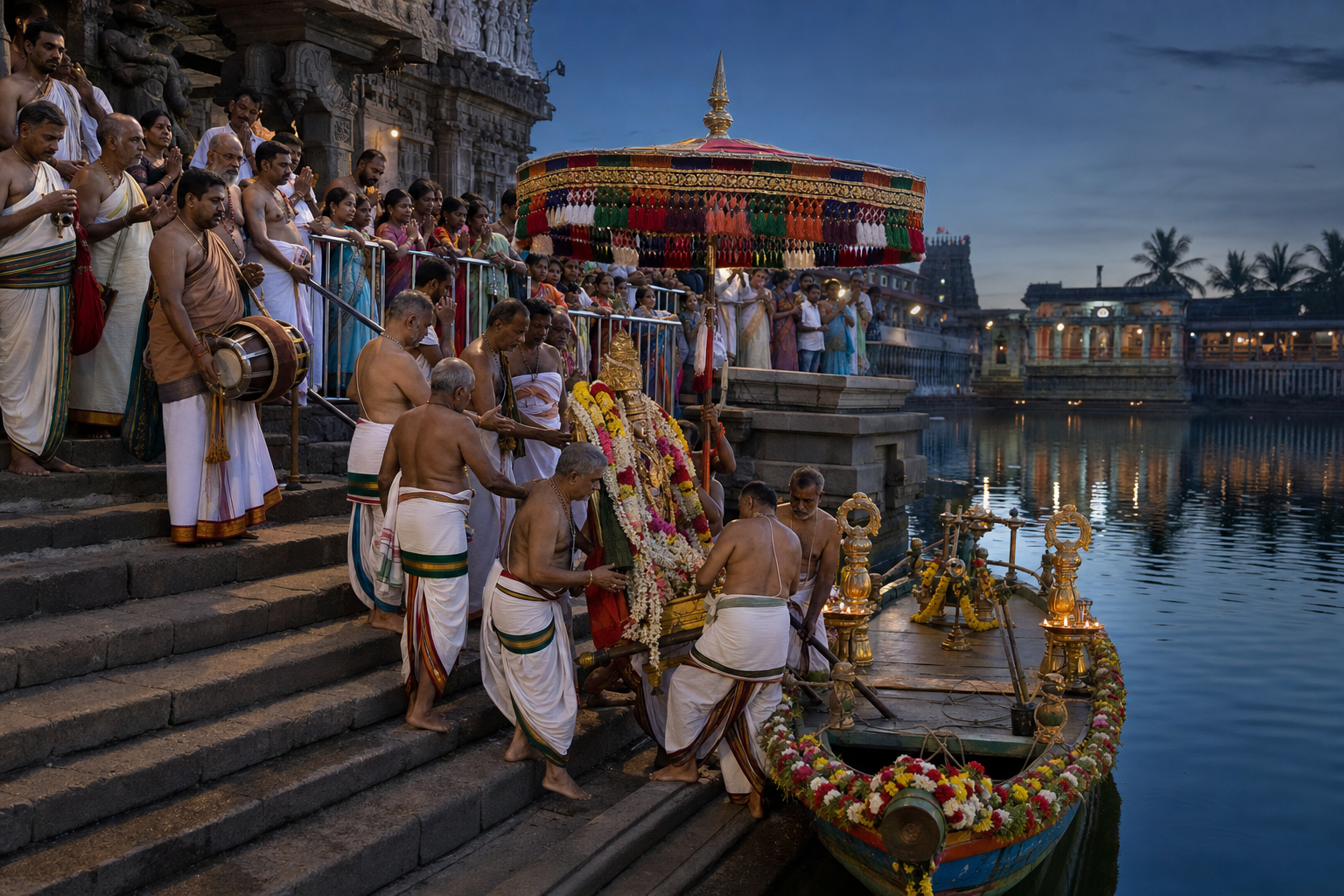
A pushkarini can look like an architectural setting when it is empty. During Teppotsavam, it becomes the ritual space itself. The procession carries sacred presence from the temple toward the water, and the boat extends the movement of circumambulation beyond the path a devotee would ordinarily walk.
The nine opening-day rounds are therefore more than repetition for visual effect. Repeated sacred movement gives worshippers time to settle their attention. Instead of trying to record every circuit, watch at least one complete round without looking through a screen. Notice the approach of the deities, the turn of the boat, the response of the gathered devotees, and the way the same scene changes as it returns.
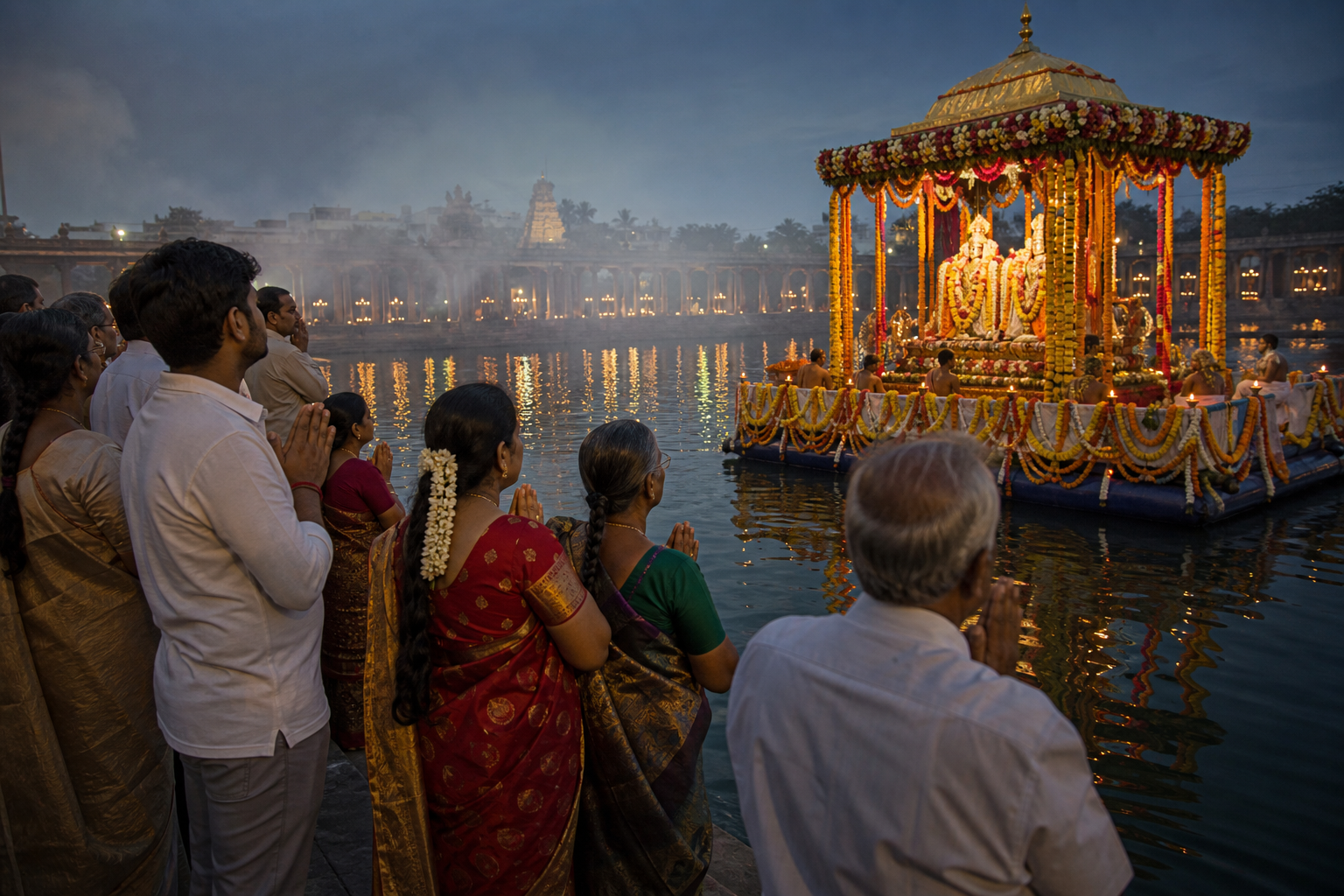
Light and sound deepen that attention. Lamps reflected on the water and temple music carried across the complex are not incidental decorations around the ritual. They make the sacred movement perceptible across the gathered community, including people who cannot stand closest to the tank.
This also explains why the festival can hold collective celebration and quiet contemplation at the same time. You need not choose between joining the devotional response and maintaining inward attention. Bhakti can be public without becoming merely performative, while contemplation can remain inward without withdrawing from the community.
Plan your participation around darshan, not spectacle
A useful visit begins before you reach the pushkarini. Work through these decisions in order:
- Verify the edition. A notice bearing 2025-26 dates cannot confirm a later festival. Look for a newly announced start date, end date, and daily programme.
- Choose your devotional priority. Decide whether you chiefly want regular temple darshan, the procession to the tank, a particular deity’s observance, or the float ceremony itself. That choice determines which timing matters most.
- Allow for peak footfall. Arrive early enough that entry, movement through the complex, and family coordination do not compete with the moment you came to witness.
- Agree on a family meeting point before joining the gathering. Do not rely on being able to move freely or remain side by side once attention turns toward the water.
- Follow the directions given at the temple. Barriers, designated paths, and instructions around the tank protect the ritual route as well as the devotees using it.
- Ask before photographing or recording. Do not assume that a clear view means recording is permitted, and do not raise a device in a way that blocks another devotee’s darshan.
- Carry out what you bring in. Avoid disposable offerings or packaging that can become litter near the sacred tank, and use only the arrangements the temple provides.
Decorum is not a demand to remain emotionally distant. It means placing the deity, the ritual, and the shared right to darshan ahead of personal convenience. A quieter person should not lose the view because another visitor wants a long video, and a family should not have to push through a blocked route created by spectators.
The dharmic work continues after the boat stops
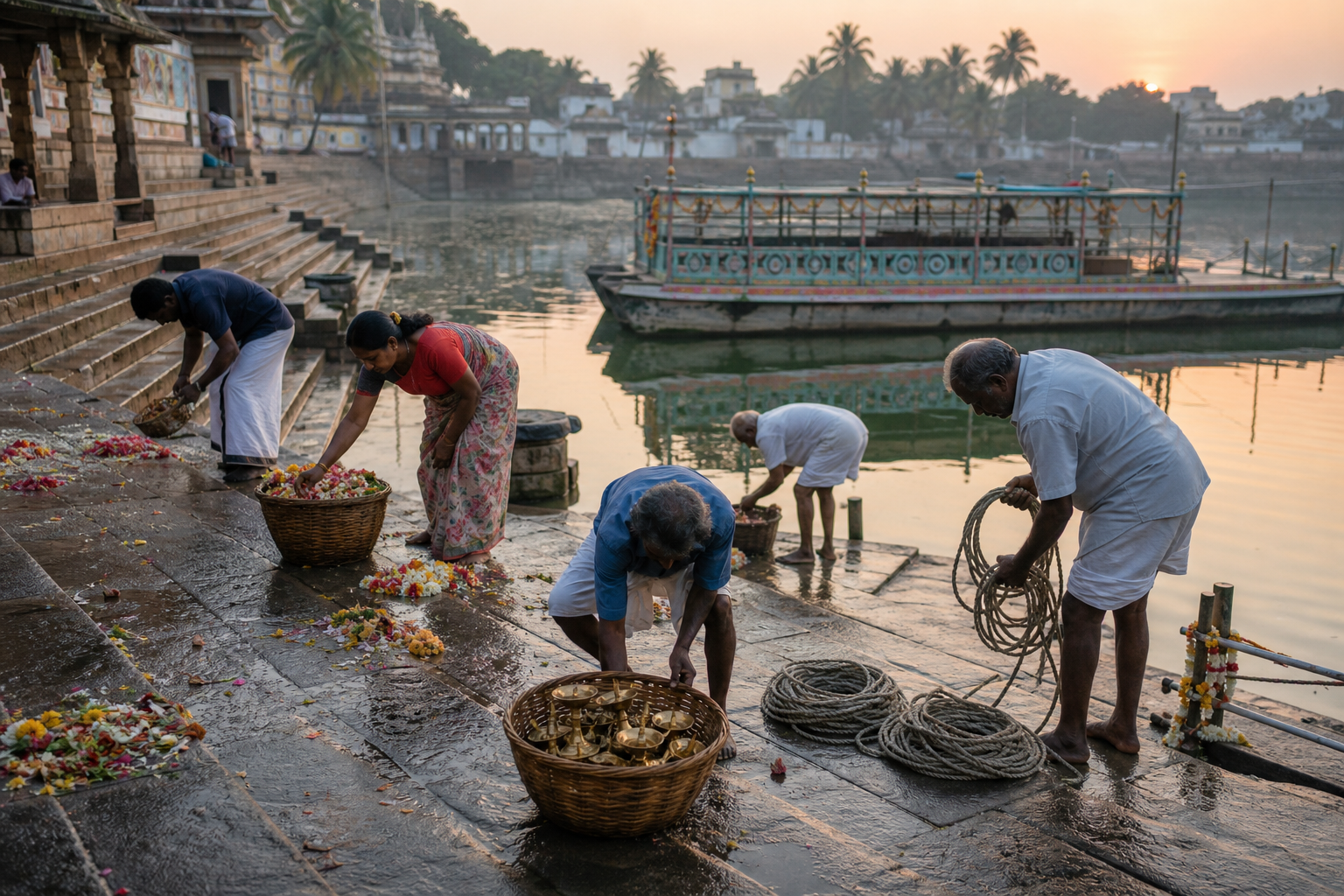
Teppotsavam survives as living heritage because people do more than admire it. Priests maintain the ritual sequence, temple workers prepare the sacred space, devotees gather with discipline, and families transmit the meaning of what children are seeing. Preservation happens through conduct, not only through photographs and records.
The values visible here also belong to a wider dharmic vocabulary. Seva, dana, and reverence for sacred spaces are recognisable across Hindu, Buddhist, Jain, and Sikh communities, even though their theologies and ritual forms remain distinct. We do not need to flatten those differences to recognise the kinship. A specifically Hindu temple festival can express a shared civilisational ethic while remaining fully rooted in its own deity, temple, and custom.
When the next Kapileswara Swamy Temple Teppotsavam is announced, begin with the new daily schedule rather than an old date card. Then attend in a way that leaves the pushkarini cleaner, the pathways clearer, and another devotee’s darshan as unobstructed as your own. That is a practical form of seva, and it is how a festival remains sacred while passing from one generation to the next.
References
