

You may be preparing for Karva Chauth in your spouse’s ancestral village, only to hear that the fast must not be kept there. Do not assume that the family is careless about tradition. In some communities, abstaining from Karva Chauth is itself the inherited tradition.
The practical answer is simple: ask about the household’s maryada before making ritual plans. The deeper answer matters too. A village taboo can preserve a local Hindu memory even when the same observance is considered auspicious almost everywhere around it.
Non-observance can be a religious custom, not an omission
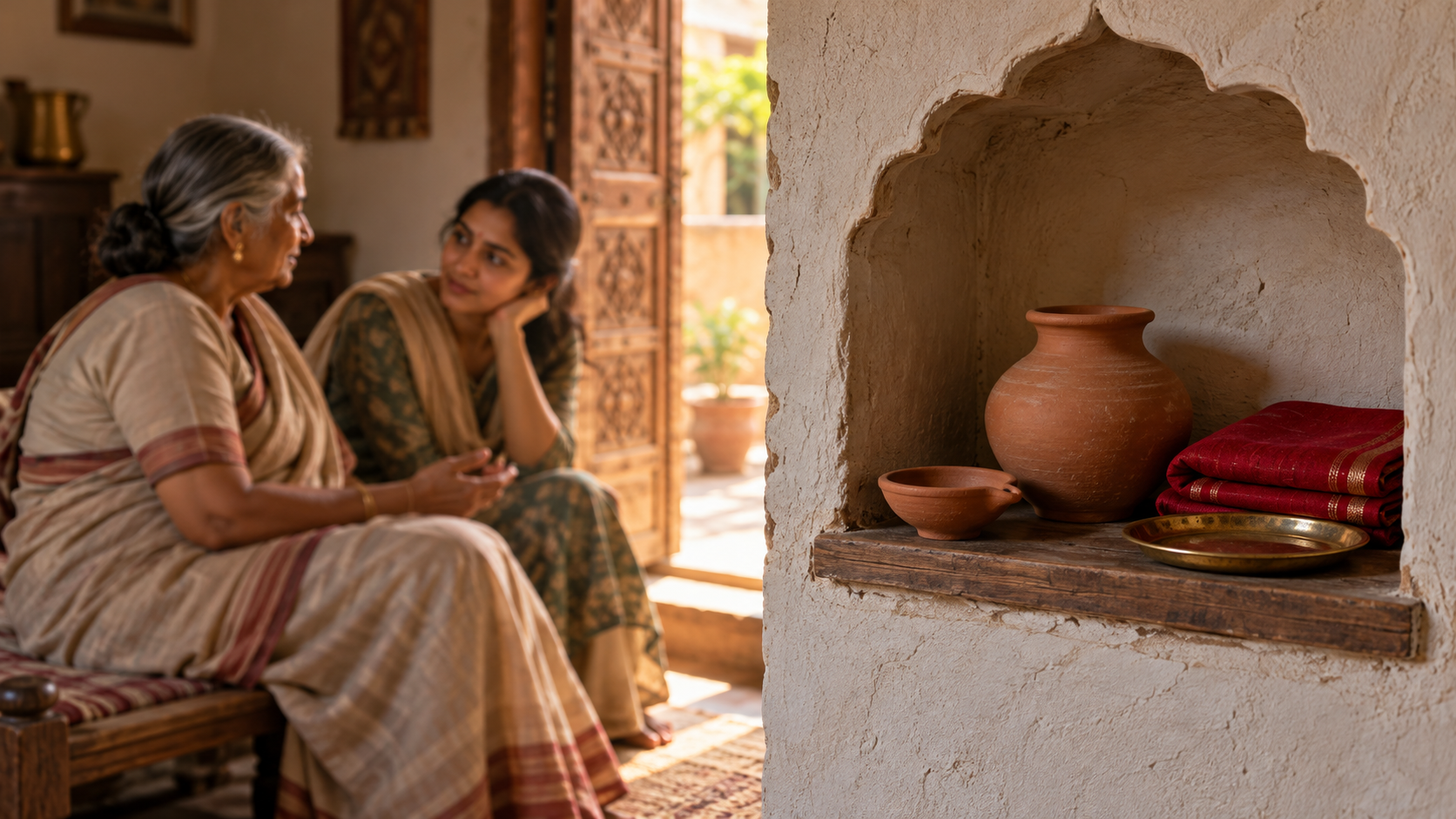
Karva Chauth is generally approached as an auspicious vrata. Yet some villages in Uttar Pradesh and Rajasthan deliberately do not observe it. The local prohibition rests on an inherited belief that keeping the fast could bring grave misfortune upon the family.
That distinction changes how you should read the situation. If a household forgets an observance, its absence may indicate indifference. If a household has been taught that the observance itself is inauspicious, abstention becomes a protective act. The outward result is the same, but the religious intention is almost the reverse.
It is therefore misleading to say that such a village has no Karva Chauth tradition. Its tradition concerns Karva Chauth precisely because the day carries a remembered restriction. The taboo defines what the community must not do.
What you cannot safely infer is the exact scope of that restriction. One family may describe it as a prohibition on the fast; another may understand the local rule more broadly. Do not decide from a generic account whether decorations, gatherings, private prayer or observance outside the village are acceptable. Those are questions for the family that actually carries the custom.
Local prohibition does not cancel the wider Hindu festival
People often force this situation into a false choice. Either Karva Chauth is auspicious and the village taboo must be dismissed, or the taboo is valid and the wider festival must somehow be dangerous. Hindu tradition does not require that flattening.
Hindu practice is transmitted at several levels. Some observances are shared across broad regions. Others are shaped by a particular village, lineage or household. The same ritual act can therefore carry different inherited meanings in different places. Recognising that difference does not make every claim universally binding; it simply allows a local parampara to remain local.
You also do not need to establish a curse as an observable cause before you can understand the force of the taboo. Inherited narratives often tell a community where a boundary lies and why crossing it is feared. The historical details of a narrative and the role it now plays are separate questions. Confusing them leads either to ridicule or to an exaggerated claim that every Hindu must accept the village rule.
A sound Dharmic approach avoids both errors. Do not mock a community’s inherited memory merely because it is not universal. Do not turn a local restriction into a command for families that have always observed Karva Chauth auspiciously. Respect here means preserving scale: a village custom should be understood in the village context that gives it meaning.
Ask these questions before making ritual plans

If the taboo may affect you, speak to your spouse or host before the day arrives. Do not begin preparations and then ask the family to approve a decision you have effectively made already. Use this sequence:
- Establish the household custom. Ask, “Does this family observe Karva Chauth, or is non-observance part of our family tradition?” This is more precise than asking whether people in the area celebrate it.
- Establish the reach of the village rule. Ask whether the restriction is understood to apply only inside the ancestral village, to families originating there wherever they live, or only to particular households. Do not supply the answer in your question.
- Establish what non-observance includes. Ask whether the maryada concerns the fast alone or the whole set of activities associated with the day. This prevents a well-meant partial observance from crossing a boundary the host family considers important.
- Ask who carries the family account. If explanations differ, identify the elder or relative recognised within the family as knowledgeable about the custom. Seniority alone does not guarantee that a person knows the relevant history.
- Decide privately before acting publicly. If your natal and marital families follow different traditions, discuss the difference with your spouse first. A public argument on the festival day turns a question of practice into a test of loyalty.
The aim is not to obtain permission from whichever person gives the answer you prefer. It is to learn what the family believes it has inherited, where that custom applies and what conduct will avoid an unnecessary breach.
If you are merely visiting, follow the host household’s public practice unless you have agreed on another arrangement in advance. If you belong to the family and expect the decision to recur every year, record the explanation accurately and discuss it when there is no festival-day pressure. That is a better setting for resolving disagreement than the hours immediately before a fast.
Handle the curse narrative without exaggerating it
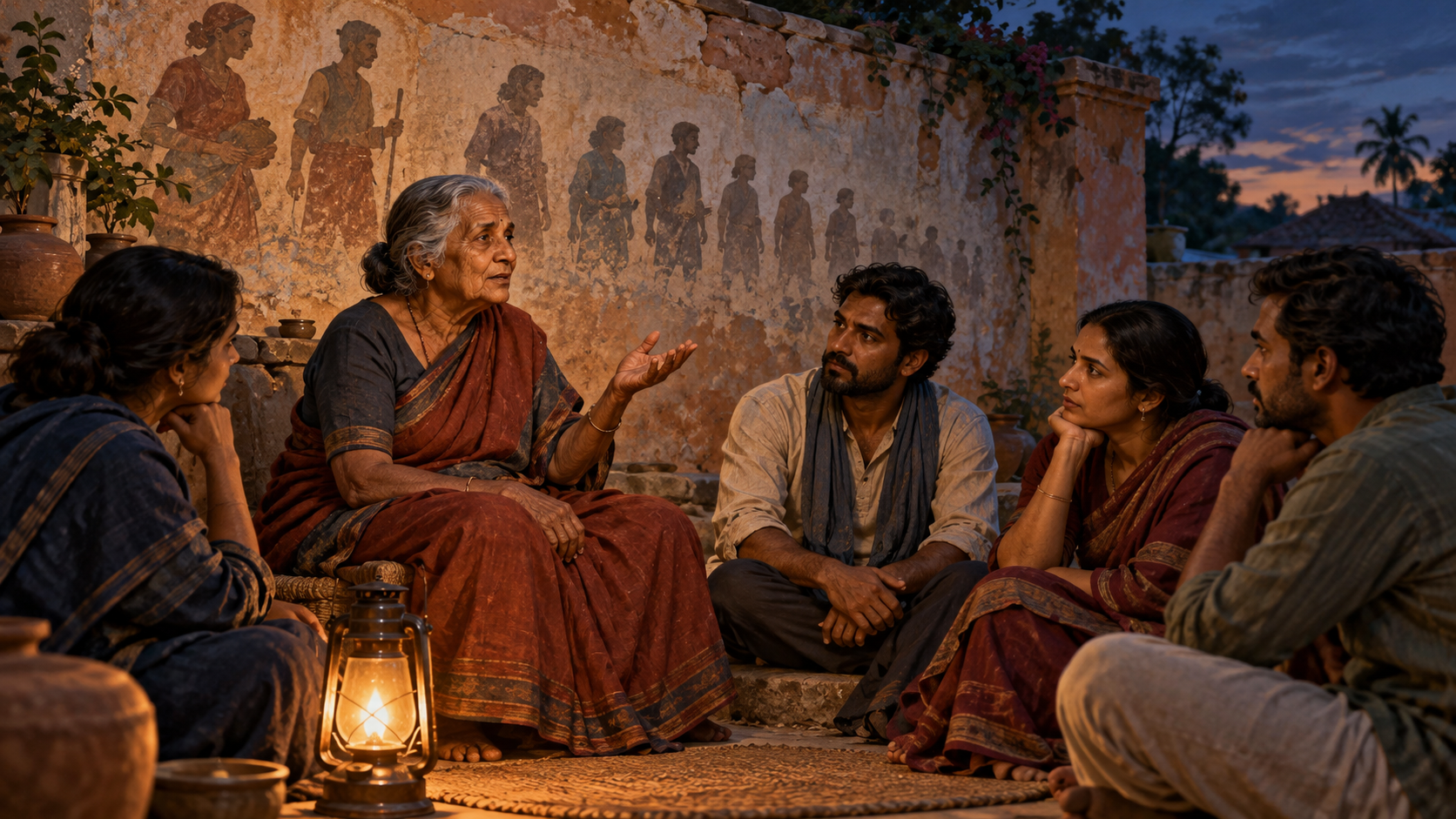
A taboo attached to a curse naturally attracts dramatic retellings. That makes accuracy especially important. If you do not know the village’s account, say only what you know: the community associates observance with misfortune and therefore abstains. Do not fill missing details with a story from another village, a social-media caption or your own guess.
When asking an elder, neutral language works best. You might say, “I understand that our village does not observe Karva Chauth. What account was handed down in our family, and what exactly are we expected to avoid?” This wording acknowledges the custom without claiming that you already know its origin.
Avoid opening with, “Is the curse really true?” That question immediately demands a verdict on belief when what you first need is an accurate description of the tradition. Learn the account, its boundaries and its place in family life before debating its truth or authority.
Use the same care when explaining the custom to children. Tell them that Karva Chauth is auspicious for many Hindu families, while their village or lineage may preserve a different rule because of an inherited account of danger. This teaches two truths at once: their family custom deserves respect, and other Hindu families are not wrong for observing the vrata.
Public sharing requires one further restraint. A family’s taboo should not be displayed as an exotic curiosity without consent. If you write or speak about it, distinguish clearly among what the community says, what your own family follows and what you personally believe. That prevents a local memory from being recast as a universal claim about Karva Chauth.
Key takeaways
- Some villages in Uttar Pradesh and Rajasthan avoid Karva Chauth because observing it is believed to endanger the family.
- In those communities, abstention can be an inherited religious boundary rather than neglect of Hindu practice.
- Do not assume that a village taboo applies identically to every household, every associated activity or family members living elsewhere; ask locally.
- Respecting the taboo does not require declaring Karva Chauth inauspicious for Hindu families that traditionally observe it.
- When the origin story is uncertain, repeat only the details your family or village actually preserves.
Before the next Karva Chauth, make one call to the relative who knows your family’s parampara. Ask what the rule covers, whom it binds and how it should be explained. A clear answer obtained early will protect both family harmony and the integrity of the tradition.
References

Leave a Reply
You must be logged in to post a comment.