
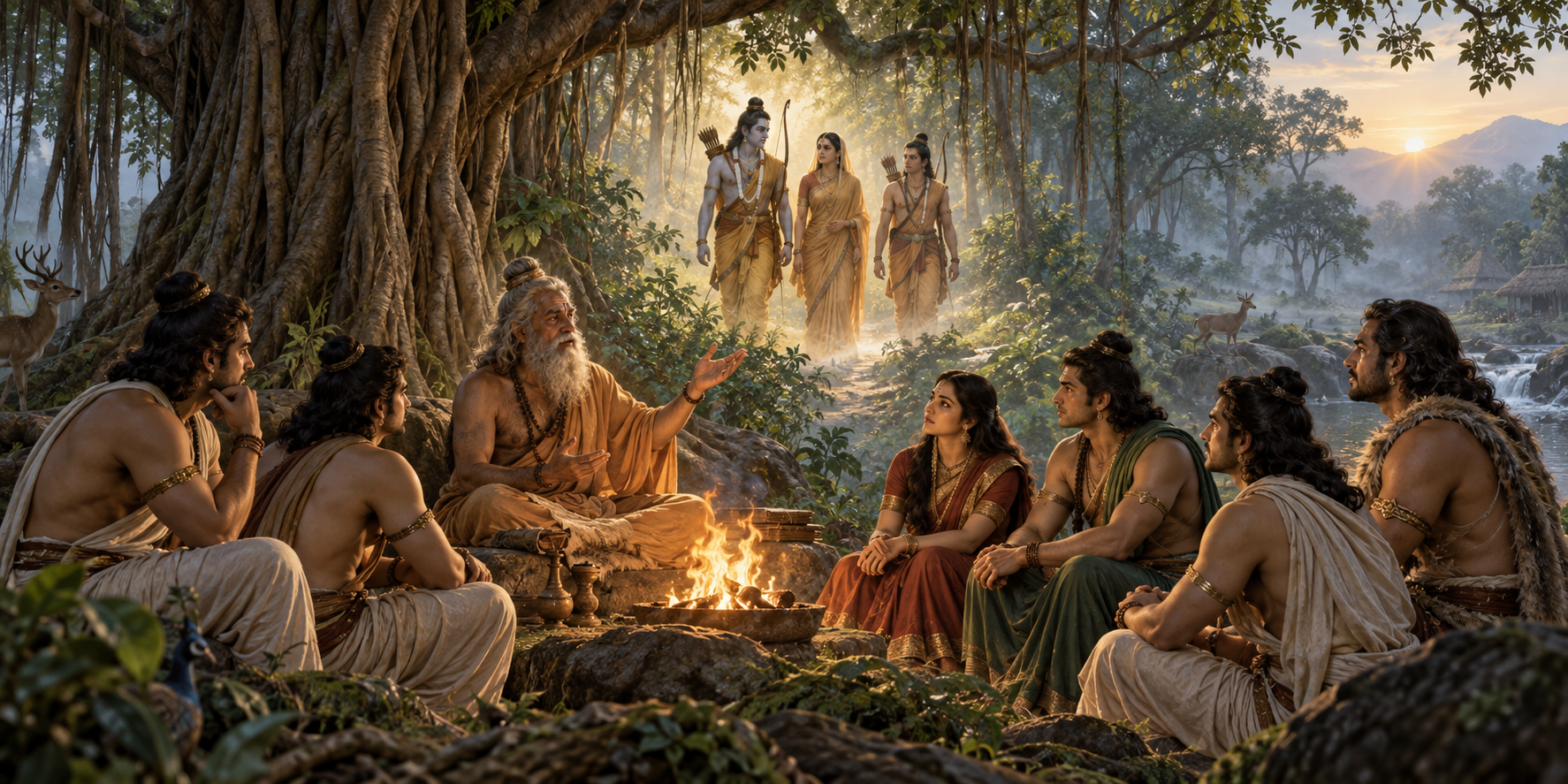
You may open the Mahabharata expecting the conflict between the Pandavas and Kauravas, then find Rama’s story entering the narrative. If you treat that moment as a digression, you miss what the epic is asking you to do.
The Ramayana material works as a dharmic mirror. It places one remembered crisis beside another so that you can compare conduct, consequence, endurance and responsibility. The practical question is therefore not simply, “Why is Rama here?” It is, “What becomes clearer when Rama is remembered here?”
The Mahabharata is larger than one family conflict
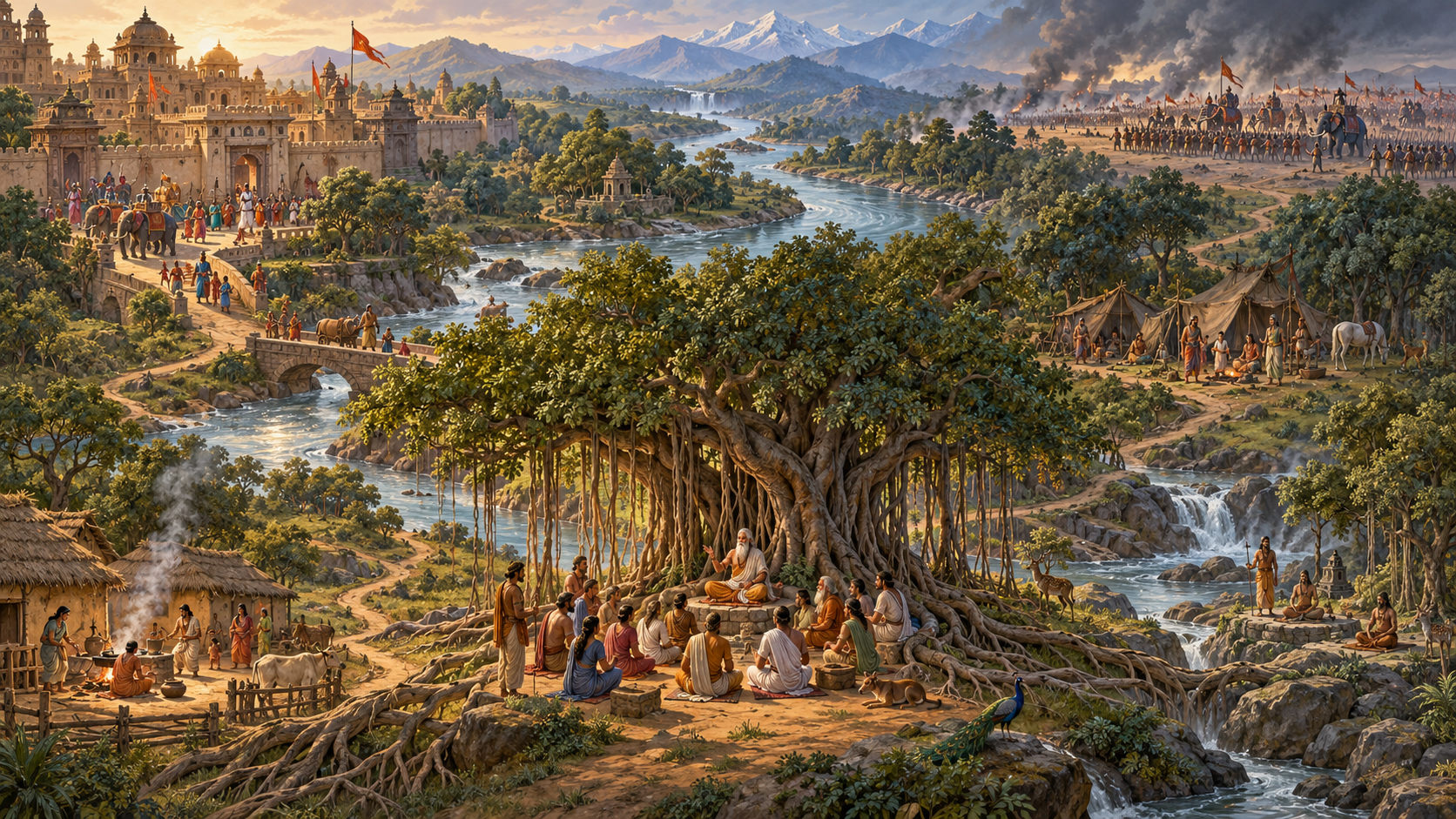
Calling the Mahabharata the story of the Pandavas and Kauravas is accurate as an introduction, but incomplete as a reading method. The work composed by Sage Vyasa encompasses dharmic instruction, historical accounts and sacred narratives as well as the central dynastic struggle.
That breadth changes how you should approach an apparent interruption. A modern reader may expect every passage to advance the immediate plot. The Mahabharata also advances understanding. Its narrative can widen the frame, recall an exemplary life, test an argument or place a present difficulty inside a much longer civilizational memory.
Rama’s presence is therefore not evidence that the Mahabharata has forgotten its own subject. It shows that the epic’s subject is bigger than the fortunes of one generation. The Pandavas and Kauravas act within a world already filled with remembered examples of dharma and adharma. Their choices are not made in an ethical vacuum.
This gives you a simple reading discipline: when the outer action pauses for a sacred narrative, slow down rather than skipping ahead. Mark the unresolved question immediately before the shift. That question is usually more important for interpretation than the mere fact that another story has begun.
Rama’s story becomes a dharmic mirror

An embedded narrative has two audiences. Someone within the Mahabharata encounters the remembered account, while you encounter both that account and the circumstances in which it is being told. The second frame matters. It turns familiar events into instruction addressed to a particular difficulty.
The Ramayana narratives living within the Mahabharata invite comparison without requiring a crude one-to-one match between their characters. A dharmic exemplar is not a stencil. Remembering Rama does not mean that every later person occupies Rama’s role, that every exile is identical or that one response can be copied mechanically into every circumstance.
The comparison is more demanding than that. It asks what remains binding when circumstances become painful. It also asks how a person bears a duty whose cost cannot be wished away. In this kind of reading, the remembered narrative does not remove the outer crisis. It clarifies the standard by which conduct within that crisis can be examined.
- Similarity is not identity. Two situations may illuminate each other without being interchangeable.
- An exemplar is not a formula. Rama’s conduct directs attention toward dharma, but the surrounding duties and relationships still have to be understood.
- Memory is not an escape from action. The purpose of recalling a sacred life is to return to the present choice with better judgment.
This distinction protects you from a common mistake: turning epic characters into simple labels. If you begin by deciding that one person “is Rama” and another “is Ravana,” you will tend to ignore everything that does not fit. Begin instead with the moral pressure shared by the two situations. Then examine how each person responds to it.
An embedded Ramayana is not a substitute for the Ramayana

A narrative placed inside another narrative is necessarily framed by its new setting. The selection, emphasis and immediate audience tell you why that telling belongs at that point. Even when you already know the larger Ramayana, you should notice which part of its moral world the Mahabharata brings forward.
That means reading in both directions. Knowledge of the Ramayana helps you recognise the weight carried by Rama’s example. Attention to the Mahabharata’s surrounding scene helps you understand why that example has been invoked. Ignore the Ramayana, and the reference loses depth. Ignore the Mahabharata’s frame, and the embedded account becomes detached from the question it is meant to illuminate.
You also should not use a condensed telling within one epic as a replacement for reading the other epic in its own fullness. Compression serves the immediate frame. What is absent may simply be unnecessary to the present instruction. Omission in a retelling is not, by itself, rejection or contradiction.
This approach also keeps you clear of an unhelpful competition between the epics. The useful question is not which work owns the moral lesson. The Ramayana and Mahabharata participate in a shared dharmic memory while placing human beings under different forms of pressure. Their relationship becomes visible through resonance, not by flattening one into an appendix of the other.
A six-step method for reading the nested narratives

You do not need a specialised theory before reading these passages closely. Use the following method each time the Mahabharata turns toward Rama or another inherited sacred narrative.
- Locate the interruption. Write down the unresolved problem in the outer narrative before the remembered account begins. Is the pressure centred on duty, loss, power, loyalty, endurance or judgment?
- Identify the two audiences. Note who is speaking, who is listening and what the listener needs at that moment. Then add yourself as the second audience: what assumption is the passage asking you to reconsider?
- Summarise before interpreting. State the selected portion of Rama’s story in one plain sentence. Do not add the moral yet. This prevents a familiar devotional association from replacing attention to what is actually present.
- Name the point of contact. Identify the precise tension shared by the inner and outer narratives. Compare the structure of the difficulty rather than forcing characters into identical roles.
- Notice the difference. Ask what changes between the two situations. Differences in responsibility, knowledge, relationships or power may be as instructive as the resemblance.
- Return to the outer frame. Observe the next judgment, speech or action. Even when no immediate resolution follows, ask what standard the remembered narrative has supplied for assessing what comes next.
A two-pass reading works especially well. On the first pass, follow the narrative movement without stopping for every possible association. On the second, place two short notes in the margin: “Why this story?” and “Why here?” If your interpretation cannot answer both questions, it probably remains too general.
This method is useful for devotional reading, literary study and group discussion because it separates observation from conclusion. In a discussion, ask everyone to identify the outer problem before debating the lesson. That small change keeps the conversation anchored in the epic rather than in pre-existing opinions about what Rama must symbolise.
Key takeaways
- The Mahabharata is not confined to the Pandava-Kaurava conflict; its sacred narratives are part of its larger work of transmitting dharmic wisdom.
- Rama’s presence creates a comparison between remembered dharma and a difficulty unfolding within the Mahabharata.
- The comparison should illuminate moral pressure, not turn different characters and situations into exact equivalents.
- An embedded telling has to be read with its surrounding frame; the best interpretive questions are “Why this story?” and “Why here?”
- The Ramayana passage within the Mahabharata complements, but does not replace, a full reading of the Ramayana.
At your next encounter with Rama inside the Mahabharata, pause before reading past it. Write down the crisis outside the remembered narrative and the principle revealed inside it. That pair of notes will show you how one epic becomes a lens within another, and how inherited dharma is carried from memory back into decision.
References

Leave a Reply
You must be logged in to post a comment.