
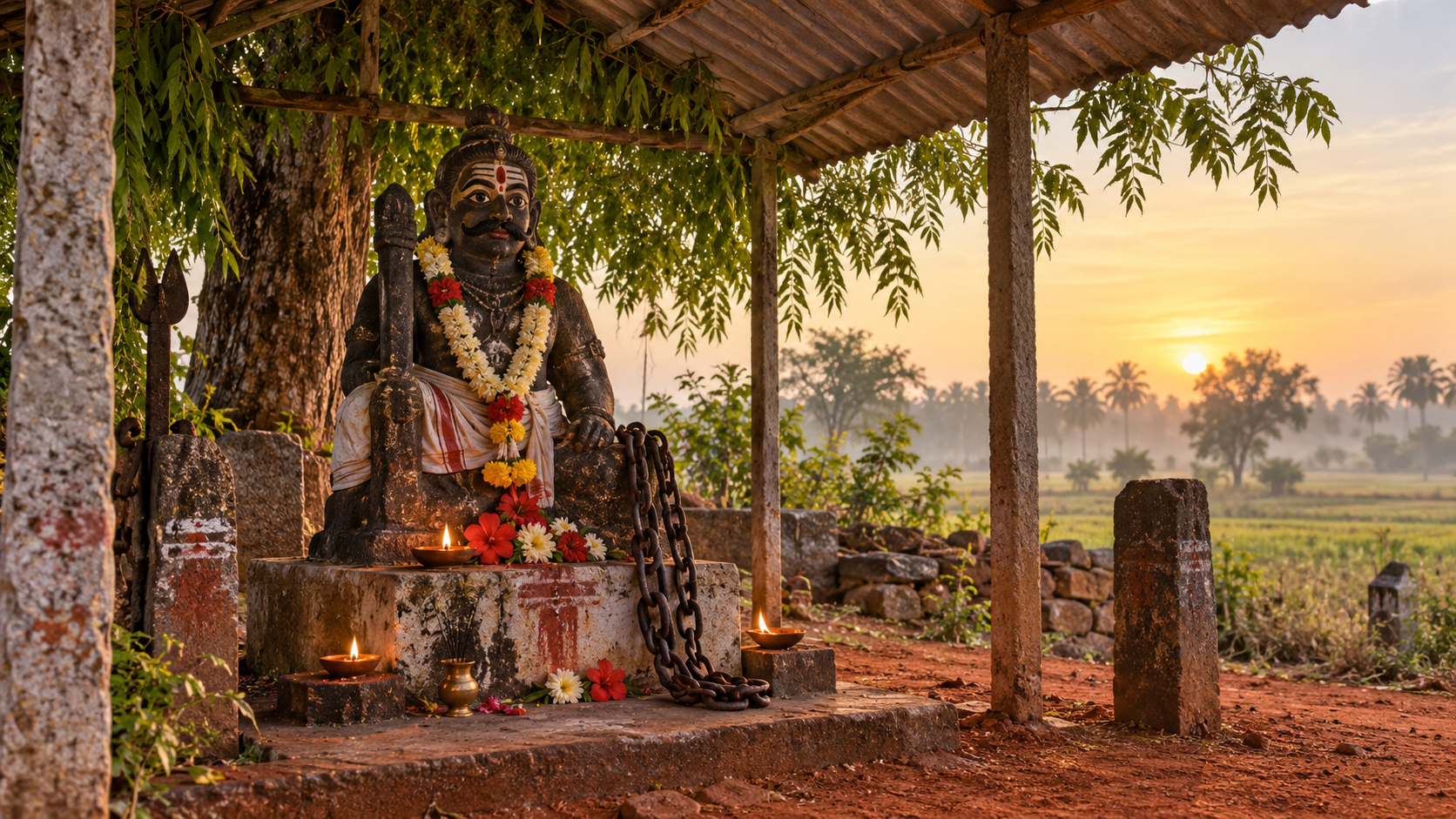
If you encountered Sangili Muni at a shrine, in a family tradition or through a Tamil community abroad, you may be wondering where he belongs in Hindu worship. Is he a form of another deity, a village guardian or a presence with his own identity? The most useful answer is not an either-or answer.
Approach Sangili Muni through three connected realities: his place within the Muneeswaran tradition, his protective function and the customs of the community that worships him. That approach will help you understand the deity without either dismissing Tamil folk devotion as superstition or forcing every local form into a single standardized scheme.
Begin with the relationship, not a pantheon chart
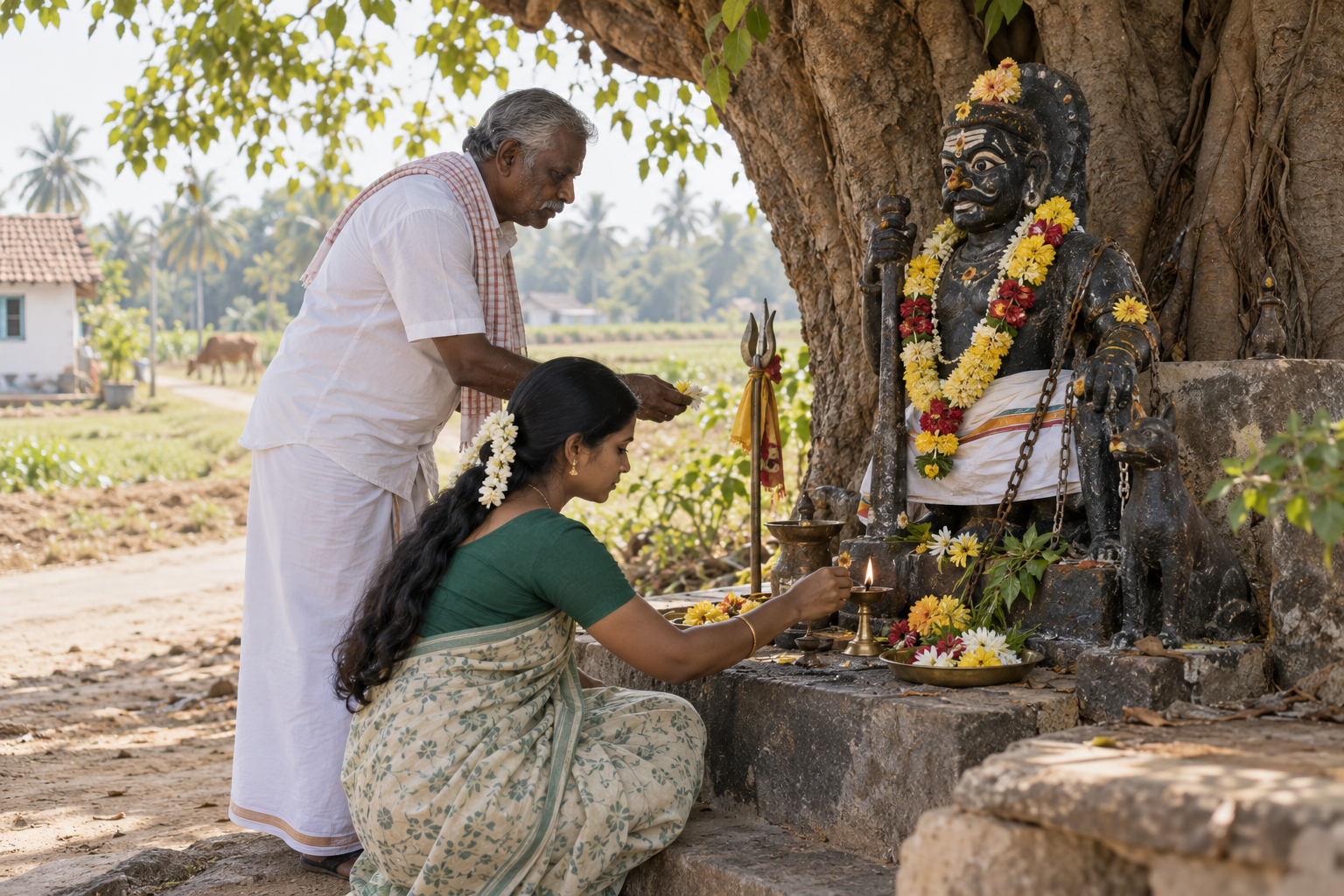
Sangili Muni is also known as Sangili Muniyappan and Sangili Muniswaran and is understood as one of the manifestations of Muneeswaran or Muniyandi. These related names provide a religious family resemblance. They do not make every shrine, image or local account interchangeable.
This distinction matters because a village guardian is known through a relationship, not merely through a list of attributes. The community recognizes who guards, what is guarded and how that guardianship should be honored. Place, inherited memory and customary practice can therefore be as important as a theological label.
Sangili Muni is described as a grama devata, or village deity, within Tamil Nadu’s extensive and long-established tradition of folk worship. The word “village” should not be mistaken for “minor,” “obsolete” or “outside Hinduism.” It identifies the scale of the deity’s relationship: protection is experienced in connection with a particular place and the people who belong to it.
When you encounter a local guardian, the first question should not be, “Which better-known deity is this really?” Ask instead: “What relationship does this community recognize here?” The first question tends to erase difference. The second makes room for both connection and local identity.
Read the chain as a discipline of protective power
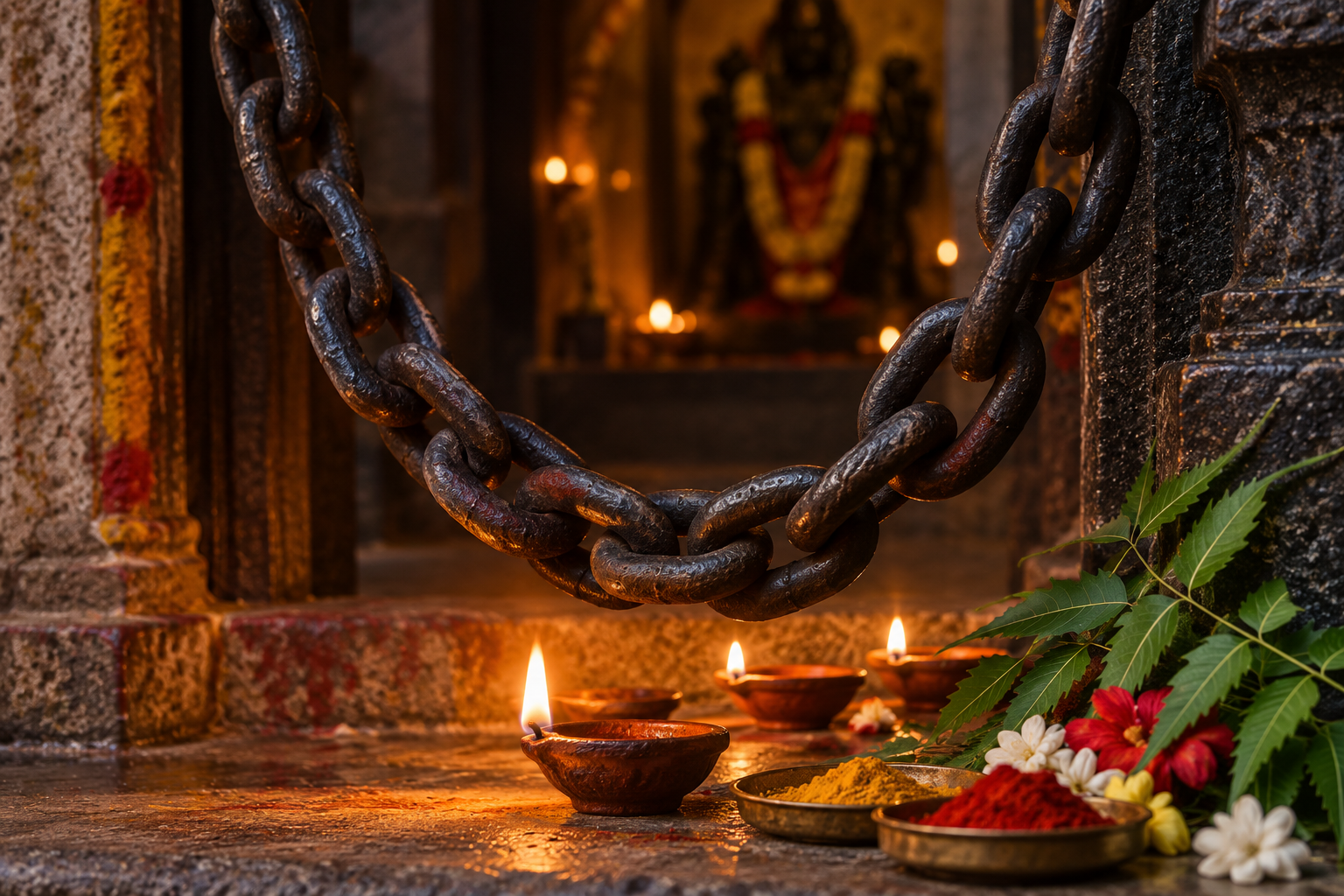
The name Sangili points to the chain. Because the chain distinguishes this manifestation, it should not be treated as an incidental ornament. It directs attention toward a particular way of imagining guardianship: power that confronts danger while remaining tied to a protective responsibility.
A chain can be read through three connected ideas. It can signify restraint, because formidable power is held rather than allowed to become aimless. It can mark a boundary, because a guardian distinguishes what must be protected from what threatens it. It can also suggest obligation, because the guardian’s strength is bound to a duty.
These are interpretive possibilities, not a universal code that overrides every shrine. If local worshippers preserve a particular account of the chain, that explanation deserves priority. Symbolism is most reliable when it helps you notice the deity’s protective character without pretending that one outsider’s theory settles every local meaning.
This also guards against a common misreading. Fierce imagery does not automatically represent uncontrolled anger or evil. In guardian worship, a formidable appearance can communicate vigilance, authority and the capacity to confront what ordinary gentleness cannot. The right question is what the power serves. In Sangili Muni’s case, the central frame is the philosophy and practice of protection.
Allow local forms to differ without declaring one false
Tamil folk worship is a living religious world, not a museum catalogue with one authorized specimen of each deity. A name may connect several communities while each community preserves its own emphasis. Images, narratives, forms of address and customary observances may therefore differ without every difference becoming a contradiction.
You can investigate a Sangili Muni shrine carefully by separating five questions that are often collapsed into one:
- What exact name is used at this shrine: Sangili Muni, Sangili Muniyappan, Sangili Muniswaran or another local form?
- How do worshippers describe the deity’s connection with Muneeswaran or Muniyandi?
- What place, community or boundary is associated with his guardianship?
- What meaning do local worshippers attach to the chain and to any other visible features?
- Which observances are customary here, and which practices would be considered inappropriate?
Keeping those questions separate prevents two opposite errors. The first is fragmentation: treating every variant name as an entirely unrelated deity. The second is flattening: assuming that all manifestations must share an identical history and ritual routine. Sangili Muni can belong to the wider Muneeswaran devotional world and still possess a distinctive local identity.
The same care is needed outside Bharat. Sangili Muni is venerated in Tamil Nadu and among Tamil communities across the world. Diaspora worship is neither automatically identical to practice in Tamil Nadu nor automatically less authentic. Look for the community’s actual continuity: the name it uses, the relationships it preserves and the discipline with which it maintains worship.
How to approach a Sangili Muni shrine respectfully
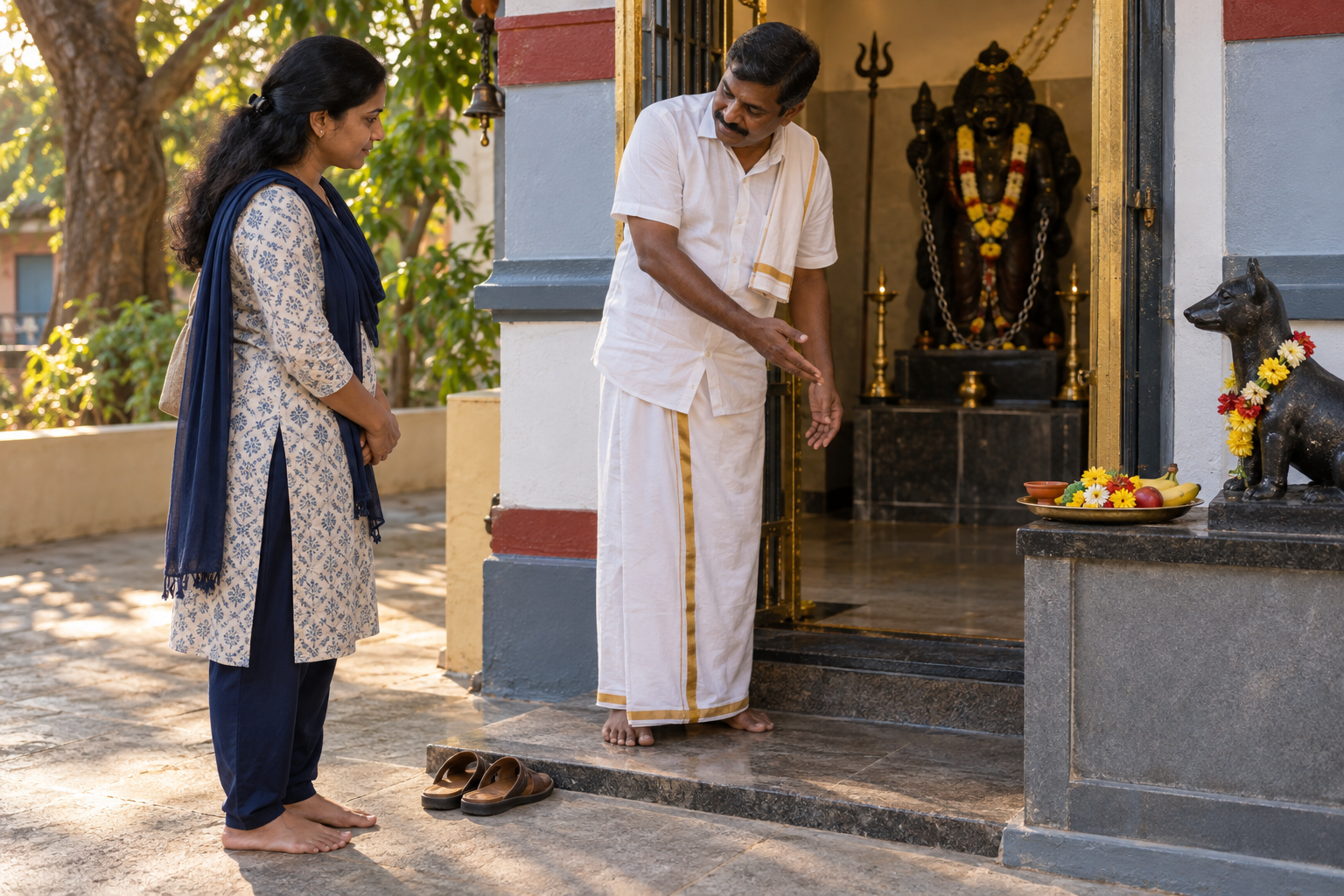
Respectful conduct begins with recognizing that a living shrine is not a generic cultural display. You do not need to arrive with a complete theory, but you should be willing to let the shrine’s custodians and worshippers explain its religious grammar.
- Identify the local form. Read the shrine name carefully and use the form of address used there. Do not replace it immediately with the name you know from another temple.
- Observe before acting. Notice where devotees stand, how they enter and which areas or sacred objects they do not approach. Observation will often answer basic questions without interrupting worship.
- Ask before presenting an offering. Do not assume that a practice associated with one Muneeswaran shrine applies unchanged to Sangili Muni everywhere. Ask a custodian or knowledgeable local devotee what is accepted at that particular place.
- Follow the shrine’s boundaries. Rules concerning footwear, photography, access and ritual participation should be treated as part of the sacred relationship, not as inconveniences. If permission is unclear, refrain.
- Do not improvise a vow. A vow creates an obligation in the devotee’s own understanding. Do not make one merely because an online list presents it as customary. Learn what the local practice means before undertaking it.
- Let uncertainty remain honest. If nobody is available to guide you, a quiet, respectful prayer is more appropriate than inventing a ritual from fragments gathered elsewhere.
If you are approaching Sangili Muni as a devotee from another Hindu tradition, bring reverence without assuming uniformity. If you are approaching as a student of culture, remember that terms such as “folk” and “village” describe a religious setting; they do not give you permission to reduce worshippers’ devotion to folklore alone.
Key takeaways
- Sangili Muni is a Tamil guardian deity connected with the wider Muneeswaran or Muniyandi tradition.
- His chain is best approached as a sign of protective power, boundary and restraint, while allowing local explanations to take precedence.
- The designation grama devata describes a deity’s relationship with place and community; it does not imply spiritual inferiority.
- Related manifestations can share a devotional identity without having one standardized account or ritual manual.
- Before making offerings or vows, learn the rules of the particular shrine rather than copying practices from another place.
- Tamil diaspora worship should be understood through the community’s living practice, not judged by an imagined test of geographic purity.
The next time you stand before Sangili Muni, begin with three acts of attention: use the local name, ask what is being protected and learn the custom before participating. That is more than etiquette. It is how you meet a living guardian tradition on its own terms.
References

Leave a Reply
You must be logged in to post a comment.