
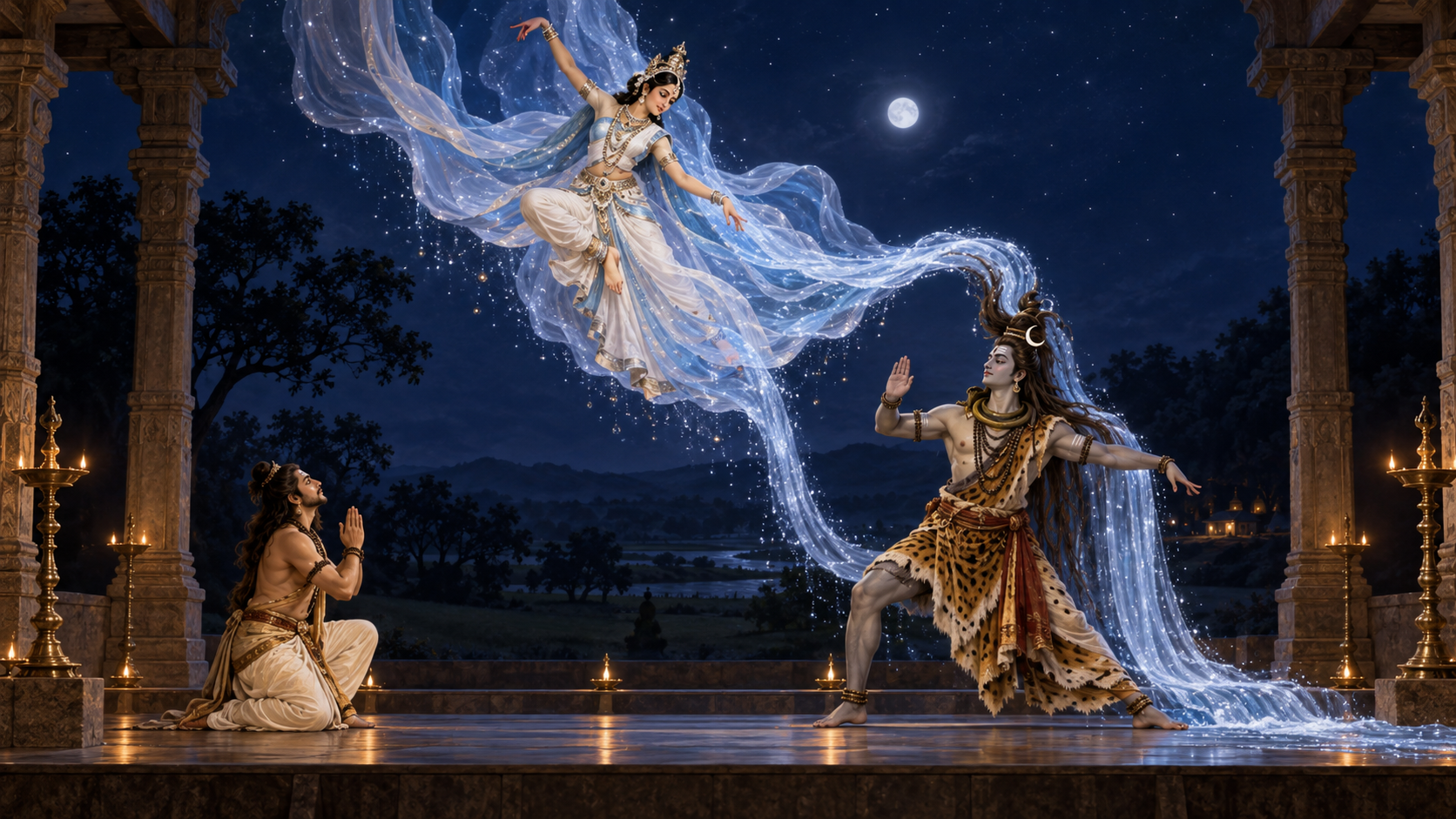
If you came across New Goloka’s Ganga Avataranam and wondered whether you need to know every name, gesture, or scriptural variation before watching, you don’t. Begin with three figures and one sacred movement: Bhagiratha calls, Ganga descends, and Shiva receives her so her waters can reach the world without destroying it.
That simple arc opens the dance as more than a retelling. It becomes a meditation on tapas, grace, restraint, and service. The Ganga Avataranam dance drama was presented for Maha Shivaratri at New Goloka in Hillsborough, North Carolina, on 15 February 2026. Its festival setting gives you the first interpretive clue: watch what Shiva does with immense power.
Avataranam means descent, not merely appearance
The word avataranam points to a descent or bringing down. That distinction matters. Ganga does not simply arrive on a stage; she crosses from a higher realm into the human world. The central question is therefore not only who she is, but how a sacred force of such magnitude can enter earthly life.
In the widely known narrative, Bhagiratha undertakes sustained tapas so Ganga may descend and bring liberation to his ancestors. Her unchecked fall would be too powerful for the earth. Shiva receives her in his matted locks and releases her in a bearable flow. Tellings differ in how they emphasize Ganga’s force, Shiva’s intervention, and Bhagiratha’s purpose, but the underlying relationship remains clear: aspiration calls grace downward, discipline receives it, and service gives the descent its purpose.
Keep that causal chain in mind while you watch: responsibility, tapas, descent, containment, release, benefit. It will help you follow the drama even if you cannot identify a single mudra. It also prevents a common misreading. Shiva does not stop Ganga because sacred energy is unwelcome. He gives that energy a form through which it can sustain life.
Read the drama through four spiritual functions
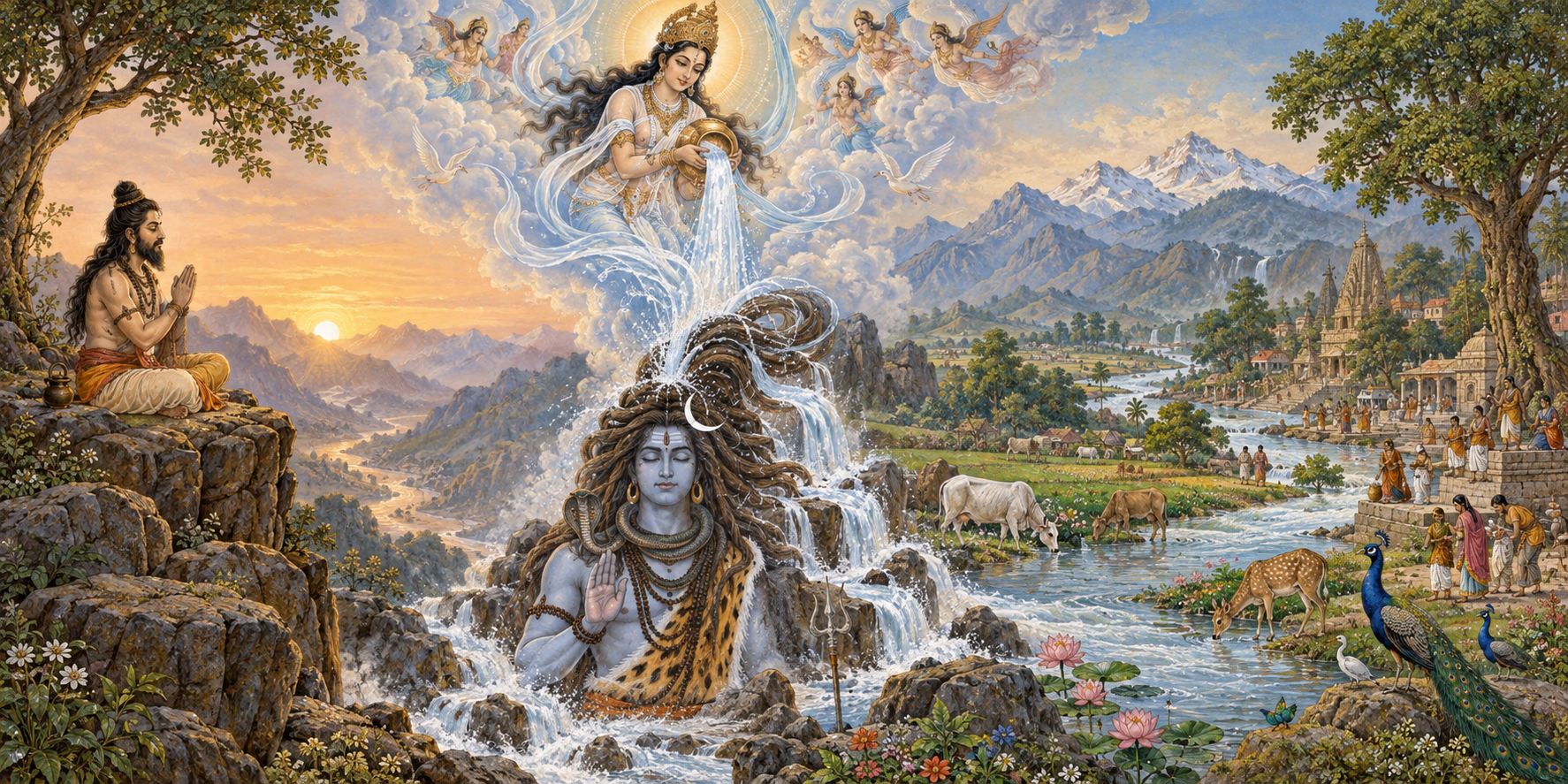
A dance production may condense episodes, combine roles, or choose one narrative emphasis. Instead of treating the choreography as an illustrated checklist, notice the spiritual function each figure performs.
Bhagiratha turns inheritance into responsibility
Bhagiratha inherits an unfinished duty and refuses to leave it unfinished. His tapas is not private self-improvement. It is disciplined effort undertaken for those who cannot complete the work themselves. If the choreography gives him repeated, restrained, or prayerful movement, do not mistake stillness for inactivity. In this story, persistence is action.
Ganga is grace with real magnitude
Ganga is at once a divine presence, a purifying current, and the sacred river known in earthly geography. A performance may express her through flowing movement, confident expansion, or a sudden change in pace. The crucial point is that grace is not presented as weak or decorative. It is powerful enough to transform the condition of the world, and powerful enough to require preparation.
Shiva reveals restraint as strength
Shiva’s role is not best understood as domination. He accepts an impact that the earth cannot bear and channels it without extinguishing its sacred purpose. This is strength expressed as steadiness. Watch for the contrast between movement and stillness, descent and reception, abundance and control. Even when the choreography is unfamiliar, that contrast usually carries the theological meaning.
The beneficiaries reveal the purpose
The story does not end when Ganga meets Shiva. It ends in flow: grace reaches the realm for which Bhagiratha labored. Ancestors, earth, and the wider community give the descent its moral direction. If an ensemble enters, the stage opens outward, or the movement changes from confrontation to procession, notice whether private tapas is becoming shared blessing.
Why Ganga’s descent belongs naturally to Maha Shivaratri
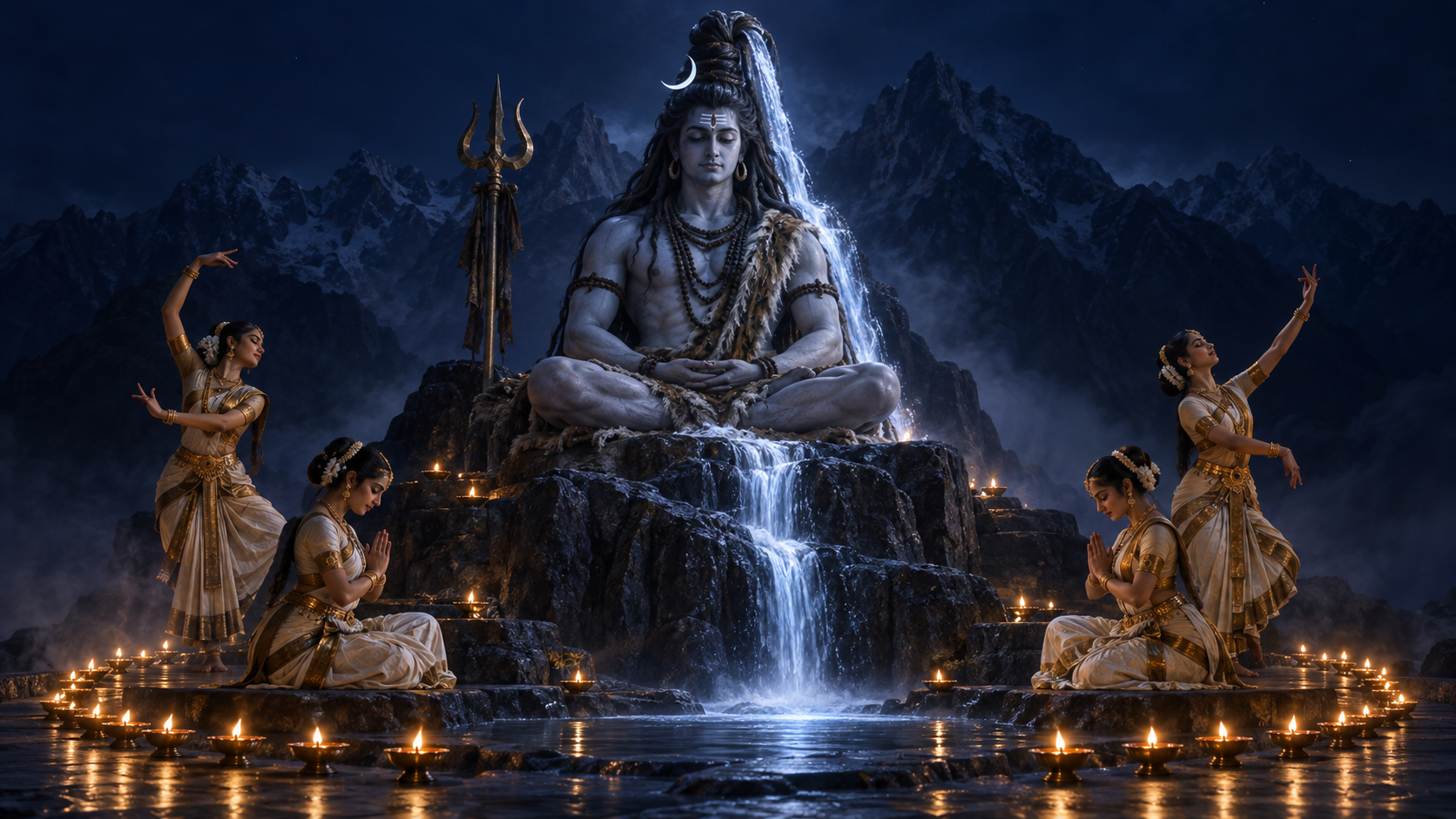
Maha Shivaratri directs attention toward Shiva as yogi, ascetic, and compassionate protector. Common observances include fasting, worship, mantra, and vigil, though customs vary across regions and traditions. Ganga Avataranam adds a dramatic image to that discipline: Shiva’s inward mastery enables him to receive an overwhelming force for the good of others.
This gives you a practical question for the festival night: what in your life needs a channel rather than either indulgence or suppression? Speech can wound when it pours out without discrimination, yet silence can become neglect. Ambition can serve a worthy duty, yet unrestrained ambition consumes everything around it. Knowledge can illuminate, yet badly timed instruction can overwhelm the person receiving it. Shiva’s matted locks offer a demanding model: receive the force, remain steady, and release it in the measure that serves dharma.
Bhagiratha supplies the other half of the lesson. Before asking for transformation, he accepts the discipline required to make transformation fruitful. Maha Shivaratri is therefore not only a night for requesting Shiva’s grace. It is also a time to ask whether you have prepared yourself to carry what you seek.
How to watch when you do not know every mudra
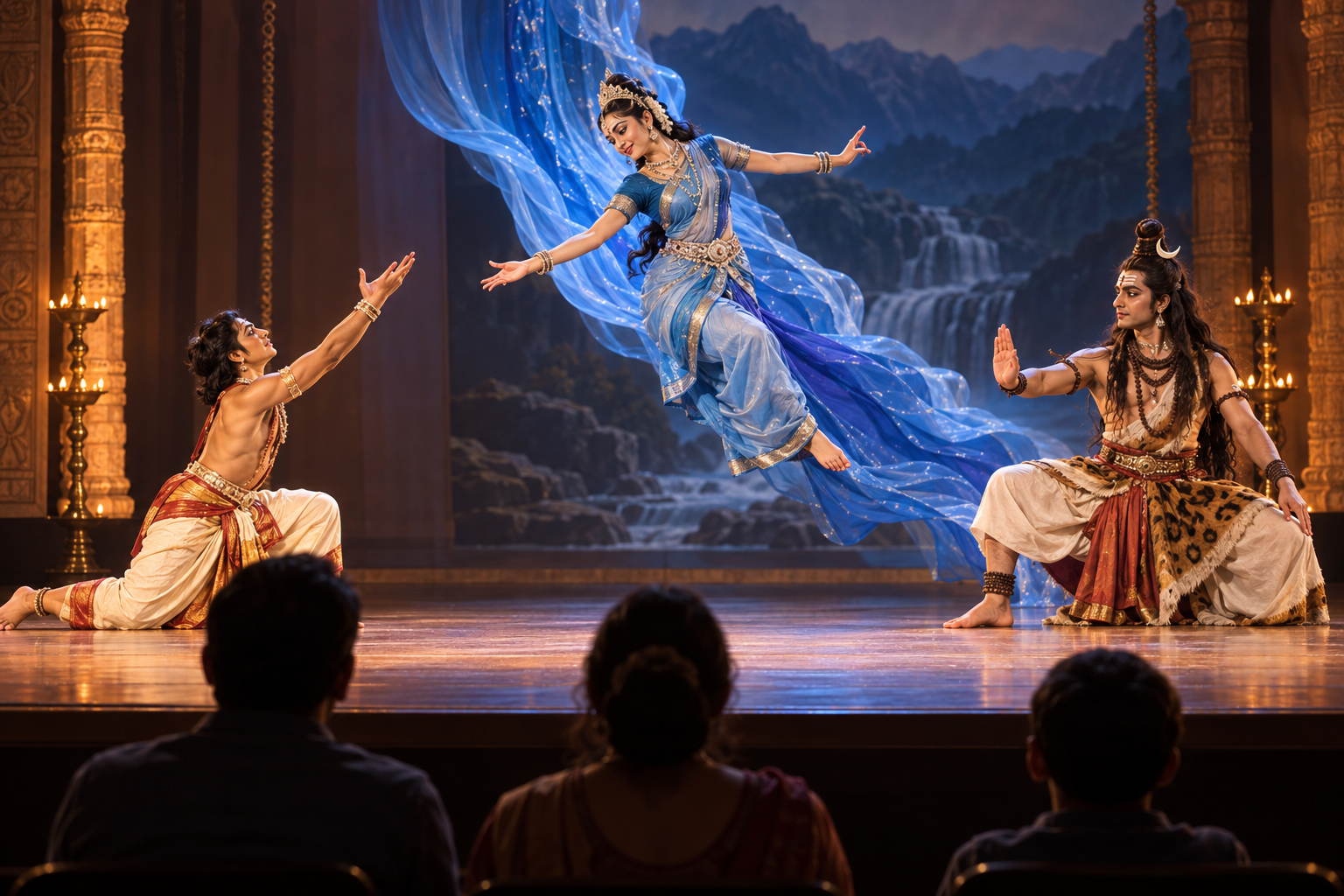
Begin by identifying the likely figures through introductions, program notes, costume cues, and the order of entrances. Do not assign a fixed meaning to every hand gesture in isolation. Indian dance traditions use gesture within a larger grammar of gaze, posture, rhythm, dramatic context, and established convention. Narrative position is often a safer guide than a guessed translation of one pose.
Then track contrasts. Notice whether one figure moves while another remains centered; whether motion descends from a higher level toward the floor; whether a solo expands into an ensemble; and whether turbulent movement resolves into an ordered flow. These are viewing questions, not predictions about a particular choreography. Their value is that they direct your attention to relationship: who seeks, who descends, who receives, and who ultimately benefits.
Afterward, test your understanding with three questions. What did Bhagiratha do before Ganga descended? Why was Shiva needed? Who was helped once the descent became a life-giving flow? These work especially well when discussing the performance with children because they move the conversation beyond costumes and spectacle without demanding a lecture.
Finally, allow more than one level of meaning without collapsing them into each other. Ganga is not merely a metaphor for water management, and Shiva is not merely a symbol of emotional control. The drama is first a sacred narrative involving divine persons and devotional memory. Ethical and ecological applications can grow from that foundation. Reverence for Ganga should deepen responsibility toward rivers and water, not replace the Devi with an abstract environmental slogan.
Key takeaways
- Avataranam describes a descent: the dramatic problem is how immense sacred power can enter earthly life.
- Bhagiratha represents disciplined responsibility undertaken for the welfare of others.
- Ganga’s force is part of her meaning; grace requires a worthy channel rather than passive admiration.
- Shiva protects the earth by receiving, containing, and releasing power without destroying its purpose.
- You can follow the drama without decoding every gesture by tracking intention, descent, restraint, release, and benefit.
When you next encounter Ganga Avataranam, do not stop at asking what each movement depicts. Ask what made the descent possible. Then choose one powerful current in your own life and give it a disciplined channel before expecting it to do good. That is a concrete way to let the teaching of Maha Shivaratri continue after the stage grows quiet.
References

Leave a Reply
You must be logged in to post a comment.