

You want to perform Shraddha for a parent or forebear, but one question keeps interrupting the act: if that person has already taken another birth, who could possibly receive the pinda?
The apparent contradiction comes from treating the offering like a parcel that must be delivered to the ancestor’s last known form. Shraddha works through ritual intention, ancestral relationship, and dharma. It does not require you to discover where the departed being is now or what body that being may have assumed.
The contradiction appears only when pinda is treated as physical delivery
Punarjanma teaches that death does not end the journey of the being. A person may be born again in this world or in another abode of existence according to karma. Shraddha, meanwhile, directs an offering toward someone known through a particular ancestral relationship.
Those teachings would conflict only if Shraddha required the ancestor to remain permanently disembodied and physically consume the offering. It does not. The pinda is physically present in the rite, but its religious significance is not a claim that the same material object must travel through space and enter another mouth.
Keep three things separate:
- The material offering is what you prepare and offer here.
- The ritual addressee is the forebear identified by your intention and ancestral relationship.
- The fruit of the rite belongs to the unseen order described by the tradition you follow.
Confusion begins when these three are collapsed into one physical transaction. Rebirth concerns the continuing journey shaped by karma. Shraddha concerns the living descendant’s relationship and obligation to the departed. They answer different questions.
Who receives the offering if the ancestor has another body?

The most careful answer is this: the Shraddha is offered for the ancestor named or intended in the rite, while Hindu traditions differ in how they describe the unseen reception of its benefit. Some explanations emphasize the continuing jiva wherever it may be. Others speak more broadly of the Pitrs, the ancestral order to which the rite is addressed. These explanations need not be forced into a single mechanical account.
Rebirth itself requires continuity across a change of body, even though Hindu schools do not describe that continuity in precisely the same way. If bodily change made a person wholly unrelated to the one who died, karma could not connect one embodiment with another. The same distinction helps with Shraddha: the last body is gone, but the being designated through the former relationship is not reduced to that body.
Your grandfather remains your grandfather in the history of this life even if his onward journey has continued. Shraddha addresses that real relationship. It does not assert that his current embodiment, if any, still carries the same social identity or must consciously remember you.
This also means you do not need to locate a supposed rebirth. Do not turn an intuition, dream, resemblance, or family story into a claim that a particular living person is the ancestor. The rite gives you a way to honor the relationship without pretending to possess knowledge that you do not have.
Shraddha is an ancestral duty, not a test of afterlife geography
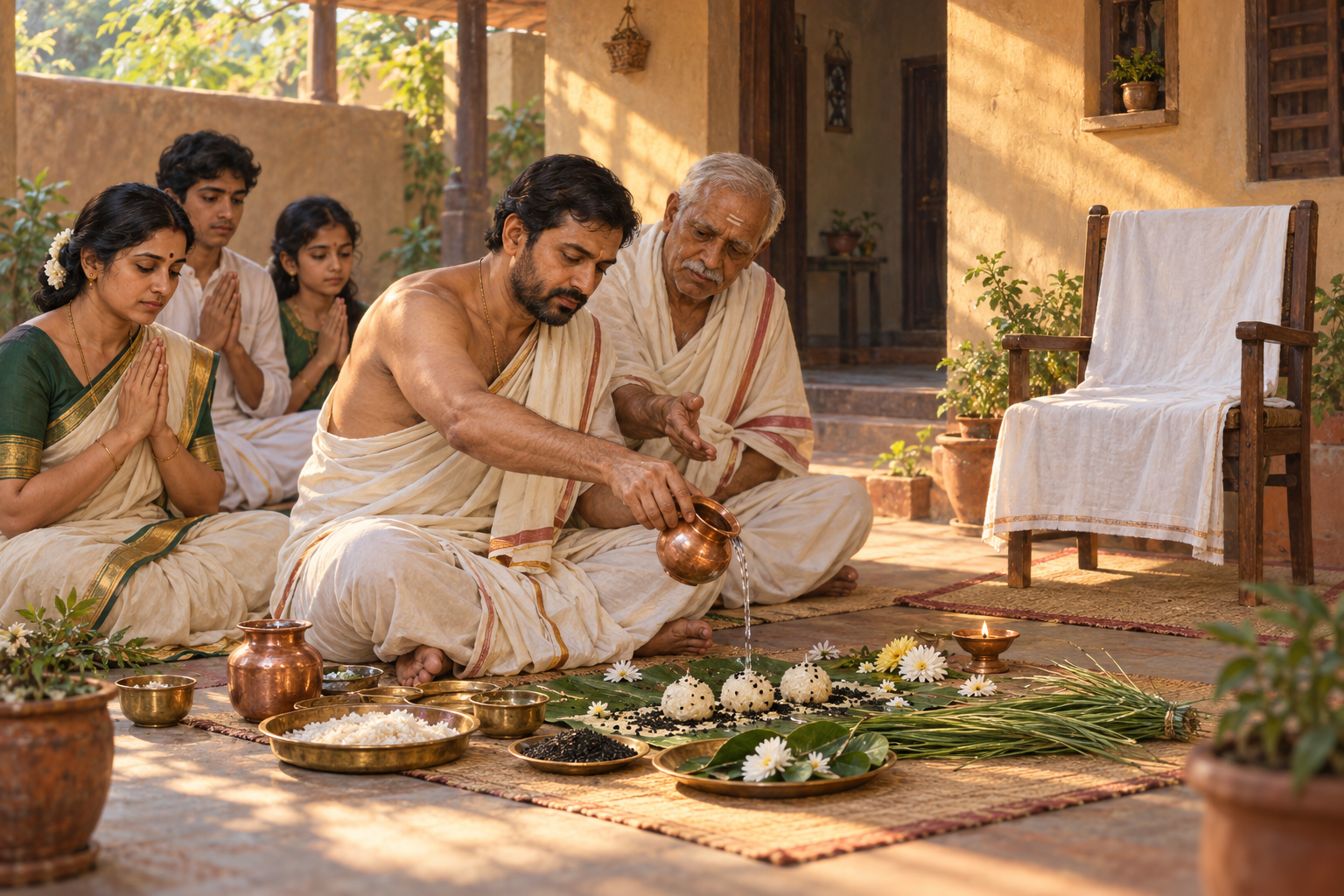
A transactional picture asks, “Where is the food going?” A dharmic picture asks, “What is required of the person who has inherited life, care, memory, and family continuity from those who came before?” The second question is closer to the purpose of Shraddha.
This does not mean that the offering is merely a psychological symbol. A practicing Hindu may understand Shraddha as a real act with an unseen fruit. It means only that the reality of the act should not be confused with ordinary digestion or material transport. Ritual uses visible actions to participate in a reality that is not exhausted by those visible materials.
Nor should Shraddha be reduced to fear. You do not need to imagine an unfed ancestor waiting angrily because you cannot solve every question about rebirth. The stronger basis is gratitude and responsibility: you received a place in a lineage, and the rite allows you to acknowledge that debt in the form preserved by your tradition.
That responsibility survives uncertainty. You rarely know the karmic state of another being, living or dead. If complete metaphysical knowledge were a condition of ritual duty, almost no one could perform any rite with confidence. Shraddha asks for a sincere and properly directed act, not omniscience.
How to perform Shraddha without claiming more than you know
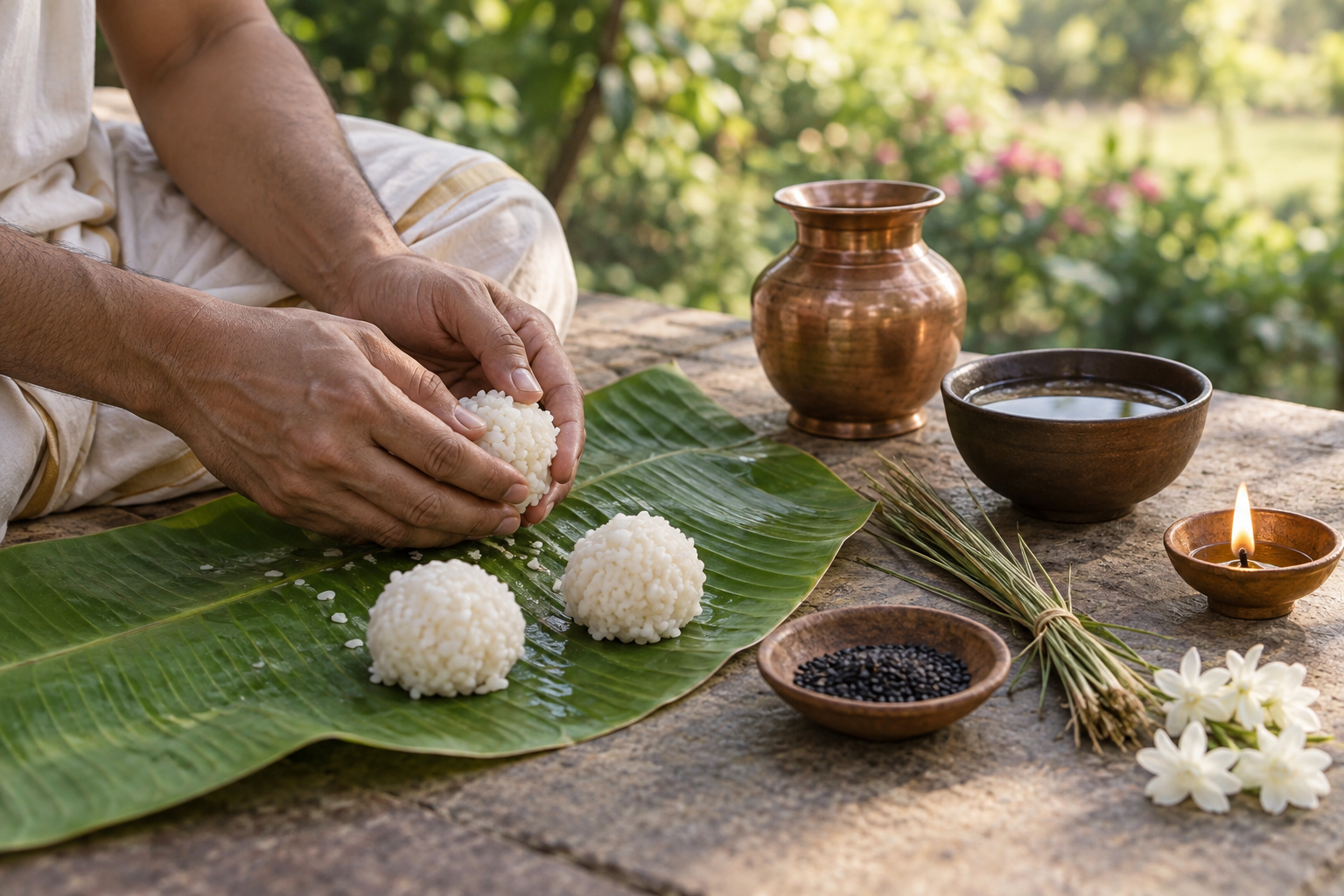
Theological doubt does not have to end the practice. It should make your practice more disciplined. Use the following approach when you are unsure how your family should proceed:
- Identify the tradition before choosing the procedure. Ask which family, regional, or sampradaya practice has normally been followed. Shraddha is not performed identically in every Hindu community.
- Consult someone who knows that practice. A family purohita, a knowledgeable elder, or a priest familiar with your community can tell you which rite applies. Ask for the reasoning as well as the sequence if the question about rebirth still troubles you.
- Use accurate information and admit what is missing. Provide the ancestor’s name, relationship, and other lineage details when known and required. Do not invent a forgotten name or gotra. Tell the ritual guide what you do and do not know.
- Make the sankalpa clear. The sankalpa is the ritual statement of intention. It identifies whom the act concerns and why it is being performed. This is more important than privately imagining the ancestor’s present location or form.
- Follow one coherent method. Do not combine fragments from unrelated online instructions merely because each looks traditional. A complete procedure from your own lineage or a competent guide is more intelligible than a mixture assembled without context.
- Carry the remembrance into family life. Preserve the names and relationships of forebears, explain the observance to younger relatives, and treat living elders with attention. Ritual gratitude becomes hollow when it is separated from conduct.
If relatives disagree, ask which custom each person is following and which theological claim each person is actually making. One person may be defending a family procedure while another is questioning a crude picture of physical delivery. Once those issues are separated, much of the argument disappears.
You can also be honest about the boundary of the explanation. The unseen result of Shraddha is a theological matter, not something verified by tracking what happens to the physical pinda. Faithfulness does not require false certainty, and intellectual honesty does not require abandoning a rite simply because its fruit cannot be physically inspected.
Key takeaways
- Rebirth and Shraddha address different matters: the onward journey of the being and the descendant’s duty toward an ancestral relationship.
- The pinda is a material offering, but the rite does not depend on that material traveling into the ancestor’s present body.
- If the ancestor has been reborn, the former relationship still identifies the person for whom the act is intended.
- Hindu traditions do not all describe the unseen mechanism in identical language; follow the explanation and procedure of your sampradaya or family tradition.
- You do not need to locate the ancestor’s new birth, and you should not claim that a particular living person is the ancestor without reliable grounds.
- When ritual details are uncertain, consult a purohita or knowledgeable elder familiar with your actual lineage instead of improvising a hybrid procedure.
At the next Shraddha, do not wait until you can map the entire afterlife. Bring an honest sankalpa, the family information you genuinely know, and a coherent traditional procedure. Let the offering express the duty that is yours; leave the ancestor’s onward journey to karma and the larger order in which the rite has meaning.
References

Leave a Reply
You must be logged in to post a comment.