

If you are trying to decide whether Aurangzeb has been unfairly maligned or defensibly remembered as a persecutor of Hindus, don’t begin with either label. Begin by asking which part of his record is under discussion: his seizure of the throne, his religious convictions, his governing program, or the consequences of state power.
That separation gives you a firmer answer than either romanticisation or outrage. It lets you acknowledge what is documented, identify what still needs incident-specific evidence, and defend Hindu historical memory without turning the past into inherited hostility.
Begin with the chronology, not the verdict

Aurangzeb was born in 1618 as Muhi al-Din Muhammad in Dahod, Gujarat. He was the third son of Shah Jahan and Mumtaz Mahal. These details identify the ruler, but they do not yet explain why his name carries such weight in Hindu memory.
The more consequential chronology begins with the Mughal war of succession. Aurangzeb imprisoned his father, defeated his elder brother Dara Shikoh, and had Dara executed. He then ruled from 1658 until 1707, a reign of nearly half a century.
This sequence establishes that his ascent was ruthless. It also gives you a useful historical boundary: conduct during a succession struggle is evidence about the character of the contest for power, but it cannot by itself prove every claim about the policies that followed. The execution of a rival answers how Aurangzeb secured the throne. A claim of religious persecution must additionally answer how the state treated particular communities after he secured it.
Keep those questions separate. If you collapse them into one accusation, a sceptical reader can dismiss a valid concern about governance by pointing out that Mughal succession was violent. If you ignore the accession entirely, you miss the political setting in which Aurangzeb’s religious and imperial program emerged.
Separate four different claims about Aurangzeb
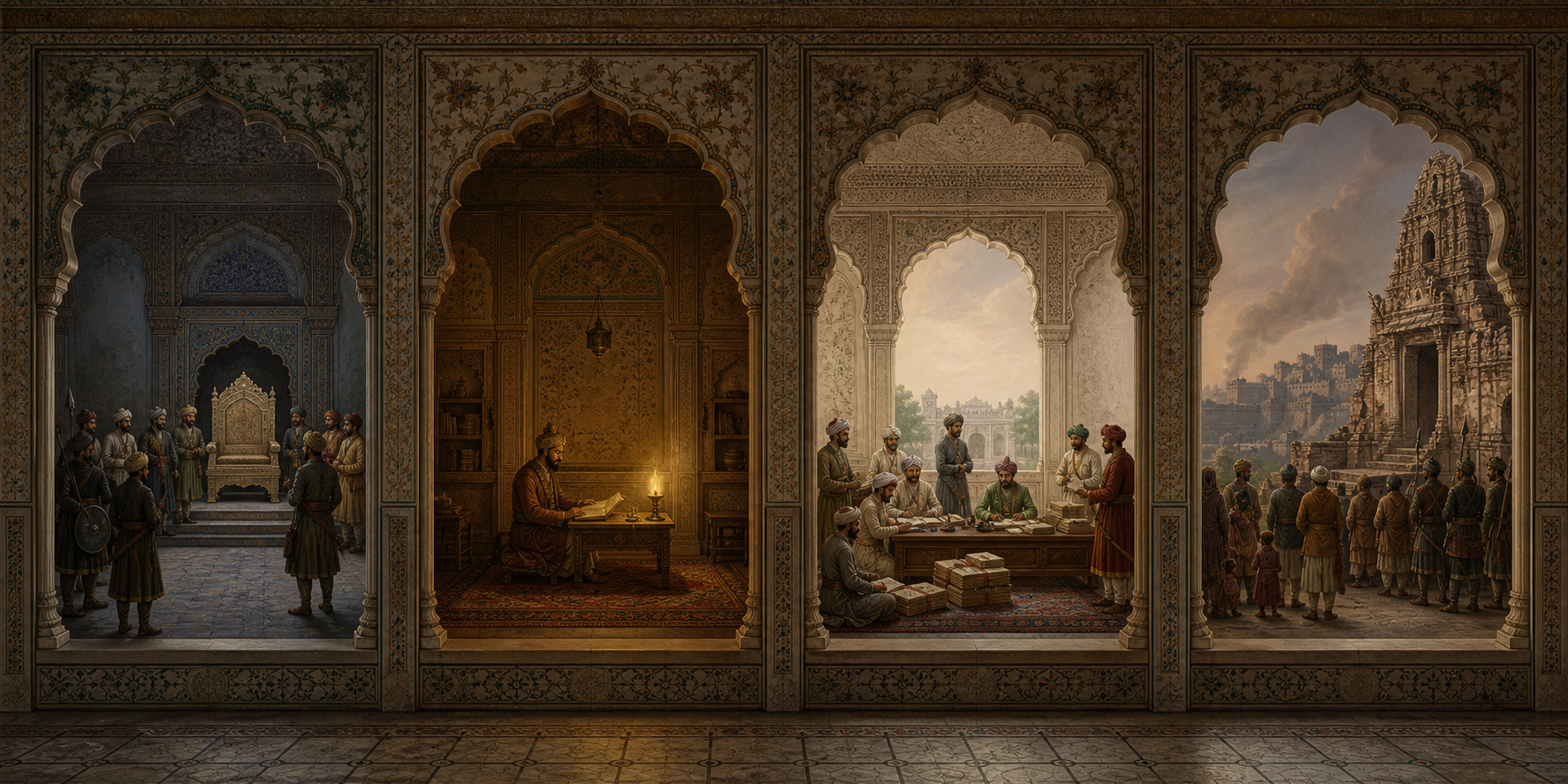
Statements about Aurangzeb often move silently from biography to theology, from theology to policy, and from policy to civilisational consequence. You can prevent that slippage by sorting each statement into one of four layers.
Personal and dynastic conduct
The imprisonment of Shah Jahan and execution of Dara Shikoh belong first to the history of dynastic power. They show what Aurangzeb was prepared to do to obtain and secure sovereignty. That matters when judging him, but it is not yet a complete account of Hindu experience under his rule.
Religious conviction
Aurangzeb is presented as a devout Sunni Muslim whose religiosity developed into rigid orthodoxy. Private devotion and public intolerance are not synonyms, so the relevant question is not whether he was pious. It is whether his convictions shaped decisions backed by imperial force.
A program of government
After taking the throne, Aurangzeb sought to reshape the empire according to his conception of Islamic governance, with restricted space for religious plurality. This is the hinge between belief and history. A ruler’s theology becomes a public matter when it determines what the administration permits, rewards, burdens, suppresses, or destroys.
Consequences for Hindus and the cultural landscape
Hindu Post frames the reign as a period of state-sponsored persecution directed especially against Hindus, accompanied by cultural destruction. This is the strongest layer of the case, and therefore the layer that most needs policy-specific and place-specific corroboration. A moral verdict may be justified, but adjectives alone cannot establish which order was issued, who implemented it, where it operated, or who suffered from it.
Dara Shikoh matters across these layers. He represented a more syncretic and inclusive religious outlook, while Aurangzeb had him executed on a charge of apostasy. The struggle was unquestionably dynastic, but the charge shows that religious judgment was also part of the political conflict. Do not go further than the evidence allows: Dara’s death illuminates the alternatives inside Mughal political culture, but it does not prove a counterfactual story about everything he would have done as emperor.
Preserve Hindu memory without reducing it to a slogan
There are two easy ways to mishandle this history. The first is sanitisation: treating personal piety as an answer to evidence of coercive government. The second is inflation: treating a broad condemnation as proof of every incident later attached to Aurangzeb’s name. Both weaken historical understanding.
You don’t need exaggeration to retain moral clarity. Use a three-part discipline whenever you explain the reign:
- State the event. Aurangzeb imprisoned Shah Jahan, defeated and executed Dara Shikoh, took the throne, and ruled from 1658 to 1707.
- State the interpretation separately. His orthodox religious outlook and proposed Islamic order of government provide a framework for interpreting allegations of anti-Hindu persecution.
- State the evidentiary limit. A claim about a particular temple, decree, conversion, locality, or victim still requires documentation for that particular claim.
This discipline protects Hindu memory from two pressures at once. It refuses to erase persecution merely because the subject is politically uncomfortable. It also refuses to replace historical proof with collective blame.
Be equally precise about who is responsible. Aurangzeb was a ruler exercising imperial power through a state. Criticism of his conception of Islamic governance is not an indictment of every Muslim who lived under him, much less of Muslims living centuries later. Descendants do not inherit guilt. Victims and their descendants do not owe anyone forgetfulness. Those principles can stand together.
A pro-Hindu reading is strongest when it names the ruler, action, institution, affected community, and evidence. It becomes weaker when it substitutes a whole religious population for the responsible historical actors. Precision is not a concession to Aurangzeb’s defenders; it is what makes evasion harder.
Use this six-question test on every historical claim

When you encounter a confident statement about Aurangzeb, pause before accepting or sharing it. Put it through these six questions:
- What exactly is being claimed? Replace words such as tolerant, intolerant, great, or tyrannical with a specific action or policy.
- When did it happen? Confirm that the event falls within the 1658-1707 reign, or explain why an earlier succession event is relevant.
- Who acted? Distinguish an order attributed to Aurangzeb from an action by an official, commander, local authority, or later narrator.
- Who or what was targeted? Identify the community, institution, person, practice, or place affected. Avoid converting a local event into an empire-wide rule without further evidence.
- What kind of evidence supports it? Look for a dated order, administrative record, contemporary chronicle, inscription, correspondence, or clearly identified historical testimony. Each kind of evidence has limits, but a named record can be examined; an unattributed slogan cannot.
- Where does interpretation begin? Mark the difference between what the record states and what a modern writer concludes from it. Interpretation is unavoidable, but it should be visible.
The test works in both directions. If someone says Aurangzeb was intolerant, ask which decision demonstrates it. If someone says his actions were merely succession politics, ask whether religious orthodoxy subsequently informed governance. If someone points to his piety, ask what that fact establishes about the treatment of people outside his religious vision. None of those labels settles the policy question on its own.
Apply an especially high standard to claims involving a named temple, a particular decree, a conversion, or a numerical death toll. A broad account of the reign cannot supply missing incident-level details. Until those details are documented, repeat only the broader claim and preserve its level of uncertainty.
Key takeaways for reading Aurangzeb’s reign
- Aurangzeb’s violent accession, religious orthodoxy, governing program, and effects on Hindus are connected questions, but they are not interchangeable claims.
- The imprisonment of Shah Jahan and execution of Dara Shikoh establish the ruthlessness of the succession struggle; evidence about later administration is still needed to assess persecution.
- Religious piety neither proves tolerance nor proves persecution. The decisive issue is how belief operated through state power.
- Dara Shikoh’s execution on an apostasy charge shows that religious judgment entered the political conflict, even though the conflict also concerned the throne.
- Hindu historical memory deserves neither sanitisation nor exaggeration. Specific claims should identify an actor, action, date, target, and form of evidence.
- Condemning a ruler and an imperial ideology does not justify assigning inherited guilt to a present-day community.
The next time Aurangzeb’s name appears in a debate, write the disputed claim as one plain sentence and run it through the six questions before you repeat it. That small habit will help you defend Hindu history with evidence, proportion, and moral confidence.
References
