
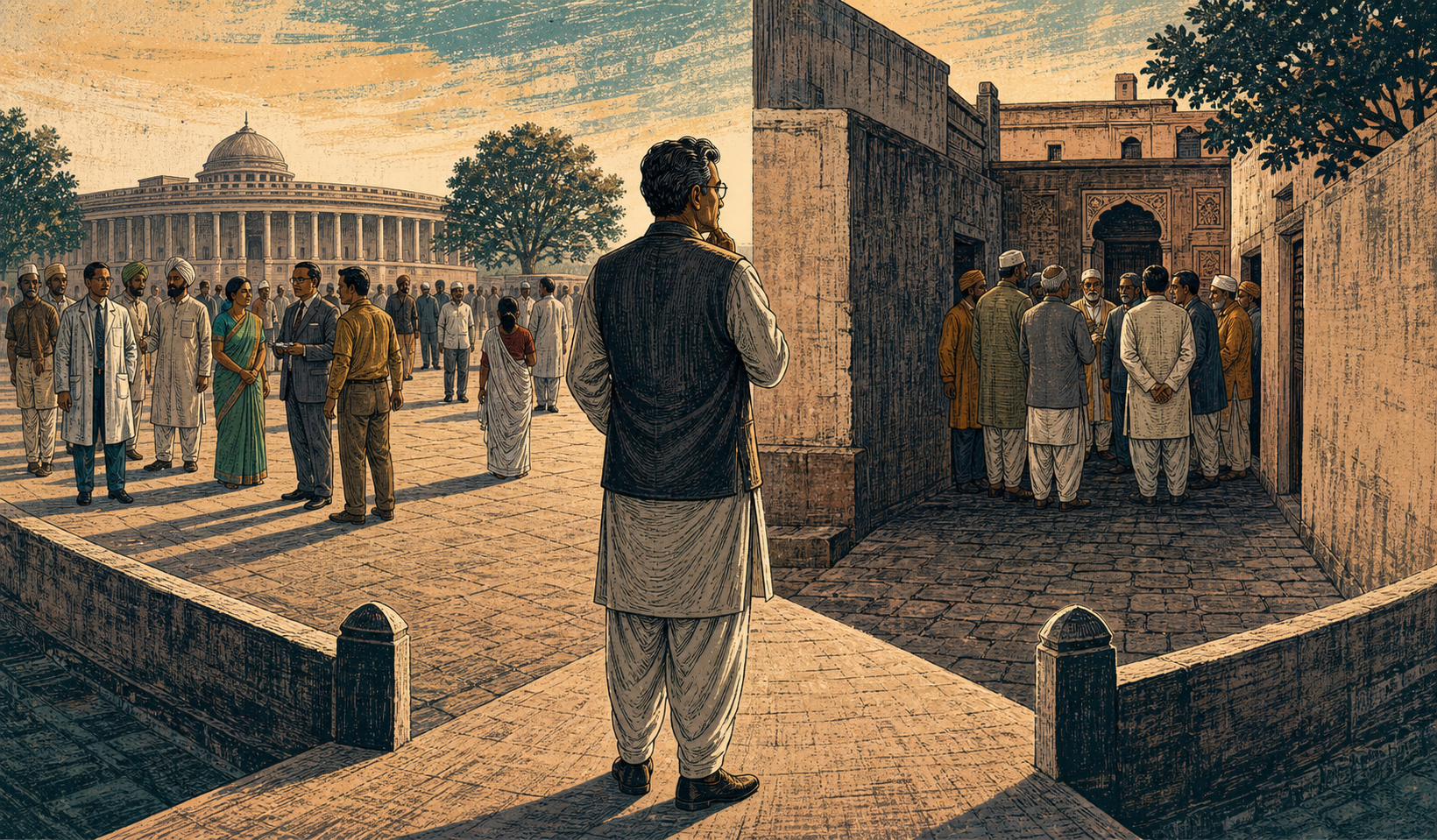
If you have encountered Hamid Dalwai’s claim that a communal Muslim and a nationalist Muslim were politically indistinguishable, you may feel pushed toward one of two conclusions: dismiss him as excessively harsh, or use his words as a verdict on every Muslim. Both reactions miss the question that makes his argument useful.
The question is not whether somebody calls himself an Indian nationalist. It is whether loyalty to a common Indian political community still governs his conduct when it conflicts with the demands, authorities or advantages of his religious bloc. That is where you should test Dalwai’s claim.
The difference appears only when loyalties collide

In Indian political vocabulary, communal does not merely mean religious or attentive to one’s community. Communal politics treats a religious collective as a primary political unit. It expects people to speak, bargain and vote as members of that unit, often allowing recognised leaders to present their preferences as the will of the whole community.
Nationalism begins from a different political unit: a shared nation whose citizens may retain distinct faiths, customs and institutions. A nationalist need not abandon religious belonging. The decisive issue is whether that belonging becomes an authority above the common political order.
Dalwai advanced the deliberately severe judgment that he found no meaningful difference between the communal and nationalist Muslim. This was his contested diagnosis of Muslim politics, not a neutral definition and not a self-proving fact. To understand its force, concentrate on political function rather than personal identity.
When national interest and communal solidarity point in the same direction, a communal politician and a nationalist politician may sound alike. Both can praise Bharat, condemn an external enemy or celebrate national achievements. Their difference becomes visible only when the two loyalties pull apart. Will the politician accept a common rule that disadvantages his own religious bloc? Will he protect an internal dissenter against communal pressure? Will he defend the same civic principle when another community benefits from it?
This conflict test prevents two common mistakes. Religious devotion is not automatically communal politics, and a patriotic declaration is not automatically evidence of nationalism. A devout person may accept equal civic rules at real cost to his group. A speaker using secular and national language may still treat religious blocs as the permanent owners of political claims.
You should also distinguish minority protection from communal privilege. Protection against discrimination can strengthen common citizenship by ensuring that an individual receives the same security as every other citizen. A claim becomes structurally communal when permanent religious identity is treated as a political entitlement that overrides individual dissent, shields community authorities from scrutiny or demands one standard for the claimant’s group and another for everyone else.
Reform, not hostility, explains the sharpness of Dalwai’s critique
Dalwai first published Muslim Politics in India in 1968 as a collection of writings directed at problems he believed constrained Muslim society. His severity came from a declared reformist purpose. He wanted change within his own community, not merely criticism delivered from outside it.
That orientation had appeared early. During his teenage years, he joined a socialist organisation, becoming the only person from his village to take that path and attracting severe criticism from his peers. His willingness to depart from an expected group position therefore preceded the political arguments for which he became known.
This background matters because internal reform tests the meaning of communal solidarity. A community can protect its members against prejudice while still permitting them to question inherited practices and political leadership. But when loyalty is defined as silence, the community ceases to be a field of living argument. Its appointed spokesmen acquire power over the individuals they claim to represent.
Dalwai’s criticism made him persona non grata within much of the broader Indian intelligentsia. That isolation shows the cost of his position; it does not, by itself, prove every part of his diagnosis. Unpopularity can establish courage, consistency or social discomfort. It cannot substitute for examining the argument.
The reform question remains valuable: does a political movement make room for the person who criticises his own community without renouncing membership in it? If the only acceptable Muslim is one who repeats communal leadership, nationalism has not displaced the bloc. If a Muslim can defend common civic principles, challenge his own side and remain fully Muslim, the alleged equivalence begins to break down.
Use a five-step test instead of trusting political labels

You can turn Dalwai’s provocation into a practical method. This is not a claim that he supplied a formal five-part checklist. It is a disciplined way to decide whether nationalist language has changed the structure of a communal demand.
- Remove the identity label. Write the exact political claim in one sentence without using communal, secular, nationalist, minority or majoritarian. If you cannot state the proposal without a flattering or condemnatory label, you do not yet know what you are judging.
- Identify the political unit. Ask whether the claim begins with the rights and duties of individual citizens or assumes that a religious community possesses one permanent interest represented by authorised leaders. Consultation with a community is not the same as granting its leadership ownership over every member.
- Apply the cost test. Find the point at which the stated principle would impose a cost on the speaker’s own side. A commitment to equal rules is meaningful when it survives that moment. Patriotism expressed only when nation and group interests coincide tells you very little.
- Apply the dissenter test. Ask what happens to a Muslim who rejects the community position. Can that person criticise religious leadership, support reform and retain equal standing? A movement that treats internal disagreement as betrayal is defending collective discipline, not merely cultural continuity.
- Reverse the identities. Apply the same proposed rule with the religious groups exchanged. If the speaker immediately changes his principle, the original claim was probably a group preference dressed in universal language. If the rule survives reversal, it has a stronger claim to be national rather than communal.
Consider a demand presented as protection for a religious minority. Do not accept or reject it merely because it is group-specific. Ask who receives the protection and who exercises the resulting power. A safeguard that protects individual citizens against discrimination can support equal national membership. An arrangement that gives unelected communal authorities lasting control over dissenting members raises a different problem.
Use the same precision with patriotic speech. A declaration of love for India is relevant, but it is not the final evidence. Compare the declaration with the speaker’s position on one issue where a common rule is inconvenient to his constituency. Conduct under conflict reveals more than ceremonial language.
Read Dalwai without converting criticism into collective guilt

Dalwai criticised Muslim society from within it. That gives his intervention a distinctive reformist significance, but it does not authorise you to convert a political diagnosis into a hereditary judgment. No community is a single mind, and the conduct of communal leadership cannot be assigned automatically to every Muslim citizen.
- Do not turn Muslim into a synonym for communal. Evaluate the institution, demand, leader or argument in front of you. Otherwise you erase the very Muslim dissenters and reformers whose freedom is central to the issue.
- Do not make personal piety the test. Religious observance tells you that a person takes faith seriously. It does not, without political evidence, tell you whether he accepts a common civic standard.
- Do not use another community’s wrongdoing as an escape. Hindu communalism, where it exists, does not disprove a claim about Muslim communalism. Nor does Dalwai’s focus on Muslim politics exempt Hindu organisations from the same tests of consistency, dissent and civic equality.
- Do not confuse reform with hostility. An internal critic may be trying to enlarge the freedom and dignity of community members. Examine the proposed reform and its reasoning before assigning motives.
- Do not use Dalwai’s name in place of evidence. A quotation cannot establish that a present-day leader, organisation or demand is communal. You still need the exact claim, the relevant conduct and a consistently applied standard.
A pro-Hindu analysis is strongest when it is exact. It can identify Muslim communal politics without pretending that all Muslims share one political will. It can defend Hindu civilisational interests without asking for an evidentiary standard that changes with the identity of the accused. Precision is not timidity; it is what separates a serious diagnosis from reciprocal slogan-making.
There is also a mistake on the other side: treating any forceful criticism of Muslim politics as prejudice. Dalwai’s life as a Muslim reformer makes that dismissal especially inadequate. The proper response to a disputed criticism is to examine its definition, evidence and consistency, not to make the critic’s identity the deciding factor.
Key takeaways
- Dalwai’s equivalence was a severe political judgment about communalism and nationalism, not a licence to pronounce every Muslim communal.
- The meaningful test comes when religious bloc loyalty conflicts with a common civic rule; agreement during easy moments proves little.
- Nationalism does not require abandoning faith or culture. It requires that religious belonging not become an authority above the shared political community.
- Freedom for internal criticism is a practical dividing line. Communal power treats dissent as betrayal; reform allows members to challenge their own leadership.
- Minority protection and communal privilege are not the same. Examine whether a proposal protects citizens or entrenches unaccountable group authority.
- Apply the same rule after reversing religious identities. A principle that survives reversal is more credible than one tailored to the speaker’s own bloc.
The next time Dalwai’s claim appears in a speech, debate or social-media exchange, do not forward the line by itself. Put the specific political demand beside it. Ask what common rule the speaker accepts when that rule costs his own side, how he treats internal dissent and whether his principle survives an exchange of identities. If those questions have no clear answers, you have a slogan. If they do, you have a basis for judgment.
References
