

You may have encountered the name Cittira Varna Jwala while looking for the goddess associated with Margazhi, only to find that it doesn’t match the Margazhi traditions you already know. The name is neither a replacement for Andal nor a universal designation used by every Hindu community.
Cittira Varna Jwala is the presiding goddess of Margazhi within a Tamil Shaiva Agamic and Tantric system. She belongs to the Dvadasa Masa Devis, the twelve goddesses associated with the twelve Tamil months. Once you place her in that setting, you can understand her significance without collapsing several distinct Margazhi traditions into one.
Why Margazhi can have more than one devotional centre
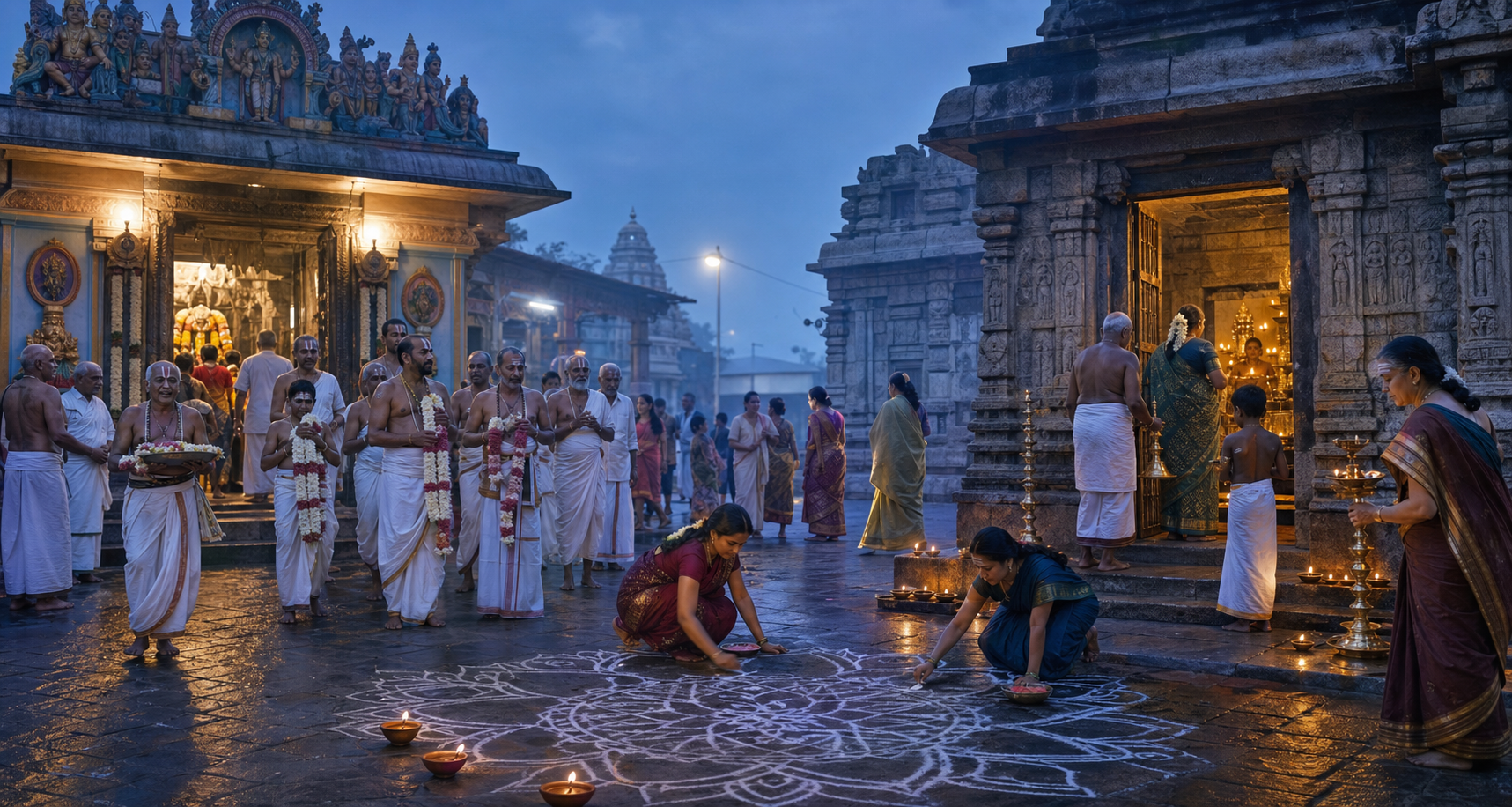
Margazhi is not experienced through a single ritual vocabulary. Depending on your family, temple and sampradaya, you may know the month through Andal and the Tiruppavai, through the Tiruvempavai, through early-morning temple worship, through kolam and music, or through a household vrata. The Dvadasa Masa Devi system is another layer: it regards time itself as divine and gives each Tamil month a presiding goddess.
The name explains the structure. Dvadasa means twelve, masa means month, and Devi means goddess. Margazhi is therefore not merely a date range in which worship happens. Within this framework, the month has a sacred presence that can be approached through a particular form of Shakti.
This does not make the monthly goddess the exclusive deity of Margazhi. A presiding form and a chosen object of devotion perform different roles. Your devotion to Vishnu, Shiva, Andal, a family deity or another form of Devi does not become invalid because a Shaiva calendar tradition personifies the month differently.
That distinction gives you a practical rule: keep each observance in its own lineage before looking for connections. If your Margazhi discipline is centred on the Tiruppavai, continue it as such. If you are studying the Dvadasa Masa Devis, approach Cittira Varna Jwala through the Shaiva Agamic and Tantric setting in which the name belongs. You do not need to make one tradition impersonate the other in order to honour both.
What the radiant-flame name allows you to notice
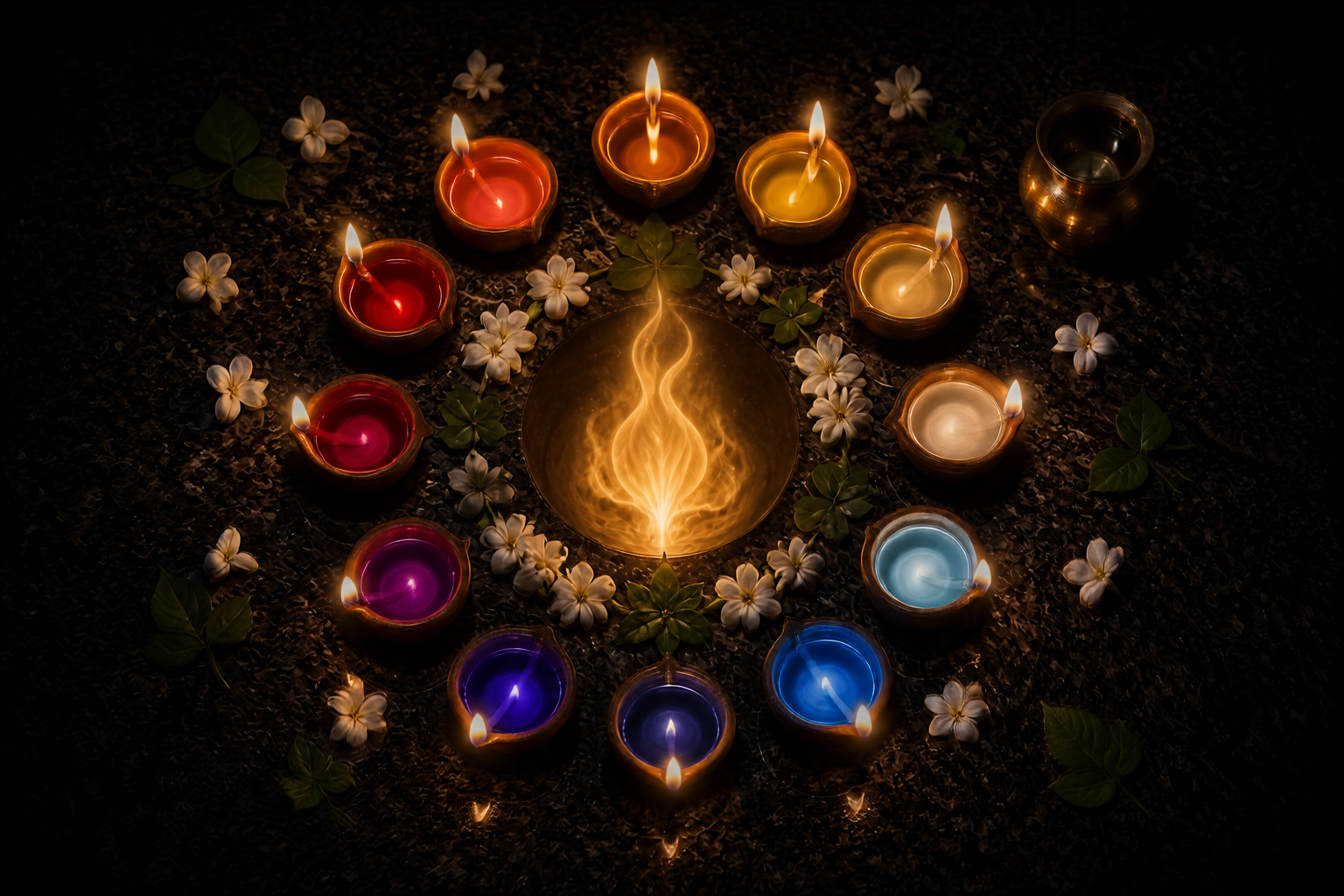
At the level of plain imagery, Cittira Varna Jwala evokes brilliance, colour and flame. She is described as resplendent. This is especially meaningful in a tradition that treats time as a manifestation of the divine rather than as an empty container through which life passes.
A flame reveals what darkness concealed. It also changes whatever enters it. As a contemplative reading, this gives you two useful questions for Margazhi: What has become visible now that your routine is quieter and more disciplined? What habit, attachment or confusion are you prepared to stop carrying into the next turn of the calendar?
The imagery of varied colour adds another dimension. Divine radiance need not erase difference. Many colours can appear through one light, just as distinct deities, hymns and observances can express a shared recognition of sacred time. This is an interpretive key, not a claim that every lineage gives the name exactly the same philosophical explanation.
Symbolism must also be kept separate from iconography. A radiant-flame name does not, by itself, establish a prescribed complexion, number of arms, set of weapons, yantra, mantra or offering. If you encounter such details, check whether they come from an identified temple tradition, Agamic procedure or transmitted ritual manual. Do not turn an evocative translation into a supposedly canonical image.
How this tradition relates to familiar Margazhi worship
Several devotional streams can occupy the same sacred month without being interchangeable:
- Tamil Vaishnava devotion gives Margazhi a powerful association with Andal and the recitation of the Tiruppavai.
- Tamil Shaiva devotion includes the Tiruvempavai and Shiva-centred worship during the month.
- The Dvadasa Masa Devi framework identifies a presiding goddess for each Tamil month and names Cittira Varna Jwala for Margazhi.
- Temple and household customs may add local observances shaped by a community’s own history and discipline.
These are related by season and sacred purpose, but they are not synonyms. Andal should not be relabelled as Cittira Varna Jwala, and Cittira Varna Jwala should not be treated as merely another name for whichever goddess your family already worships in Margazhi. The honest connection is broader: each tradition refuses to treat the month as spiritually neutral.
You may also see the Tamil month written as Margazhi or Margali. Search both forms when looking through temple calendars or discussions, but do not assume that a change in spelling proves a change in deity. Transliteration helps you find material; lineage tells you how that material should be understood.
A respectful way to include the goddess in your observance
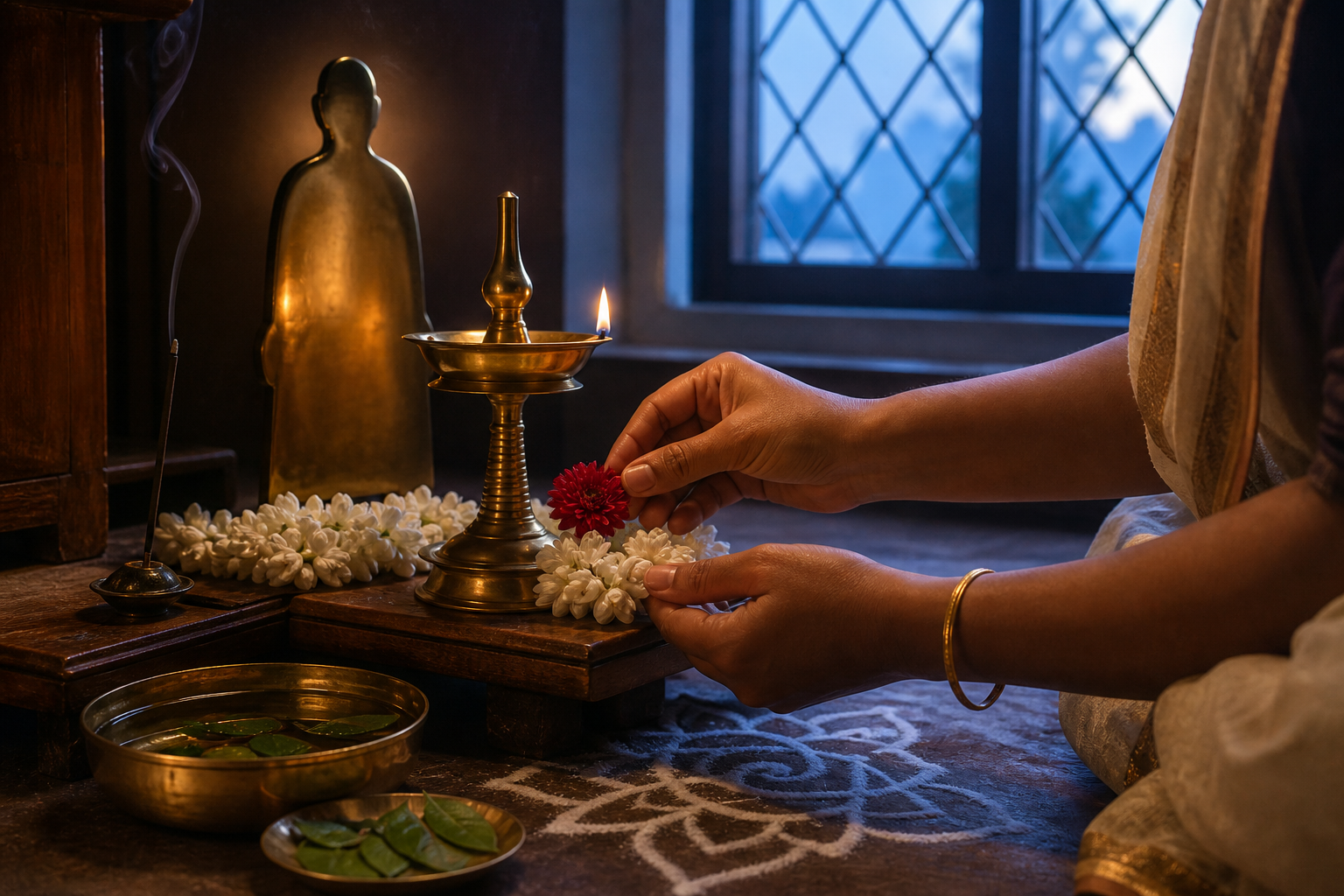
If your family or guru has already given you a Margazhi practice, that instruction comes first. If you have no transmitted procedure and simply want to acknowledge Cittira Varna Jwala, keep the observance modest. A public divine name is not permission to manufacture an esoteric ritual around it.
- Begin with your established practice. Recite the hymn, nama or prayer your family already uses rather than abandoning it for something unfamiliar.
- Prepare a clean, quiet place. If it is safe to do so, light a lamp as a visible aid to contemplation. The lamp is a simple devotional focus, not a claim to be performing a formal Tantric rite.
- Acknowledge the month as sacred time. Offer namaskara to Cittira Varna Jwala by name, without adding an invented bija, mantra, yantra or ritual promise.
- Contemplate radiance concretely. Identify one confusion you need to see clearly and one disciplined action you will carry through during Margazhi. Keep the action small enough to repeat.
- Close in the manner familiar to your home. Consistency with your existing dharma is more valuable than an elaborate procedure assembled from disconnected online fragments.
If you want more than this simple acknowledgement, ask a knowledgeable Shaiva temple priest or teacher precise questions. Does the temple recognise the Dvadasa Masa Devi cycle? Is Cittira Varna Jwala named in its liturgical tradition? Is there a public stotra or archana, or does the practice require specific guidance? Which pronunciation and ritual details does that lineage preserve? Specific questions make it easier to distinguish living practice from confident-looking invention.
Four checks before you repeat a ritual claim
- Does the claim identify the Shaiva, Agamic, Tantric, temple or regional context in which it belongs?
- Does it distinguish a symbolic interpretation from a prescribed ritual detail?
- Does it say whether the practice is intended for ordinary home devotion, public temple worship or guided ritual use?
- Can its iconography, mantra and offerings be traced to an identifiable tradition rather than inferred from the goddess’s name?
Obscurity alone does not make a tradition false; Hindu practice preserves many regional and specialised forms. Yet obscurity also should not shield a claim from examination. Respect means neither dismissing an unfamiliar Devi nor pretending to possess ritual knowledge that has not been established.
Key takeaways
- Cittira Varna Jwala is Margazhi’s presiding goddess within the Tamil Shaiva Agamic and Tantric tradition of the twelve monthly goddesses.
- Her place in that system does not displace Andal, Shiva, Vishnu, your ishta devata or your family’s established Margazhi observance.
- Her name evokes resplendence, colour and flame, but symbolism alone cannot establish a formal icon, mantra or ritual procedure.
- You can acknowledge her through simple namaskara and contemplation; seek lineage-specific guidance before adopting specialised practices.
- The most useful question is not whether every Hindu worships this form, but whether you are approaching her in the framework that gives the name meaning.
Before your next Margazhi observance, choose one concrete step: ask your temple about the Dvadasa Masa Devis, preserve the name in your study notes, or add a brief acknowledgement of sacred time to the practice you already keep. Let curiosity deepen discipline rather than displace it.
References
