
When you must decide whether to speak, yield, confront, or wait, “be righteous” is too vague to guide you. A good intention can still end in passivity, confusion, or uncontrolled anger if it never becomes disciplined action.
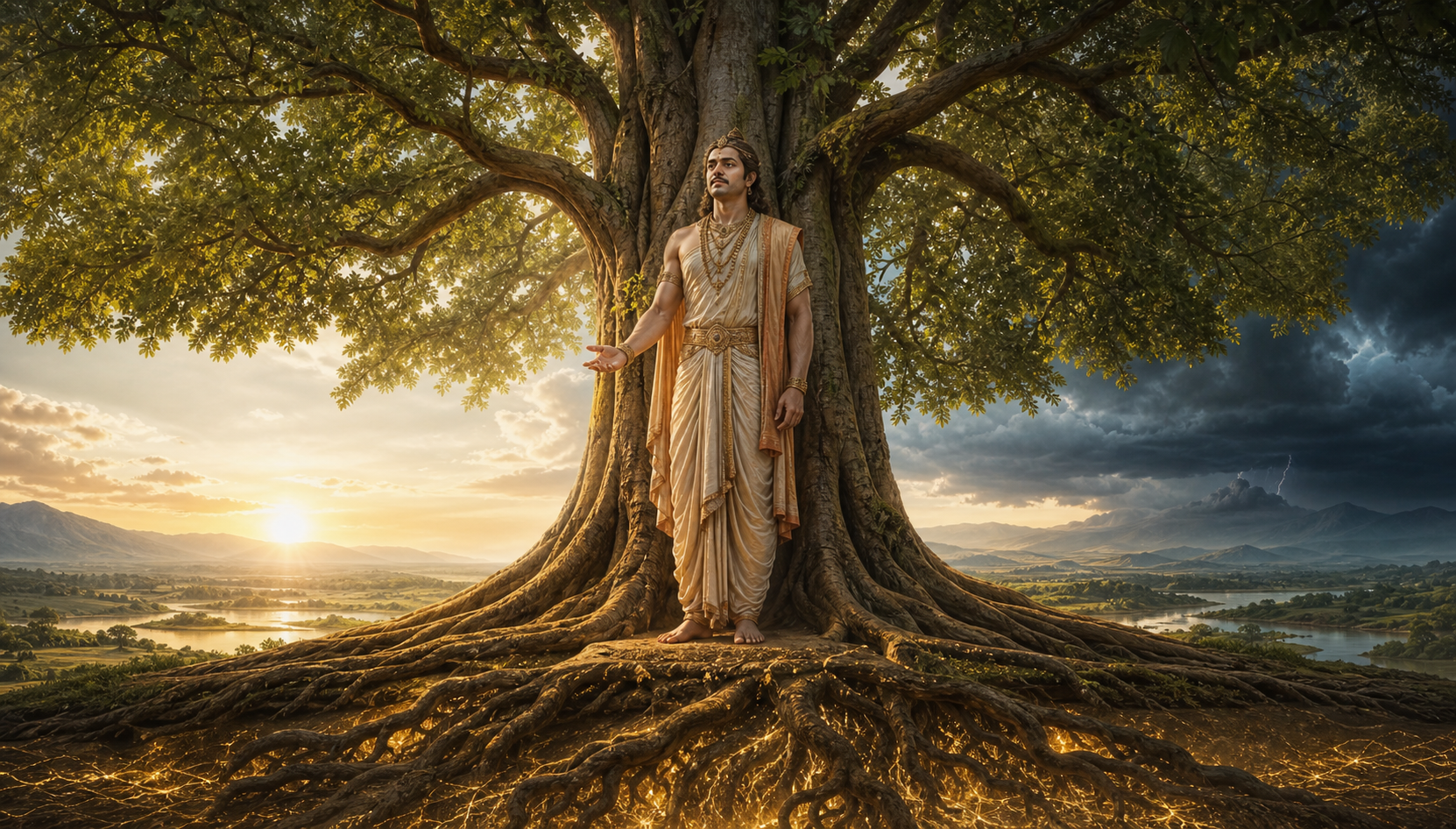
Yudhishthira as the Dharma Tree gives you a more demanding test. It asks three connected questions: What is right? What can carry it steadily? What strength must extend or defend it in the world?
What the tree metaphor changes
The Mahabharata presents the eldest Pandava as a great tree arising from righteousness. Arjuna forms its strong, dependable trunk, while Bhima forms its forceful, spreading branches. Yudhishthira is therefore not portrayed as an isolated moralist. He is the living whole in which principle, capability, and power must remain connected.
Do not reduce this image to a ranking of the brothers. A tree is not a contest between its parts. The trunk does not compete with the branches, and the branches do not make the whole independent of its sustaining structure. Each part performs a different function within one order.
Read symbolically, Arjuna’s position as the trunk points to disciplined execution. A trunk gives continuity and bears weight. Bhima’s position as the branches points to reach, force, and outward effect. Branches occupy space and carry the tree beyond its central line. Dharma supplies the governing character of the whole; skill and strength make that character effective.
This corrects a common mistake. Dharma is not whatever allows you to feel morally clean. If your choice preserves your innocence only by making another person bear the danger, confusion, or labour, your reasoning is incomplete. You must examine not only your intention but also the structure and consequences of your action.
Why dharma needs both discipline and force
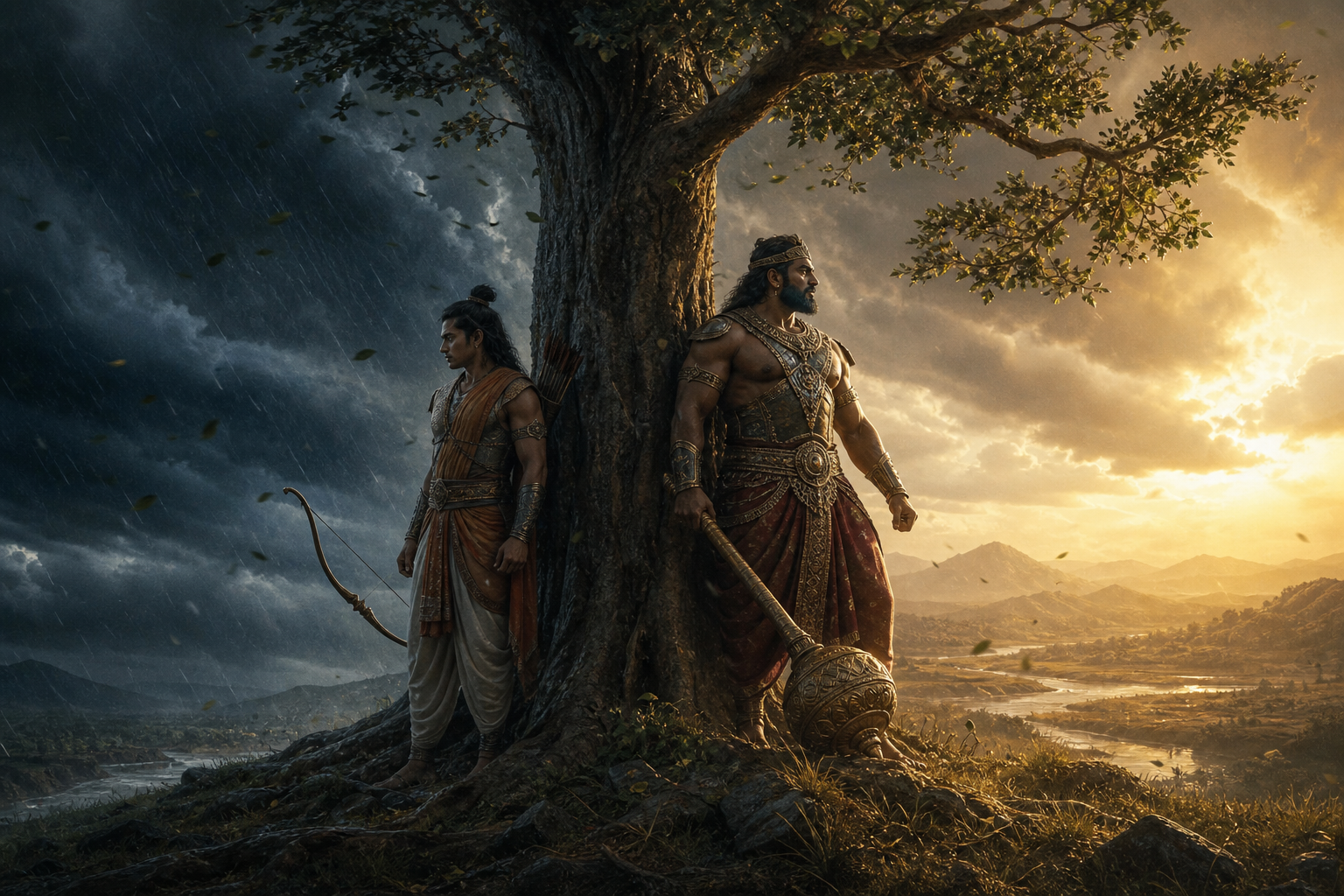
People sometimes mistake righteousness for harmlessness. They assume that a dharmic person must always withdraw, soften a boundary, or avoid confrontation. The tree metaphor does not support that conclusion. Bhima’s branches belong to the Dharma Tree; strength has a rightful place when it remains ordered by righteousness.
The opposite error is just as serious. Power does not become dharmic merely because its holder feels justified. Branches derive their position from the tree. In practical terms, force must answer to a clearly stated duty, serve a defined protective purpose, and stop when that purpose has been secured. Anger seeking release cannot supply those limits.
Arjuna’s trunk helps you distinguish restraint from helplessness. Restraint is controlled capacity: you could act, but you choose the form and timing that best serve your duty. Helplessness is the absence of a workable means. Calling helplessness “peace” does not transform it into a virtue. If you know what is right but have no truthful plan, capable person, or sustainable process to carry it, you have identified an aspiration rather than completed a decision.
Waiting can be dharmic when it serves a real purpose, such as obtaining necessary clarity or preparing a responsible response. Waiting becomes evasion when nothing relevant is expected to change. Before you postpone action, complete this sentence: “I am waiting until ___ because ___ will then become possible.” If you cannot fill both blanks concretely, reconsider the delay.
Use a similar discipline before confrontation: “This action protects ___, prevents ___, and will not go beyond ___.” The final blank matters. A boundary without a limit can become retaliation; a limit without enforcement can become a request that everyone is free to ignore.
Use the three-part Dharma Tree test
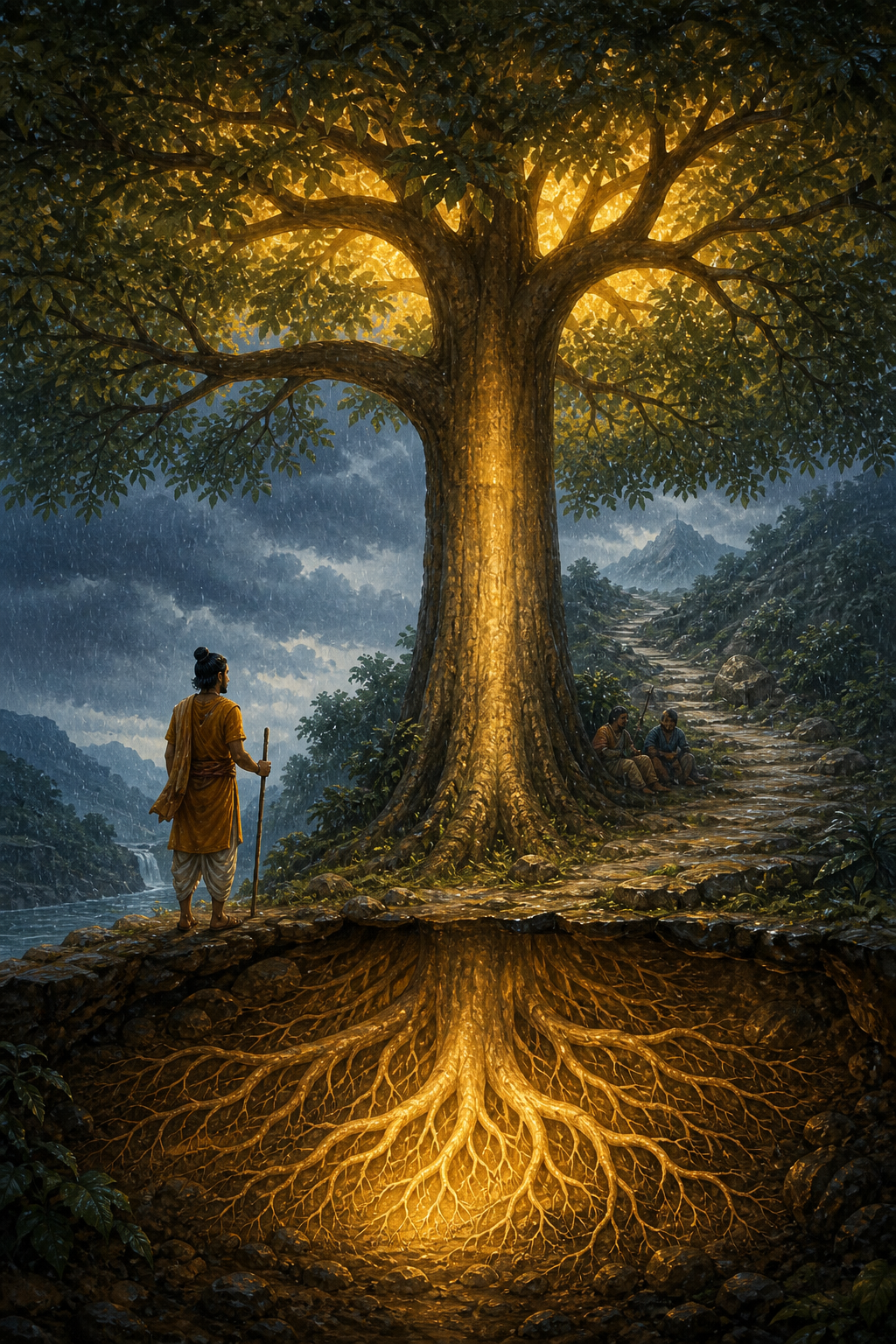
When a choice is morally tangled, work through the tree in order. Do not begin with the action you are eager to take and then search for a noble explanation.
- The Yudhishthira question: What duty governs this choice? Name what you owe in your actual role, not merely what outcome you prefer. Your duty may concern truth, a promise, a dependent person, a shared institution, or a legitimate responsibility. If duties conflict, state the conflict plainly: “I must protect this person without deceiving that person.” Honest tension is more useful than a conveniently simple answer.
- The Arjuna question: What stable action can carry that duty? Identify the facts you need, the person responsible, the sequence of action, and the point at which the decision will be reviewed. Choose a method you can sustain. A dramatic declaration that collapses the next day is not a trunk; it is a gesture.
- The Bhima question: What boundary or protective force makes the duty real? Decide what must be stopped, refused, defended, or enforced. Use enough strength to secure the dharmic purpose, but define a stopping condition. Intensity must not substitute for clarity.
The order prevents three predictable failures. Beginning with Bhima produces action first and justification afterward. Stopping with Yudhishthira leaves you with moral language but no implementation. Beginning with Arjuna alone can make you highly efficient at carrying out a purpose you have never examined.
Consider a community decision being pushed forward while important questions remain unanswered. The Yudhishthira question identifies the governing duty: protect truthful deliberation without using delay as sabotage. The Arjuna question produces a method: record the unanswered questions, assign responsibility for the missing information, and establish when the decision will be reconsidered. The Bhima question supplies the boundary: no final approval until the required information is available, with the same rule applied to every faction.
Notice what this method avoids. Silence would abandon the duty. Personal abuse would exceed it. Endless discussion would lack a trunk. The dharmic response joins a clear principle to a workable process and an enforceable limit.
Build dharmic leadership around distinct responsibilities
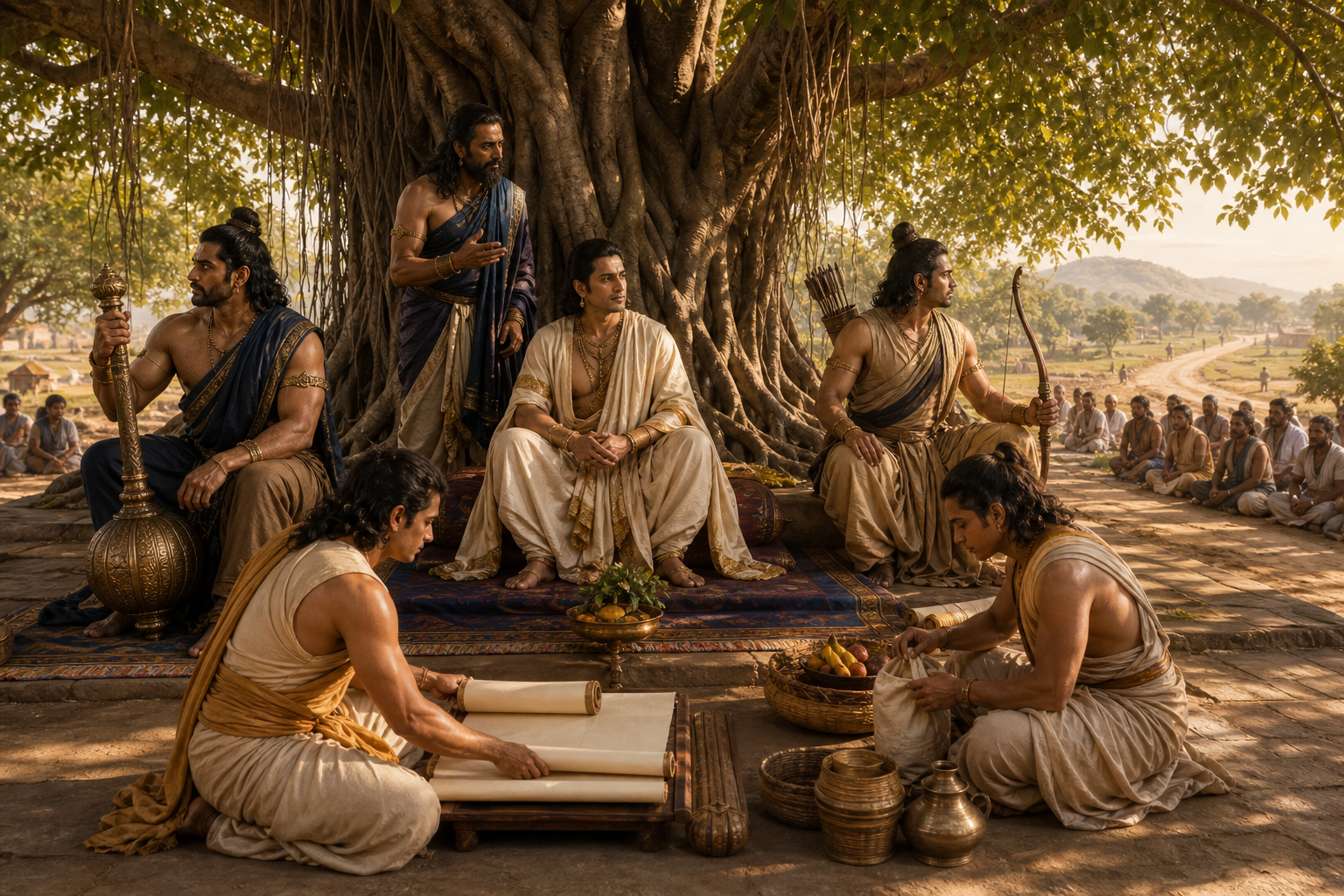
The Dharma Tree is also a useful model for a family, temple committee, community organisation, or public institution. A leader does not preserve dharma by trying to perform every function personally. The work becomes more reliable when moral direction, execution, and protective strength are distinguished and then deliberately coordinated.
- Guard the purpose. Someone must keep asking which duty the group is serving, whose legitimate interests are affected, and which means would contradict the stated principle.
- Carry the decision. Someone must turn principle into responsibilities, sequence, communication, and follow-through. This is the trunk function: it keeps the decision upright after enthusiasm fades.
- Hold the boundary. Someone must be authorised to refuse violations, defend people exposed to harm, and enforce the agreed limit. This is the branch function: it gives the decision reach and consequence.
One person may perform more than one function, but the functions should not be blurred. If everyone is guarding principles and nobody owns execution, the same moral debate will recur without movement. If the plan is detailed but repeatedly weakened under pressure, the boundary function is missing. If decisive action is taken while its reasons keep changing, the group has lost its dharmic centre.
You can diagnose a stalled decision by asking which part of the tree is absent. When the centre is missing, pause and state the duty. When the trunk is missing, assign the next responsible action and its review point. When the branches are missing, agree on the boundary and who may enforce it. This is more precise than demanding that everyone simply show greater commitment.
The model also guards against personality worship. Moral authority cannot excuse poor execution, technical competence cannot choose its own ends, and physical or institutional power cannot govern itself. Dharmic leadership appears in the right relationship among these capacities.
Key takeaways and your next action
- Yudhishthira as the Dharma Tree represents righteousness made into an ordered, living whole, not virtue isolated from practical life.
- Arjuna as the trunk shows why a right intention needs disciplined, dependable execution.
- Bhima as the branches shows why dharma may require strength, reach, and enforcement, while also requiring that force remain governed and limited.
- A complete decision names the governing duty, the action capable of carrying it, and the boundary that makes it effective.
At your next difficult decision, write three headings on a page: “Duty,” “Carrier,” and “Boundary.” Put one concrete answer beneath each. If the duty has no carrier, it remains an aspiration. If the boundary cannot point back to the duty, stop and reorder it. Let your next action grow from dharma as a whole tree grows: centred in righteousness, supported by discipline, and strong enough to stand in the world.
References
