
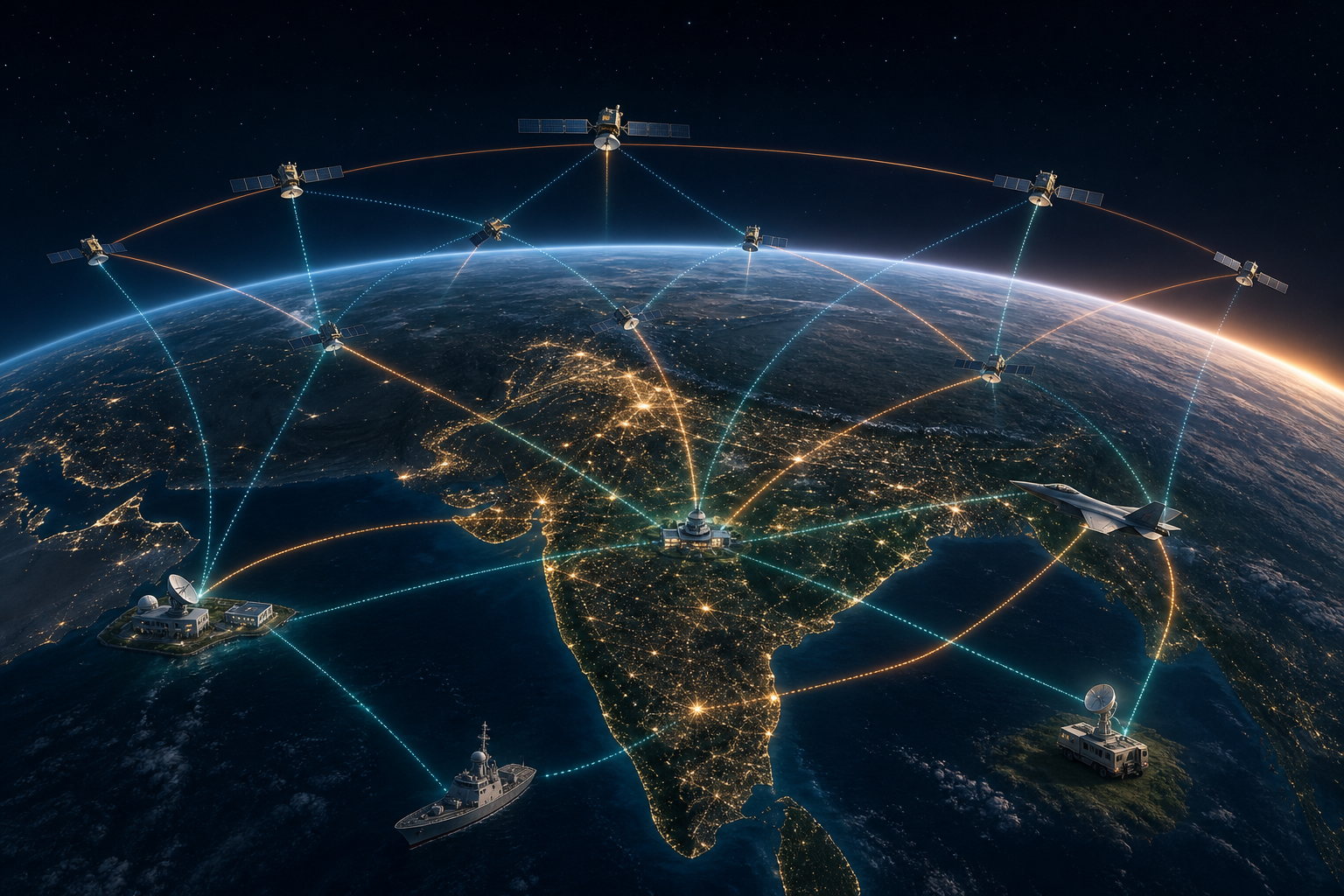
If you are trying to decide whether India’s military-space push is substance or slogan, do not begin by counting satellites. Ask a harder question: can Indian forces still observe, communicate, navigate and make timely decisions after an adversary jams a link, compromises a ground station or disables an orbital asset?
That is the test of a military space architecture. Modern operations depend on capabilities positioned roughly 500 to 36,000 kilometres above Earth, but the satellites are only the visible layer. Resilience comes from the entire chain connecting orbit to commanders, weapons and units in the field.
A military space architecture is a chain, not a fleet

The phrase “military space architecture” can sound like a grand name for a satellite programme. That interpretation is too narrow. An architecture is the complete system through which a military requests information, collects it, moves it securely, turns it into an operational product and delivers it to the person who must act.
You can understand that system through six connected layers:
- Orbital assets: satellites and their payloads for surveillance, communications, navigation, missile warning and other specialised missions.
- Launch and replenishment: the rockets, launch facilities, integration processes and ready replacements needed to place new capability in orbit.
- Ground infrastructure: control centres, tracking stations, antennas and facilities that command satellites and receive their data.
- Data and communications: the secure links, encryption, processing systems and distribution networks that carry information from a sensor to an operational user.
- Command and coordination: the authorities and procedures that decide which task takes priority, who may access the result and how the services share it.
- Operational users: commanders, aircraft, ships, missile units, air-defence formations and other forces that must receive an accurate service in time to use it.
A weakness in any one layer can neutralise an expensive satellite. A high-resolution image delivered after the target has moved is not useful intelligence. A secure communications spacecraft cannot help a unit whose terminal is incompatible with it. A navigation service becomes a liability if users cannot identify interference or shift to an alternative method.
This gives you the first rule for evaluating India’s progress: never treat the spacecraft as the whole capability. Look for evidence that the ground segment, data pipeline, user equipment, training and replacement plan are advancing with it.
Why resilience has become an operational requirement
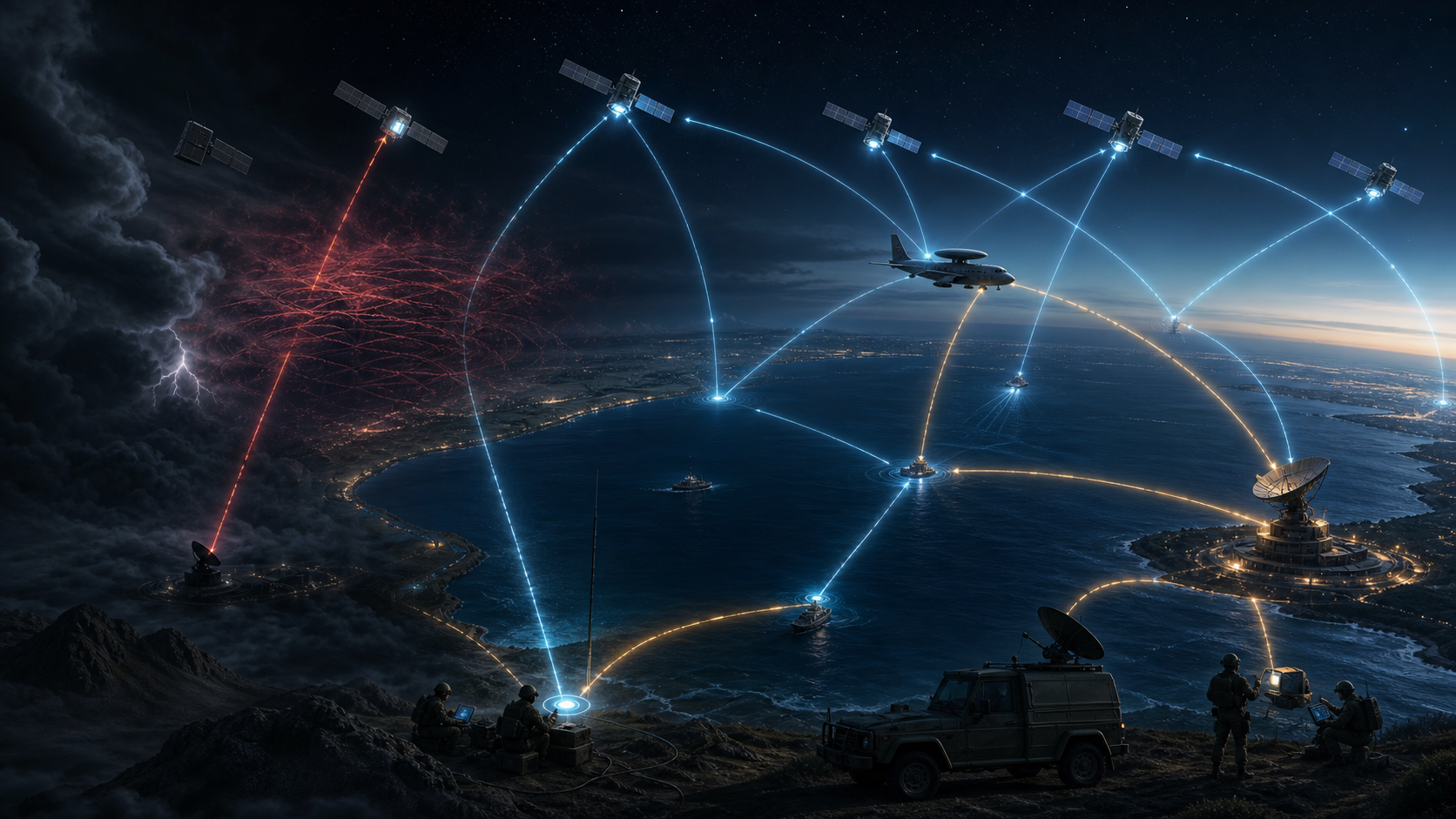
Surveillance, secure communications and rapid intelligence cycles are no longer distant strategic conveniences. They shape what a joint force can see, how quickly it can coordinate and whether different services can act from the same operational picture.
Operation Sindoor brought that dependence into sharper operational focus. The timing of related decisions remains qualified: directives to accelerate India’s next surveillance constellation were reportedly issued in the days immediately before the operation. If that chronology is accurate, it means the requirement was already recognised and the operation reinforced it. The subsequent fast-tracking of SBS-III is the firmer public indication that persistent surveillance had become a priority.
The threat is also broader than a missile striking a satellite. Since China’s 2007 direct-ascent anti-satellite test, Beijing’s counter-space toolkit has been assessed by the Secure World Foundation and CSIS to include co-orbital systems, ground-based lasers, jamming and cyber capabilities. These methods can target different parts of the architecture and can create effects ranging from temporary disruption to physical destruction.
- Direct-ascent weapons can physically destroy a spacecraft, creating an immediate loss and potentially generating dangerous debris.
- Co-orbital systems can approach or operate near another satellite. Proximity itself does not prove hostile intent, but it can create options for inspection, interference or attack.
- Lasers can interfere with optical sensors without necessarily destroying the entire spacecraft.
- Jamming attacks the radio-frequency connection, potentially denying a service while leaving the satellite intact.
- Cyber operations can target control networks, software, data integrity or user access rather than the object in orbit.
China also conducted an on-orbit refuelling experiment during the second half of 2025. Refuelling can support legitimate servicing and extend a satellite’s useful life. The same ability to approach, dock with and manipulate objects in orbit has an evident dual-use character. India therefore has to assess behaviour and capability together, without pretending that every servicing technology is automatically a weapon or that its military potential can be ignored.
The practical consequence is important. Protection cannot mean armouring every satellite against every threat. India needs enough distribution, alternative pathways, warning, recovery capacity and operational discipline to keep essential services functioning when one part of the system is degraded.
Six tests for a credible Indian architecture

A serious architecture should be judged by the missions it can preserve under pressure. These six tests reveal more than an announcement about a new platform or constellation.
- Can it survive the first disruption? Concentrating a critical mission in a small number of exquisite satellites creates obvious failure points. Distribution across more assets can complicate an adversary’s targeting problem, but numbers alone are not enough. Satellites that share one control facility, one vulnerable communications path or one software weakness may fail together.
- Can the force reach the same service through another path? Alternative satellites, ground stations, communications routes and non-space systems should be planned before a crisis. A backup that requires improvised integration after the primary link fails is not an operational backup.
- Can India recognise what is happening? A system must distinguish equipment failure from jamming, cyber compromise, orbital interference and deliberate deception. Space-domain awareness, network monitoring and rehearsed reporting procedures are necessary because a commander cannot respond intelligently to an unexplained outage.
- Can capability be restored quickly? Reconstitution requires more than a launch vehicle. Replacement payloads, compatible satellite buses, integration capacity, trained teams, tested software and available launch opportunities must form one prepared pipeline. Otherwise, “rapid launch” remains a slogan attached to hardware.
- Can raw data become a decision in operational time? Persistent collection has little value if processing and distribution create a bottleneck. India should measure the complete interval from tasking a sensor to delivering a usable product, not merely the satellite’s ability to capture an image or signal.
- Can the armed services use it as one joint system? The Army, Navy and Air Force may need different products, but incompatible terminals, access rules and data formats create friction at the decisive moment. Joint standards and rehearsed priority-setting matter as much as the orbital platform.
These tests also prevent a common analytical error: treating every satellite as interchangeable. A communications spacecraft cannot replace a surveillance sensor, and neither automatically provides missile warning. Resilience has to exist within each essential mission and across the infrastructure shared by several missions.
Watch especially for common-mode failures. Two constellations are not genuinely independent if both depend on the same exposed ground station, external software update channel or narrow pool of trained controllers. Real redundancy separates the failure paths, not merely the equipment names.
Sovereign access is control, not isolation

India’s requirement for sovereign military-space capability should not be reduced to a demand that every component be produced by the state or even that every component be domestic. The decisive question is whether Bharat can obtain and direct an essential service when political pressure, commercial restrictions or active conflict make normal arrangements unreliable.
Sovereign access therefore has several practical dimensions:
- Indian authorities can set tasking priorities without waiting for a foreign operator.
- India controls encryption, authentication and permissions for military users.
- Critical data can be received, processed and distributed through infrastructure available during conflict.
- Indian forces understand the system well enough to diagnose interference and continue operating in a degraded mode.
- Replacement spacecraft or payloads are not trapped behind a single unavailable supplier, launch route or external approval.
- Commercial and international partnerships have clear wartime obligations, technical interfaces and fallback arrangements.
This distinction matters because partnership and sovereignty are not opposites. Private Indian companies can add manufacturing capacity, software expertise and launch options. Trusted international cooperation can improve awareness and provide complementary data. Those relationships strengthen India only when the state knows which dependencies it is accepting and has a plan for the moment one becomes unavailable.
When you see a new contract or partnership, ask five concrete questions: Who can command the asset? Who controls the keys and software? Where is the data processed? What happens if the principal link is denied? How does India replace or bypass the service? If those answers are missing, the announcement may expand capacity without delivering assured access.
Key takeaways: how to read the next announcement
- Start with the military effect. Identify whether the programme improves surveillance, communications, navigation, missile warning or another specific mission. “Space capability” is too vague to evaluate.
- Look beyond the satellite. Check for ground stations, secure links, processing, compatible user terminals, training and joint command arrangements.
- Find the failure path. Ask what happens after jamming, cyber intrusion, loss of a ground facility or loss of a spacecraft. A resilient design should offer a prepared alternative.
- Distinguish duplication from true redundancy. Additional assets do not solve the problem if they share the same vulnerable infrastructure or dependencies.
- Examine replacement capacity. A replenishment plan needs ready hardware, integration, software, trained personnel and launch access, not just a rocket.
- Measure delivery, not collection. The operational metric is how quickly reliable information reaches the authorised user and supports a decision.
- Test sovereign control. Determine whether India can task, secure, operate, repair and reconstitute the capability during wartime.
India does not need a mirror image of another country’s space establishment. It needs an architecture fitted to its geography, military missions, industrial capacity and strategic autonomy. As new programmes appear, use this scorecard rather than the headline satellite count. The strongest sign of progress will be a force that can lose a component, understand the attack, shift to another path and continue its mission.
References
