
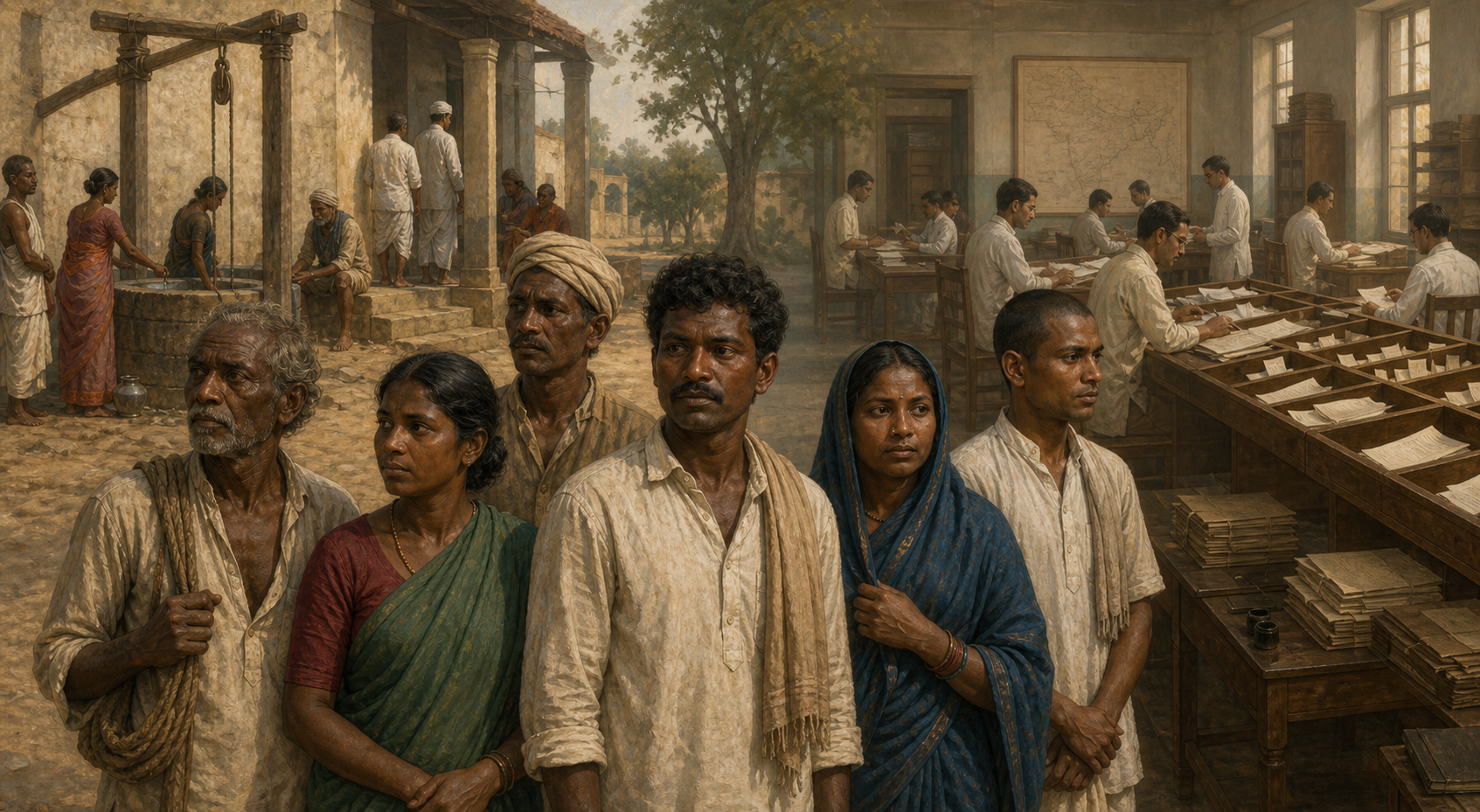
If you arrived here because someone said the Scheduled Caste category is either an ancient Hindu classification or a wholly British fiction, neither claim is precise enough. Before you can judge the argument, you need to ask what is being dated: the social injury, the administrative label, or the present eligibility rule.
The short answer is that colonial rule did not create untouchability, but it did convert older, community-based disabilities into a population that the state could enumerate, classify, and govern. The Scheduled Caste category emerged from that administrative process, and its connection to the Hindu social order was established before the Constitution.
The social wound and the official label began at different times
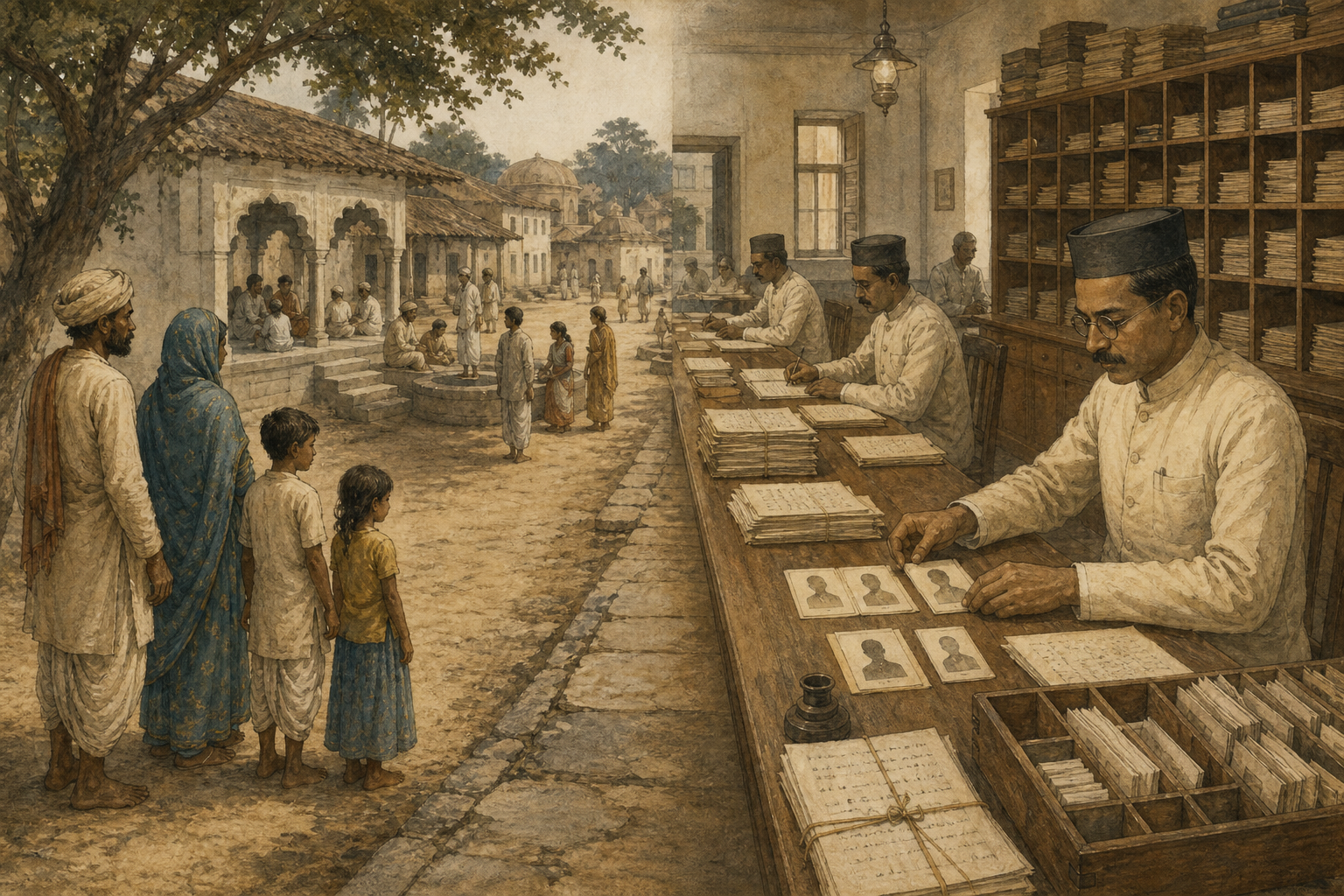
Untouchability existed as a lived condition before “Scheduled Caste” existed as an official name. Communities faced restrictions connected to birth: exclusion from temples, wells, schools, and public roads, as well as hereditary confinement to occupations treated as degrading. The label came later than the disabilities it was meant to identify.
This distinction immediately corrects one common error. Saying that the category has colonial origins is not the same as saying that British rule invented every practice classified under it. One claim concerns the origin of a state classification; the other concerns the origin of social conduct. Evidence for the first does not establish the second.
The administrative transformation became visible in the 1881 census and the decennial enumerations that followed. Officials recorded birth communities whose members experienced recognisable forms of exclusion. Census operations did more than count people: they grouped varied local communities under categories that could be used across a large colonial bureaucracy.
That process can be understood in four stages:
- A social condition existed: particular communities endured inherited disabilities in everyday life.
- The state identified a population: census and ethnographic administration associated those disabilities with named birth communities.
- The population became an administrative class: local differences were translated into a form that officials could enumerate and address through policy.
- The class entered constitutional politics: the Republic received an established category rather than beginning with a blank page.
Keep those stages separate whenever you encounter the word “caste.” A person may accept that an oppressive practice predated colonial rule while also examining how colonial enumeration formalised the identities attached to it. Conversely, criticism of colonial classification does not make the underlying exclusion imaginary.
By the time constitutional arrangements were being drafted in 1949, the administrative and political treatment of these communities had already developed over more than two decades of colonial practice. That chronology matters because it rules out the idea that the religion-linked character of the category appeared without precedent after independence.
Why religion was built into the colonial category
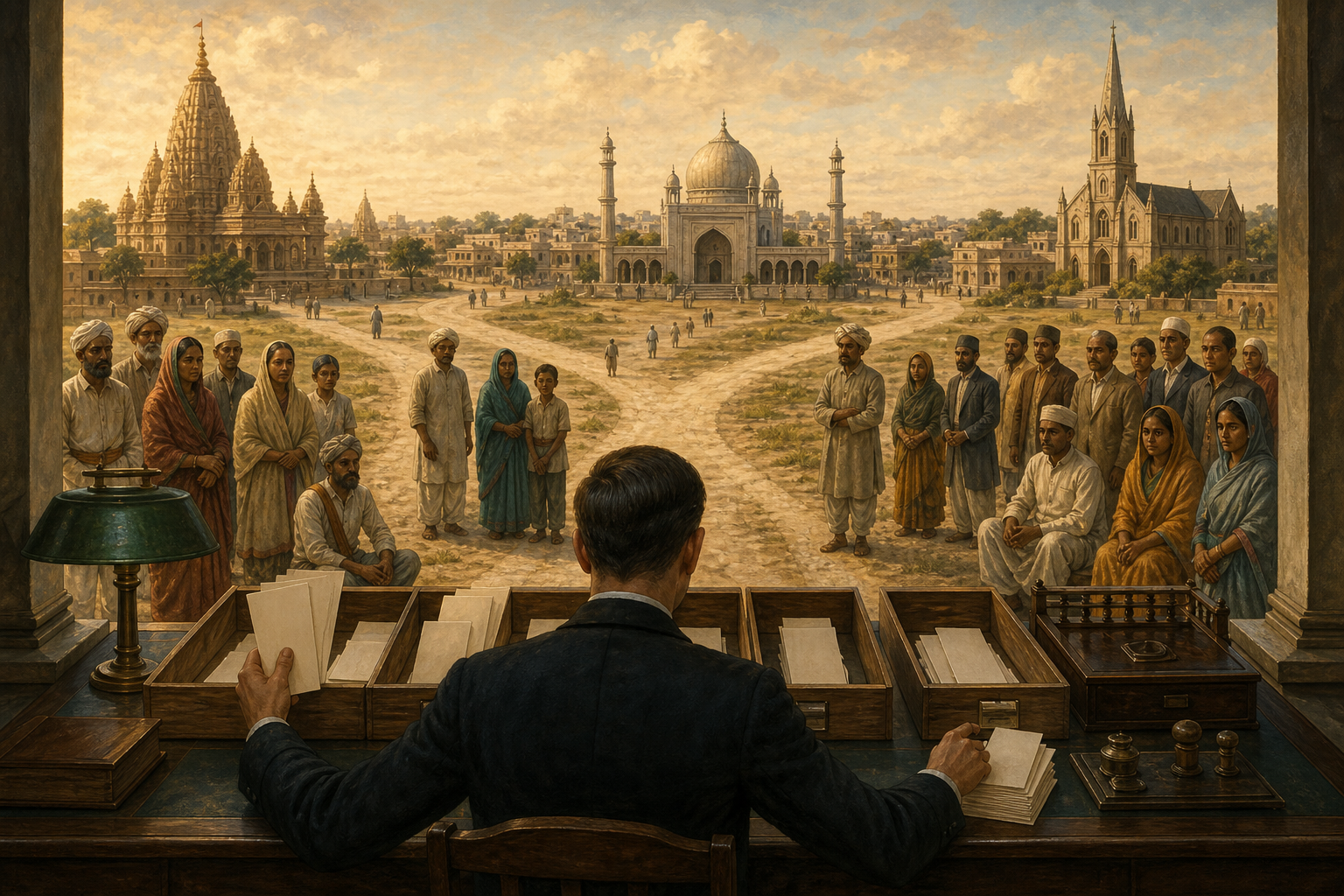
The colonial administration was not merely identifying poverty, low status, or disadvantage in general. It was attempting to classify a particular kind of inherited exclusion. Its diagnosis located untouchability within Hindu social organisation and connected it to ideas of ritual pollution.
Officials therefore treated the targeted disability as different in kind from economic hardship or social inequality that might exist in any religious community. Christianity and Islam already included converts from communities regarded as untouchable, but colonial administrators saw no equivalent doctrinal basis for ritual untouchability in those faiths. That reasoning placed religious identity inside the definition of the remedial category.
You should understand that as an account of the category-makers’ logic, not as proof that caste prejudice could never follow a convert into a Christian or Muslim social setting. Three different questions are easily confused here:
- The doctrinal question: Does a religious tradition authorise the ritual distinction being targeted?
- The sociological question: Do people from a converted community continue to encounter inherited stigma or disadvantage in practice?
- The remedial question: Which injuries was the state category designed to address, and whom should the law recognise now?
Doctrine cannot answer the sociological question by itself. Evidence of social disadvantage cannot, by itself, determine the proper boundaries of a specific constitutional remedy either. Each proposition needs its own argument.
Conversion brought this distinction directly into colonial politics. Demands to extend caste-based protections to Christian and Muslim converts were not unknown or discovered only after independence; colonial practice confronted and rejected those demands. Whatever judgment you reach about that decision, the historical sequence prevents it from being described as a sudden invention of the post-1950 Republic.
Precision is also needed when discussing the present religion link. The definition at issue recognises members of Hindu, Sikh, and Buddhist communities, not Hindus alone, while proposals for change concern Dalit converts to Christianity and Islam. An account of the category’s Hindu origin and an account of its present boundary are related, but they are not identical.
What the colonial origin proves, and what it does not
Historical genealogy is useful because it narrows the claims that can honestly be made. It does not settle every moral, constitutional, or policy question attached to the category.
The colonial origin establishes several important points:
- The terminology is administrative, not timeless. “Scheduled Caste” should not be projected backwards as though historical communities had always used it as a collective self-description.
- The underlying disabilities preceded the terminology. Creating an official name for exclusion is not the same as creating the exclusion itself.
- The religion link predates the Constitution. Colonial officials connected the category to their diagnosis of untouchability within Hindu society.
- Conversion was already part of the dispute. Christian and Muslim converts were considered within colonial arguments over the category’s limits.
- Constitution-makers inherited a developed framework. The post-independence settlement did not arise in an administrative vacuum.
Those facts do not prove several other propositions that are often smuggled into the debate:
- They do not prove that British officials invented untouchability merely by recording it.
- They do not tell us how much census classification later hardened, standardised, or altered the identities being counted.
- They do not prove that every Hindu tradition, scripture, sect, or community can be reduced to one undifferentiated social practice.
- They do not establish that conversion must erase inherited disadvantage in every person’s lived circumstances.
- They do not make a colonial policy morally correct merely because it is older than the Constitution.
- They do not, by themselves, decide whether the present boundary should be retained or changed.
This is the central discipline the debate requires: origin and justification are different questions. A policy can possess deep historical continuity and still require a present-day defence. It can also have colonial origins without being nothing more than a colonial imposition. History identifies the path by which the state arrived at a rule; public reasoning must still examine the rule’s purpose and effects.
The same discipline protects a Dharmic reading from two opposite distortions. It prevents colonial classification from being mistaken for an eternal description of Hindu society, and it prevents real, birth-based exclusion from being dismissed just because the modern category was bureaucratically constructed. Dharma is not defended by confusing a state label with civilisational truth, or by denying the suffering that gave the label political force.
A five-question test for claims about Scheduled Caste history

When you read a speech, court argument, campaign statement, or social-media claim about the category, apply these questions in order. They expose most historical shortcuts quickly.
- What exactly does “Scheduled Caste” mean in this claim? Is the speaker discussing untouchability as a social practice, particular affected communities, the colonial administrative category, or present legal recognition? If the meaning shifts during the argument, the conclusion is probably unreliable.
- Which date is doing the work? The 1881 census, the colonial political practice that followed, the 1949 drafting moment, and the post-1950 order are not interchangeable reference points. Ask what allegedly began at the chosen date.
- Is documentation being confused with invention? Colonial officials could observe and classify an existing disability while also reshaping how communities were represented to the state. Those propositions can both be true; neither should be assumed to cancel the other.
- Is the claim doctrinal, sociological, or legal? A statement about what Christianity, Islam, or a Dharmic tradition teaches is not automatically evidence about how a local society treats converts. Evidence of continuing stigma is not automatically an argument for one particular legal remedy.
- Does the conclusion go beyond the evidence? Showing that a religion link existed before the Constitution defeats the claim that it appeared from nowhere in 1950. It does not prove that the boundary can never be reconsidered. Showing that the category is colonial defeats the claim that its official form is ancient. It does not prove that the classified injuries were fabricated.
Consider three frequently heard formulations. “The British invented untouchability” collapses the official category into the older condition it classified. “The religion restriction began only after independence” ignores the colonial treatment of untouchability and the earlier rejection of conversion-based claims. “The colonial origin proves the present rule must remain unchanged” turns historical continuity into a moral argument without supplying the missing reasoning. All three fail for different reasons.
If the issue concerns an individual’s legal eligibility, do not use a historical account as a substitute for the operative law and official process. The genealogy explains why the category took its form; it cannot determine a person’s case.
Key takeaways
- Untouchability as a social disability came before “Scheduled Caste” as an administrative label.
- The 1881 census and later enumerations helped turn locally identified birth communities into a population legible to the colonial state.
- Colonial officials framed the targeted disability as a feature of Hindu social organisation rooted in ritual exclusion.
- Demands involving Christian and Muslim converts arose before independence and were rejected within colonial practice.
- The Constitution inherited a developed, religion-linked category rather than inventing one without precedent.
- This genealogy corrects false origin stories, but it does not settle the present policy debate by itself.
The next time someone offers a one-line history of the Scheduled Caste category, ask them to name the thing whose origin they are describing. Separate the injury from the label, the colonial diagnosis from present social evidence, and historical continuity from policy justification. Once those distinctions are kept in view, you can debate the category’s future without falsifying its past.
References
