

If you encountered Ananda Shakti in a discourse or spiritual conversation, you may have translated it as simply “feeling happy.” That translation is too small. It turns a philosophical principle into mood management and leaves you wondering what bliss has to do with sadhana, dharma, or a difficult decision.
Read Ananda Shakti instead as a way to examine how awareness becomes action. The practical question is not whether you feel pleasant at this moment. It is whether your actions arise from grasping and fear, or from a deeper sufficiency that does not need the world to flatter you.
What changes when bliss is understood as power

In a straightforward philosophical reading, ananda means bliss or profound fullness, while shakti means power, capacity, or dynamic potency. Ananda Shakti therefore points to bliss as an active divine power, not merely a reward waiting at the end of spiritual practice.
Three ideas are joined in this expression:
- Awareness is the capacity by which experience is known.
- Ananda is the fullness associated with consciousness when it is not reduced to craving, aversion, and restless self-concern.
- Shakti is the dynamism through which consciousness becomes intention, expression, and effective action.
These are not mechanical stages or three separate objects. They form a contemplative map. Pure awareness is not inert; bliss is not merely private enjoyment; divine will is not disconnected from consciousness. Ananda Shakti names the living power through which fullness can become expression.
At the cosmic level, the concept concerns the dynamic character of divine consciousness. At the level of practice, it asks you to notice how your inner condition shapes what you say, choose, create, and protect. This does not mean that the individual ego can manufacture or possess divine power. It means that action becomes less distorted when compulsive wanting no longer occupies the centre of awareness.
Ananda is not the same as getting what you want
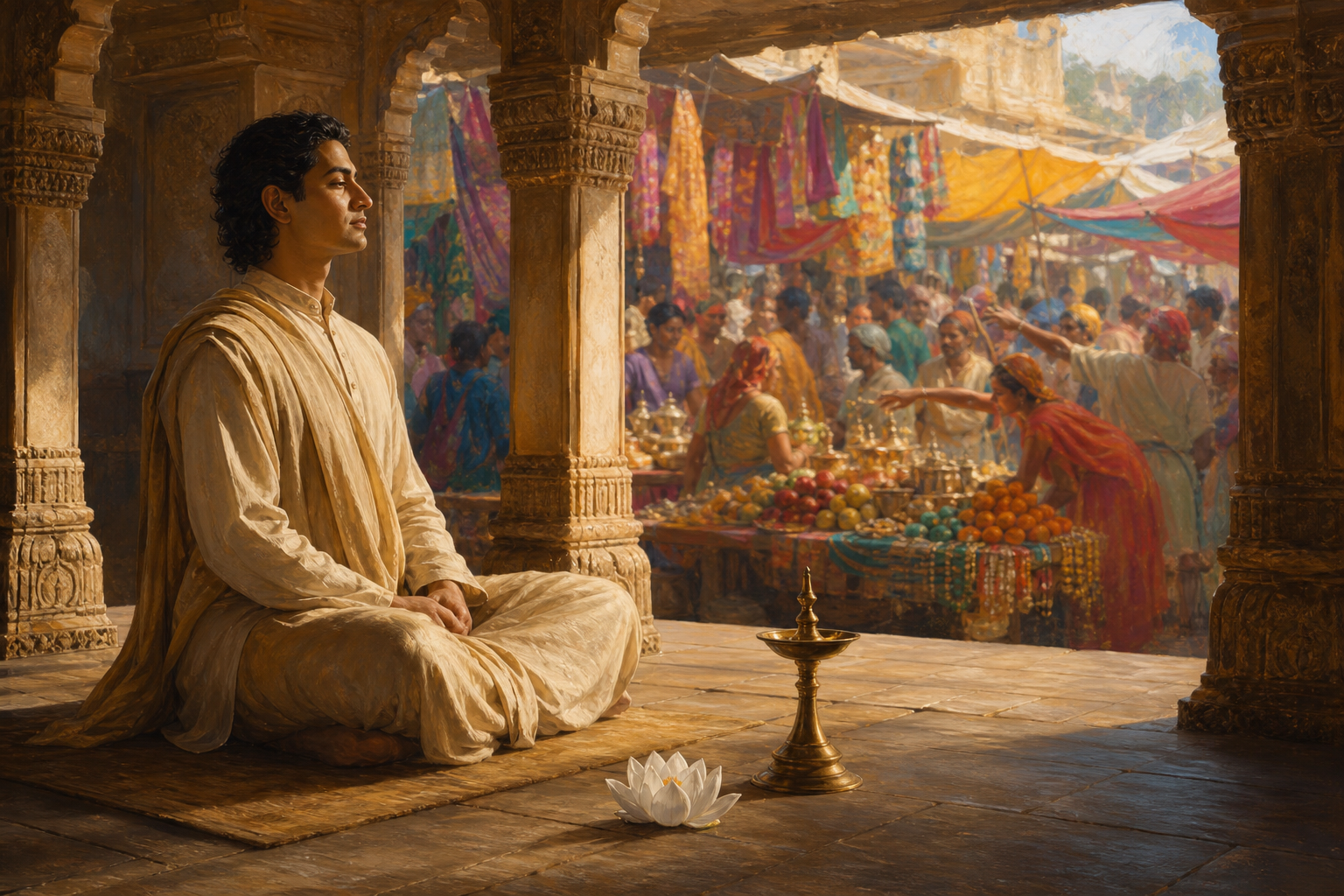
The most common mistake is to confuse ananda with ordinary pleasure. Pleasure depends on contact with something preferred: praise, comfort, success, possession, companionship, taste, or relief. When the condition changes, the feeling changes. Ananda, in this philosophical use, points beneath that cycle to a fullness that is not created by acquiring the preferred object.
| Question | Ordinary pleasure | Ananda in this philosophical sense |
|---|---|---|
| What activates it? | Contact with a preferred condition or object | Recognition of a fullness not produced by acquisition |
| What happens when conditions change? | The pleasant feeling usually changes with them | The underlying orientation is not defined by the passing condition |
| How does it affect action? | It can renew the demand for more of the same | It can loosen grasping and make clearer action possible |
| What is the practical test? | “Did I get what I wanted?” | “Can I remain clear and act rightly without getting my preference?” |
This distinction does not require you to condemn pleasure. A beautiful meal, affection, music, worship, and success can all be received gratefully. The problem begins when you ask a temporary experience to establish your permanent worth or completeness. Enjoyment then becomes dependence, and its loss begins to govern your conduct.
Bliss must not become an excuse for denial either. If you use spiritual language to avoid grief, ignore wrongdoing, or silence another person’s pain, you are not moving from fullness into responsible action. You are protecting an image of serenity. Ananda Shakti does not require you to pretend that suffering is pleasant. It asks whether pain will be met by clear awareness and dharmic action, or by another layer of fear and evasion.
How awareness becomes dharmic action

The bridge between consciousness and will becomes practical when you observe it inside an actual choice. A reaction ordinarily moves quickly: something happens, desire or fear takes control, and action follows before awareness has fully seen the situation. The contemplation of Ananda Shakti interrupts that sequence.
- Recognise what is present. Notice the event, your feeling, and the story you are telling about it. Do not immediately treat that story as the whole truth.
- Locate the grasping. Ask what result, possession, recognition, or escape appears necessary before you believe you can be whole.
- Return to awareness. Notice that the desire is being known. The knowing capacity is not identical to the desire passing through it.
- Discern the dharmic demand. Ask what is truthful, non-exploitative, responsible to your role, and sustainable beyond the immediate emotional reward.
- Act without making bliss a payment. Do what should be done without demanding that the action produce praise, sweetness, or instant relief.
You can apply this sequence in ordinary situations. Before sending a harsh reply, separate the fact that must be addressed from the wounded pride demanding retaliation. While offering seva, notice whether your willingness disappears when nobody praises you. When convenience conflicts with duty, ask which choice preserves integrity after the reward has been removed. While enjoying something beautiful, receive it fully without insisting that it become your possession.
The test is not passivity. An action arising from inner fullness can be gentle, firm, creative, protective, or corrective. Freedom from compulsive anger does not prevent you from opposing adharma. It prevents anger from appointing itself as the sole judge of what must be done.
A disciplined contemplation you can use in one real decision

Do not begin with a vague ambition to “be blissful.” Choose one live decision in which you feel pulled by craving, fear, resentment, or the need for approval. Work with that decision through the following inquiry:
- Name the outcome you want. State it plainly, without making it sound more spiritual than it is.
- Name the threatened identity. Complete the sentence, “If I do not get this, I fear it means that I am…” This exposes the burden you have placed on the outcome.
- Distinguish awareness from the reaction. Notice that fear, desire, and bodily tension are experiences appearing within awareness. They are real experiences, but they do not exhaust what you are.
- Remove applause from the calculation. Ask what you would regard as truthful and responsible if nobody admired you for choosing it.
- Take the smallest complete dharmic action. Speak the necessary truth without the unnecessary insult, fulfil the neglected duty, make the repair you owe, or decline what would require dishonesty.
- Review the quality of action. Look for less compulsion, greater clarity, and more responsibility. Do not grade the practice by whether it produced an emotional high.
This exercise is not designed to force a special state. Intensity, unusual sensations, or emotional sweetness do not by themselves prove spiritual understanding. The more useful evidence is a change in relationship: you can see a desire without obeying it automatically, enjoy something without clinging to it, and perform a duty without using it to purchase an identity.
Different Hindu lineages can give familiar Sanskrit terms distinct doctrinal, devotional, or ritual meanings. If you received a specific teaching, mantra, or practice from a guru or sampradaya, follow that context rather than replacing it with a general explanation. The inquiry offered here is a philosophical aid, not a universal ritual manual.
Key takeaways
- Ananda Shakti means the divine power of bliss, not the pursuit of a permanently pleasant mood.
- Ananda points to fullness; Shakti points to the capacity through which consciousness becomes intention and expression.
- Ordinary pleasure depends on preferred conditions. The contemplation of ananda asks whether your clarity and integrity can survive when a preference is frustrated.
- The practical measure is not emotional intensity but reduced compulsion, clearer discernment, and more responsible action.
- Bliss language must never be used to deny pain, avoid duty, or excuse indifference to adharma.
At your next difficult choice, do not ask first, “What will make me feel better?” Ask, “What action remains truthful when praise, possession, and immediate relief are removed?” If you can answer that question without denying what you feel, Ananda Shakti has begun to move from an attractive idea into lived Hindu philosophy.
References
