
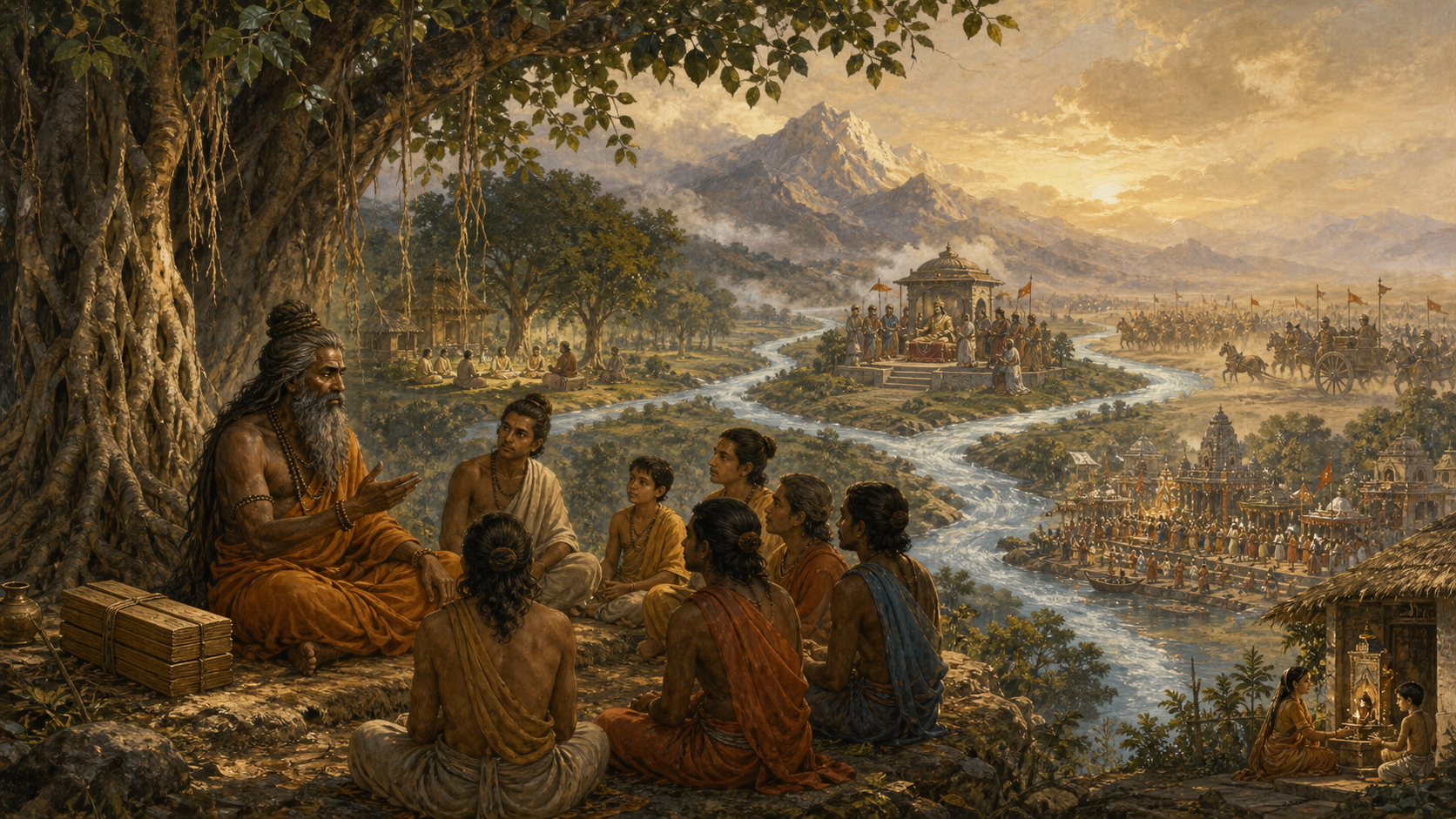
If you know Veda Vyasa only as the name attached to the Mahabharata, you have one part of the picture but not the pattern holding it together. The apparent catalogue of Vedas, epic, Bhagavad Gita, and Puranas can feel too vast to approach, especially when you want spiritual guidance rather than another list of titles.
The more useful question is not merely which works tradition attributes to Vyasa. Ask what kind of spiritual culture his legacy sustains, how its different forms teach, and what you should do differently when you read them. Seen this way, Vyasa’s achievement becomes a living method: preserve wisdom, place it inside human conflict, clarify paths of practice, and carry sacred memory into communal life.
See the architecture behind the individual works
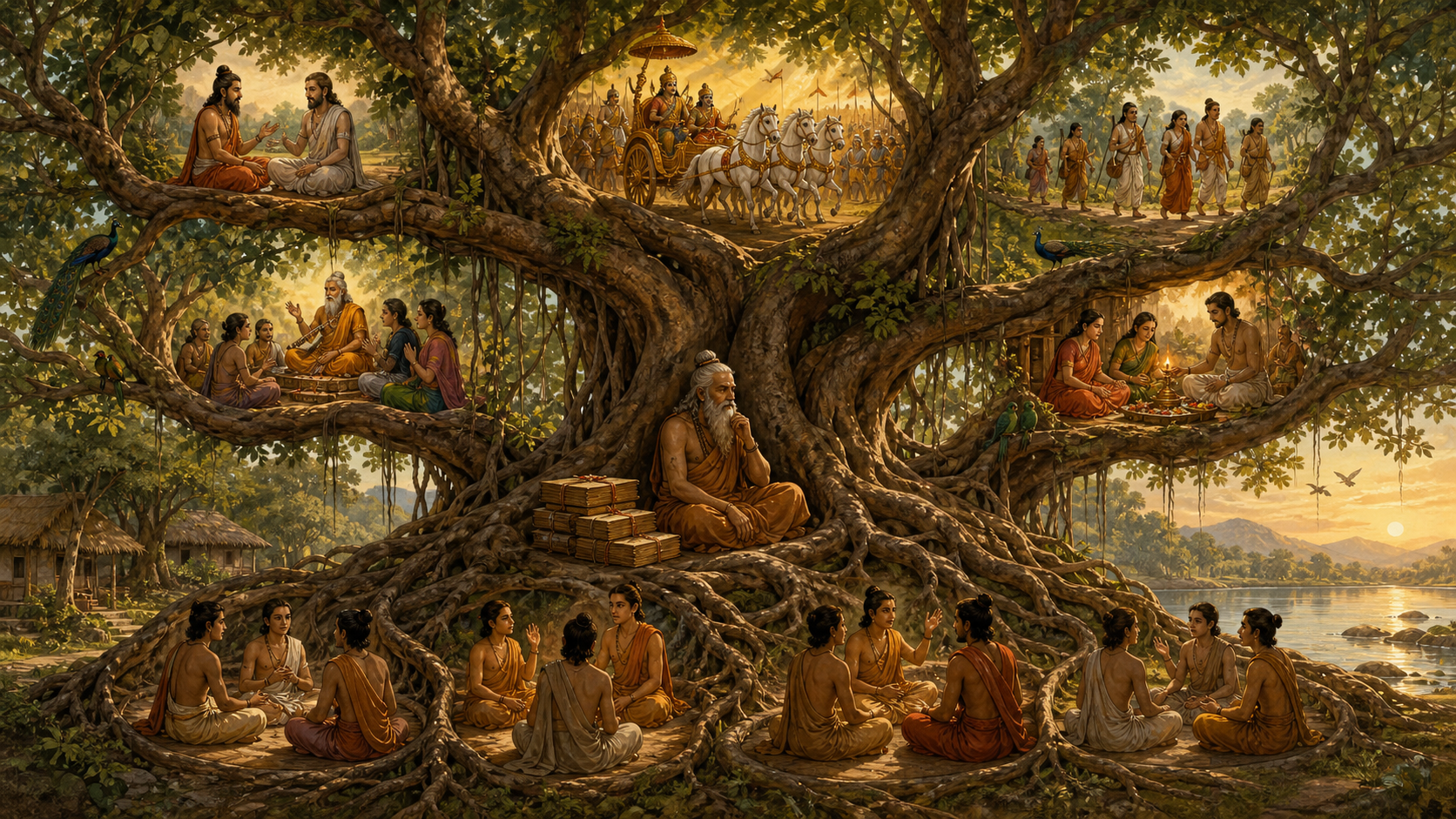
Hindu tradition remembers Krishna Dvaipayana Vyasa as a synthesizing sage. He is credited with organizing Vedic knowledge, composing or redacting the Mahabharata, and transmitting wisdom through Sanskrit narratives. These are related activities, not disconnected achievements.
Organization matters because a large oral inheritance needs form if it is to remain teachable. Redaction matters because inherited material must be arranged so that relationships, arguments, and consequences can be followed. Narrative matters because principles that remain abstract are difficult to test against family loyalty, leadership, public responsibility, grief, ambition, and moral uncertainty.
- The Vedic dimension preserves and systematizes foundational sacred knowledge.
- The Mahabharata places dharma inside conflicts in which several duties can make claims at once.
- The Bhagavad Gita brings action, devotion, and knowledge into a focused spiritual teaching within that conflict.
- The Puranic dimension connects sacred memory with place, worship, festivals, temples, and oral instruction.
This structure gives you a practical reading rule. Before interpreting a passage, identify the work it is doing. Is it preserving a sacred teaching, dramatizing a conflict, clarifying a spiritual path, or joining a community to sacred memory? A passage can do more than one of these things, but naming its primary function prevents a common mistake: treating every form of Dharmic literature as though it were the same kind of manual.
You should therefore resist reducing Vyasa to an author in the modern sense of a person producing an isolated book. The legacy associated with him joins preservation, arrangement, interpretation, and transmission. Its unity lies less in literary uniformity than in a sustained concern with dharma and liberation.
Read the Mahabharata as training in discernment
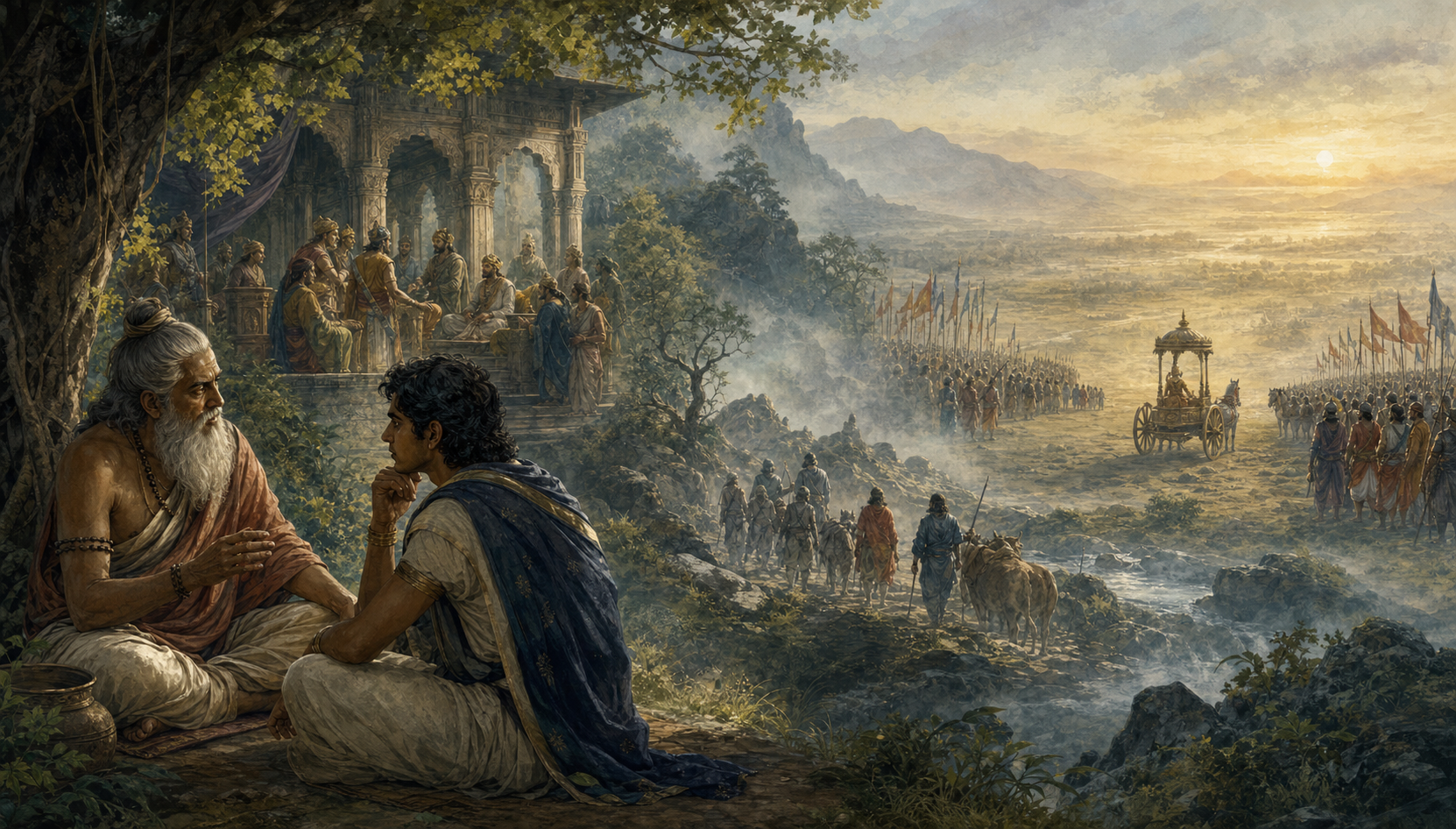
The Mahabharata remains spiritually demanding because it does not pretend that knowing moral vocabulary removes moral conflict. Duties arise through different relationships and responsibilities. What you owe a family member may pull against what leadership requires. Loyalty may compete with justice. A defensible action may still carry a painful cost.
If you approach the epic only to sort everyone into heroes and villains, you miss much of its training. The more fruitful task is to notice why a decision becomes difficult, which obligations collide, what motive directs the actor, and what consequences follow. Dharma is not simply whatever a sympathetic character wants, nor is it a convenient name for winning.
Use this five-question method when a Mahabharata episode troubles you:
- Name each person’s role before judging the action. A person may be acting simultaneously as a relative, ruler, teacher, student, ally, or seeker.
- Write the competing duties on separate lines. Do not conceal a real conflict beneath a vague statement that everyone should do the right thing.
- Separate the outward act from the inward motive. Similar actions can arise from duty, fear, pride, attachment, or the desire to avoid responsibility.
- Identify the cost that cannot be escaped. A tragic choice is not made simple merely because one option appears more defensible.
- Ask what the episode exposes in you. Notice whether you excuse a favored character too quickly, demand impossible purity from another, or judge an earlier choice only by its final result.
This method turns reading into ethical practice. You are not copying an ancient decision into a modern situation. You are strengthening the discernment needed to recognize roles, motives, competing claims, and consequences in your own decisions.
Let the Bhagavad Gita’s threefold counsel remain together
The Bhagavad Gita appears within the pressure of the epic rather than outside human responsibility. Its teaching integrates action, devotion, and knowledge, giving the seeker more than a slogan about duty.
- Through the lens of action, ask what responsibility cannot honestly be abandoned.
- Through the lens of devotion, ask whether action is being offered beyond the narrow demands of ego and personal reward.
- Through the lens of knowledge, ask what confusion about identity, control, or attachment is distorting the decision.
Do not use one lens to cancel the others. Action without inward examination can become restless compulsion. Reflection used to avoid action can become sophisticated evasion. Devotional language without responsibility can hide attachment instead of releasing it. The practical discipline is to bring outer duty and inner orientation into the same field of attention.
Before a difficult family, professional, or civic decision, make three short notes: the action presently required, the attachment most likely to distort it, and the larger spiritual orientation you want to preserve while acting. That exercise will not remove every ambiguity. It will make the ambiguity more honest and therefore more workable.
Notice how the Puranas carry memory into lived culture
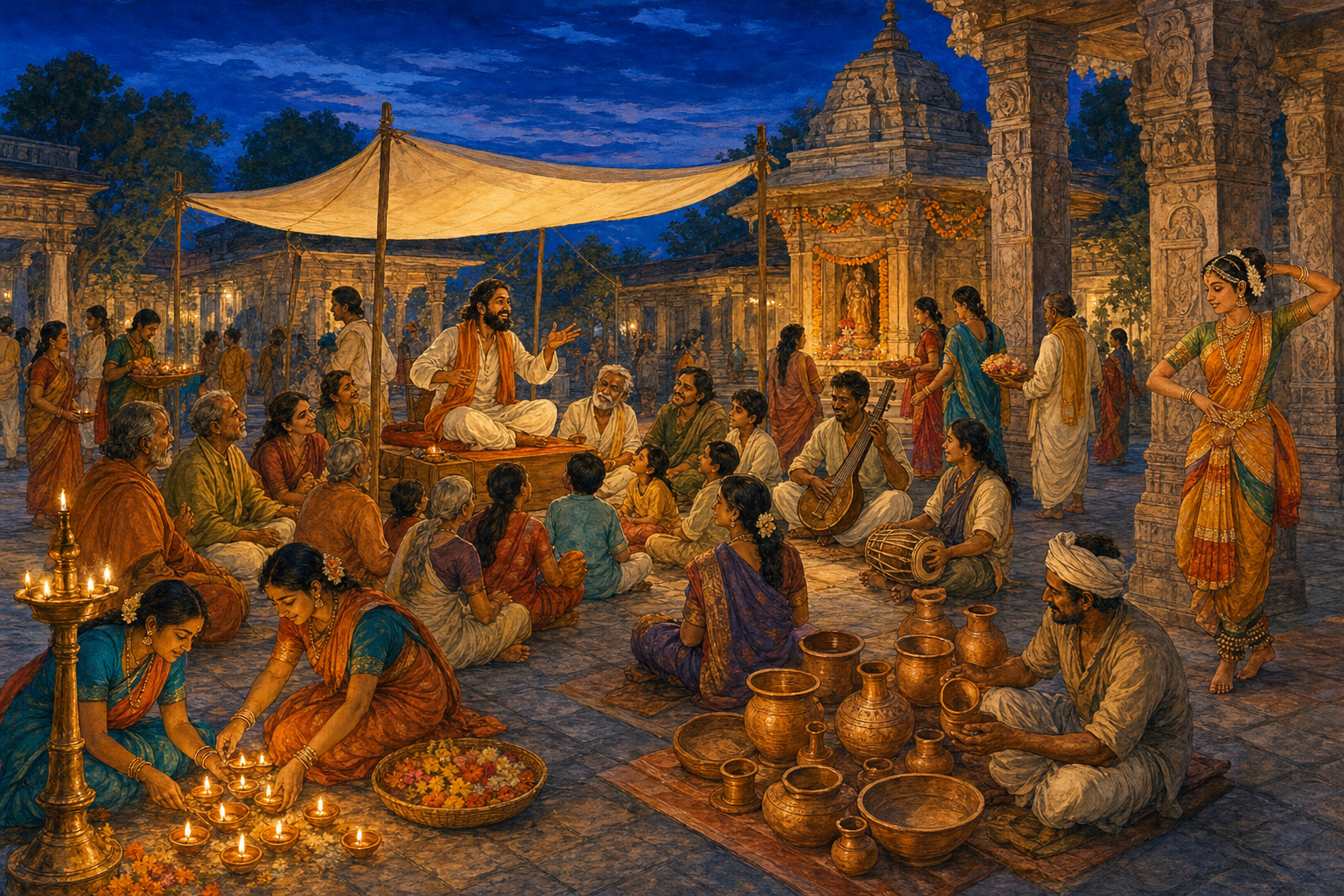
Vyasa’s legacy cannot be confined to philosophical argument. The Puranas attributed to him preserve cultural memory, sacred geography, and devotional practice. Their influence reaches temple traditions, festival calendars, and oral storytelling.
This helps explain why a sacred narrative can remain active outside a manuscript. A place becomes part of remembered sacred geography. A festival gives recurring form to memory. A temple locates devotion in communal space. Oral retelling lets a teaching pass between generations and adapt to the needs of a listening community without ceasing to belong to a larger inheritance.
When you encounter a Puranic narrative, do not stop at asking whether an event should be classified as literal history or symbolic myth. That argument can overlook several things the narrative is doing in practice. Ask instead:
- Which sacred memory is this narrative preserving?
- How does it connect a teaching with a place, deity, observance, or community?
- Which quality or devotional relationship is the listener being invited to cultivate?
- What would be lost if the narrative disappeared from temples, festivals, family recitation, and oral memory?
These questions do not require you to strip the narrative of sacred truth. They help you see that truth can be carried through several dimensions at once: theological, ethical, geographical, ritual, and communal. Vyasa’s Puranic legacy endures partly because it gives people ways to inhabit an inheritance, not merely propositions to affirm.
Use shared Dharmic values as a bridge, not an eraser
Vyasa belongs centrally to Hindu sacred memory. Hinduism, Buddhism, Jainism, and Sikhism are distinct traditions with their own authorities, disciplines, and doctrinal commitments. Treating them as interchangeable would weaken the very diversity that a Dharmic outlook should be able to respect.
They can nevertheless meet in serious conversation around compassion, truthfulness, restraint, and service. Use those values as points of civilizational relationship without claiming that every tradition explains them identically. In inter-Dharmic discussion, name the difference first and then examine the shared discipline. That produces a stronger unity than blurring every boundary.
Hold sacred attribution and textual history together
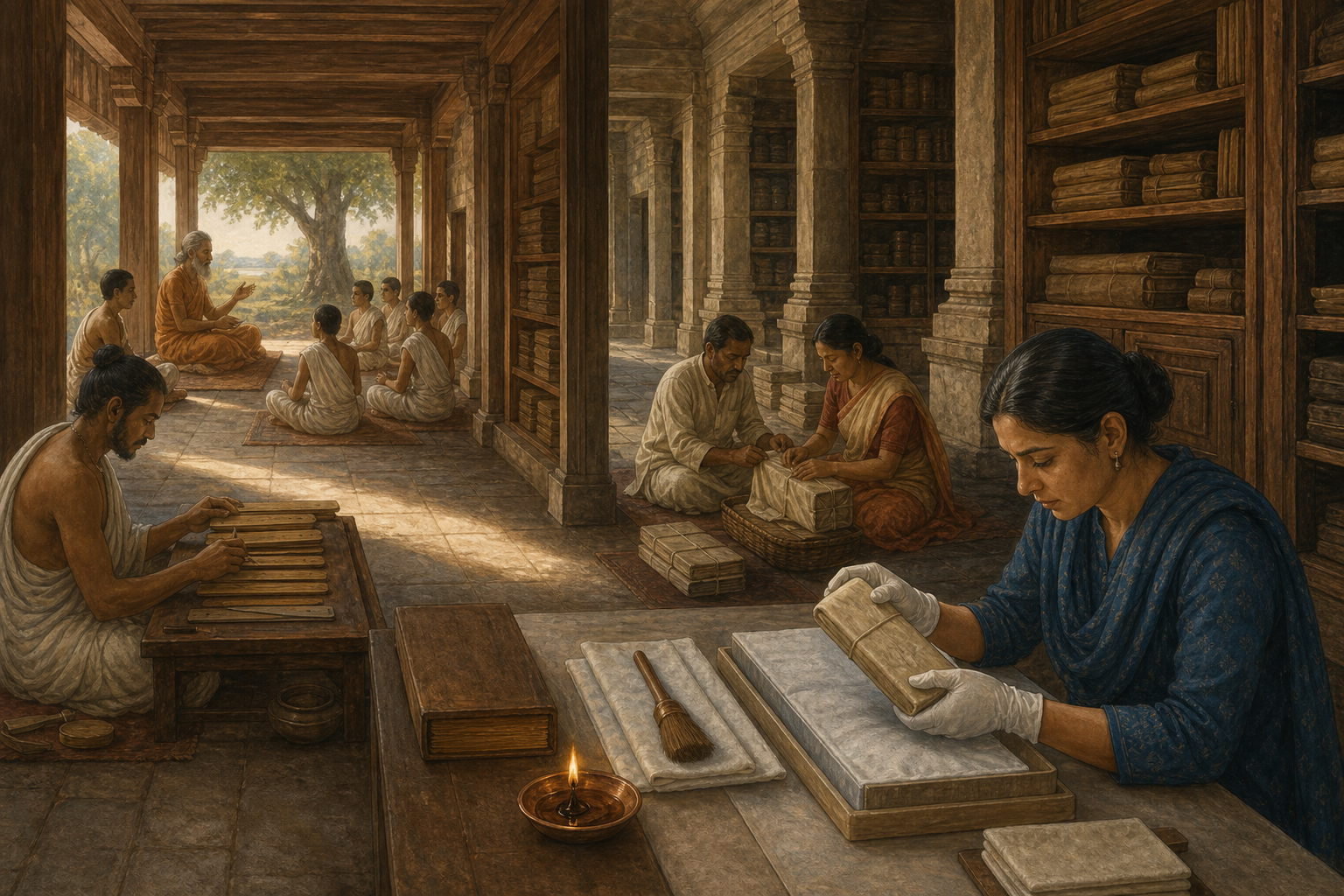
Traditional attribution and academic textual inquiry often answer different questions. Sacred memory recognizes Vyasa as the organizing intelligence associated with an immense inheritance. Textual scholarship examines how that inheritance moved through oral transmission, regional recensions, historical layering, redaction, and later philosophical elaboration.
You do not have to make devotion hostile to inquiry, or make textual complexity a reason to dismiss sacred authority. A work can possess a long history of transmission and still carry a coherent civilizational concern. In Vyasa’s corpus, that persistent concern is the disciplined pursuit of dharma and liberation amid the complexity of human life.
Textual awareness also makes you a more careful reader. A translation is not the Sanskrit text itself. A commentary interprets rather than merely repeats. Regional forms and recensions may preserve differences. If you move between versions without noting that change, you can mistake a difference of wording or interpretation for a contradiction in the underlying tradition.
Use a simple reading record rather than collecting disconnected quotations:
- Record the work, translation, and commentary you are using. If you change versions, note the change.
- Read the passage once for its immediate narrative or philosophical setting. Identify who is speaking, to whom, and under what pressure.
- Read it again for the central problem of dharma. Write the conflict in one sentence without resolving it prematurely.
- Identify the mode of teaching: sacred preservation, epic discernment, counsel on action, devotion and knowledge, or Puranic memory and practice.
- Write one application and one unresolved question. An honest open question is more useful than a forced moral.
This routine protects you from quotation-driven reading, in which an attractive line is detached from the dilemma that gives it force. It also places you within the legacy of commentary and debate. You can disagree with an interpretation while remaining disciplined: identify the passage, explain the context, state the principle at issue, and show why another reading accounts for the whole more adequately.
A teacher, reading group, or established commentary can help expose assumptions that solitary reading leaves untouched. The aim is not to surrender judgement. It is to make judgement answerable to language, context, tradition, and practice.
Key takeaways for your first serious reading
- Approach Vyasa as a preserver, organizer, narrator, and spiritual teacher, not merely as a name on a book cover.
- Identify what kind of work a passage is doing before deciding how it should guide you.
- In the Mahabharata, map roles, conflicting duties, motives, and unavoidable costs before assigning praise or blame.
- In the Bhagavad Gita, keep action, devotion, and knowledge together when examining a real decision.
- In the Puranas, notice how sacred memory becomes place, worship, festival, storytelling, and community continuity.
- Respect differences among Dharmic traditions while using shared disciplines such as truthfulness, restraint, compassion, and service as grounds for conversation.
- Note your translation and commentary, read passages in context, and let unresolved questions lead to deeper study rather than instant certainty.
Begin with one contained passage rather than promising yourself the entire corpus. Read it once for what happens, again for the competing demands of dharma, and a third time for the change it asks of the reader. Then carry one clearly stated question into your next decision. Vyasa’s legacy becomes intelligible when preserved wisdom turns into disciplined discernment in your own life.
References
