
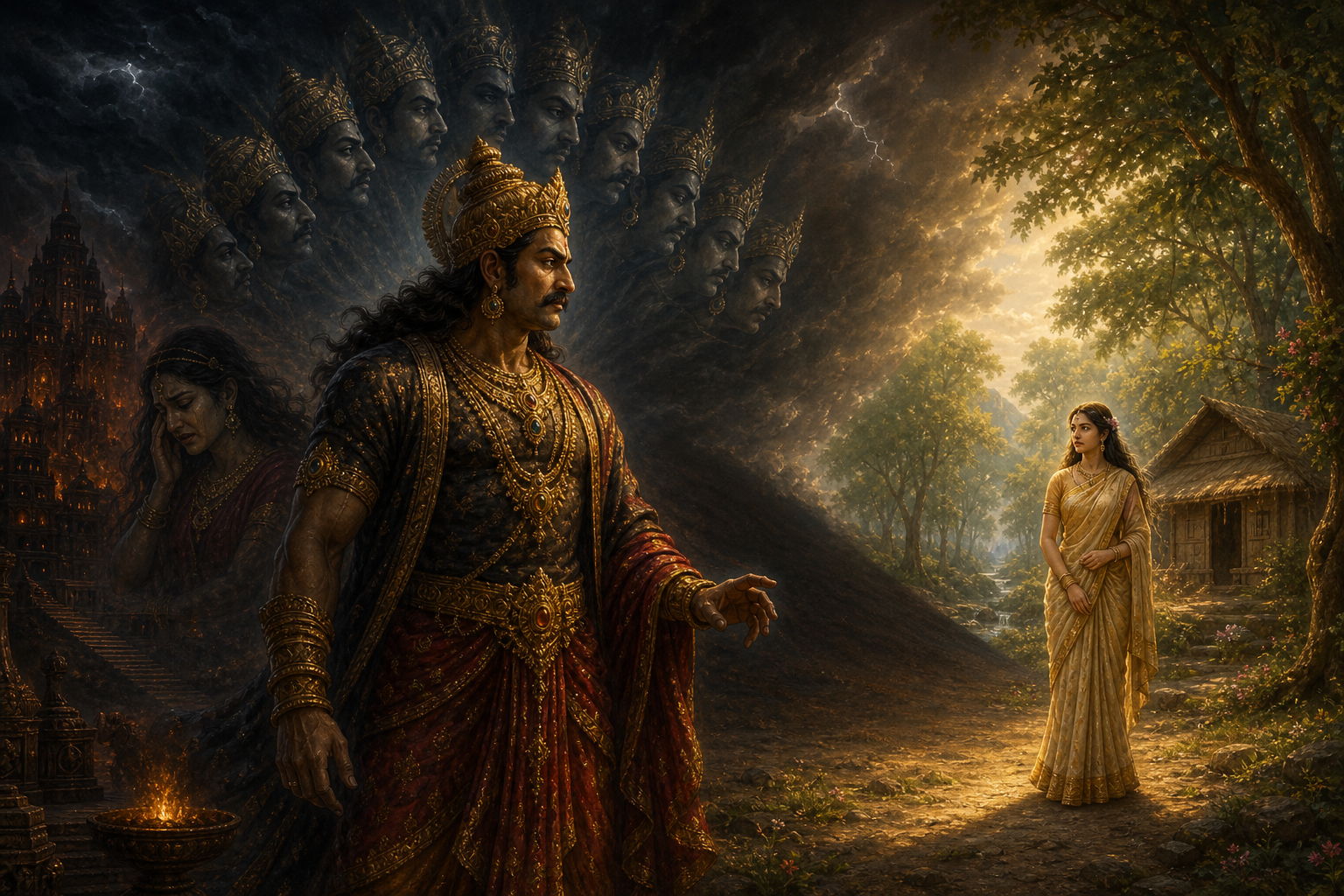
If you are trying to understand Ravana’s motive without reducing him to a caricature or turning his restraint into innocence, keep two questions separate: Why did he take Sita, and why did he stop short of violating her?
The clearest answer is that the abduction arose from vengeance and desire, within a widening conflict between Ravana and Rama after the humiliation of Shurpanakha. Ravana’s subsequent restraint is morally significant, but it does not make Sita’s removal protective, consensual, or righteous. Alternative Dharmic readings deepen this answer only when they are identified as interpretations rather than substitutes for the principal narrative.
The shortest responsible answer
In the Valmiki Ramayana’s principal account, Ravana takes Sita as part of a cycle of insult, retaliation, enmity, and desire. Shurpanakha’s humiliation supplies the immediate background of vengeance. Ravana’s attraction to Sita and hostility toward Rama give that vengeance a personal and possessive form.
That combination matters. Explaining the abduction as revenge alone leaves out desire. Explaining it as desire alone leaves out the conflict already unfolding around Shurpanakha and Rama. Ravana’s action joins the two: he wrongs Sita while striking at Rama.
Key takeaways
- Vengeance and desire provide the main explanation for Ravana’s decision to take Sita.
- His restraint in Lanka explains a limit he observed; it does not justify the abduction.
- Protective or guardian-like interpretations belong to regional, folk, and philosophical strands rather than replacing the principal account.
- Any interpretation that ignores Sita’s consent and autonomy has missed the ethical center of the episode.
Separate Ravana’s motive, method, and moral limit

Many arguments about Ravana become confused because they treat motive, method, and limit as though they were the same thing. They are not.
- Motive: What did Ravana hope to satisfy or accomplish? Vengeance, desire, enmity, and, in some alternative readings, the wish to force Rama into open confrontation all belong here.
- Method: What did Ravana actually do? He removed Sita from the forest against her will, took her to Lanka, and refused to return her.
- Limit: What boundary did he nevertheless observe? Sita remained unviolated in Ashoka Vatika, creating the tension that later interpreters have tried to explain.
A person can cross one grave boundary while observing another. Ravana’s restraint therefore tells you something real about his code, self-conception, fear, vow, or recognition of sacred limits. It does not erase the earlier violation of Sita’s freedom.
This distinction gives you a reliable way to evaluate claims about Ravana. If someone points to his restraint as proof that the entire act was righteous, ask whether that argument has moved from explaining a limit to excusing the method. If it has, the reasoning does not hold.
What the protective interpretation can and cannot explain

Some regional and folk traditions give Ravana a protective, paternal, or guardian-like self-understanding. In this reading, he regards Sita as sacrosanct, preserves her honor in Lanka, and uses the crisis to bring Rama into direct confrontation. The interpretation tries to account for an obvious paradox: a powerful ruler commits an abduction but stops at a further transgression that appears to be within his power.
Used carefully, this reading can illuminate Ravana’s restraint. It suggests that even a transgressive figure may recognize a boundary around Sita’s sanctity. It can also show how Ravana might have understood himself: not as a man without any code, but as a ruler whose pride and grievance distorted the code he still claimed to honor.
Used carelessly, however, the word protective becomes misleading. Protecting someone’s honor is not the same as respecting that person’s will. Ravana may be interpreted as preserving Sita from one kind of violation while remaining responsible for another: taking and holding her without consent. A guardian-like self-image cannot convert captivity into guardianship.
The paternal language must also be handled as an interpretive frame, not quietly promoted into a fact of the principal narrative. Its value lies in the question it raises: Why would Ravana recognize Sita as inviolable while refusing the one action that could end the wrong, namely returning her?
That refusal is decisive. Whatever honor Ravana believed he was preserving, pride and possession kept him from restoring Sita’s freedom. The protective reading is strongest when it exposes this contradiction. It becomes weakest when it tries to absolve him of it.
How to read different Ramayana traditions without flattening them

Dharmic traditions often preserve ethical inquiry through narrative variation. A different telling need not be dismissed merely because it differs from the best-known account. But neither should every version be blended into a single supposedly original story.
The Jain Paumacariyam reconfigures characters and outcomes to foreground ahimsa and karmic causality. Buddhist Rama-related tellings give greater weight to ethical exemplarity, compassion, intention, and the consequences of attachment. Regional traditions may focus on honor, vows, sacred identity, or Ravana’s internal limits. These approaches ask different moral questions even when they use recognizably related characters and conflicts.
Anekantavada, the Jain discipline of many-sided truth, offers a useful method here. It does not require you to declare contradictory claims equally factual. It asks you to notice which facet each viewpoint reveals and what its limits are.
When you encounter a claim about Ravana’s motive, identify its level before accepting or rejecting it:
- Principal narrative: Is the claim being made about the Valmiki Ramayana’s account?
- Retelling: Does it belong to a regional, folk, Jain, Buddhist, or other narrative tradition with its own ethical emphasis?
- Philosophical interpretation: Is it a lens applied to the episode, such as an inquiry into karma, ahimsa, compassion, honor, or restraint?
- Modern moral application: Is someone using the story to discuss consent, dignity, power, or justice in contemporary terms?
This simple classification prevents two common errors. The first is dismissing every alternative telling as though diversity were foreign to Dharmic culture. The second is allowing a later interpretation to overwrite the narrative it was created to interpret.
Sita’s agency is the test every interpretation must pass

Debates about Ravana can become so absorbed in his learning, power, motives, and restraint that Sita is reduced to evidence about his character. That reverses the moral order of the episode. Sita’s dignity, steadfastness, autonomy, and truthfulness are not side issues; they are the measure by which Ravana’s conduct must be judged.
Ravana’s restraint matters because Sita is inviolable, not because his self-control gives him a claim over her. His view of himself cannot determine whether the act was dharmic. Sita’s lack of consent and his refusal to return her reveal the failure more clearly than any flattering account of his intentions can conceal it.
This is also why the episode cannot be reduced to a contest between two powerful men. Rama and Ravana do enter a conflict shaped by justice, pride, power, and the demands of dharma. Yet the moral crisis begins with a wrong done to Sita, and Ravana repeatedly preserves that crisis by keeping her in Lanka.
If you are discussing the episode with family, teaching it, or weighing a new retelling, use four questions:
- Does the interpretation distinguish Ravana’s reason for acting from the rightness of the act?
- Does it treat restraint as a limited virtue rather than a complete acquittal?
- Does it identify its textual or traditional setting instead of presenting every version as the same account?
- Does Sita remain a moral agent, or has her experience been pushed aside to rehabilitate Ravana?
An interpretation that passes these tests can add depth without sacrificing moral clarity. Ravana may be more complex than a one-dimensional villain and still be responsible for adharma. His limits can be acknowledged without turning those limits into virtue large enough to cancel coercion.
So when you answer why Ravana took Sita, answer in layers but keep the order clear: begin with vengeance and desire, recognize the real but limited significance of his restraint, label protective readings as alternative interpretations, and let Sita’s autonomy decide where explanation must stop and justification cannot begin.
References
