
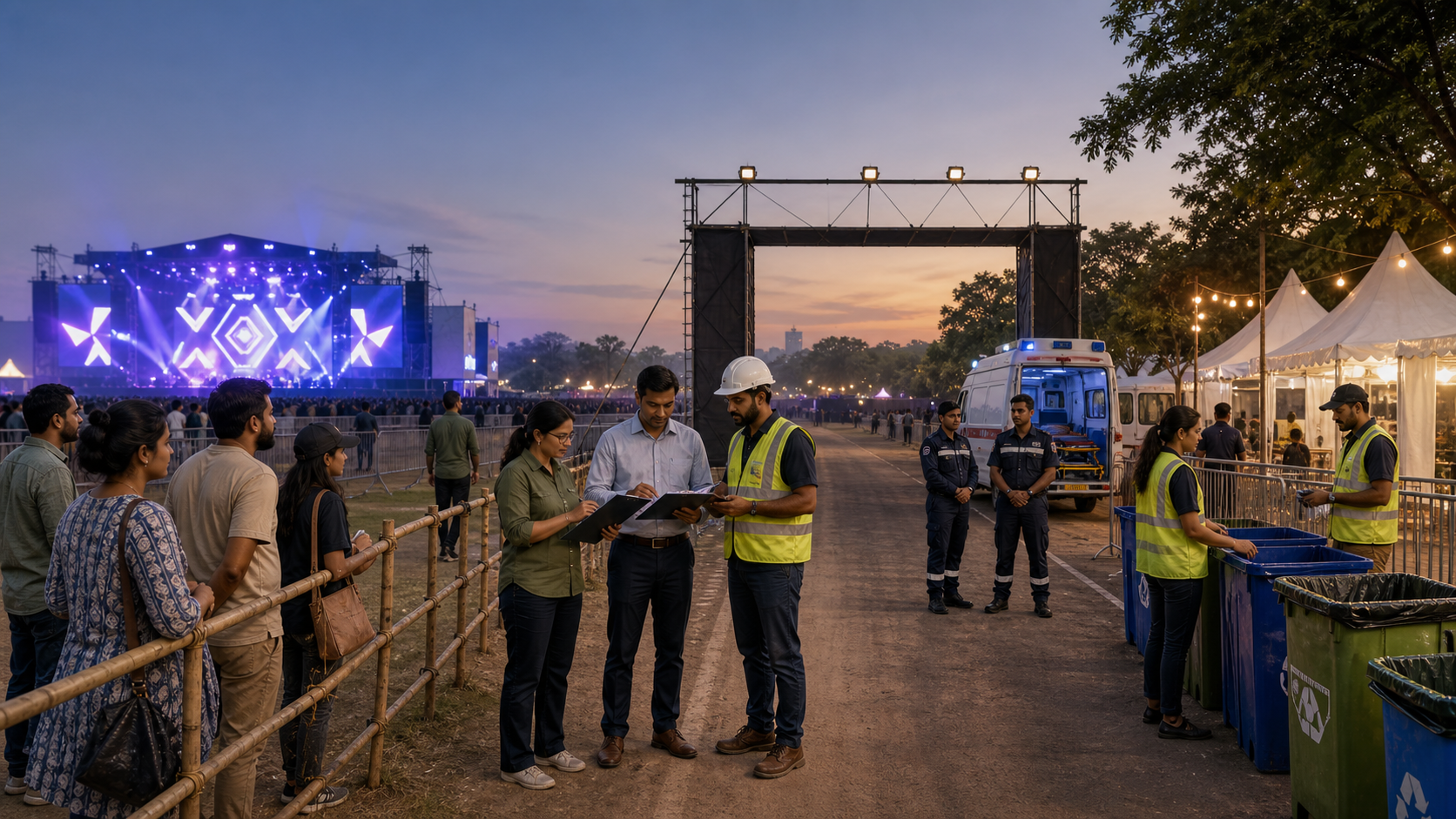
If you live near a proposed Sunburn venue, organise community events, attend large concerts, or simply expect public rules to be applied equally, the useful question is not whether electronic music is acceptable. It is whether a private festival seeking public permission has proved that it will obey the law, protect its host community, and bear the costs it creates.
That question can be answered without moral panic and without giving a famous organiser a free pass. You need a visible compliance record, an honest account of social costs and benefits, enforceable operating conditions, and a clear explanation of who is responsible when those conditions are breached.
Permission should follow verified compliance
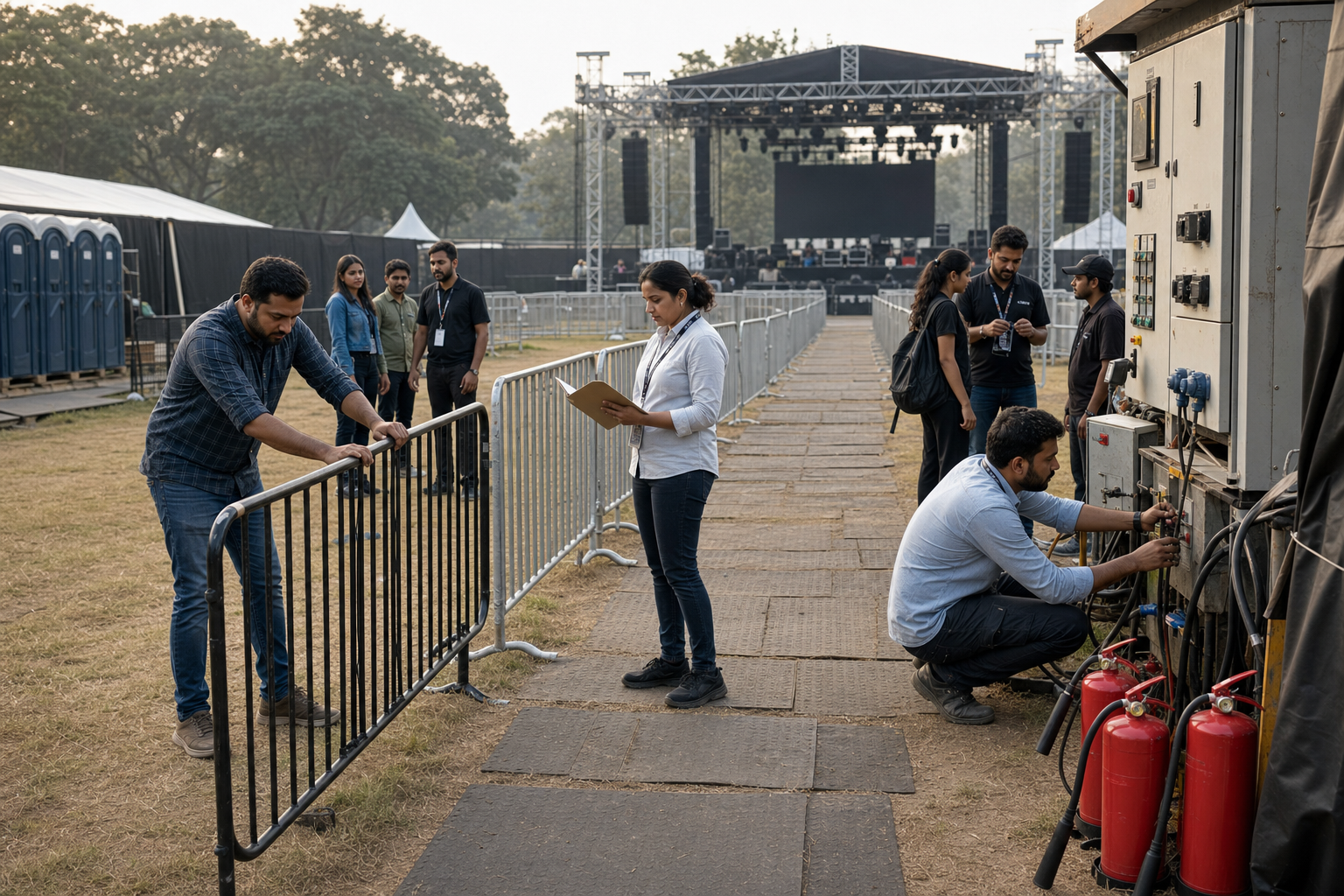
The immediate governance problem is serious but must be framed carefully. Sunburn organisers have reportedly faced stamp-duty and penalty arrears exceeding ₹1 crore in Pune, reaching back to 2016, while the event received permission in Mumbai. That contrast warrants scrutiny. It does not, by itself, establish that the Mumbai permission was unlawful.
Several facts could change the legal position. The demand might be disputed. A court or competent authority might have stayed recovery. An approved payment schedule might exist. The entity applying in Mumbai might not be legally identical to the entity liable in Pune. The authority issuing the event permission might also lack the power to collect that particular levy. Citizens should not have to speculate about any of this. The permission record should explain it.
A credible pre-permission check should disclose five things:
- Applicant identity: the legal entity seeking permission, including its relationship to the festival brand and any entity carrying earlier liabilities.
- Compliance status: whether taxes, duties, penalties, licence fees, and other government claims are paid, disputed, stayed, or subject to an authorised instalment plan.
- Inter-agency verification: which revenue, police, municipal, fire, health, and other relevant authorities were consulted before approval.
- Reasoned treatment of unresolved dues: the legal basis for proceeding despite an outstanding claim, if that is what occurred.
- Recovery protection: an enforceable payment schedule, escrow arrangement, or bank guarantee where legally permitted and proportionate.
This is what equal treatment looks like in practice. Equality does not mean declaring an organiser guilty before a dispute is decided. It means applying the same verification rule to a major entertainment company that would apply to a small business, housing society, temple committee, or neighbourhood association seeking official permission.
Cross-city coordination matters because administrative boundaries can otherwise become compliance gaps. An unresolved claim in Pune should not disappear merely because the next application is made in Mumbai. Equally, one department should not quietly turn an unverified demand into an unofficial ban. The answer is a documented interdepartmental process, not selective severity.
Count the costs that ticket receipts do not show
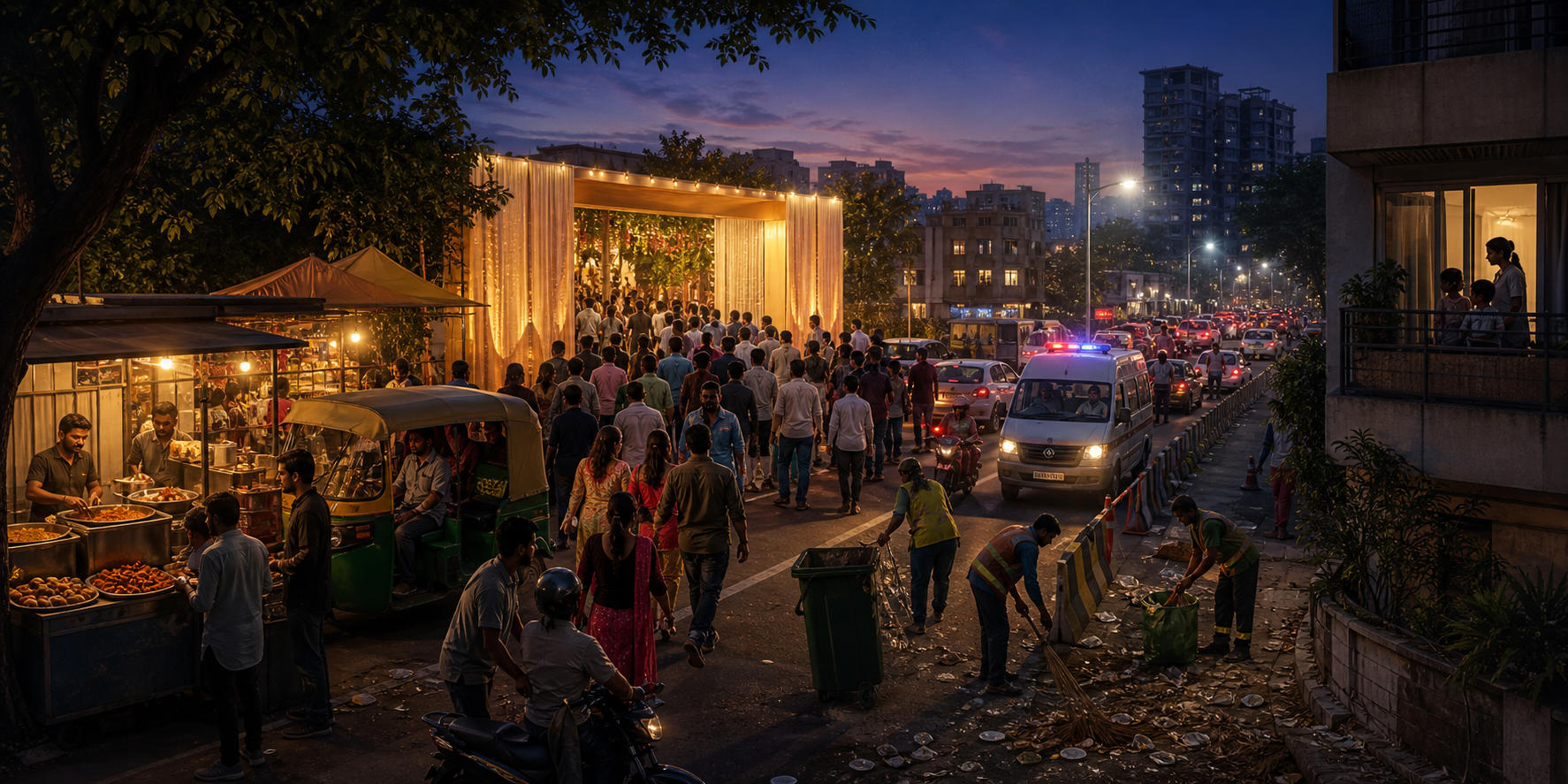
Large festivals can generate tourism spending, temporary employment, and a shared cultural space. Those benefits deserve to be counted. But an economic claim is incomplete when it counts private revenue and visitor spending while ignoring public expenditure and burdens imposed on nearby residents.
The burdens are not abstract. Late, high-decibel sound can disturb sleep, study, prayer, and ordinary family life. Concentrated arrivals and departures can obstruct local movement. Dense crowds increase the importance of emergency access, hydration, medical readiness, and safe exit management. Policing, traffic control, sanitation, waste removal, and emergency care can shift costs onto the public unless the approval specifies who pays.
Substance misuse is another legitimate safety concern, but it should be handled through prevention, detection, medical readiness, and lawful enforcement rather than by treating every attendee as an offender. The relevant governance test is whether the organiser has a credible plan for a predictable risk and whether officials can enforce that plan.
Use the same evidence standard for both benefits and harms:
| Decision area | Evidence to request | What approval should settle |
|---|---|---|
| Tourism and employment | Expected local procurement, temporary work, and visitor activity, with a method for checking claims after the event | Which benefits are likely to remain in the host community rather than merely passing through it |
| Neighbourhood disturbance | Venue map, nearby residential and sacred areas, operating schedule, sound-control plan, and complaint channel | Where sound is monitored, who can order corrective action, and what happens after a breach |
| Crowd and health safety | Capacity plan, controlled entry and exit, emergency lanes, water access, medical response, and substance-control procedures | Named responsibility, escalation authority, and conditions under which entry or performances must pause |
| Traffic and public services | Transport, policing, sanitation, waste, and restoration plans | Which costs the organiser bears and which services remain public obligations |
| Legal and revenue compliance | Verified status of duties, fees, penalties, disputes, stays, and payment arrangements | Whether approval is unconditional, conditional, deferred, or legally unavailable |
This prevents two common distortions. Supporters cannot cite jobs and tourism as if disruption were free. Opponents cannot invoke disruption while refusing to consider a safer venue, earlier schedule, tighter capacity, or enforceable mitigation. The decision becomes about evidence and design rather than slogans.
A Dharmic standard tests conduct, not musical taste
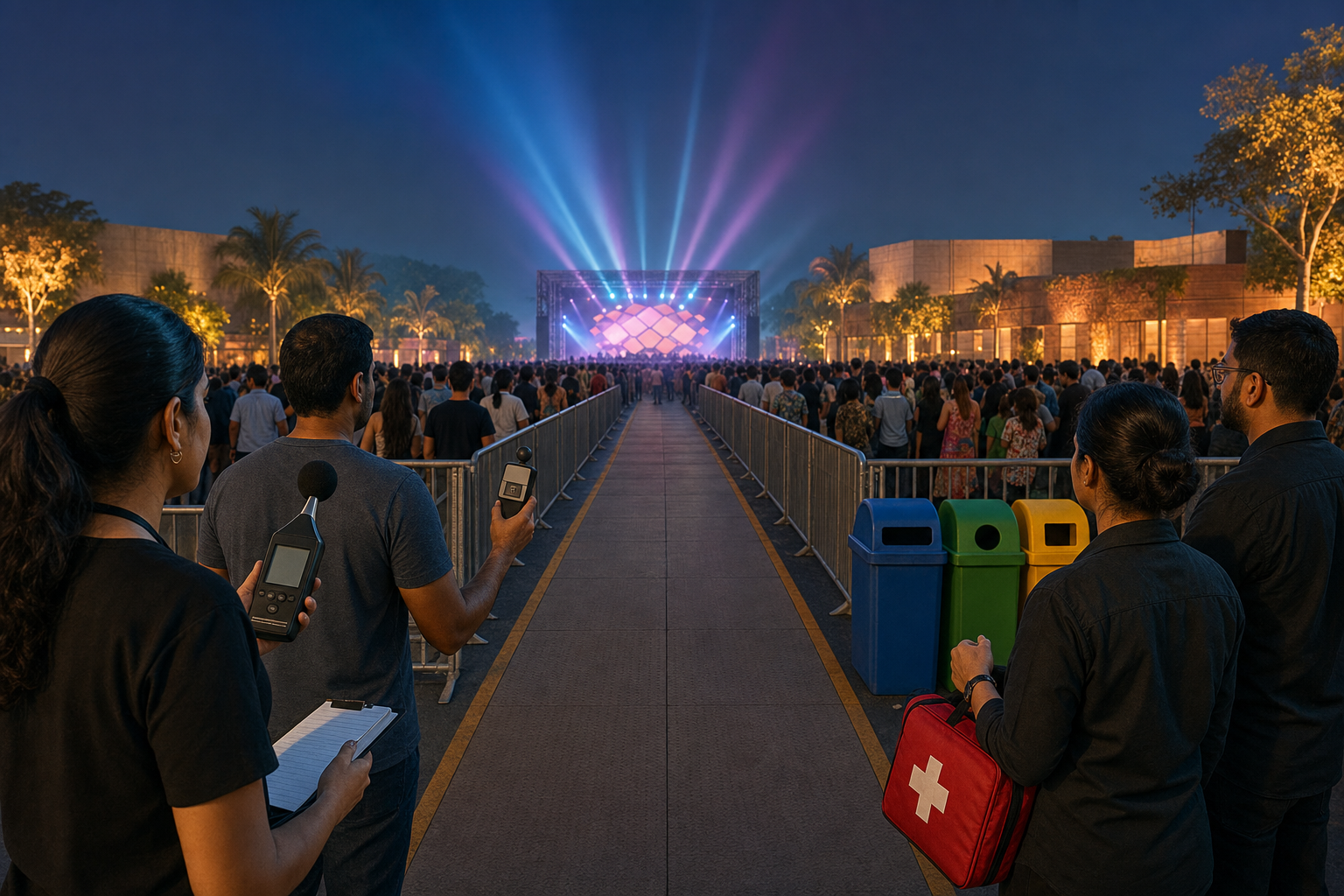
A Dharmic assessment should not become an identity veto against young people, unfamiliar music, or every cultural form that arrived from elsewhere. Bharat has always absorbed, tested, adapted, and transformed new forms. The proper question is whether a celebration fulfils its duties toward the people and place that make it possible.
Ahimsa asks organisers and officials to prevent avoidable harm, including injury, intimidation, sleep disruption, and dangerous crowd conditions. Aparigraha challenges excess when commercial ambition demands more volume, longer hours, denser attendance, or heavier use of public resources than a place can responsibly bear. Seva turns host communities from obstacles into people who must be served through consultation, accessibility, cleanliness, and prompt remedy. Buddhist mettā, Jain discipline, and Sikh seva are not interchangeable doctrines, but they reinforce a shared civic demand: celebration should not externalise its burdens onto others.
These principles translate into ordinary administrative choices. Protect residential and sacred zones. Set meaningful time and sound conditions. Plan for health and crowd risks before gates open. Prevent illicit substances without abandoning medical care for anyone in distress. Restore the venue and its surroundings. Respond to complaints while the disturbance can still be corrected, not weeks later.
The same framework leaves room for contemporary creativity. Daytime youth music gatherings, substance-free concerts, culturally rooted fusion, strict operating limits, and venues away from sensitive areas can preserve energy and artistic freedom while reducing foreseeable harm. These are not cosmetic alternatives. Timing, location, capacity, and event design determine who enjoys the festival and who is forced to absorb it.
Cultural confidence is strongest when it can distinguish form from conduct. Electronic music is a form. Noise imposed on unwilling neighbours is conduct. Youth celebration is a legitimate social good. Weak safety planning is a governance failure. Commercial success may be welcome. Preferential exemption from public obligations is not.
Eight questions make a festival approval auditable

If you are examining a Sunburn permission, attending a public hearing, writing to an elected representative, or assessing an official defence of the event, ask these questions in order:
- Who exactly is the applicant? A brand name is not enough. The approval should identify the responsible legal entity and any relevant relationship to entities with earlier liabilities.
- What is the verified status of government dues? Separate paid amounts, confirmed arrears, disputed claims, legal stays, and authorised payment schedules. The word “pending” conceals too much.
- Which agency checked which obligation? A list of permissions is not the same as proof that departments exchanged compliance information.
- Why is this venue suitable? The answer should address residences, schools, hospitals, sacred places, road access, emergency routes, and ordinary local activity rather than merely asserting that the site is available.
- Are operating limits measurable and enforceable? Conditions should identify what will be monitored, who monitors it, who can intervene, and what consequence follows a breach.
- Who pays for the public burden? Policing, traffic management, sanitation, medical readiness, waste removal, and restoration should appear in the decision, with financial responsibility made clear.
- How can residents obtain a remedy during the event? A complaint mechanism needs a reachable authority and the power to act in real time. A mailbox that produces a later acknowledgement is not protection.
- What will be disclosed afterward? A closure record should show incidents, violations, corrective action, restoration, and whether financial and administrative conditions were fulfilled.
The answers support four different outcomes. Approval is reasonable when compliance is verified and risks are proportionately controlled. Conditional approval may be defensible when an unresolved matter is legally manageable through a binding plan and adequate security. Deferral is appropriate when essential facts are missing. Refusal, relocation, or redesign becomes justified when a legal requirement is unmet or foreseeable harms cannot be controlled at the proposed place and time.
Conditional permission must be more than reassuring language. A condition without monitoring, intervention authority, and a consequence is only a request. Officials should also avoid conditions so vague that neither organisers nor residents can tell when a breach has occurred.
Key takeaways for citizens and decision-makers
- Government permission does not itself prove that earlier financial or legal obligations were settled.
- A reported arrear does not automatically prove that a new permission is unlawful; the status of the claim, any stay, the responsible entity, and the authority’s legal powers all matter.
- Festival benefits and festival burdens belong in the same decision record, with evidence and financial responsibility attached to both.
- A Dharmic response protects youth creativity while insisting on ahimsa, restraint, reciprocity, and equal treatment under public rules.
- Venue, hours, capacity, crowd planning, substance controls, and neighbourhood protection are core design choices, not details to be settled after approval.
- Transparency should continue after the festival through a public account of compliance, incidents, corrective action, costs, and restoration.
When the next proposal appears, do not begin with a demand to approve or prohibit it. Ask for the permission order, the cross-department compliance check, the venue-impact plan, the enforcement mechanism, and the promised post-event account. If those records are missing, your objection has a precise basis. If they exist, test whether they protect the public in practice. That is how concern becomes accountable governance rather than another temporary controversy.
References
- DharmaRenaissance Blog – Sunburn’s ₹1 Crore Stamp-Duty Arrears vs Mumbai’s Green Light: A Test of Accountability
- DharmaRenaissance Blog – Why Bharat Should Reconsider Sunburn: Protecting Culture, Health, and Community Harmony
