

You may have heard the striking claim that Ravana once assumed Rama’s appearance before Sita, only to find that the disguise disturbed his own intention. The immediate question is reasonable: should you understand this as a Ramayana episode, a later devotional telling, or an allegory about the power of dharma?
The safest answer preserves both devotion and textual honesty. This is a motif found in later regional, devotional, and oral Ramayana traditions, and it can be read as either an illusion within the narrative or a symbolic encounter between appearance and character. Its force lies in a precise question: can someone borrow the visible form of righteousness while keeping an intention built on adharma?
Place the episode before you interpret it

The episode belongs to the moral world surrounding Sita’s captivity in Lanka. Ravana has failed to break her resolve. Appearance becomes another instrument of persuasion: if Sita cannot be moved by threat or argument, perhaps the semblance of Rama can reach where Ravana himself cannot.
That does not mean every Ramayana recension contains one standardized scene in which Ravana becomes Rama. No single verse, chapter, recension, or fixed sequence should be supplied when the telling itself has not been identified. If someone gives you an exact textual location, ask which Ramayana, which edition, and which regional or devotional tradition is meant. The title Ramayana alone is not a complete citation for a variant episode.
This distinction does not diminish the story. A later retelling can develop an ethical possibility already present in the characters: Ravana is powerful enough to imitate appearances, Sita is steadfast enough to resist appearances, and Rama represents a standard that cannot be reduced to a face. The responsible approach is to identify the narrative layer first and then ask what that layer is trying to reveal.
How to retell the episode responsibly
- Signal its status. Say that the episode appears in some later or regional Ramayana traditions. Do not introduce it as a scene found uniformly in every version.
- State the stable narrative core. Ravana assumes Rama’s form in an attempt to influence Sita, but the impersonation brings him into conflict with the dharma associated with Rama.
- Preserve the range of interpretation. It may be heard as a literal illusion within the story, an inward psychological drama, or both at once.
- Do not invent textual coordinates. If you do not know the precise recension or passage, acknowledge that limit. Honest uncertainty protects the credibility of the tradition.
This method matters beyond one episode. It lets you respect the Ramayana as a living civilizational tradition without collapsing its many tellings into a single undifferentiated text.
Why a perfect likeness would still fail
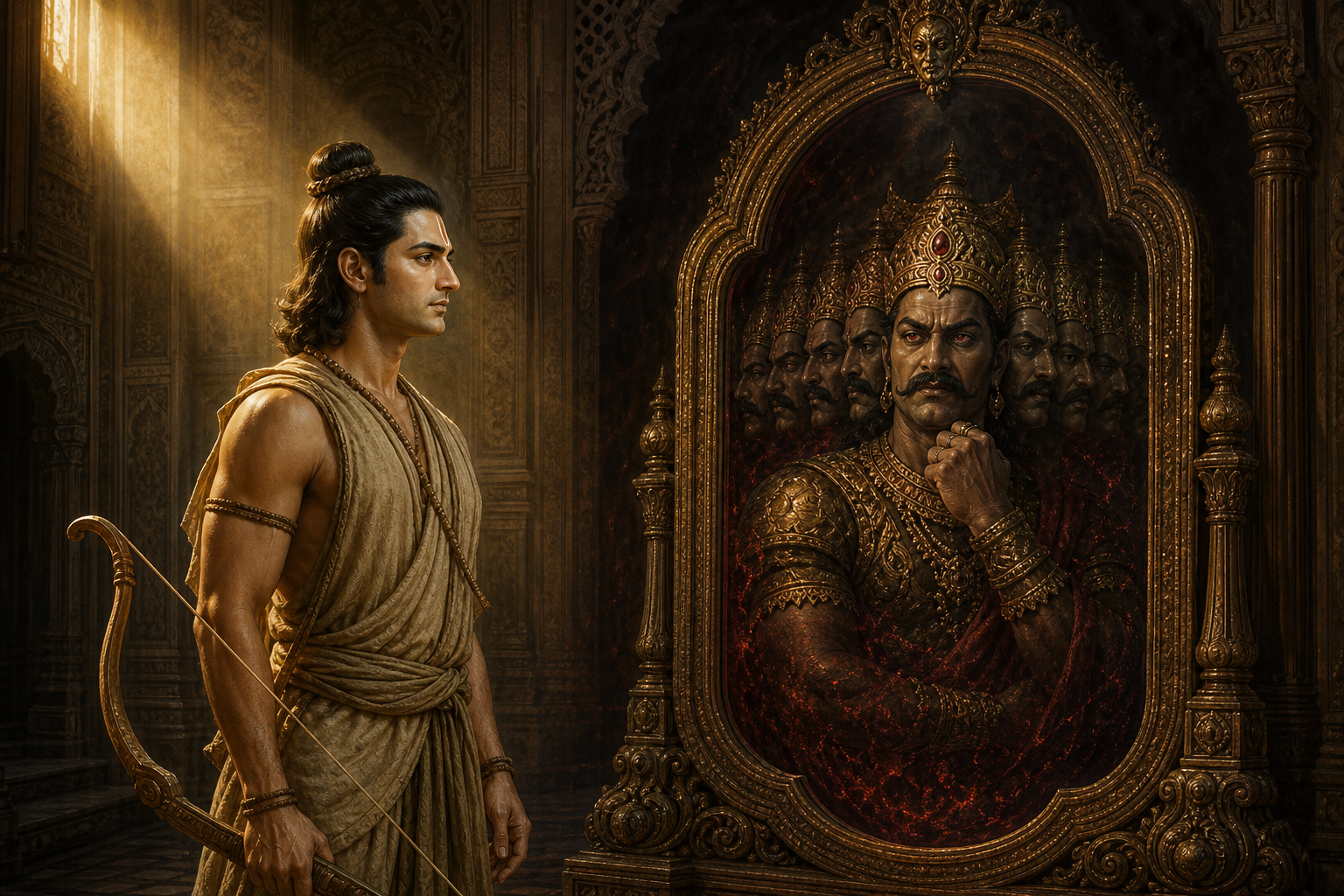
Ravana’s strategy contains a contradiction before Sita even responds. He wants Rama’s appearance to serve a purpose opposed to Rama’s character. The more convincing the likeness becomes, the sharper the contradiction grows. A false Rama must ask Sita to accept something that the real Rama’s relationship with her would not require.
This is the difference between form and moral identity. A form can be copied from the outside. Moral identity is sustained by agreement among intention, word, action, and relationship. Remove that agreement and the borrowed form becomes evidence against the impersonator. The face says Rama while the intention says Ravana.
Sita is therefore more than the target of the deception. Her fidelity supplies the standard by which the counterfeit is exposed. In the moral logic of the episode, she knows Rama through character as well as appearance. A familiar face cannot make an un-Rama-like demand trustworthy.
That point gives you a practical way to recognize counterfeit dharma. When a leader, teacher, relative, or public figure uses sacred language, inherited status, or a revered image, do not judge the claim by appearance alone. Examine the request being made through it.
- Inspect the end. What result does the person want, and who gains from it?
- Inspect the means. Does the person preserve another’s agency, or rely on fear, concealment, humiliation, or coercion?
- Inspect the relationship. Is the conduct consistent with the duty attached to the role being claimed?
- Remove the sacred label. If the same demand came without holy language, costume, title, or reputation, would it still look righteous?
- Watch the response to correction. A commitment to dharma should make honest self-correction possible; a commitment to the mask makes every question feel like a threat.
This test should begin with yourself. The tale loses its sharpest edge when it is used only to identify Ravana in other people. Its harder question is where you want the authority of Rama’s form without accepting the restraint that Rama’s dharma places upon desire.
Ravana’s interruption is not Ravana’s redemption
The inward effect of the disguise must not be exaggerated. A moment of moral arrest is not the same as a transformed life. Ravana’s inability to sustain the form shows that he encounters a standard he cannot reconcile with his purpose. It does not erase his conduct or turn a passing recognition into completed repentance.
Three stages are easy to confuse:
- Moral recognition is seeing what the right course requires.
- Moral restraint is stopping or redirecting an impulse because of that recognition.
- Moral transformation is making the right course stable through repeated choice, discipline, and accountability.
The motif gives Ravana at least a flash of the first and an interruption resembling the second. It does not establish the third. That distinction prevents a sentimental reading in which contact with a sacred appearance automatically purifies everything. Dharma is not a costume that mechanically changes whoever wears it.
The deeper change occurs when a person accepts the consequences of the standard encountered. Recognition becomes meaningful when it leads to relinquishing an unjust advantage, ending a deception, repairing harm, or accepting a limit on one’s own power. Without that movement, admiration for virtue can coexist with continued adharma.
This is why Ravana’s pause can be read as an awakening without being mistaken for liberation. He glimpses an incompatibility. Rama’s form cannot be imagined coherently while Ravana’s purpose remains untouched. The borrowed identity either has to fall away, or the intention has to change.
Turn the story into a personal dharma audit

You do not need a dramatic disguise to repeat Ravana’s mistake. It happens whenever the appearance of a role becomes more important than the duties that make the role truthful. A person may want to be seen as a devoted practitioner, a fair leader, a patient parent, a trustworthy friend, or a servant of the community while resisting the inconvenient action that the identity requires.
Use the episode as an audit at the next point of friction, not as an abstract meditation after the conflict has passed:
- Name the form you want to present. Complete the sentence: I want to be seen as a person who is fair, truthful, restrained, compassionate, or devoted.
- Name the duty inside that form. Ask what such a person must do in the present conflict, especially when the action carries a cost.
- Name the competing desire. Identify the advantage, comfort, praise, control, or escape from accountability that makes the duty difficult.
- Find the contradiction. Put the desired identity and the actual method side by side. If the first requires honesty while the second depends on concealment, the disguise has already failed.
- Choose an observable correction. Tell the truth that was withheld, stop the coercive tactic, return the unfair benefit, hear the objection, apologize without qualification, or accept the boundary you were trying to evade.
- Repeat the correction when the role is tested again. One elevated feeling is recognition. Character is built when the aligned action becomes dependable.
The corrective action should match the contradiction. A leader who speaks of seva while suppressing legitimate correction should make correction safe and respond to its substance. A family elder who invokes maryada while humiliating someone with less power should end the humiliation and acknowledge the harm. A devotee who displays religious identity while benefiting from unfairness should repair the unfairness, not add another display.
The aim is not public self-condemnation. It is coherence. Guilt can remain private and inactive; dharma becomes visible through changed conduct. Ravana’s failed disguise is useful precisely because it moves the question away from how virtuous a person feels and toward what the claimed virtue makes that person do.
Keep the shared Dharmic resonance without flattening traditions
The episode also opens a meaningful conversation across distinct but converging Dharmic disciplines. A Hindu reading emphasizes dharma as embodied alignment rather than borrowed appearance. A Buddhist resonance lies in attentive scrutiny of intention. A Jain resonance lies in self-restraint and ahimsa as tests of the passions behind conduct. A Sikh resonance lies in sat and seva: truth must be lived and service must be real.
These are not interchangeable doctrines, and they should not be reduced to a claim that every Dharmic tradition teaches exactly the same thing. The genuine meeting point is narrower and stronger: inner motive must answer to disciplined conduct. In an inter-Dharmic discussion, name each tradition’s vocabulary accurately, then use the shared question that the Ravana motif makes unavoidable: does the life support the truth being claimed?
Key takeaways
- Ravana’s assumption of Rama’s form should be identified as a motif from some later regional, devotional, and oral Ramayana traditions, not presented as a standardized scene in every recension.
- The episode can work as a literal illusion, a psychological allegory, or both; its ethical meaning does not require false certainty about one exclusive reading.
- The disguise fails because Rama’s appearance and Ravana’s intention cannot form a coherent moral identity.
- Sita’s steadfastness is central: recognition rests on character, relationship, and dharma rather than visual likeness alone.
- A brief recognition of virtue is not complete transformation. Change begins when recognition produces restraint, repair, and accountable action.
- The most useful application is self-directed: compare the role you claim with the method you are using when desire, status, or power is at stake.
At your next difficult choice, do not ask only what Rama would look like in your place. Ask what action becomes impossible once you accept Rama’s standard. Then relinquish that action, even if it offered the easier advantage. That is where the form of dharma stops being a mask and begins to shape the person who bears it.
References
